Annual Holding Costs of a Bali Villa: A Realistic Owner's Budget
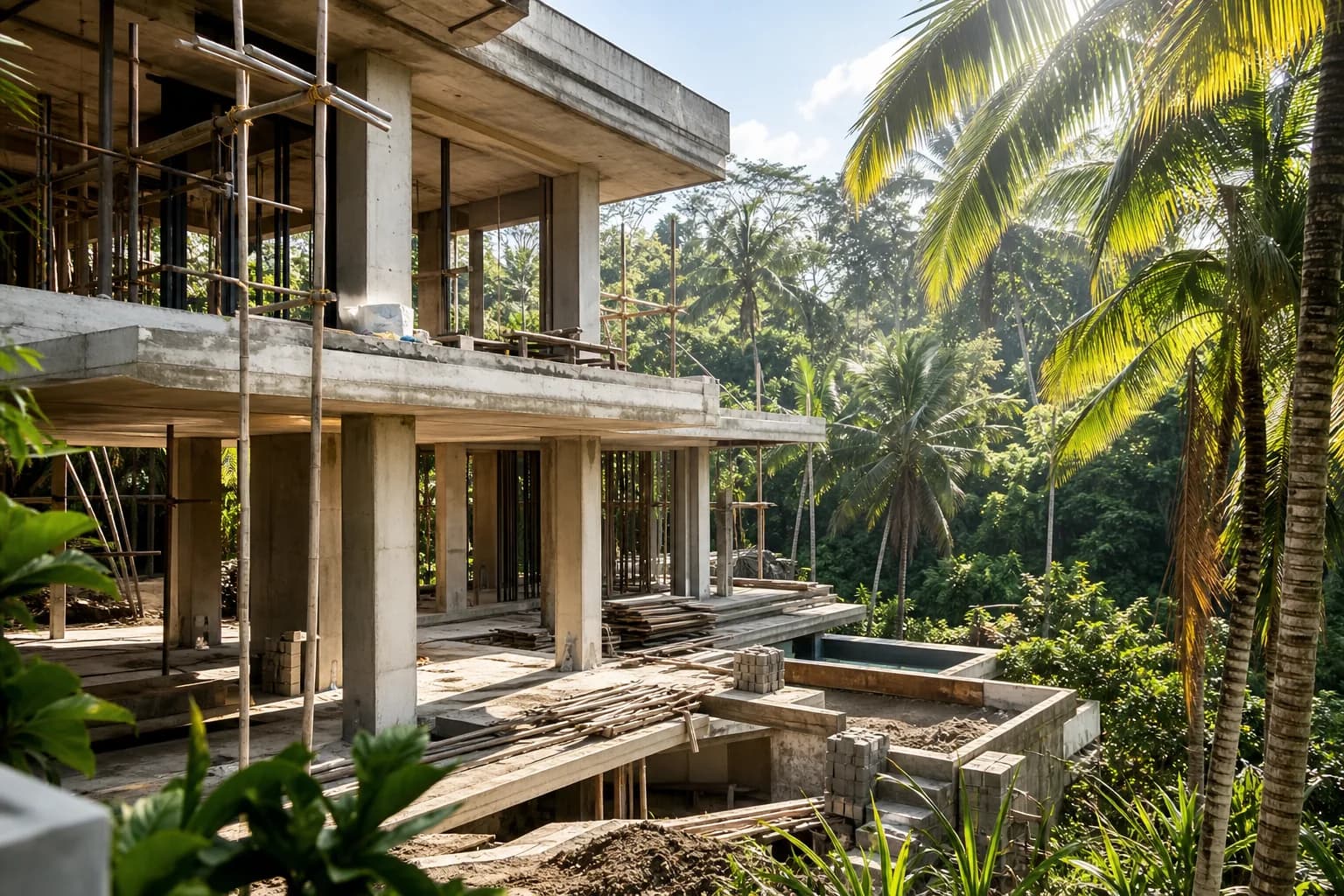
Most buyers model the purchase or build price of a Bali villa to the last dollar, then treat everything after handover as a rounding error. It is not. Bali villa holding costs — staff, utilities, pool and garden care, maintenance in a tropical climate, insurance, property tax and possibly a management company — typically run from a few thousand dollars a year for a modest lock-up-and-leave home to well over twenty thousand for a large rental villa in full operation. This article breaks the annual budget into its real components with 2026 numbers, so you can decide what to run yourself, what to outsource, and what the villa genuinely needs to stay in the condition you paid for.
Why tropical ownership costs more than you expect
Bali is hard on buildings. Humidity, salt air near the coast, intense UV, heavy wet-season rain and active insect life mean that a villa left alone deteriorates visibly within months, not years. Timber moves, paint fades, pools turn green in days, gardens grow a meter in a season. The owners who complain about surprise costs are almost never the ones who budgeted for continuous light maintenance — they are the ones who deferred it and then paid for restoration. Build your budget around prevention, and the numbers below stay predictable.
Bali villa holding costs line by line
Staff
Staff are the backbone of villa upkeep and the largest recurring line for most owners. The 2026 minimum monthly wage in Badung regency — which covers Canggu, Berawa and much of the villa belt — is around IDR 3.8 million (roughly $230), the highest in Bali, and real market salaries for good people sit above the minimum. Realistic monthly figures in 2026:
- Housekeeper (full-time): roughly $230–350
- Gardener / pool attendant (often part-time or shared): $100–250
- Villa manager (for rental operations): $350–700+
- Security or night guard, where used: $200–300
Remember the employer's side: Indonesian employment brings a 13th-month religious-holiday allowance (THR) and social-security contributions (BPJS), which add meaningfully to headline salaries. A private villa with one full-time housekeeper and a part-time gardener runs a realistic $4,500–7,000 per year in total staff cost; a rental villa with a small team runs several times that.
Utilities
Electricity is the big one, and air conditioning is the reason. A mid-size villa with daily AC use typically sees $80–150 per month in utilities, of which electricity is $50–120 and water $5–15. A large four-bedroom rental villa running AC for guests, a pool pump, and hot water can exceed $300–500 per month in high season. Internet adds $20–40. Two design decisions made at build stage — insulation, cross-ventilation, ceiling fans, efficient AC zoning — permanently change this line, which is why Teville treats passive cooling as a budget item, not a luxury; you can see how design choices play out across our portfolio of villa concepts.
Pool and garden
If your staff do not cover it, outsourced pool cleaning plus garden maintenance commonly costs $80–150 per month combined. A pool needs servicing two to three times a week in Bali, not weekly — skipping visits shows immediately. Budget separately for periodic pump and filter replacement: pool equipment in continuous tropical use has a service life of a few years, not decades.
Maintenance and repairs
The steady drumbeat: repainting exposed surfaces every couple of years, re-oiling timber, resealing stone, servicing AC units quarterly, fixing leaks after the first serious wet season, replacing corroded fittings near the coast. Hospitality-industry practice is to reserve roughly 3–5% of property value per year for upkeep on operated properties; for a well-built private villa a floor of $2,000–5,000 per year is realistic, more for large or beachfront homes. Build quality moves this number more than any other factor — proper waterproofing, drainage and material selection during construction are cheaper than every repair they prevent, which is one reason Teville backs its builds with a lifetime structural guarantee.
Insurance
Property insurance in Indonesia typically prices around 0.2% of insured value per year — in the region of $400–600 annually for a $200,000–300,000 villa — covering fire and commonly earthquake as an add-on. If you rent the villa out, add liability cover. Insurance remains under-bought in Bali; for the cost, it is the cheapest line in this whole budget relative to the risk it removes.
Property tax and government charges
Annual land and building tax (PBB-P2) is set regionally and calculated on the government-assessed value (NJOP), which usually sits below market value. Effective rates are low — typically in the 0.1–0.3% range of assessed value, capped at 0.5% — so most villa owners pay a few hundred dollars a year, occasionally more in high-NJOP zones. If you operate rentals, separate taxes apply to the income itself, and a licensed rental also carries the local 10% tax on guest bills; verify current rates for your regency with your tax consultant, as regional governments set them.
Management fees (rental villas)
If a management company runs your villa, expect 15–25% of gross rental revenue for full-service management, with operating costs passed through to you on top. Marketing-only arrangements cost less; hands-off full operation costs more. Across the industry, total operating costs for professionally run rental villas absorb roughly 30–50% of gross rental income — the honest number behind the gap between advertised gross yields and the ~7–12% net that well-run Bali villas have historically achieved.
A sample annual budget: three ownership profiles
| Cost line | Lock-up private villa (2BR) | Owner-used + occasional rental (3BR) | Full rental operation (4BR) |
|---|---|---|---|
| Staff (incl. THR/BPJS) | $3,500–5,000 | $6,000–9,000 | $12,000–20,000 |
| Utilities & internet | $900–1,500 | $1,800–3,000 | $4,000–7,000 |
| Pool & garden (if outsourced) | $1,000–1,800 | $1,200–1,800 | included in staff |
| Maintenance reserve | $2,000–3,500 | $3,000–6,000 | $6,000–12,000 |
| Insurance | $300–500 | $400–700 | $600–1,200 |
| PBB-P2 property tax | $100–400 | $150–500 | $300–800 |
| Licenses & accounting | — | $300–800 | $1,000–3,000 |
| Indicative total | $7,800–12,700 | $12,850–21,800 | $23,900–44,000 + 15–25% mgmt fee |
Ranges are wide because choices are wide: a frugal owner in Ubud with a small pool and shared staff lands near the bottom; a beachfront property in Berawa with a full team lands near the top. The point of the table is not precision — it is that zero is never the number.
What moves the needle most
- Build quality. Waterproofing, drainage, roof detailing and material selection decide whether your maintenance line is a subscription or a series of emergencies. This is decided before you ever own the villa — during design and construction.
- Passive cooling. Every room that stays comfortable without AC is a permanent utility discount.
- Right-sizing staff. Sharing a gardener with neighbours, or scaling housekeeping to actual use, saves thousands without visible difference.
- Preventive rhythm. Quarterly AC service and biennial repainting are dramatically cheaper than the failures they prevent.
- Location. Salt-air coastal frontline positions carry a real corrosion premium on everything metal; budget accordingly when comparing plots.
When you compare buying an existing villa against building, run holding costs into the comparison: an older villa with deferred maintenance can carry a five-figure catch-up bill in year one. The villa cost calculator helps you frame the build side of that comparison, and our guides cover taxes and rental economics in more depth.
How Teville fits in
Teville builds villas with the holding-cost decade in mind, not just the handover photo — material choices, drainage, passive cooling and a lifetime structural guarantee all exist to keep this article's numbers at the low end of their ranges. If you are budgeting a build and want the operating costs modelled alongside the construction cost, talk to our team.
If you are weighing the numbers, our villa cost calculator gives an instant range based on real 2026 build rates, the land catalog lists legally vetted leasehold plots, and the villa concepts show what different budgets actually buy. More practical guides live in the Bali construction library.
FAQ: Bali villa holding costs
How much does it cost per year to maintain a villa in Bali?
A realistic 2026 range is roughly $8,000–13,000 per year for a modest private two-bedroom villa, $13,000–22,000 for a three-bedroom home with occasional rental, and $24,000+ plus management fees for a full rental operation. Staff, utilities and the maintenance reserve are the three largest lines; property tax is usually the smallest.
Can I own a Bali villa without staff?
Technically yes, practically no — a pool needs servicing multiple times a week and a tropical garden grows continuously. Owners who visit occasionally still need at least a part-time housekeeper and gardener or an outsourced service, typically $150–400 per month combined. An unstaffed villa in Bali deteriorates visibly within a single wet season.
What percentage of rental income goes to costs?
For professionally managed rental villas, total operating costs commonly absorb 30–50% of gross rental income, including the management fee of 15–25% of revenue. That is why honest underwriting works from net figures: well-run Bali villas have historically netted around 7–12% — market context, never a guarantee.
How much is annual property tax on a Bali villa?
Annual PBB-P2 tax is calculated on the government-assessed value (NJOP), which typically sits below market price, at regionally set rates capped at 0.5%. Most villa owners pay a few hundred dollars a year. Rental income taxes and the local tax on guest bills are separate obligations — verify current rates for your regency with a tax consultant.
Essential Bali build & buy guides
- Bali villa construction cost per m² in 2026
- How much will your villa cost? Calculator
- Building a villa in Bali: the complete guide
- Buying land in Bali: step-by-step for foreigners
- Bali villa investment: yields, risks, returns
- Leasehold vs freehold: what foreigners can own
- Construction defect liability & 10-year warranty
- Bali building codes and construction standards
Related guides
Transferring Money to Indonesia for a Property Purchase: Banking, Documentation and Safe Practice
Moving six figures across borders is the least glamorous part of buying in Bali, and the part most buyers under-prepare for. This guide covers the rupiah rule, notary escrow, transfer documentation, and the paper trail that protects a future exit.
8 min read
Milestone Payment Schedules in Bali Construction: How Staged Payments Protect You
Milestone-based payment schedules are a Bali builder's best client protection: what a healthy 6-stage structure looks like, how to verify progress remotely, and which payment terms to refuse.
7 min read
Financing a Bali Villa: Why the Market Is Cash-Only for Foreigners — and the Realistic Alternatives
Why foreign buyers in Bali almost always pay cash, the narrow 2026 bank options for residents, and the realistic alternatives — from home-country equity to milestone-staged construction payments.
7 min read