Bali s 10-Year Construction Defect Liability Law Explained
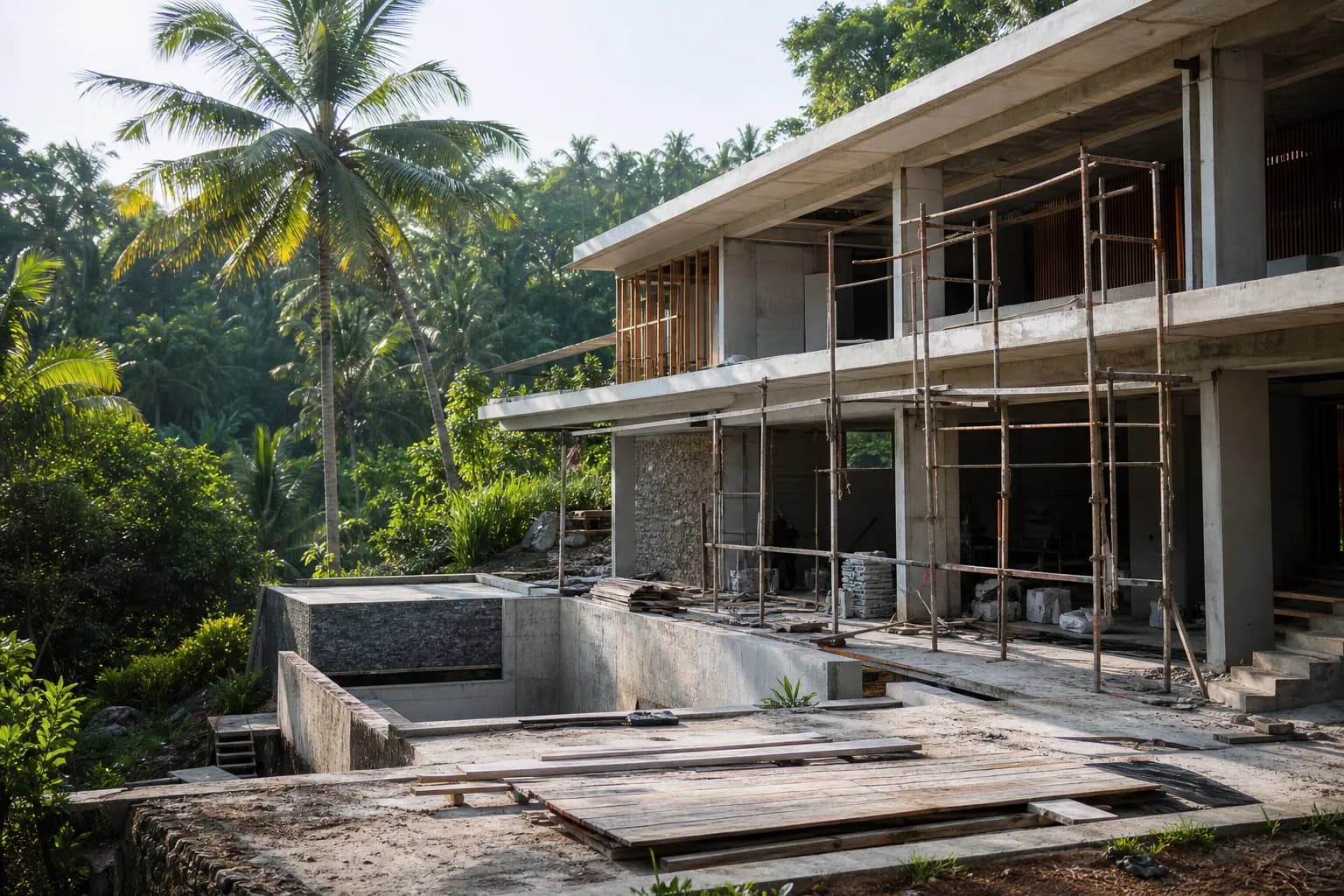
Construction Defect Liability Period: Bali’s 10-Year Structural Warranty Law
When a villa owner in Seminyak discovered structural cracks spreading across load-bearing walls just eight years after construction completion, the original contractor had dissolved their business entity and disappeared. The owner faced USD $87,000 in emergency remediation costs with no legal recourse—despite Indonesia’s Law No. 2 of 2017 establishing a 10-year liability period for structural failures. This scenario repeats across Bali because most foreign buyers don’t understand how Indonesia’s construction defect liability framework actually functions, who bears responsibility when contractors vanish, and what documentation proves enforceable claims. The 10-year structural warranty isn’t automatic protection—it’s a legal mechanism that only works when properly structured during the construction contract phase, with specific liability insurance requirements and defect notification protocols that most villa projects completely ignore.
The Legal Framework: Indonesia’s 10-Year Structural Liability Mechanism
Indonesia’s Law No. 2 of 2017 concerning Construction Services (Undang-Undang Jasa Konstruksi) establishes three distinct liability periods that apply to all construction projects in Bali, including private villas. The framework distinguishes between minor defects (180 days), functional system failures (2 years), and structural integrity failures (10 years maximum). This isn’t a consumer warranty—it’s a professional liability framework that requires specific contractual structures to become enforceable.
The 10-year period specifically covers structural failures defined as defects in load-bearing elements that compromise building safety or habitability. This includes foundation settlement exceeding engineering tolerances, structural frame failures, load-bearing wall deterioration, and roof structure collapse. The law applies to licensed construction service providers (Badan Usaha Jasa Konstruksi) who hold valid IUJK certificates, not to informal contractors or individual builders operating without proper business registration.
Liability Activation Requirements
The 10-year liability only activates when four conditions are simultaneously met. First, the construction contract must explicitly reference Law No. 2/2017 liability provisions and specify defect notification procedures. Second, the contractor must maintain valid Construction Service Business Entity (BUJK) registration throughout the liability period. Third, the project must have completed mandatory quality inspections documented in the Construction Completion Certificate (Sertifikat Laik Fungsi or SLF). Fourth, the building owner must provide written defect notification within 30 days of discovery, following procedures specified in the construction contract.
Most villa construction contracts in Bali fail on the first requirement. Standard agreements drafted by real estate agents or copied from generic templates rarely include proper defect liability clauses. When Teville structures villa construction projects, we incorporate specific liability schedules that define structural elements covered, defect notification procedures, inspection protocols, and remediation timelines—creating enforceable protection rather than theoretical rights.
The Insurance Gap That Nullifies Protection
Indonesian construction law requires contractors to maintain Construction All Risk (CAR) insurance during construction and Professional Indemnity Insurance covering the liability period. However, enforcement is inconsistent for private residential projects under 500 square meters. The critical issue: most small-scale contractors in Bali carry no liability insurance whatsoever, making the 10-year warranty legally valid but practically worthless when structural failures occur.
Professional indemnity insurance for construction contractors in Indonesia typically costs 0.8-1.5% of total construction value annually. For a USD $400,000 villa project, this represents $3,200-$6,000 per year over 10 years—$32,000-$60,000 in total insurance costs. Most contractors building 2-3 villas annually cannot sustain this expense, so they simply operate without coverage. When defects emerge, the contractor either disputes liability through prolonged legal processes or dissolves the business entity, leaving owners with no recovery mechanism.
Structural vs. Non-Structural: The Classification Battle
The most common dispute in construction defect claims involves classification. Contractors argue that reported failures are non-structural maintenance issues (2-year liability) rather than structural defects (10-year liability). Foundation cracks get classified as cosmetic surface issues. Water infiltration through walls becomes a waterproofing maintenance problem rather than structural envelope failure. Roof leaks are attributed to tile maintenance rather than structural deck deterioration.
Indonesian courts require independent structural engineering assessments to classify defects, adding 3-6 months and USD $5,000-$12,000 to the claims process. The engineering report must demonstrate that the defect results from design errors, material deficiencies, or construction workmanship failures—not from owner modifications, lack of maintenance, or normal wear. This evidentiary burden falls entirely on the building owner, who must prove causation while the contractor simply denies responsibility.
Hidden Risks: What Villa Buyers Miss About Liability Protection
The most dangerous assumption foreign buyers make is that Bali’s 10-year structural warranty provides automatic protection similar to new home warranties in Western countries. It doesn’t. The Indonesian framework is a professional liability mechanism that requires active enforcement through civil litigation—there’s no government warranty fund, no mandatory arbitration system, and no consumer protection agency that investigates claims.
Buyers purchasing completed villas face even greater risk. When ownership transfers, the structural liability doesn’t automatically transfer unless explicitly assigned in the sale agreement. If the original construction contract was between the contractor and the developer (not the current owner), the new buyer has no contractual relationship with the builder and cannot enforce liability claims. This is why purchasing land and contracting construction directly creates stronger legal protection than buying completed properties.
The Contractor Dissolution Strategy
Sophisticated contractors in Bali structure their businesses to limit liability exposure. They establish separate PT (limited liability company) entities for each major project or project cluster, then dissolve the entity 2-3 years after project completion—well before structural defects typically manifest. When foundation settlement or structural deterioration appears in years 5-8, the liable entity no longer exists, and Indonesian corporate law provides limited mechanisms to pierce the corporate veil and pursue individual owners.
This practice is entirely legal. PT entities can be dissolved once all tax obligations are settled and no pending litigation exists. Owners discovering defects years later find themselves pursuing claims against dissolved entities with no assets, no insurance, and no recovery potential. The 10-year liability period becomes meaningless without a solvent, insured entity to enforce it against.
Step-by-Step Process: Structuring Enforceable Liability Protection
Phase 1: Pre-Contract Due Diligence (Before Signing)
Before engaging any contractor for villa construction in Bali, verify their BUJK registration status through Indonesia’s Construction Services Development Board (LPJK). Request copies of current Professional Indemnity Insurance policies with coverage limits matching or exceeding total project value. Verify the insurance policy specifically covers the 10-year structural liability period, not just construction phase risks.
Review the contractor’s corporate structure and operational history. PT entities established less than 3 years before your project carry higher dissolution risk. Request audited financial statements for the past two years to assess financial stability. Contractors with negative equity or declining revenue may lack resources to maintain insurance or address future defect claims.
Phase 2: Contract Structuring (Legal Framework)
Work with construction-specialized Indonesian legal counsel to draft liability provisions that exceed minimum legal requirements. Specify that structural liability covers all load-bearing elements, foundation systems, structural frames, roof structures, and building envelopes. Define “structural defect” to include any failure that compromises safety, habitability, or requires remediation exceeding IDR 50 million (approximately USD $3,200).
Include mandatory defect notification procedures with specific timelines: owner provides written notice within 30 days of discovery, contractor inspects within 14 days, contractor provides remediation proposal within 30 days, remediation completion within 90 days. Specify that failure to meet these timelines constitutes breach of contract and triggers alternative remediation with costs charged to contractor.
Establish a retention mechanism: withhold 5-10% of total contract value in an escrow account for 24 months after project completion. This retention fund covers immediate defect remediation and provides financial leverage during the critical post-completion period when most defects emerge. Release retention only after independent structural inspection confirms no significant defects.
Phase 3: Documentation During Construction
Maintain comprehensive photographic and video documentation of all structural work before it’s concealed. Document foundation excavation, reinforcement placement, concrete pours, structural frame assembly, and roof structure installation. This evidence becomes critical if defects emerge years later and causation must be proven.
Require the contractor to provide material certifications for all structural components: concrete mix designs with compressive strength test results, steel reinforcement mill certificates, structural timber grade certifications, and waterproofing membrane technical specifications. These documents prove whether materials met design specifications or contributed to subsequent failures.
Phase 4: Completion Certification and Handover
Engage an independent structural engineer (not affiliated with the contractor) to conduct a comprehensive inspection before final payment. The inspection should include concrete core sampling to verify compressive strength, reinforcement cover measurements, structural level surveys to establish baseline settlement data, and moisture intrusion testing of building envelopes.
Obtain the Sertifikat Laik Fungsi (SLF) from local building authorities, which certifies the structure meets safety and functionality standards. While SLF doesn’t guarantee quality, it’s a prerequisite for enforcing liability claims. Document the final inspection with a detailed punch list of any deficiencies requiring correction before warranty periods begin.
Realistic Cost and Timeline Considerations
Structuring enforceable liability protection adds measurable costs to villa construction budgets. Legal counsel specializing in Indonesian construction contracts charges USD $2,500-$5,000 to draft comprehensive agreements with proper liability provisions. Independent structural engineering inspections at project completion cost USD $3,500-$7,000 depending on villa size and complexity.
The retention mechanism temporarily increases financing requirements. On a USD $400,000 construction project, a 10% retention holds $40,000 in escrow for 24 months. Buyers must either finance this amount separately or delay final contractor payment, which may require additional construction financing costs of approximately 8-12% annually (USD $3,200-$4,800 per year).
If structural defects emerge during the liability period, enforcement costs are substantial. Legal proceedings in Indonesian courts for construction defect claims typically require 18-36 months and cost USD $15,000-$35,000 in legal fees, expert witness fees, and court costs. Even with favorable judgments, enforcement against contractors without insurance or assets may prove impossible, making prevention through proper contract structuring far more cost-effective than litigation.
Timeline considerations: from defect discovery to remediation completion typically spans 6-12 months when contractors cooperate, or 24-48 months when disputes require litigation. During this period, the structural defect may worsen, requiring temporary shoring or emergency stabilization at owner expense (USD $8,000-$25,000 for typical foundation or structural frame issues).
Frequently Asked Questions: Bali’s 10-Year Structural Warranty
Does the 10-year structural warranty apply to villas built on leasehold land?
Yes, the liability period under Law No. 2/2017 applies regardless of land tenure type. However, enforcement becomes more complex with leasehold properties because the building technically belongs to the landowner (Indonesian citizen) while the leaseholder funded construction. The construction contract must clearly establish that the leaseholder has standing to enforce defect claims, and remediation obligations run with the structure regardless of lease status. If the lease expires during the liability period, unresolved defect claims may become unenforceable unless specifically addressed in the lease agreement.
What happens if the contractor’s company is dissolved before the 10-year period ends?
This is the most common scenario that nullifies liability protection. Once a PT entity is legally dissolved, it ceases to exist as a legal person and cannot be sued or held liable. Indonesian law provides limited mechanisms to pursue individual shareholders or directors of dissolved companies, requiring proof of fraudulent intent or gross negligence—extremely difficult evidentiary standards. This is why verifying contractor insurance and implementing retention mechanisms during construction are critical. Professional indemnity insurance policies typically remain valid for claims arising during the policy period even if the insured entity later dissolves, but only if the policy was properly maintained.
Can I enforce structural warr 2144 m²11 month(s)from 104.000 USD
Narayana
 1from 198.000 USD
Private: Haridas Villas
 3127 m²9 month(s)from 177.000 USD
Mukunda
 3124 m²6 month(s)from 123.000 USD
TALA 8
 164 m²7 month(s)from 79.000 USD
TALA TWO
 172 m²8 month(s)from 120.000 USD
Keshava
 4344 m²16 month(s)from 290.000 USD
Radha
 3180 m²7 month(s)from 142.000 USD
Vasudeva
 3173 m²6 month(s)from 125.000 USD
TALA FOUR
164 m²7 month(s)from 79.000 USDPrivate: Haridas Villas, Tegallalang

Want to calculate?
 3104 m²11 month(s)from 99.000 USD
TALA 100
Start With Real Numbers, Not Guesses
Before buying land or finalizing a design, check the realistic build cost range for your project in Bali.
Our team reviews your inputs and gives a grounded estimate.
Available lands
 1300 m²10 min$ 312192Bali, Kutuh South Bali
 1700 m²10 min$ 632257Bali, Kuta
 1230 m²15 min$ 132543Bali, Tegallalang
 800 m²10 min$ 307882Bali, Tibubeneng
 7000 m²36 min$ 284483Bali, Gianyar
 400 m²15 min$ 67192Bali, Tabanan
 2500 m²5 min$ 609606Bali, Kedungu
 5028 m²10 min$ 361000Bali, Ubud
 585 m²8 min$ 165702Bali, Mengwi
 6000 m²10 min$ 1330049Bali, Kutuh South Bali
 220 m²2 min$ 66565Bali, Cemagi
 2850 m²15 min$ 315887Bali, Tabanan
 7900 m²25 min$ 413485Bali, Tabanan
 1000 m²8 min$ 134544Bali, Bukit
 1362 m²15 min$ 335468Bali, Tumbak
Essential Bali build & buy guides
- Bali villa construction cost per m² in 2026
- How much will your villa cost? Calculator
- Building a villa in Bali: the complete guide
- Buying land in Bali: step-by-step for foreigners
- Bali villa investment: yields, risks, returns
- Leasehold vs freehold: what foreigners can own
- Bali building codes and construction standards
Related guides

Why a Cheap Bali Leasehold Is Cheap: Pricing Red Flags Every Buyer Should Decode
Suspiciously cheap Bali leaseholds are priced low for a reason: short remaining terms, forbidden zoning, missing road access, disputes or weak contracts. How to decode the discount before you pay for it.
8 min read
Fake Compliance and Licensing Agents in Bali: The 2026 Paperwork Scam and How to Verify Documents
Forged certificates, permit fixers and fake notaries: how Bali's paperwork scams work in 2026 and how to verify every property document at its government source.
7 min read
Buying a Bali Villa from Instagram: Phantom Listings, Render-Only Projects and How to Verify
Instagram is Bali's biggest property shop window and its least verified. How phantom listings, render-only projects and cloned developer accounts work — and the verification steps that expose them.
7 min read