Milestone Payment Schedules in Bali Construction: How Staged Payments Protect You
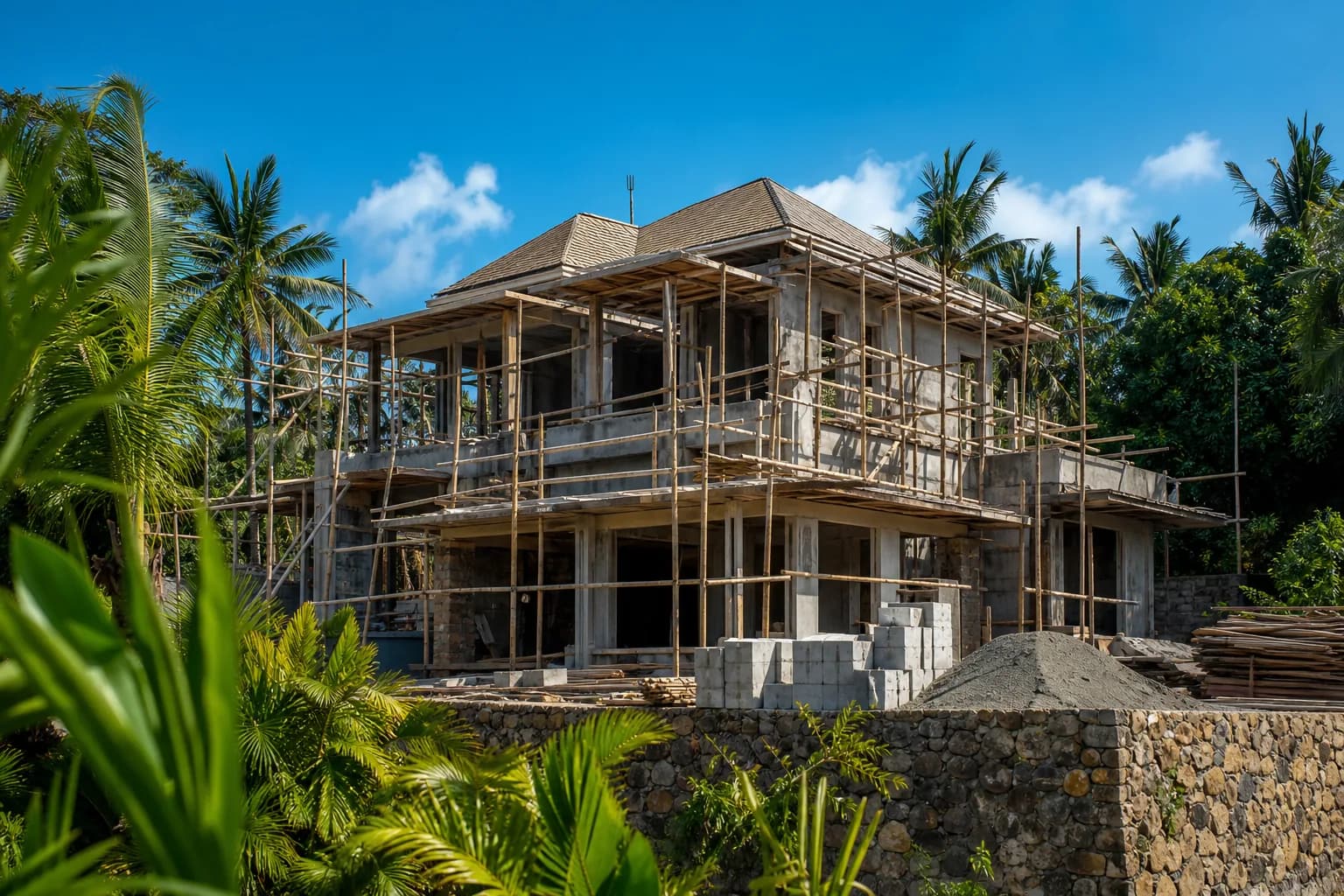
The single most important clause in a villa build contract is not the price — it is the Bali construction payment schedule. How much you pay, at which moments, against which evidence of progress, determines who carries the risk for the next year: you or the builder. Bali has seen enough stalled sites and vanished deposits that the payment schedule has become the sharpest available test of a contractor's seriousness. This guide explains how staged, milestone-based payments work, what the market's typical structures look like in 2026, which schedules protect you, which quietly transfer all the risk to you, and how to verify progress before every transfer — including when you are managing the build from another continent.
Why the payment schedule is your main protection
Construction in Bali is largely prepaid in slices: there is no escrow culture comparable to some Western markets, no completion bond industry, and limited practical recourse if a builder folds mid-project. Litigating a failed build from abroad is slow and rarely economic. That leaves one mechanism that actually works, and it works well: never let your money get far ahead of the value standing on site. A properly staged schedule means that at any moment, if everything went wrong tomorrow, you would own land plus completed work roughly equal to what you have paid. That is the entire philosophy. Every clause below serves it.
The inverse is also true. When a builder asks for 50% upfront "to buy materials", you are no longer a client — you are an unsecured lender to a construction company you met last month.
Bali construction payment schedule: how milestone-based staging works
A milestone (construction-linked) schedule divides the contract price into tranches, each released only when a defined physical stage is complete and verified. A typical healthy structure in the Bali market looks like this:
| Stage | Trigger | Typical share of price |
|---|---|---|
| 1. Contract signing / mobilisation | Signed contract, permits in progress, site setup | 10–20% |
| 2. Foundation complete | Footings, ground works verified | 15–20% |
| 3. Structure complete | Columns, beams, floor slabs done | 15–20% |
| 4. Roof and building envelope | Roof structure and covering complete, building closed | 15–20% |
| 5. Finishing / fit-out | MEP, plaster, floors, joinery, pool works | 15–20% |
| 6. Handover | Snagging resolved, documentation delivered | 5–10% |
Teville works on exactly this logic: a typical 6-stage milestone schedule across a build of 8–16 months, where each invoice follows documented, verifiable progress — you pay as work progresses, never ahead of it. The precise percentages matter less than three structural properties any good schedule must have:
- Front-load is modest. The pre-construction payment should reflect real mobilisation costs, not fund the builder's other projects.
- Triggers are physical, not calendar. "Foundation complete" is verifiable; "Month 4" is not progress, it is just time passing.
- The tail has teeth. A meaningful final payment held until snagging is resolved is the only leverage you have during handover — give it away and defect lists get answered slowly, if at all. Our handover checklist in the guides section covers what to test before releasing it.
Construction-linked vs time-based schedules
Bali contracts broadly follow one of two models, and the difference is the whole ballgame:
- Construction-linked: money follows verified milestones. If work stalls, payments stall automatically. Risk sits with the builder to keep the site moving — which is exactly where you want it.
- Time-based: instalments fall due on calendar dates "for your planning convenience". If work stalls, you keep paying anyway. Common in off-plan sales, where it effectively makes buyers finance the developer. Combined with a large deposit, it is the mechanism behind most Bali off-plan horror stories.
If a contract mixes both — calendar dates "provided works are on schedule" — insist that the milestone condition dominates: no verified milestone, no payment, regardless of the date. And in any off-plan purchase, ask whether your instalments are ring-fenced for your unit or pooled into the developer's general cash flow; the honest answer is usually the latter, which is why vetting the builder matters more than the schedule itself.
Verification: what "milestone complete" must mean
A milestone schedule protects you only if completion is verified by someone answerable to you. Build these into the contract:
- Defined completion criteria per stage — a short technical description of what "structure complete" includes, referenced to the drawings, so completion is a fact, not an opinion.
- Photo and video documentation tied to each invoice — dated, geotagged where possible, covering the elements the stage claims.
- Right of inspection — you or your representative may visit the site and commission an independent inspection before releasing any tranche, at your cost, without it counting as delay.
- Payment window after verification — e.g. payment due within 7–14 days of verified milestone, so the builder has predictability and you have review time.
- Retention — commonly around 5% held after handover against defects for an agreed period, released when the defect list is closed. Market practice varies; what matters is that something survives handover.
For remote clients this verification layer is the difference between confidence and anxiety. Teville builds it in as standard: clients building from abroad receive structured progress reporting at every milestone, and each payment request arrives with the evidence attached — the same remote-management discipline that lets buyers acquire plots from our vetted land catalogue via Power of Attorney without setting foot on the island until the walls are up.
Red flags in a proposed schedule
- More than ~30% before ground is broken. Materials for early stages do not cost half the contract. Large deposits fund something — just usually not your villa.
- Vague stage definitions. "Progress payment 2" with no technical criteria is an invoice you cannot dispute.
- Discounts for prepaying future stages. A builder selling tomorrow's work at a discount today has a cash-flow problem, and you are being recruited to solve it.
- No retention, or final payment due "at practical completion" before snagging. Handover leverage is not optional.
- Cash payments off the contract. Every rupiah should move traceably against an invoice that matches the schedule. Untraceable payments are unprovable payments.
- Price that only holds if you pay fast. Payment terms and price are separate negotiations; a builder who blends them is repricing risk onto you.
None of these alone proves bad faith — young contractors genuinely do have thinner working capital. But each one moves risk from their balance sheet to yours, and pricing should reflect that honestly. A builder confident in their pipeline and margins can live with milestone discipline; that willingness is itself the strongest credential they can show you, alongside completed projects you can visit — browse what finished work should look like in Teville's portfolio.
How staged payments interact with your budget
A milestone schedule is also a budgeting instrument. With construction at $600–800/m² (Essential), $900–1,300/m² (Premium) or $1,400–2,000/m² (Luxury) and a build time of 8–16 months, a 200 m² Premium villa at roughly $220,000 breaks into six tranches of about $22,000–44,000 spread across a year — outflows many buyers can meet from income and staggered savings rather than a lump sum. That cash-flow shape is the closest thing Bali offers to financing, and unlike a loan it costs nothing. Model your own project's tranche sizes with the villa cost calculator, then add a 10–15% contingency line — held by you, not prepaid to anyone — for scope changes and surprises.
One more budgeting note: tie any variation orders (changes you request mid-build) to the same discipline. Each variation should be priced, signed and slotted into the schedule before the work happens — verbal changes are where controlled budgets go to die.
How Teville fits in
Milestone payments are not a feature Teville added for marketing — they are how we have built since 2018: a typical 6-stage schedule, payments released against documented progress, structured reporting for remote clients, and a final stage that stays unpaid until handover is genuinely complete, backed by a lifetime structural guarantee. If you want to see a real schedule against a real budget, contact Teville for a project estimate.
FAQ: Bali construction payments
What deposit is normal for a villa build in Bali?
Healthy contracts start with roughly 10–20% at signing to cover mobilisation, with some market offers ranging to 30%. Anything materially above that before ground is broken shifts risk heavily onto you. The rest should be split across physical milestones — foundation, structure, roof, finishing — with a final tranche held until handover and snagging are complete.
What is the difference between milestone and time-based payment plans?
Milestone (construction-linked) plans release money only when defined physical stages are verified complete, so a stalled site automatically stops your payments. Time-based plans bill on calendar dates regardless of progress, which means you finance delays. Always prefer construction-linked terms, and make the milestone condition override any dates in the contract.
How do I verify milestones if I'm not in Bali?
Contract for it: defined completion criteria per stage, dated photo and video evidence attached to every payment request, the right to commission an independent inspection before release, and a 7–14 day review window. Reputable contractors offer this reporting as standard for remote clients; resistance to independent verification is itself a red flag.
Should any money be held back after handover?
Yes. A retention — commonly around 5%, or a meaningful final payment released only after the snagging list is resolved — is your only practical leverage for defect fixes. Agree the defect liability period and release conditions in the contract. A builder who wants 100% at "practical completion", before you have tested the villa, is asking you to trade away that leverage.
Essential Bali build & buy guides
- Bali villa construction cost per m² in 2026
- How much will your villa cost? Calculator
- Building a villa in Bali: the complete guide
- Buying land in Bali: step-by-step for foreigners
- Bali villa investment: yields, risks, returns
- Leasehold vs freehold: what foreigners can own
- Construction defect liability & 10-year warranty
- Bali building codes and construction standards
Related guides
Transferring Money to Indonesia for a Property Purchase: Banking, Documentation and Safe Practice
Moving six figures across borders is the least glamorous part of buying in Bali, and the part most buyers under-prepare for. This guide covers the rupiah rule, notary escrow, transfer documentation, and the paper trail that protects a future exit.
8 min read
Financing a Bali Villa: Why the Market Is Cash-Only for Foreigners — and the Realistic Alternatives
Why foreign buyers in Bali almost always pay cash, the narrow 2026 bank options for residents, and the realistic alternatives — from home-country equity to milestone-staged construction payments.
7 min read
Bali Rental Income Tax and Compliance Costs: The 10% Rule and the Real Math
How Bali rental income is really taxed in 2026 — the 10% final tax, the 20% non-resident trap, PB1, licensing overhead — and a worked example showing what a villa owner actually keeps.
7 min read