Transferring Money to Indonesia for a Property Purchase: Banking, Documentation and Safe Practice
You have found the land, negotiated the lease, agreed the villa contract. Now comes the step that most buyers spend the least time planning: how to transfer money to Indonesia for the property purchase itself. Done carelessly, an international transfer can stall a closing for weeks, trigger compliance reviews at both banks, or leave you without the paper trail you will need years later when you sell and want your money back out. Done properly, it is routine. This guide explains how payments into Indonesian property deals actually work in 2026, what the currency rules require, and the habits that keep your money safe at every step.
The rupiah rule: what currency your purchase settles in
Indonesia's Currency Law (Law No. 7 of 2011) requires transactions carried out within Indonesian territory to be settled in Indonesian rupiah. That includes property deals. It does not matter that you are a foreigner, that your money starts in dollars or euros, or that the listing was advertised in USD — advertising in foreign currency is common, but the money that changes hands at closing is rupiah. Bank Indonesia treats this as a live rule, not a formality, and has penalized parties for settling domestic transactions in foreign currency.
Practically, this means one of two things happens to your dollars or euros:
- Your international transfer arrives at an Indonesian bank and is converted to rupiah on arrival, at the receiving bank's rate; or
- You convert in advance — through your own bank or a licensed transfer service — and send rupiah-denominated value to the recipient's Indonesian account.
Either way, price your deal with conversion in mind. On a purchase of several hundred thousand dollars, the difference between a bad bank rate and a competitive one can be thousands of dollars. Ask for the actual conversion rate and fee schedule before you commit to a channel, not after the money has landed.
Where the money should go: the notary escrow principle
The single most important safe practice in a Bali transaction is simple: your money should not go directly to the seller until the legal work is done. Standard practice among careful buyers is to pay the deposit — commonly 10 percent or so of the price — into the escrow account of an independent notary/PPAT, not to the seller and never to an agent. The notary holds funds while due diligence completes: certificate verification at the land office, zoning check, confirmation of the ownership chain, and a check for debts or disputes attached to the land. Every plot Teville lists on its vetted land catalogue has already been through exactly this due diligence sequence — certificate, zoning/ITR, ownership chain — before it is offered.
Rules of thumb that hold in almost every legitimate deal:
- Appoint your own notary, or at minimum verify the notary's license independently. Do not simply accept a notary chosen by a seller you have never met.
- All payments by bank transfer. No cash handovers, no personal accounts of intermediaries, no crypto workarounds — these destroy your paper trail and can breach currency rules.
- Funds release against milestones: deposit on signing, balance only when the deed is signed and the certificate position is confirmed.
- Get the account details in writing, signed, from the notary directly — and verify them by a second channel (a phone call to a number you sourced yourself) before sending anything. Invoice-interception fraud, where a scammer emails altered bank details, is a real and growing risk in cross-border deals everywhere.
How to transfer money to Indonesia: your practical options
Most buyers use one of three channels, often in combination:
| Channel | Strengths | Watch out for |
|---|---|---|
| International bank wire (SWIFT) | Familiar, accepted everywhere, strong paper trail | Bank FX margins can be wide; intermediary fees; compliance holds on large first-time transfers |
| Licensed specialist transfer services | Often better rates than banks; rate-locking tools | Per-transfer limits may force multiple tranches; confirm the service supports large property-sized amounts to Indonesia |
| Your own Indonesian bank account | Control over conversion timing; convenient for staged construction payments | Usually requires a stay permit (KITAS) to open a full account; account opening takes time |
For a construction project rather than a one-shot purchase, staged transfers map naturally onto staged payments. Teville contracts run on milestone-based payments — a typical six-stage schedule where you pay as work progresses — so instead of one enormous transfer you make a series of mid-sized ones over the 8–16 months a build usually takes. That is easier on compliance reviews, lets you average out exchange rates across the year, and means your money is never sitting idle in Indonesia ahead of need. You can model the total budget these transfers need to cover with the villa cost calculator.
Documentation: what banks will ask for, and what you must keep
Large inbound transfers into Indonesia go through normal anti-money-laundering screening. Expect your sending bank, the receiving bank, or both to ask for supporting documents, especially on a first large transfer. Have ready:
- The signed sale-and-purchase or lease agreement, or construction contract, naming you and matching the transfer amount;
- Proof of source of funds — sale of a property at home, savings statements, investment account records;
- Your passport and, if you use one, your Indonesian tax or immigration documents.
Bank Indonesia also requires supporting transaction documents for larger foreign-exchange purchases against the rupiah — a threshold that has commonly sat at USD 25,000 per month for documentation purposes, though you should verify current thresholds with your bank at the time of transfer. A genuine property contract satisfies this easily; the rule exists to separate real transactions from currency speculation.
Just as important is what you keep for the long term. When you eventually sell and want to move proceeds back out of Indonesia, you will be asked to evidence: the original inbound transfer (SWIFT confirmations, credit advices), the contract it related to, and proof that Indonesian taxes on the transaction and on any rental income were settled. Buyers who kept a clean file repatriate without drama; buyers who paid through a friend's account or in cash discover, years later, that they cannot document their own money. Keep every transfer confirmation, every tax receipt, every signed deed — digitally and in duplicate.
Do you need an Indonesian bank account?
Not necessarily. Plenty of buyers complete a leasehold purchase or a full villa build without ever opening a local account: transfers go from their home bank to the notary's escrow account or the contractor's corporate account, in the contractually agreed rupiah amounts. Where a local account earns its keep is in the ownership phase — paying staff, utilities and maintenance without international transfer fees on every small bill, and collecting rental income if you operate the villa. Full-service local accounts generally require a stay permit such as a KITAS; requirements vary by bank, so treat account opening as a separate project with its own lead time rather than a closing prerequisite.
Note one asymmetry: getting money into Indonesia is straightforward; rupiah itself is not freely transferable abroad. Repatriation happens by converting rupiah back to foreign currency through a bank, with documentation — which is precisely why the paper trail above matters.
Timing, exchange risk and the mistakes that cost real money
Between reserving a plot and finishing a villa, a year or more can pass, and exchange rates will move. You cannot eliminate that risk, but you can manage it: some buyers convert in tranches to average the rate; others use forward contracts through specialist providers to lock a rate for known future milestones. What you should not do is gamble the whole budget on a hoped-for rate move — you are buying a villa, not trading currency.
The mistakes we see most often, all avoidable:
- Sending money before due diligence is complete, because the seller pressed urgency. Legitimate sellers accept notary escrow.
- Paying any part of the price in cash or to a personal account to save fees. You save a fraction of a percent and lose your legal footing and your repatriation evidence.
- Ignoring conversion costs until closing day, then accepting whatever rate the receiving bank applies.
- Splitting transfers artificially to duck documentation. Structuring looks like exactly what compliance teams are trained to flag; send honest amounts with honest paperwork.
- Not budgeting for closing costs and taxes on top of the price — the transfer needs to cover more than the headline number. Our guides section covers closing costs and taxes in detail.
How Teville fits in
Teville has been building villas in Bali since 2018 and runs every client payment through contracts and milestone schedules designed for remote buyers — most of our clients transfer funds from abroad, many complete their entire purchase via Power of Attorney without flying in. If you want a build budget structured around clean, staged, documented payments, talk to us or read more about how we work.
If you are weighing the numbers, our villa cost calculator gives an instant range based on real 2026 build rates, the land catalog lists legally vetted leasehold plots, and the villa concepts show what different budgets actually buy. More practical guides live in the Bali construction library.
FAQ: transferring money for a Bali purchase
Can I pay for a Bali property in US dollars?
No — Indonesian law requires transactions inside Indonesia to settle in rupiah, regardless of the buyer's nationality. Prices are often advertised in dollars, but the actual payment converts to rupiah, either before or on arrival at the Indonesian bank. Factor conversion rates and fees into your budget from the start, and confirm the rupiah amount in the contract.
Is it safe to send a deposit before I have visited Bali?
It can be, if the money goes into an independent notary's escrow account after the land has passed due diligence — certificate, zoning and ownership-chain checks. It is not safe to send deposits directly to sellers, agents or developers you have not verified. Remote purchases via Power of Attorney are routine when the escrow and verification steps are respected.
Will my bank block a large transfer to Indonesia?
Banks rarely block documented transfers, but large or first-time transfers often trigger compliance questions. Pre-empt them: tell your bank in advance, and have the signed contract and proof of source of funds ready. Undocumented or artificially split transfers are far more likely to be delayed than one honest, well-papered payment.
Can I get my money back out of Indonesia when I sell?
Yes, sale proceeds can generally be converted and repatriated through the banking system, but you must document the original inbound transfers, the transaction itself, and that Indonesian taxes were paid. Keep every SWIFT confirmation, deed and tax receipt from day one — repatriation is a paperwork exercise, and the paperwork is built years earlier.
Essential Bali build & buy guides
- Bali villa construction cost per m² in 2026
- How much will your villa cost? Calculator
- Building a villa in Bali: the complete guide
- Buying land in Bali: step-by-step for foreigners
- Bali villa investment: yields, risks, returns
- Leasehold vs freehold: what foreigners can own
- Construction defect liability & 10-year warranty
- Bali building codes and construction standards
Related guides
Milestone Payment Schedules in Bali Construction: How Staged Payments Protect You
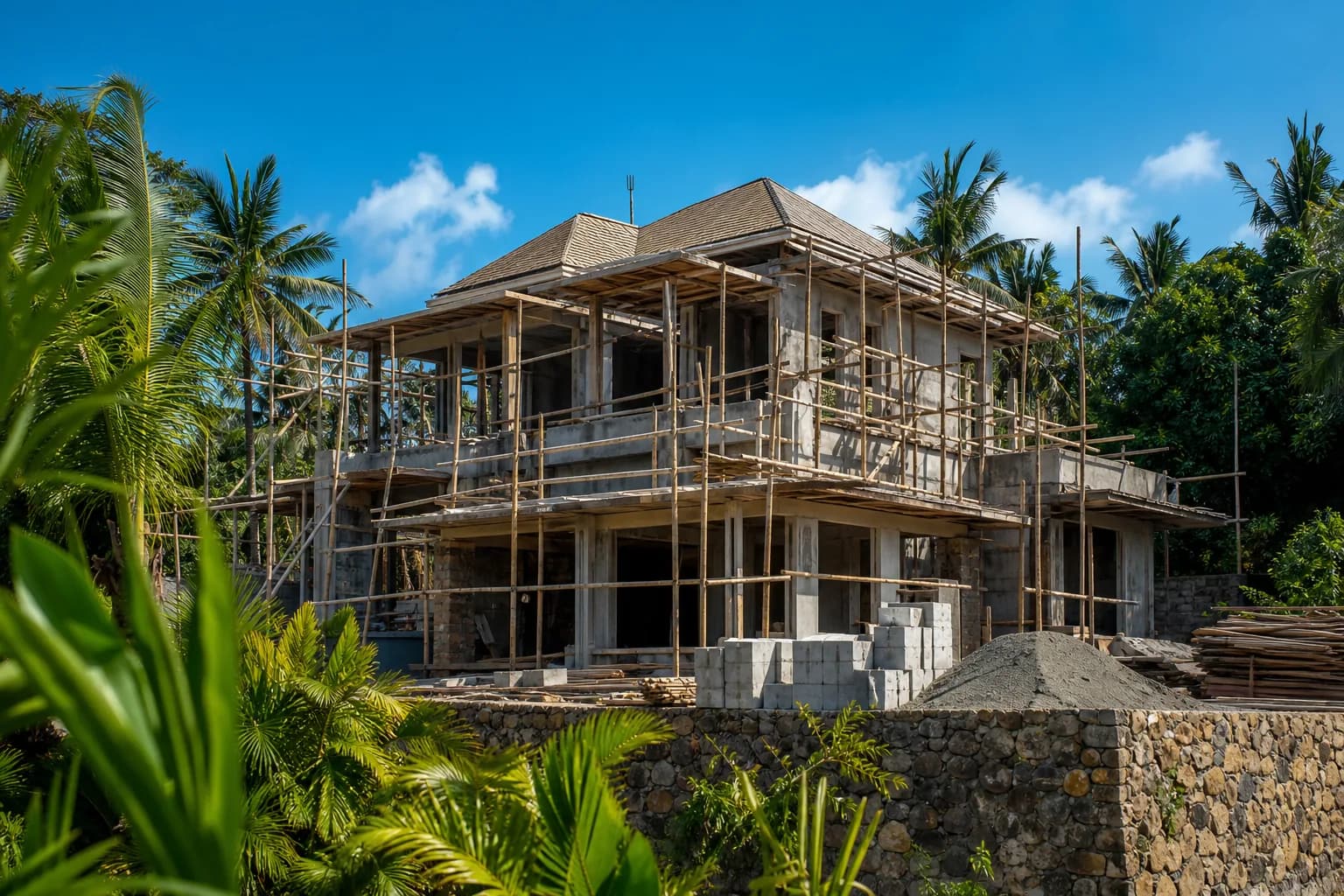
Milestone-based payment schedules are a Bali builder's best client protection: what a healthy 6-stage structure looks like, how to verify progress remotely, and which payment terms to refuse.
7 min read
Financing a Bali Villa: Why the Market Is Cash-Only for Foreigners — and the Realistic Alternatives
Why foreign buyers in Bali almost always pay cash, the narrow 2026 bank options for residents, and the realistic alternatives — from home-country equity to milestone-staged construction payments.
7 min read
Bali Rental Income Tax and Compliance Costs: The 10% Rule and the Real Math
How Bali rental income is really taxed in 2026 — the 10% final tax, the 20% non-resident trap, PB1, licensing overhead — and a worked example showing what a villa owner actually keeps.
7 min read