Bali Villa Investment in 2026: Honest Returns, Risks, and How to Invest Well
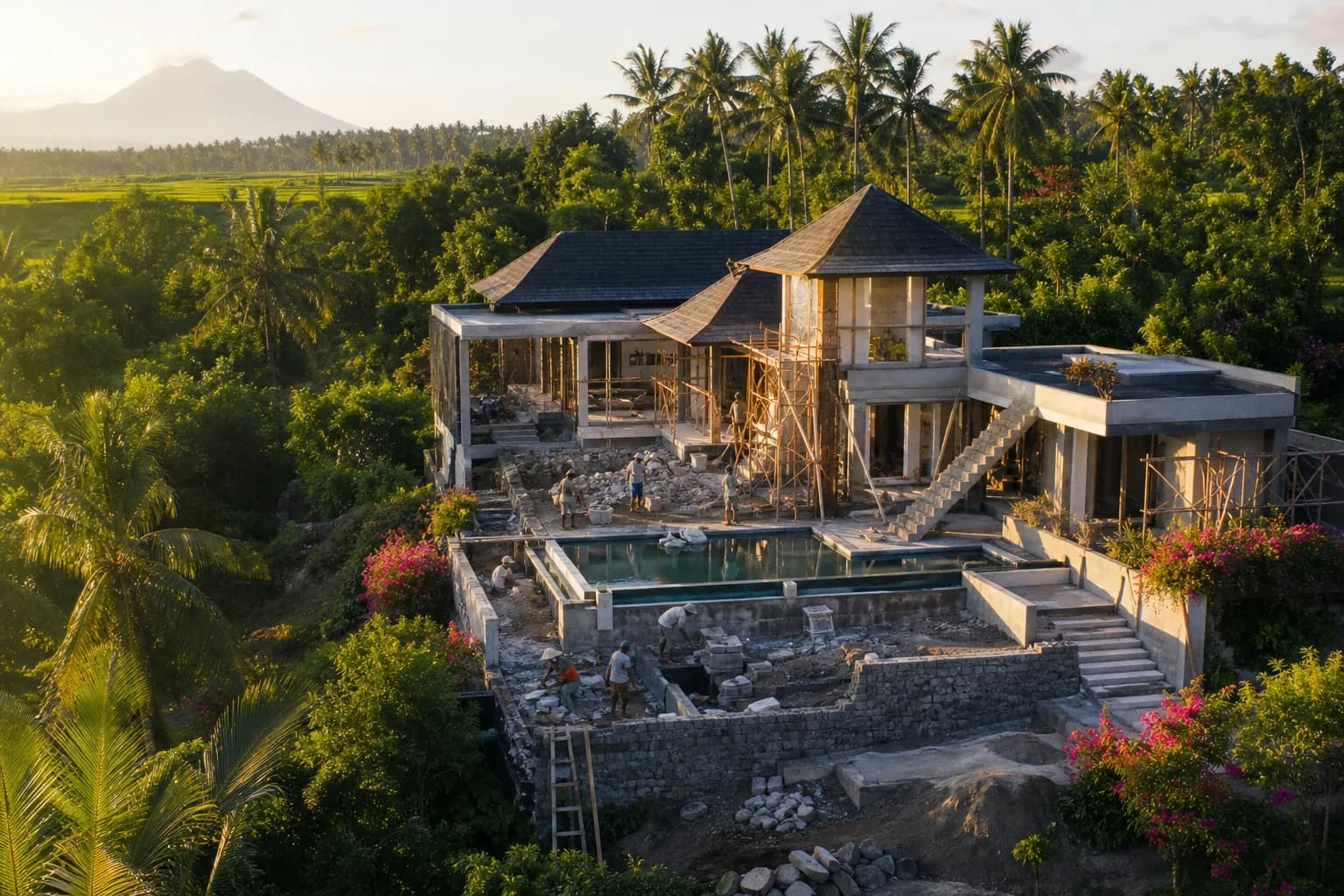
Bali villa investment gets sold hard. Instagram ads promise 20% guaranteed returns, agents quote gross numbers as if they were profit, and brochures rarely mention that most leaseholds are wasting assets with a countdown clock. The honest picture in 2026 is more interesting than the hype: well-run villas in the right areas still net 7–12% a year, while badly bought ones in oversupplied pockets struggle to cover their own management fees. This guide walks through what a Bali villa investment actually returns today, the math behind gross versus net yield, build-versus-buy economics, leasehold decay, the 2026 licensing crackdown, and — just as important — who should not invest at all.
What a Bali villa investment really returns in 2026
Start with the number everyone argues about. Historically, well-run Bali villas have netted roughly 7–12% per year after all costs — that is market context, not a guarantee, and in 2026 the spread between winners and losers has widened sharply.
The market has bifurcated. Distinctive, professionally managed villas in strong locations still run at 70–80% occupancy. Generic two-bedroom boxes in saturated streets sit at 30–45% and discount their nightly rates 10–30% just to fill the calendar. Demand for Bali itself remains healthy — the compression is a supply and management problem, not a tourism problem.
Here is how the three most-discussed investment areas compare in 2026, based on published occupancy and rate data:
| Area | Market picture in 2026 | Typical net yield range |
|---|---|---|
| Canggu / Berawa | Over 4,000 short-term rental listings in the wider area; visible oversupply in the generic 2-bedroom segment; strong performers still fill, average ones fight discount wars | ~4–7% for average product; 9–11% for well-designed, professionally managed villas |
| Pererenan / Kedungu corridor | Entry prices roughly 20–30% below core Canggu while nightly rates stay close; the value gap is the opportunity | ~9–15% for well-run villas, helped by the lower cost basis |
| Uluwatu / Bukit | Premium nightly rates (often $270–300+ average daily rate, higher for clifftop product) but occupancy varies widely — roughly 50% for average listings, 65%+ under professional management | ~4–6% self-managed; 10%+ with strong professional operation |
Two conclusions follow. First, location alone no longer saves a mediocre villa — management quality and design differentiation decide which side of the split you land on. Second, your entry price matters as much as your revenue: the same rental income against a 25% lower cost basis is the entire Pererenan thesis.
Gross vs net: a worked example
Most disappointing Bali villa ROI stories trace back to one mistake: treating gross yield as profit. Gross yield is revenue divided by investment. Net yield is what actually lands in your account after everyone else has been paid. In Bali, operating costs typically consume 40–55% of rental revenue, so a “17% yield” in a brochure and an 8% reality can both be describing the same villa.
Run the numbers on a realistic project: a two-bedroom villa of 150 m² built to a premium spec.
- Total investment: ~$240,000. A 25-year leasehold plot at ~$60,000, construction at $1,000/m² (mid-range of the $900–1,300/m² premium tier) = $150,000, plus roughly $30,000 for furnishing, landscaping and permits.
- Gross revenue: ~$43,000/year. An average nightly rate of $190 at 62% occupancy is about 226 booked nights.
- Gross yield: ~18%. This is the number the ad quotes. It is not your return.
Now subtract what it costs to earn that revenue:
| Annual cost item | Typical amount |
|---|---|
| Management fee (15–20% of revenue) | ~$7,700 |
| OTA / booking platform commissions | ~$5,000 |
| Staff, utilities, pool and garden, internet | ~$6,000 |
| Maintenance and replacement reserve | ~$2,500 |
| Rental income tax (rate depends on your structure — verify with a tax advisor) | ~$4,300 |
That leaves roughly $17,500–21,500 net, or about 7–9% on the $240,000 invested — a genuinely good return, and less than half the brochure number. Before you commit to anything, rebuild this table with your own assumptions, then stress-test it at 45% occupancy and a 15% lower nightly rate. If the deal only works in the best-case row, it does not work. You can model construction budgets for different specs with the villa cost calculator.
Build vs buy: where the margin comes from
You can invest in Bali property two ways: buy a finished (or off-plan) villa from a developer, or lease land and build your own. Buying finished is faster and simpler — and you pay for that simplicity, because the developer’s margin, marketing budget and sales commissions are baked into the price.
Building puts that margin on your side of the ledger. In 2026, construction in Bali runs $600–800/m² for an essential specification, $900–1,300/m² for premium, and $1,400–2,000/m² for luxury — construction only, land separate. A well-located plot plus a premium 150 m² build frequently totals 20–35% less than a comparable finished villa on the resale market, which directly lifts your net yield: the same rental income divided by a smaller denominator.
The trade-offs are real. Most villas take 8–16 months to build, so your capital produces nothing during construction. You also take on execution risk — contractor quality, permits, budget discipline. That risk is manageable with milestone-based payments (you pay as verified stages complete, not upfront) and proper permits from day one: a PBG building permit before construction and an SLF certificate of worthiness at completion. A villa without them is increasingly hard to license for rental — and, as 2026 has shown, hard to keep online at all. Browse real villa concepts and specifications to calibrate what each budget tier buys.
Leasehold decay and your exit
Foreigners in Bali typically hold villas on leasehold — usually 25–30 years, extendable. A leasehold is a wasting asset: every year of ownership is a year off what you can sell. A villa on a 25-year lease is, at resale in year ten, a villa on a 15-year lease, and buyers price that ruthlessly. Once the remaining term drops below roughly 18–20 years, resale value compresses materially; below 15 years the buyer pool thins to bargain hunters.
Plan your exit before you enter:
- Negotiate the extension at purchase, not in year 24. An extension option with a pre-agreed price formula, notarised upfront, is worth real money. A vague “right to extend at market rate” means renegotiating with a landowner who holds all the leverage.
- Model total return, not just yield. On a leasehold, part of your annual cash flow is effectively return of capital, not return on capital. A 10% net yield on a decaying 25-year lease is honest money — as long as you account for the asset reaching zero.
- Plan a 5–10 year hold and sell with 15+ years remaining. That window lets you smooth tourism cycles, bank several strong rental years, and still offer the next buyer a lease term they can finance their own returns against.
- Keep the paperwork exit-ready. Clean lease documents, PBG/SLF, and rental licenses transfer value; missing ones destroy it at the negotiating table.
Regulation risk in 2026: licenses and the OTA delisting wave
2026 is the year Bali got serious about rental compliance, and it changed the risk profile of every villa that earns short-term income.
Indonesia’s tourism authorities coordinated with the major booking platforms — Airbnb, Booking.com and others — around a 31 March 2026 deadline requiring listed properties to show a verified business identification number (NIB) with the correct business classification. Through 2026, platforms have moved to remove non-compliant listings, and on-the-ground enforcement is no longer theoretical: authorities demolished dozens of non-compliant structures in the Bingin Beach area in 2025, and foreigners operating unlicensed rentals face heavy fines and deportation.
The structural point matters most: a foreigner cannot personally hold a pondok wisata homestay license. Legal short-term rental as a foreign owner runs through a properly established Indonesian company (PT PMA) with the right business number and tourism licensing, or through a licensed local operating structure. This is not a reason to avoid a Bali villa investment — it is a reason to structure it correctly from the start, on land that is actually zoned for tourism accommodation. Verify the current requirements with your notary and a licensed consultant before you commit; rules continue to evolve.
There is a silver lining for compliant owners: every delisted illegal villa is supply leaving your market. Investors who did the paperwork are on the right side of the crackdown.
Red flags — and who should not invest
The traps in this market are consistent enough to list. Walk away, or at minimum slow down and verify independently, when you see:
- “Guaranteed ROI” of 15–30%. Nobody can guarantee occupancy. These schemes typically pay the “guarantee” out of your own purchase price for two years, then leave you with a market-rate villa bought above market price. If the underlying asset truly earned 25%, it would not be for sale.
- Freehold offered via a local nominee. The nominee arrangement puts the property legally in someone else’s name. Courts have sided against foreign “owners” in these structures. Take clean leasehold over fake freehold, every time.
- Green-zone or agricultural land sold as “convertible later”. Zoning determines whether your villa can ever be licensed to rent. Verify the zoning certificate (ITR) before money moves — not the agent’s assurance.
- Off-plan projects with no PBG and full payment upfront. No permit means no legal building. Milestone payments tied to verified construction stages are the industry-standard protection; refusal to offer them is an answer in itself.
- Pressure to skip the notary or independent lawyer. Legitimate sellers welcome due diligence — certificate check, ownership chain, zoning. Only bad deals fear it.
And be honest about whether this asset fits you at all. You should probably not invest in a Bali villa if: you need liquidity (leasehold exits take months, sometimes longer); this money is your safety net rather than risk capital; you expect passive index-fund behavior (a rental villa is a small hospitality business, even with a manager running it); you are stretching to a budget that forces you into the oversupplied generic segment; or you are unwilling to spend on proper legal structure and licensing. A bank deposit will not return 7–12%, but it will also never require a new roof, a business license, or a lease extension negotiation. For deeper reading on ownership, permits and costs, see our other Bali building and investment guides.
How Teville fits in
Teville is a construction company, not a booking platform — we make the build-your-own route practical for remote investors: legally vetted leasehold plots, architecture, PBG/SLF permits, and turnkey construction at $600–2,000/m² with milestone-based payments and a lifetime structural guarantee. If the numbers in this guide look workable for your budget, start with our vetted land listings or talk to us about a build plan and honest cost estimate.
FAQ: Bali villa investment
What is a realistic ROI on a Bali villa in 2026?
Well-run villas in strong locations historically net around 7–12% per year after management, platform fees, operating costs and tax — never guaranteed. Self-managed or generic villas in oversupplied areas often land at 4–6% or below. Gross yields of 15–18% are achievable on paper, but operating costs typically consume 40–55% of revenue, so always underwrite the net number.
Is Canggu oversupplied in 2026?
In segments, yes. The wider Canggu area carries thousands of short-term rental listings, and generic villas there are discounting rates to fill calendars. But demand for Bali remains strong, and differentiated, professionally managed villas still achieve 70–80% occupancy. Many investors now look one step out — Pererenan and the Kedungu corridor — where entry prices are 20–30% lower and nightly rates remain close to Canggu’s.
Can foreigners legally rent out a villa in Bali?
Yes, but only through the right structure. Foreigners cannot personally hold a pondok wisata homestay license; legal short-term rental runs through a properly licensed Indonesian company structure with a verified business number, on correctly zoned land. Since 2026, booking platforms remove listings that lack valid licensing, so compliance is now a revenue question, not just a legal one. Verify current requirements with a notary.
Is it better to build or buy a villa in Bali?
Building typically costs 20–35% less than buying a comparable finished villa, because you keep the developer’s margin — construction runs $600–2,000/m² depending on specification, plus land. The trade-off is time (8–16 months) and execution risk, which milestone-based payments and proper permits largely control. Buying finished suits investors who value speed over maximum yield.
Essential Bali build & buy guides
- Bali villa construction cost per m² in 2026
- How much will your villa cost? Calculator
- Building a villa in Bali: the complete guide
- Buying land in Bali: step-by-step for foreigners
- Leasehold vs freehold: what foreigners can own
- Construction defect liability & 10-year warranty
- Bali building codes and construction standards
Related guides
How to Build a Villa in Bali: The Complete Step-by-Step Process (2026)
Every stage of building a villa in Bali as a foreigner — from securing land and permits to handover — with realistic timelines, costs and the mistakes that derail first-time builders.
5 min read
Moisture-Resistant Gypsum Board Finishing with Epoxy Primer Bali
Learn how moisture-resistant gypsum boards with epoxy primer boost durability, finish quality, and mold resistance in Bali projects. Great for Bali homes.
10 min read
Marine-Grade Timber Joinery Finishing Corrosion Protection Bali
Discover marine-grade timber joinery finishing and corrosion protection in Bali. Durable coastal timber care, coatings, and maintenance for lasting protection.
8 min read