Energy-Efficient Villa in Bali: Solar, Insulation and Passive Cooling That Pay Back
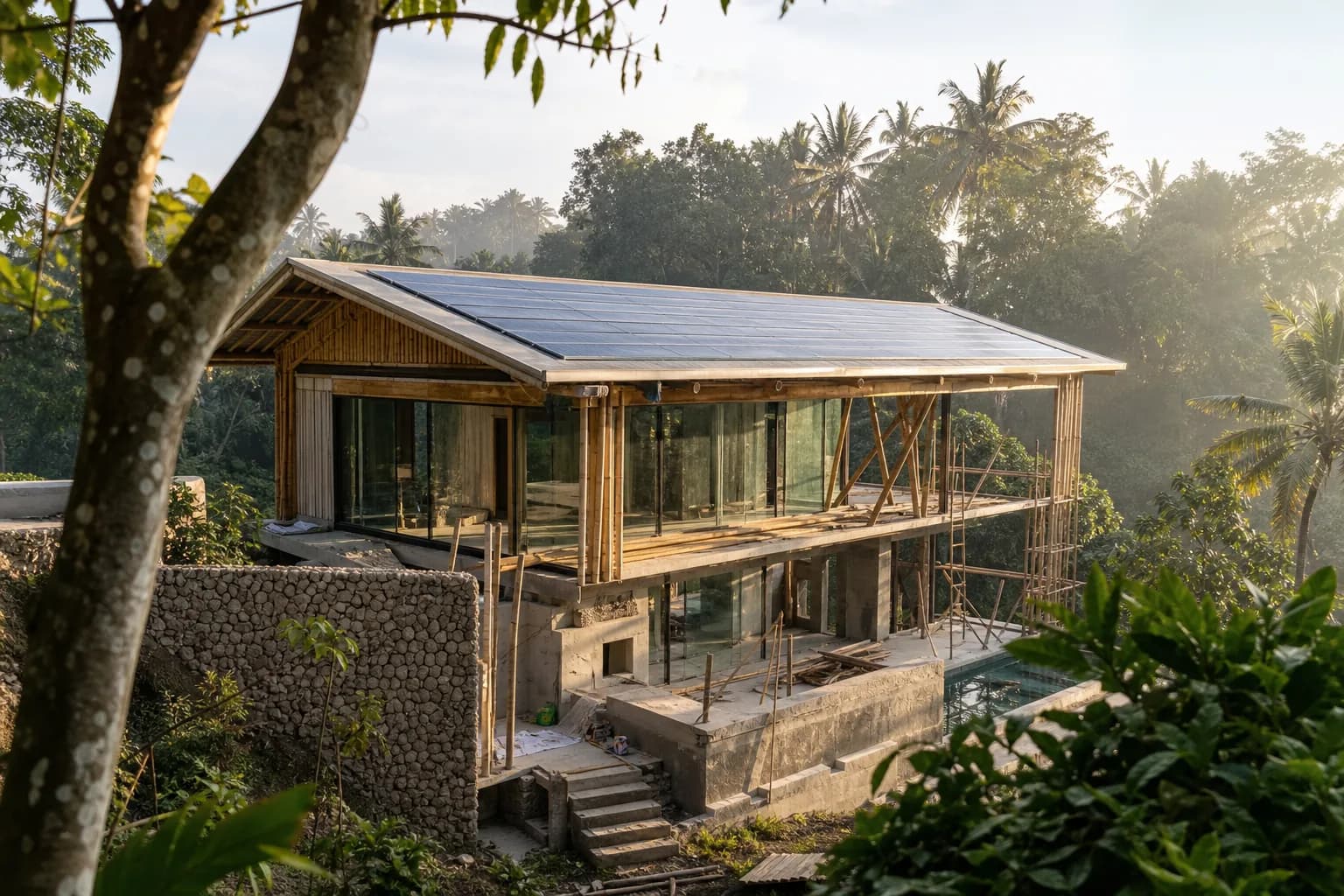
An energy-efficient villa in Bali is not a green marketing gesture — it is one of the few upgrades that pays you back every single month you own the property. Air conditioning and pool equipment dominate a tropical villa's electricity bill, and foreign owners generally pay PLN's non-subsidized tariffs, so every kilowatt-hour you avoid is real money. Efficiency also shows up in rental reviews: guests notice rooms that stay cool without an AC unit roaring all night.
The catch is that not every "eco" feature makes financial sense at 8 degrees south of the equator. Some measures pay back in two or three years; others are expensive decoration. This guide separates the two, in the order that actually matters: passive design first, insulation second, efficient equipment third, solar last.
Why energy efficiency in Bali starts at the drawing board
Bali's climate is hot and humid year-round, with strong sun and heavy rain. That means the cheapest cooling you will ever buy is the cooling you design in before construction — orientation, shading, ceiling height, and airflow cost little when planned early and are nearly impossible to retrofit later.
Research on tropical housing is blunt about the hierarchy: no active system compensates for a badly designed envelope. An insulated roof, shaded windows, and low internal heat gain do more for comfort than any amount of equipment layered on top. Traditional Balinese architecture understood this centuries ago — tall, open structures with deep roof overhangs that block sun and shed rain while letting breezes through.
If you are still choosing where to build, the site itself matters too: plots with unobstructed airflow and room to orient living spaces away from the harsh west sun are easier to keep cool. It's one more reason to evaluate vetted plots with your architect before falling in love with a location.
Passive cooling: the highest-return "system" in the tropics
These measures cost the least and return the most:
- Orientation and shading. Minimize large glass on west-facing walls, where afternoon sun load is brutal. Deep roof overhangs, pergolas, and planted shading keep direct sun off walls and glazing.
- Cross-ventilation. Position openings on opposite sides of living spaces so prevailing breezes flow through. Paired with ceiling fans, this keeps semi-open living areas comfortable most of the day without AC.
- High ceilings and ventilated roof space. Hot air rises; tall rooms and a ventilated attic zone move heat away from people. Vented ridge details let the roof cavity purge accumulated heat.
- Thermal zoning. Condition only what needs conditioning. The classic Bali layout — open-air living and dining, sealed and insulated bedrooms — means your AC serves perhaps a third of the floor area.
- Light-colored, reflective roofing. Roof surfaces that reflect solar radiation instead of absorbing it measurably cut heat gain — one of the best-documented passive techniques in Southeast Asian housing studies.
None of these add meaningful construction cost when designed in from day one. Together they can cut cooling demand dramatically compared with a sealed, Western-style box dropped into the tropics.
Insulation: the unglamorous upgrade that works
In Bali the roof is the battlefield. Midday sun turns an uninsulated roof into a radiator that keeps releasing heat into bedrooms well into the night — exactly when guests want to sleep.
- Roof and ceiling insulation is the priority: reflective foil layers plus insulation batts above bedroom ceilings deliver the biggest comfort gain per dollar in a tropical build.
- Insulated bedroom envelopes. Bedrooms that are sealed when the AC runs — solid walls, insulated ceilings, decent door seals — let a small AC unit do its job and switch off.
- Glazing choices. On sun-exposed elevations, better glass and external shading beat bigger AC units. Prioritize the west side.
- Walls matter less than roofs. With good shading, standard masonry performs acceptably; spend the marginal dollar on the roof first.
Insulation is also where cheap builds quietly cut corners, because it is invisible at handover. Make sure your specification names the insulation products and that installation is photographed before ceilings close — a standard checkpoint in a properly supervised build.
Efficient equipment: AC, pool, and water heating
Once the envelope is right, equipment choices compound the savings:
- Inverter air conditioning. Inverter units modulate instead of cycling on and off, using substantially less electricity in continuous tropical use. Over years of ownership the premium over fixed-speed units repays itself many times.
- Variable-speed pool pumps. A pool pump runs hours every day for decades. Variable-speed models cut that consumption sharply and typically pay back fast.
- Heat-pump or solar water heating. Electric storage heaters are the least efficient common option; heat pumps and rooftop solar thermal units cost more upfront but sip energy in a climate this warm.
- LED lighting and smart controls. Cheap, obvious, and worth doing everywhere — plus timers or sensors so garden and pool lighting isn't burning at 4 a.m.
Solar power in Bali: honest 2026 math
Solar works in Bali — the island gets strong, consistent sun — but the economics changed. Indonesia's rooftop-solar rules have moved away from classic net metering for new systems, so exported electricity is no longer simply credited against your bill. In 2026, system design therefore targets self-consumption: sizing the array to what the villa actually uses during daylight hours.
Current market pricing in Bali runs roughly IDR 10–20 million per installed kWp for a standard rooftop system from a reputable installer, with grid-connection paperwork on top. That makes solar most attractive for villas with heavy daytime loads — pool pumps, daytime AC in rented villas, laundry — where panels offset consumption in real time.
| Measure | Typical upfront cost impact | Payback character |
|---|---|---|
| Passive design (orientation, shading, ventilation) | Minimal if designed in early | Immediate — lower AC load from day one |
| Roof/ceiling insulation | Low | Fast — comfort plus reduced AC runtime |
| Inverter AC + variable pool pump | Moderate premium | Short — equipment runs daily for years |
| Heat-pump water heating | Moderate | Medium |
| Rooftop solar (self-consumption sized) | ~IDR 10–20M per kWp | Medium — best with strong daytime loads |
| Battery storage | High | Long — mainly an outage hedge today |
A note on batteries: they protect you from grid outages and extend solar into the evening, but at current prices they are a resilience purchase more than a return-on-investment purchase for most villas. Prices are falling; many owners install solar now and leave conduit and space for batteries later.
What an energy-efficient villa in Bali costs — and returns
Most of the measures above fit comfortably inside normal construction budgets. In 2026, quality villa construction in Bali runs $600–800/m² at essential specification, $900–1,300/m² premium, and $1,400–2,000/m² luxury — and a sensible efficiency package (insulated roof, inverter AC, variable pool pump, LED, solar-ready wiring) shifts a project only marginally within its tier. You can model specification levels against your floor plan with the villa cost calculator.
For rental villas, efficiency pays twice. Operating costs drop — electricity is one of the largest line items in villa running costs — and guest experience improves: cool bedrooms, quiet AC, and shaded outdoor living translate directly into review scores. In a market where well-run villas have historically netted around 7–12% (context, never a guarantee), shaving a meaningful slice off operating costs is one of the few levers fully in the owner's control. Design choices that support bookings are covered further in the guides library, and you can see how tropical-modern efficiency principles look in practice across the Teville portfolio.
How Teville fits in
Teville designs and builds villas for Bali's climate rather than against it — passive cooling and roof insulation planned from the first sketch, efficient equipment specified in the bill of quantities, and solar-ready wiring where owners want it, all delivered turnkey with milestone payments and a lifetime structural guarantee. If you want an energy-efficient villa in Bali costed for your plot and specification, get in touch.
FAQ: energy-efficient villas in Bali
Is solar power worth it for a Bali villa in 2026?
Usually yes, if the system is sized for self-consumption. With new rooftop systems no longer earning classic net-metering credits, the value comes from offsetting daytime use — pool pumps, daytime AC, appliances. At roughly IDR 10–20 million per kWp installed, villas with strong daytime loads see reasonable paybacks; lightly used holiday homes see longer ones.
What single upgrade makes the biggest difference?
Roof and ceiling insulation combined with shading. Bali's heat enters primarily through the roof and west-facing glass, so a reflective, insulated roof over sealed bedrooms cuts AC demand more than any equipment upgrade. It is also nearly impossible to retrofit well, which is why it must be in the construction specification from the start.
Does an energy-efficient design cost much more to build?
No. Orientation, shading, cross-ventilation, and high ceilings cost little when designed in early, and insulation is a small line in a full construction budget. The premium items — inverter AC, variable-speed pool pumps, heat-pump water heaters — carry moderate upfront costs that daily tropical use repays through lower electricity bills.
Can I keep a Bali villa comfortable without air conditioning?
Living areas, yes — with shading, cross-ventilation, ceiling fans, and high ceilings, open-plan spaces stay pleasant most of the year. Bedrooms are a different story: most owners and virtually all rental guests expect AC for sleeping. The efficient approach is sealed, insulated bedrooms with inverter units, and passive comfort everywhere else.
Essential Bali build & buy guides
- Bali villa construction cost per m² in 2026
- How much will your villa cost? Calculator
- Building a villa in Bali: the complete guide
- Buying land in Bali: step-by-step for foreigners
- Bali villa investment: yields, risks, returns
- Leasehold vs freehold: what foreigners can own
- Construction defect liability & 10-year warranty
- Bali building codes and construction standards
Related guides
Choosing a General Contractor in Bali: Red Flags, Questions and Contract Must-Haves
A practical filter for hiring a general contractor in Bali: the red flags that end conversations, the questions professionals answer with documents, and the contract clauses no villa build should start without.
7 min read
Construction Cost Overruns in Bali: Why Budgets Blow Up — and the Contract Terms That Prevent It
Most Bali construction budgets do not blow up in one disaster — they leak through vague scope, unpriced change orders and open-ended contracts. The real causes of cost overruns, and the specific contract terms, payment structure and contingency planning that prevent them.
8 min read
Build vs Buy a Villa in Bali in 2026: The Full Comparison
Building a Bali villa typically costs 20–30% less than buying comparable turnkey stock, but takes 8–16 months and demands more decisions. A full, honest comparison of cost, time, control, risk and resale — plus who should choose which route.
7 min read