Choosing a General Contractor in Bali: Red Flags, Questions and Contract Must-Haves
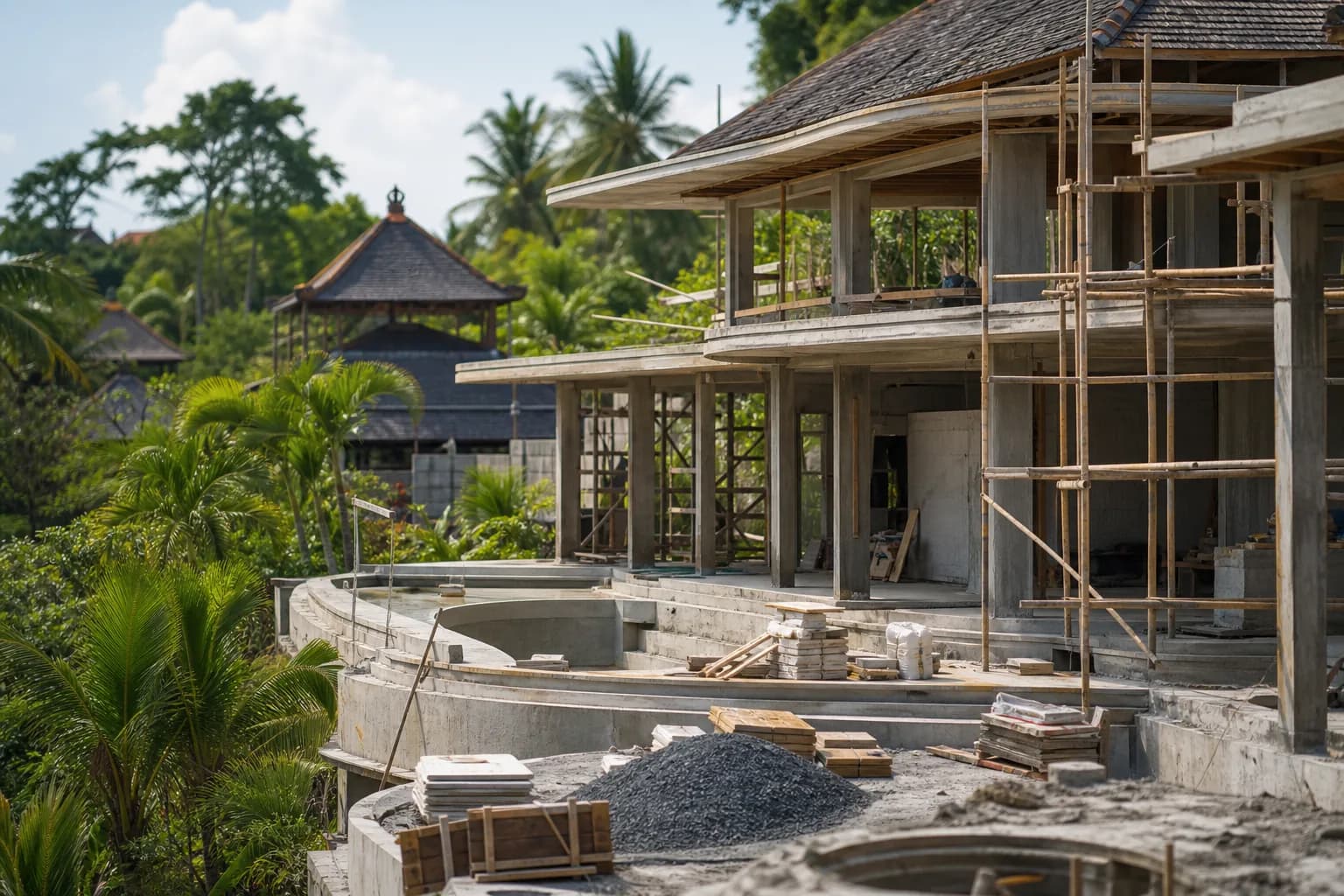
Choosing a general contractor in Bali is the single decision that determines whether your villa project finishes on budget, on time, and legally — or becomes an expensive lesson. The island has hundreds of builders, from world-class firms to two-man crews with a rendering package and a rented office. The price gap between them can look small on paper. The outcome gap is enormous.
This guide gives you a practical filter: the red flags that should end a conversation immediately, the questions that separate professionals from improvisers, and the contract clauses you should refuse to build without. It reflects how construction actually works in Bali in 2026 — permits, payment culture, supervision — not how it works at home.
Why the general contractor decision matters more in Bali
In many countries, licensing regimes, insurance requirements, and courts keep a mediocre builder within guardrails. In Bali, those guardrails are thinner. Enforcement of building standards has tightened — projects now need a PBG (building approval) before construction and an SLF (certificate of functional worthiness) before legal use — but day-to-day quality still depends almost entirely on who is running your site.
A general contractor in Bali typically coordinates architects, structural engineers, permit consultants, and multiple subcontractor crews. If that coordination is weak, you don't just get delays. You get concrete poured before inspections, waterproofing skipped under tiles where you'll never see it, and electrical work that fails the moment the first rainy season arrives. Fixing hidden defects after handover routinely costs several times what doing it right would have cost.
The good news: bad contractors are surprisingly easy to screen out if you ask the right questions before money moves, not after.
Red flags that should end the conversation
Any one of these is a reason to slow down. Two or more is a reason to walk away:
- No completed villas you can visit. Renders and concept boards are marketing, not evidence. A builder who cannot show finished, occupied projects — and let you speak to the owners — has no track record you can verify.
- A lump-sum price with no breakdown. "Your villa will cost $250,000" without a bill of quantities means the number is a hook, not a budget. Vague pricing is where surprise invoices are born.
- Large upfront payments. Requests for 30–50% before mobilization shift all risk onto you. Professional schedules tie money to verified progress; see how milestone structures work below.
- "We'll sort the permit later." Building without a PBG risks stop-work orders, fines, and in serious cases demolition. A contractor relaxed about permits is relaxed about your money.
- No legal entity or no written contract. If the company can't show registration documents, you have no counterparty to hold accountable — only a phone number.
- Pressure tactics. "This price is only valid this week" is a sales technique, not how serious construction firms book eight-month projects.
- Unrealistically low quotes. If one bid is 30% below the others, the difference will reappear as change orders, material substitutions, or an abandoned site. In 2026, quality construction in Bali realistically starts around $600–800/m² for essential specifications and runs $900–1,300/m² for premium builds.
Questions to ask a general contractor in Bali
Interview at least three firms. Ask each the same questions and compare answers side by side.
Company and legal standing
- What legal entity will sign my contract, and can I see its registration documents and tax number?
- Does the company hold the certifications Indonesian construction businesses are expected to carry, and do its engineers hold recognized professional credentials? Ask to see documents, not just hear yes.
- Who handles the PBG application and drawings — and are they signed off by licensed Indonesian professionals as the approval process requires?
Track record
- How many villas has the company completed, and can I visit two or three — including one finished more than two years ago, so I can see how it has aged through rainy seasons?
- Can I speak directly with two past clients, ideally foreign owners who built remotely?
- Has any project been delayed by more than three months, and why?
Money and contract
- Is the quote a fixed price against a detailed bill of quantities, and what exactly is excluded?
- What is the payment schedule, and is every payment tied to a verifiable milestone rather than a calendar date?
- How are change orders priced and approved — in writing, before the work is done?
- What warranty do you give on structure and on finishes, and what does the claims process look like in practice?
Site management
- Who is my single point of contact, and how often will I receive photo and video reports?
- Which works are done in-house and which are subcontracted — and who supervises the subcontractors daily?
- How do you handle quality control at hidden stages: foundations, waterproofing, conduit runs before they are covered?
The pattern to look for is not perfect answers — it's specific ones. Professionals answer with documents, names, and numbers. Amateurs answer with reassurance.
Contract must-haves before you sign
A Bali construction contract worth signing contains, at minimum:
- A detailed scope and bill of quantities — materials by brand or specification grade, not "good quality tiles." This is your only defense against silent material swapping.
- A milestone payment schedule. A typical professional structure has around six stages, each released only after you (or your independent supervisor) verify the work. Teville builds on a 6-stage milestone schedule for exactly this reason.
- A fixed completion date with delay penalties. Most well-run villa builds take 8–16 months. A contract with no date and no penalty is a contract with no deadline.
- A written change-order protocol — who can authorize changes, how cost is calculated, and a rule that no extra work proceeds without your signed approval.
- Warranty terms in writing. Finishes warranties in Bali commonly run months, not years; structural warranties should be far longer. Teville provides a lifetime structural guarantee on its builds.
- Permit responsibility clause — the contractor's obligation to build per the approved PBG drawings and support the SLF process at completion.
- Termination and dispute terms — what happens to materials on site, paid milestones, and drawings if the relationship ends.
Comparing quotes: what a real bid looks like
When bids arrive, don't compare bottom-line numbers. Compare what each number contains:
| Item | Professional bid | Risky bid |
|---|---|---|
| Pricing basis | Fixed price on itemized bill of quantities | Single lump sum or "per m² estimate" |
| Materials | Brands and specification grades named | "Standard quality" throughout |
| Exclusions | Listed explicitly (e.g., furniture, landscaping) | Discovered later as extras |
| Payments | ~6 milestones, verified before release | Large deposit, then monthly on trust |
| Timeline | Dated schedule with penalties | "Around a year, depending" |
| Warranty | Written terms, structural coverage defined | Verbal assurances |
To sanity-check the numbers themselves, run your specification through the villa cost calculator — if a bid is far below a realistic 2026 range, that gap is a warning, not a bargain.
Verify the paper trail, not the promises
Before signing anything, independently verify three things. First, the legal entity: match the name on the contract to registration documents, and make sure payments go to the company account, not a personal one. Second, the permit path: ask which architect and engineer will sign the PBG drawings and confirm they are licensed in Indonesia. Third, the land itself: no contractor should start work on a plot that hasn't passed due diligence on its certificate, zoning, and ownership chain. If you're still selecting land, browsing legally vetted plots removes that entire risk category before construction begins.
Finally, insist on seeing built work. Reviewing a contractor's completed villa portfolio — and standing inside a finished project — tells you more in an hour than a month of email correspondence. For deeper background on the building process, permits, and budgeting, the Teville guides library covers each step.
How Teville fits in
Teville has operated as a general contractor in Bali since 2018, delivering villas turnkey with a 6-stage milestone payment schedule, PBG/SLF permit handling, remote build management with regular reporting, and a lifetime structural guarantee. If you want to pressure-test a bid you've received or scope a build from scratch, talk to the team — the questions in this guide are ones we're comfortable answering with documents.
FAQ: choosing a contractor in Bali
How much should I pay a Bali contractor upfront?
As little as possible before verifiable work exists. A modest mobilization payment is normal, but the bulk of your money should be released against completed, inspected milestones — typically around six stages across the build. Any request for 30–50% before ground is broken concentrates all the risk on you and is a classic warning sign.
Do Bali contractors need a license?
Legitimate construction businesses in Indonesia operate as registered legal entities with construction-sector certifications, and PBG building approvals require drawings signed by licensed Indonesian professionals. Ask to see the documents rather than accepting assurances, and confirm the entity named on your contract is the one holding them. Your notary or legal consultant can help verify.
How long does building a villa in Bali take?
Most well-managed villa projects take 8–16 months from breaking ground to handover, depending on size, site conditions, and specification level. Be skeptical of anyone promising a full custom villa in five or six months — compressed schedules in Bali usually come at the cost of curing times, waterproofing, and inspection discipline.
Can I manage a Bali build while living abroad?
Yes, if your contractor is set up for it. Remote builds work when the contract specifies regular photo and video reporting, a single accountable point of contact, and milestone payments you approve from evidence rather than trust. Many Teville clients complete their entire build — including land purchase via Power of Attorney — without relocating to Bali.
Essential Bali build & buy guides
- Bali villa construction cost per m² in 2026
- How much will your villa cost? Calculator
- Building a villa in Bali: the complete guide
- Buying land in Bali: step-by-step for foreigners
- Bali villa investment: yields, risks, returns
- Leasehold vs freehold: what foreigners can own
- Construction defect liability & 10-year warranty
- Bali building codes and construction standards
Related guides
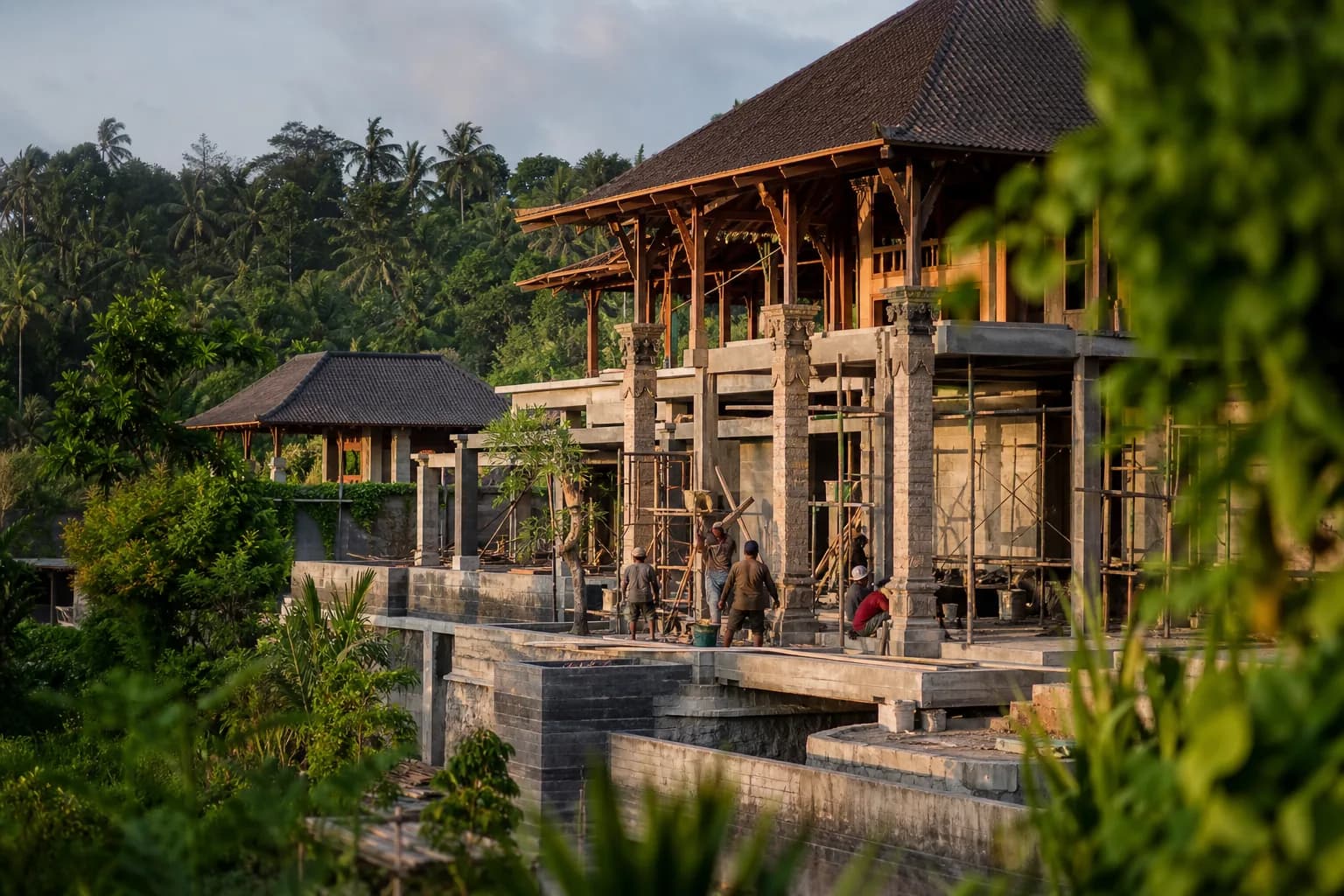
Construction Cost Overruns in Bali: Why Budgets Blow Up — and the Contract Terms That Prevent It
Most Bali construction budgets do not blow up in one disaster — they leak through vague scope, unpriced change orders and open-ended contracts. The real causes of cost overruns, and the specific contract terms, payment structure and contingency planning that prevent them.
8 min read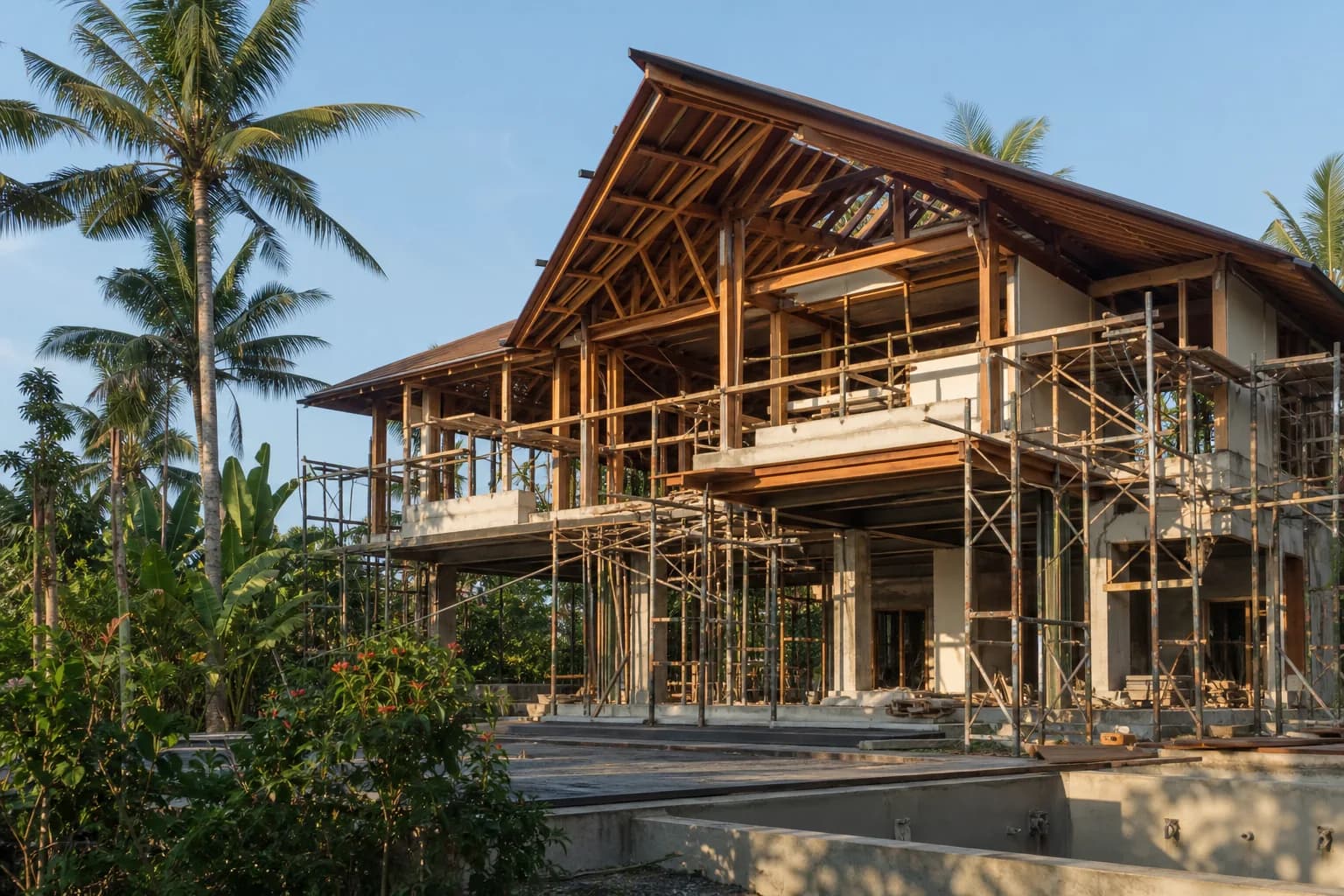
Build vs Buy a Villa in Bali in 2026: The Full Comparison
Building a Bali villa typically costs 20–30% less than buying comparable turnkey stock, but takes 8–16 months and demands more decisions. A full, honest comparison of cost, time, control, risk and resale — plus who should choose which route.
7 min read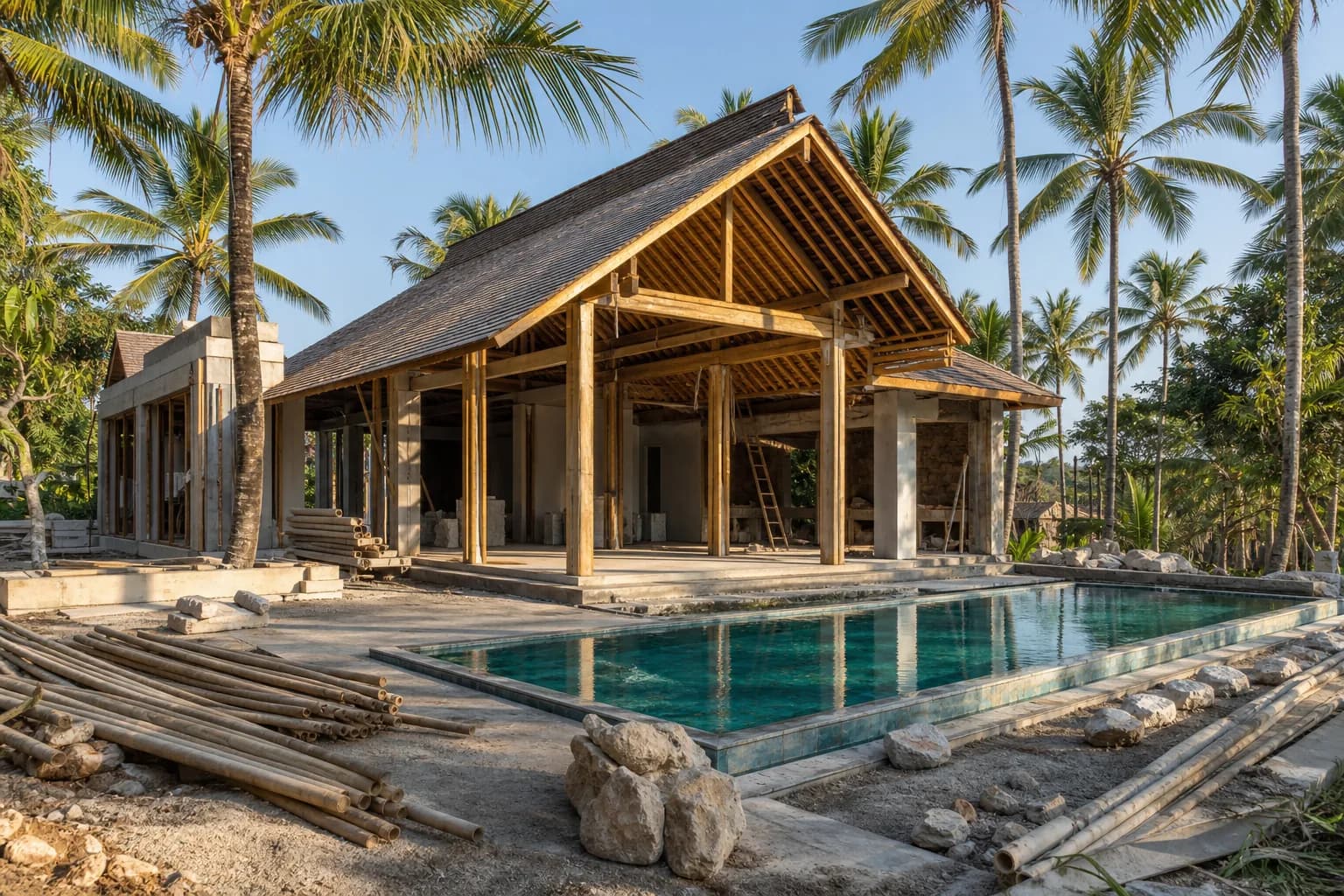
Designing a Bali Villa for Rental Performance: Layouts, Bedrooms, Pools and Features That Actually Book
In an oversupplied 2026 market, design is the difference between a Bali villa that books at premium rates and one that discounts to survive. What bedroom counts, layouts, pool decisions and features actually drive occupancy and ADR — and what they cost to build.
8 min read