Designing a Bali Villa for Rental Performance: Layouts, Bedrooms, Pools and Features That Actually Book
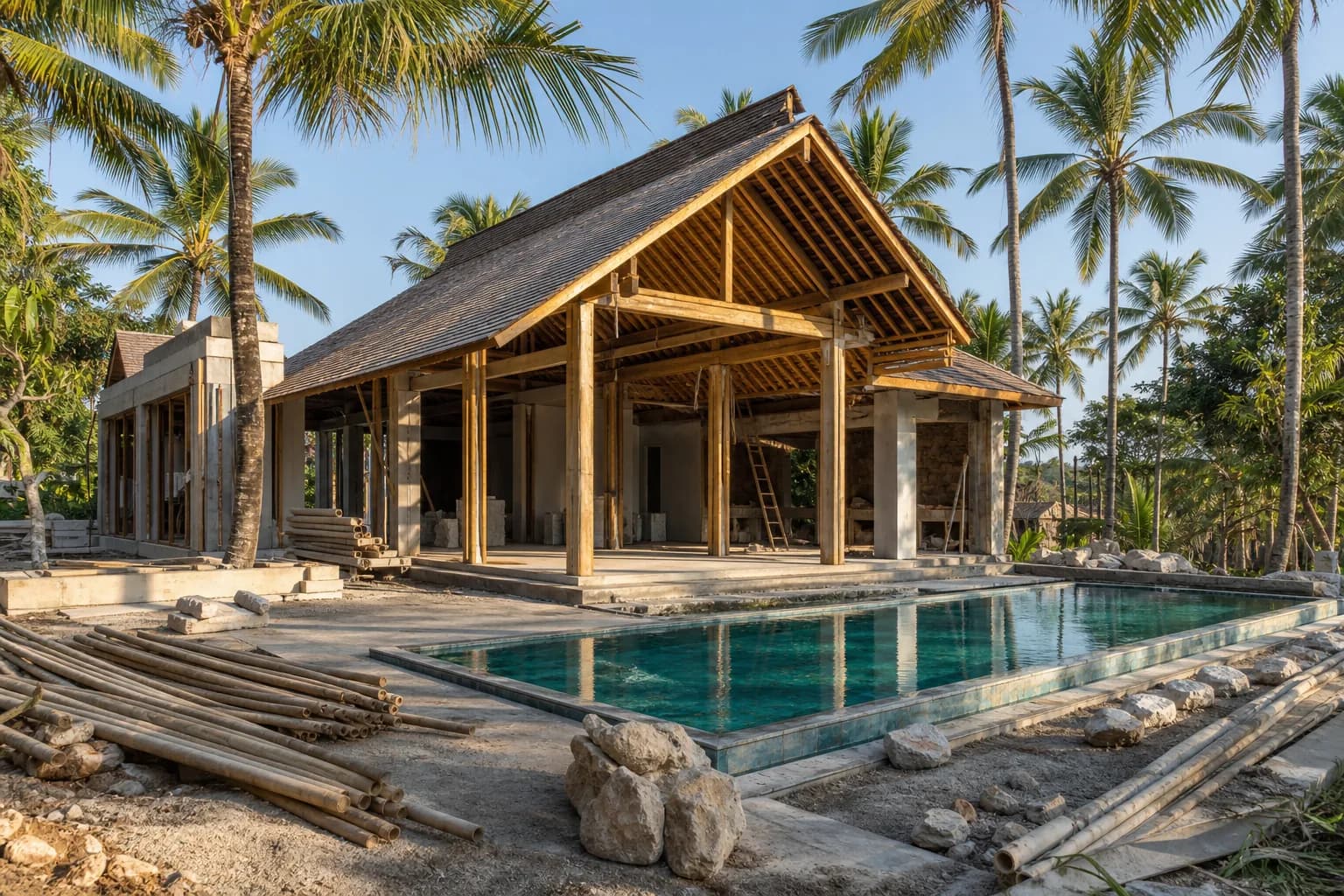
In Bali's 2026 rental market, villa design for rental performance is no longer a nice-to-have — it is the whole game. The island now carries tens of thousands of short-term listings, generic villas in saturated areas have watched occupancy slide toward the 40s, and yet well-designed properties in the same postcodes still run 70–80% occupancy at premium rates. Guests scroll past hundreds of near-identical white boxes; the villa that stops the scroll wins the booking, and that decision is made at the design stage, years before the first guest arrives.
This guide covers what actually books in Bali — bedroom counts, layouts, pool and outdoor design, the features that move ADR versus the ones that just burn budget — and connects each choice to construction cost, which you can model with our villa cost calculator.
Villa design for rental performance: the market logic
Start with how guests choose. A Bali booking decision is made in seconds, on a phone, from photos. That has three design consequences:
- The villa must photograph distinctively. One genuinely striking frame — a pool meeting a rice-field horizon, a double-height living space, a dramatic entry — outperforms ten competent but generic rooms. Listings with professional photography have been shown to earn dramatically more (studies of short-term rentals report roughly 28% more bookings and around 26% higher nightly rates with professional images) — but photography can only capture what the architecture provides.
- The hero shot must be built, not staged. Renders and styling fade after check-in; reviews are written from lived experience. Design for the photo and the stay simultaneously.
- Differentiation compounds. In an oversupplied market, distinctive design lifts occupancy, defends ADR against discount wars, and generates the reviews and repeat bookings that generic villas never accumulate. Average Bali listings have recently earned around a $98 ADR, while professionally run, well-positioned properties command more than double that — design is a large part of that gap.
Bedroom count: where the demand actually is
The most consequential single decision. Bali's construction boom concentrated on 1–3 bedroom villas, so that is where oversupply and rate pressure are worst. Meanwhile larger formats stayed scarce:
| Format | Market position in 2026 | Design notes |
|---|---|---|
| 1 bedroom | Most oversupplied; couples market is deep but price-driven | Works only with a strong concept (view, romance, design statement) at low build cost |
| 2 bedrooms | Crowded; flexible for couples and small families | Needs differentiation; second bedroom should not feel like an afterthought |
| 3 bedrooms | Workhorse format; competitive but liquid for resale | Family-friendly layout beats maximum room count on a tight plot |
| 4–6 bedrooms | Undersupplied; groups and multi-family bookings compare you to hotels, not to cheap villas | Higher absolute revenue and ADR resilience; needs generous shared spaces to match |
The group segment deserves emphasis: friends' trips, retreats, weddings and multi-generational holidays book larger villas, and that demand has far fewer properties to choose from. A well-run 4–5 bedroom villa often produces more revenue than two 2-bedroom villas on the same land, with one set of operating overheads. The trade-off is a bigger single asset and a smaller (but higher-quality) booking pool.
Layout: the decisions guests feel every hour
Layout errors are the most common flaw we see in resale villas — and the least fixable. Principles that consistently show up in high-performing properties:
- Indoor-outdoor living as the core experience. Guests come to Bali for the climate; the living space should open fully to the pool terrace, with sight lines from kitchen to pool. Enclosed, air-conditioned boxes with a pool bolted outside underperform everywhere on the island.
- Equal or near-equal bedrooms. Groups split costs; a villa with one master and two closets creates friction at booking. Ensuite bathrooms for every bedroom are close to mandatory in the group segment.
- Separation of social and sleeping zones. Bedrooms buffered from the living area (by gardens, corridors or level changes) let one guest sleep while others socialize — a review-killer when it is missing.
- A real workspace. Remote workers are a structural part of Bali demand, and monthly-stay guests filter for a desk, an ergonomic chair and reliable internet. One dedicated work nook per villa is cheap to build and widens your audience to the long-stay market.
- Back-of-house that guests never see. Staff access, laundry, storage for linen and pool equipment, and a service path that avoids the pool terrace. Villas designed without back-of-house feel chaotic to guests and cost more to operate.
- Privacy from neighbors. As plots subdivide, overlooked pools have become a top complaint. Orientation, walls, planting and window placement are design-stage decisions — impossible to retrofit convincingly.
The pool: non-negotiable, but size is strategy
A private pool is effectively mandatory for Bali short-term rentals — the question is its design role. A small plunge pool satisfies the checkbox for a 1–2 bedroom villa; a group villa needs real swimming length and, ideally, the hero shot: infinity edge toward a view, or a pool as the compositional center of the architecture. Sun exposure matters more than guests realize — a pool shaded all afternoon by the villa's own mass photographs dark and reads cold in reviews. Plan orientation early.
Add the supporting cast deliberately: proper sunbed space (one per guest, not per couple), a shaded outdoor dining/bale area, and outdoor showers — cheap to build, disproportionately loved in reviews. Skip the gimmicks that do not book: slides, swim-up bars and oversized jacuzzis add maintenance load without measurably lifting ADR in villa-scale properties.
Features that move revenue vs features that burn budget
From what performs across the market, an honest split:
- Earn their cost: striking double-height or open-truss living spaces; view capture (even a partial rice-field or ocean glimpse, framed properly); quality beds and blackout curtains; strong hot-water and water-pressure systems; fast redundant internet; a well-equipped kitchen for long-stay guests; smart locks and simple automated lighting; acoustic separation between rooms.
- Situational: a gym or yoga pavilion (valuable for retreat-positioned villas near Ubud or in the wellness market, wasted elsewhere); a cinema room (group villas only); EV/scooter charging.
- Rarely pay back: imported luxury appliances guests do not use; complex water features that fail in tropical conditions; over-automated smart-home systems that confuse guests and generate support calls; interior finishes so delicate they cannot survive 100 check-ins a year.
The durability point is the one owners learn expensively. A rental villa takes hotel-grade wear: choose finishes and furniture for replaceability and tropical resilience — hardwoods and stone that patina rather than degrade, washable paints, outdoor fabrics. This is a build-specification decision, and it is where an experienced contractor earns their fee; the difference between rental-grade and residential-grade specification is visible across our portfolio.
What performance-driven design costs to build
Design ambition and budget meet in the construction specification. At 2026 Bali construction pricing — roughly $600–800/m² for an essential specification, $900–1,300/m² premium, and $1,400–2,000/m² luxury (construction only, land separate) — the rental-performance question is where each extra dollar per square meter earns bookings. Broadly: money spent on spatial quality (volume, indoor-outdoor flow, the pool composition, view capture) and on durability lifts revenue for years, while money spent on ornamental complexity mostly lifts maintenance. Most villas complete in 8–16 months, so a villa designed this year meets the market conditions of next year — design for where demand is heading (larger formats, long-stay capability, licensed operation), not for the 2022 feed.
Land choice sets the ceiling on all of it: plot proportions, orientation, access and zoning decide what the design can achieve before an architect draws a line. Browse legally vetted plots with confirmed zoning on our land catalog, and see our guides for how zoning shapes what you may build.
Design for operations, not just for guests
Two final layers experienced owners insist on. First, operability: villas that clean fast, with accessible services and storage, keep management costs down — and management plus platform costs already consume a large share of gross rental income. Second, dual-market flexibility: a villa that works for nightly guests and for monthly tenants (real kitchen, workspace, storage) hedges against short-term market swings; in a market where well-run villas have historically netted around 7–12% (context, never a guarantee), that flexibility protects the downside.
How Teville fits in
Teville designs and builds villas specifically around rental performance — from land selection and orientation through layouts, pool composition and rental-grade specification, delivered turnkey and furnished with milestone-based payments. If you want a villa designed to book, not just to photograph once, talk to our team about your concept.
If you are weighing the numbers, our villa cost calculator gives an instant range based on real 2026 build rates, the land catalog lists legally vetted leasehold plots, and the villa concepts show what different budgets actually buy. More practical guides live in the Bali construction library.
FAQ: designing a Bali villa for rental performance
How many bedrooms should a Bali rental villa have in 2026?
The 1–3 bedroom segment is the most oversupplied, so it demands strong differentiation to perform. Larger formats — 4 to 6 bedrooms with equal ensuite rooms and generous shared spaces — remain undersupplied and capture group, retreat and multi-family demand with better ADR resilience. If your land and budget allow it, the larger format usually offers the stronger risk-adjusted case.
Is a private pool really mandatory for a Bali rental villa?
For short-term rentals, effectively yes — guests filter for it and its photo usually decides the click. Scale it to the villa: a plunge pool suits a couples' villa, while a group villa needs real swimming length and a composition worthy of the hero shot. Prioritize sun orientation and sunbed space over gimmicks like slides or swim-up bars, which add maintenance without lifting rates.
Which design features give the best return on build cost?
Spatial quality first: indoor-outdoor living that opens fully to the terrace, volume and light in the main space, view capture, and bedroom privacy with ensuites. Then the review-protectors: great beds, blackout, hot water, fast internet, acoustic separation. Durable rental-grade finishes pay for themselves within a few years of turnover wear. Ornamental complexity and over-automation are where budgets die quietest.
Should I design differently for long-stay guests?
Design for both markets at once — it costs little. A real kitchen, a dedicated workspace with reliable internet, storage and washable finishes make the villa attractive for monthly tenants and remote workers without hurting nightly appeal. That flexibility lets you shift strategy between short-term and long-term rental as market conditions and regulation evolve, which is exactly the hedge 2026 conditions reward.
Essential Bali build & buy guides
- Bali villa construction cost per m² in 2026
- How much will your villa cost? Calculator
- Building a villa in Bali: the complete guide
- Buying land in Bali: step-by-step for foreigners
- Bali villa investment: yields, risks, returns
- Leasehold vs freehold: what foreigners can own
- Construction defect liability & 10-year warranty
- Bali building codes and construction standards
Related guides
How to Build a Villa in Bali: The Complete Step-by-Step Process (2026)
Every stage of building a villa in Bali as a foreigner — from securing land and permits to handover — with realistic timelines, costs and the mistakes that derail first-time builders.
5 min read
Moisture-Resistant Gypsum Board Finishing with Epoxy Primer Bali
Learn how moisture-resistant gypsum boards with epoxy primer boost durability, finish quality, and mold resistance in Bali projects. Great for Bali homes.
10 min read
Marine-Grade Timber Joinery Finishing Corrosion Protection Bali
Discover marine-grade timber joinery finishing and corrosion protection in Bali. Durable coastal timber care, coatings, and maintenance for lasting protection.
8 min read