Off-Plan Villa Risks in Bali: Why Deposits Vanish and What Escrow Protection Actually Looks Like
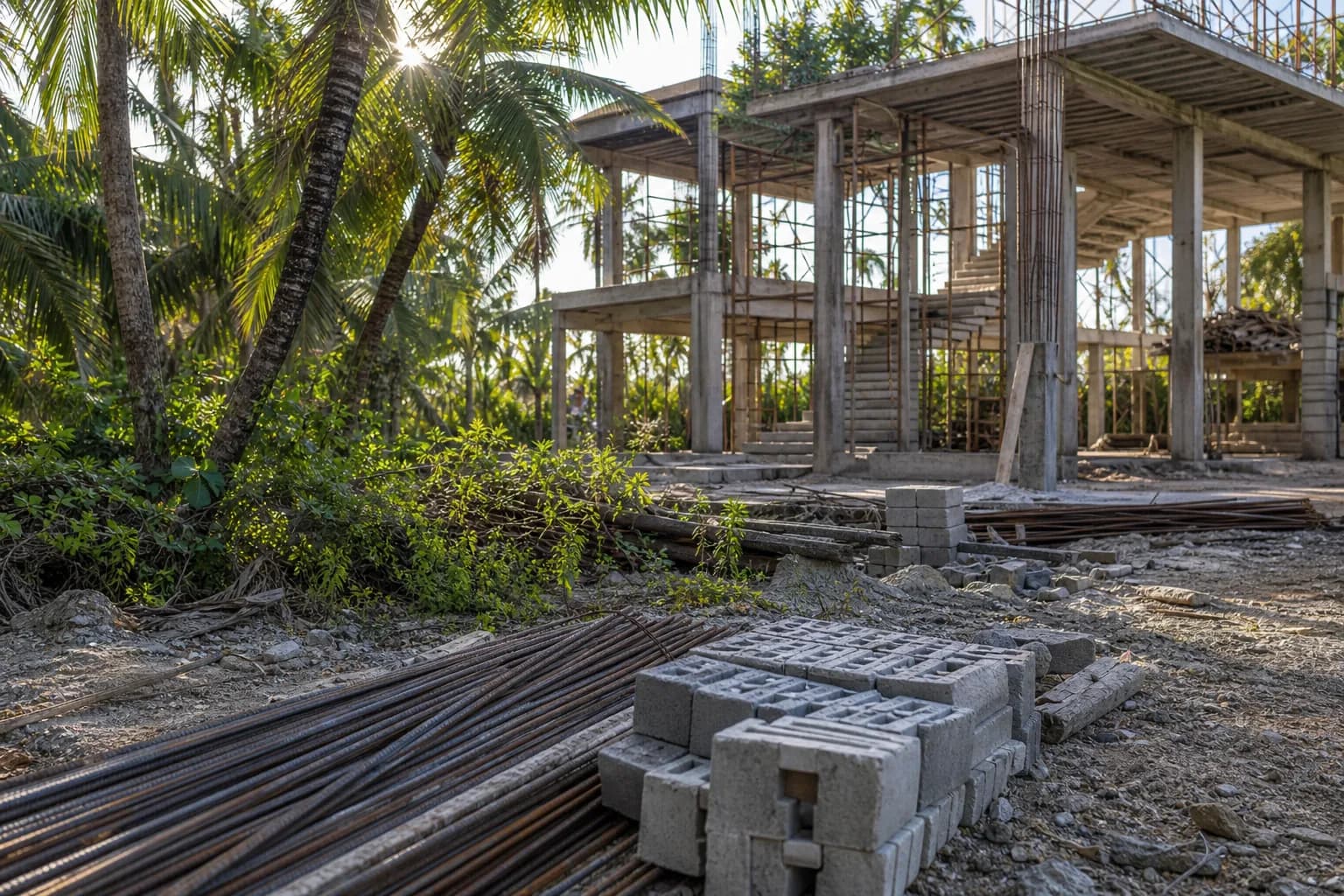
Off-plan is how a large share of Bali villas are sold in 2026: you commit to a villa that exists as renders and a floor plan, pay in stages while it is built, and take delivery one to two years later. The pitch is real — lower entry prices, modern product, payment spread over time. But the off plan villa Bali risks are equally real, and they concentrate in one place: from the moment your deposit leaves your account, your protection depends almost entirely on who is holding the money and what the contract says. This article explains why deposits vanish in failed Bali projects, what Indonesian law does and does not protect, and what genuine escrow and milestone protection look like in practice — so you can tell a structured project from a leap of faith.
Why off-plan deposits vanish: the structural problem
Start with the uncomfortable legal reality: Indonesia does not mandate third-party escrow for private off-plan villa sales the way some jurisdictions do for their residential markets. There is no default protected account your money must sit in, no statutory completion insurance, no automatic government backstop. Unless your contract creates protection, your staged payments typically go straight into the developer's operating account.
That produces a specific failure chain, seen repeatedly in Bali:
- The developer pre-sells units and uses buyer deposits as working capital — often not just for your villa, but to buy the next plot of land and fund the next launch.
- The model works only while new sales keep coming. When sales slow, costs overrun, or one project stalls, cash from newer buyers props up older obligations.
- When the music stops, construction halts. Your money is already spent — converted into someone else's half-built villa, marketing, or land the developer's company controls.
- In insolvency, you discover your legal position: an unsecured creditor. You hold a contract, not the land — the land title typically still sits with the developer's entity or the underlying landowner. Unsecured foreign buyers in Indonesian insolvency proceedings historically recover little, often after years.
Note what is absent from this chain: fraud. This is the honest failure mode. A developer who never intended to build — the render-only project — gets you to the same place faster.
The specific risks, itemised
- Developer insolvency: the big one, covered above. Your deposit becomes an unsecured claim.
- No land control: some projects are marketed before the developer has secured the land lease or title. If the land deal falls through, there is nothing to build on and nothing behind your contract.
- No building permit: construction started without a PBG (building approval) can be stopped or, in the worst case, demolished. "Permit in process" at sales stage is common; verify what actually exists.
- Delay without consequence: contracts drafted by developers often contain generous force-majeure language and no meaningful late-delivery penalty. Two-year delays with zero compensation are a standard buyer complaint.
- Specification downgrades: the render showed imported stone and a 12-metre pool; the contract annex says "or equivalent". You receive the equivalent.
- Leasehold clock ticking: on leasehold projects, your lease term usually starts before handover — every year of delay is a year of your 25–30 year term burned while the villa earns nothing.
- Resale trap: if you need out mid-construction, assignment clauses often require developer consent and fees, and the secondary market for half-built contracts is thin.
What escrow protection actually looks like
"Escrow" appears in a lot of Bali marketing decks. In practice it means something only if a specific mechanic exists in your signed documents. Genuine protection comes in three forms, in rising order of rarity:
- Notary-held funds. Your deposit sits in a notary's account and is released to the seller/developer only when contractual conditions are met — due diligence cleared, deed signed, or a construction stage verified. This is achievable in Bali today and should be your minimum for any reservation payment.
- Contractual escrow accounts. A dedicated account, sometimes with a bank, from which the developer draws against evidenced milestones. Check who verifies the milestone and whether you (or an independent QS) have inspection rights before release.
- True third-party escrow with independent certification. Funds released only against certification by an independent party. Rare in the Bali villa market — if a project genuinely offers this, it says something good about the developer.
Ask three questions of any "escrow" claim: Who legally controls the account? What exact event triggers each release? Who verifies that event, and do they answer to you or to the developer? If the answers are "the developer", "our schedule" and "us", it is not escrow — it is a payment plan with extra vocabulary.
Milestone payments: the protection that actually scales
The most robust and available protection in Bali is not exotic: it is making money follow verified work, never precede it by much. A staged, milestone-based schedule means your exposure at any moment is limited to roughly one stage of work — not the whole purchase price. Compare the two structures:
| Structure | Your exposure if the project stops halfway | Who carries the financing risk |
|---|---|---|
| Front-loaded (50–100% early) | Most of the price, as an unsecured claim | You |
| Milestone-based (pay per verified stage) | Roughly one stage of work | Shared — the builder funds work until each stage verifies |
This is how Teville structures every build: a typical six-stage schedule where each payment is tied to completed, verifiable construction progress, with remote clients receiving documented progress reports at each milestone. Most villas complete in 8–16 months on a milestone-tracked timeline. It is also why we publish transparent construction costs — $600–800/m² for Essential, $900–1,300/m² Premium, $1,400–2,000/m² Luxury in 2026, construction only, land separate — so the schedule you are paying against maps onto a budget you can sanity-check with the villa cost calculator.
The pre-payment verification list for any off-plan project
Before any non-refundable money moves, verify — independently, through your own notary and advisors:
- Land control: certificate check at the land office confirming the developer's entity holds (or validly leases) the actual plot, unencumbered.
- Permits: a PBG for this project, not a neighbouring one, not "in process". Zoning (ITR) that permits villas at this location — see our guides on zoning checks.
- Track record: completed, handed-over projects you can physically visit and owners you can speak to. A credible builder shows finished work, not only renders — that is what a real portfolio is for.
- The entity: which legal entity signs your contract, its registration, and whether it is the same entity that holds the land and permits. Shell-entity structures are a classic deposit-loss pattern.
- The contract: bilingual, notarised, with defined milestones, independent verification rights, late-delivery penalties, a specification annex with brands and dimensions, and a clear refund/assignment mechanism.
- The money path: deposits escrowed or notary-held; stage payments released against verified progress only.
A developer who resists this list is answering your real question. A serious counterparty has this file ready — asking for it is how professionals buy.
Off-plan from a developer vs building on your own land
One alternative deserves honest mention, because it restructures the risk rather than just mitigating it. When you lease a vetted plot in your own name and contract a builder to construct your villa, the land right is yours from day one — it never sits inside a developer's balance sheet. Your payments still follow milestones, but the thing being built belongs to you, on land you control, with a contract you negotiated. You give up the packaged convenience of a branded development; you gain direct ownership of both the land right and the process. Teville lists 100+ legally vetted leasehold plots and manages builds end-to-end, including for fully remote clients via power of attorney, which makes this route practical even if you are not in Bali.
How Teville fits in
Teville does not sell off-plan promises — we build villas as a general contractor on land you hold, with milestone-based payments, permit handling and a lifetime structural guarantee, so your money follows verified work from the first stage to turnkey handover. If you are comparing an off-plan offer against building on your own vetted plot, talk to us and we will give you the numbers to compare honestly.
FAQ: off-plan villa risks in Bali
Is buying off-plan in Bali ever safe?
It can be reasonable when the fundamentals verify: the developer's entity controls the land, a building permit exists for the specific project, previous projects were delivered and can be visited, payments are staged against verified milestones, and deposits sit in escrow or with a notary. Each missing element shifts real risk onto you. Price discounts do not compensate for missing fundamentals.
What happens to my deposit if a Bali developer goes bankrupt?
Usually you become an unsecured creditor of the developer's Indonesian entity, behind secured creditors, in proceedings that take years. Recovery for unsecured foreign buyers is typically partial at best. This is why the structure of payments matters more than the contract's promises: money that hasn't left escrow, or exposure limited to one construction stage, is protection that survives insolvency.
Does escrow exist for Bali property purchases?
Not by legal default — Indonesian regulation does not mandate escrow for private villa sales, so protection exists only where your contract creates it. Practical options are notary-held deposits and contractual escrow with milestone-based release. Always establish who controls the account, what triggers each release, and who independently verifies construction progress before funds move.
What should a fair off-plan payment schedule look like?
Staged against construction reality: a modest reservation/contract payment, then instalments released as verifiable milestones complete — foundations, structure, roof, MEP, finishes, handover. Teville uses a typical six-stage milestone schedule on builds that mostly run 8–16 months. Any schedule demanding the majority of funds before substantial construction exists is asking you to finance the developer unsecured.
Essential Bali build & buy guides
- Bali villa construction cost per m² in 2026
- How much will your villa cost? Calculator
- Building a villa in Bali: the complete guide
- Buying land in Bali: step-by-step for foreigners
- Bali villa investment: yields, risks, returns
- Leasehold vs freehold: what foreigners can own
- Construction defect liability & 10-year warranty
- Bali building codes and construction standards
Related guides

Why a Cheap Bali Leasehold Is Cheap: Pricing Red Flags Every Buyer Should Decode
Suspiciously cheap Bali leaseholds are priced low for a reason: short remaining terms, forbidden zoning, missing road access, disputes or weak contracts. How to decode the discount before you pay for it.
8 min read
Fake Compliance and Licensing Agents in Bali: The 2026 Paperwork Scam and How to Verify Documents
Forged certificates, permit fixers and fake notaries: how Bali's paperwork scams work in 2026 and how to verify every property document at its government source.
7 min read
Buying a Bali Villa from Instagram: Phantom Listings, Render-Only Projects and How to Verify
Instagram is Bali's biggest property shop window and its least verified. How phantom listings, render-only projects and cloned developer accounts work — and the verification steps that expose them.
7 min read