Bali Developer Bankruptcy: Early Warning Signs and What Deposit Recovery Really Involves
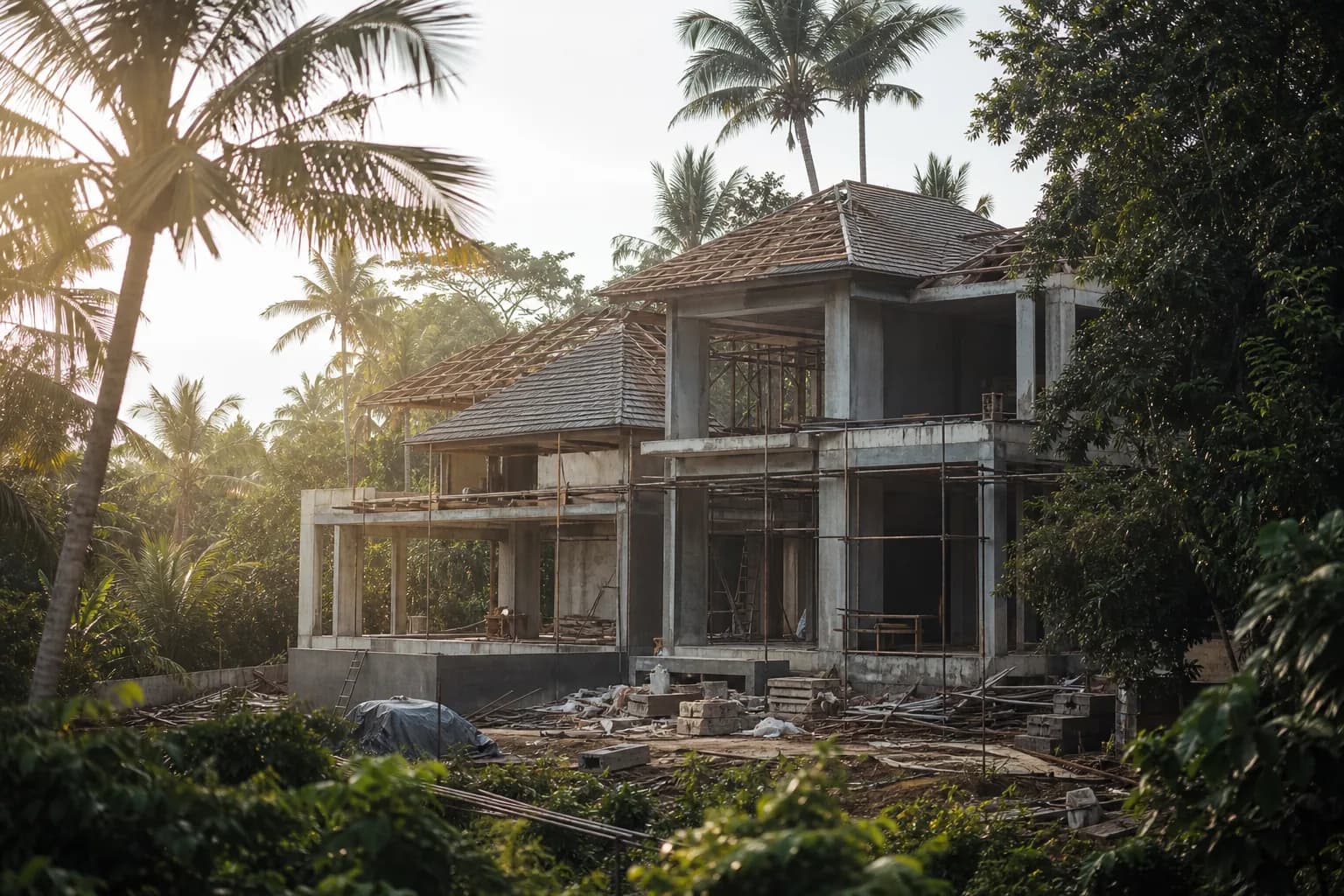
Bali developer bankruptcy is the risk nobody prices in when the render looks good and the payment plan looks easy. Yet it is the mechanism behind most of the island's worst buyer outcomes: not fraud in the criminal sense, but a legitimate company that ran out of money halfway through your villa. Because Bali's off-plan market has no statutory escrow and buyers usually rank as unsecured creditors, the difference between spotting distress early and spotting it late is often the difference between an exit and a write-off. This guide covers the early warning signs, what Indonesian insolvency law actually does, and what deposit recovery realistically involves in 2026.
Why developer failure is a structural risk in Bali
Most Bali villa projects are presale-funded: the developer sells units off-plan and uses incoming deposits as working capital. There is rarely bank construction financing behind the project, no bonding requirement, and no regulator monitoring whether sales money actually reaches the site. When sales are strong, this model works. When sales slow — or when one project's deposits quietly fund another project's overruns — the pipeline stalls, and the last buyers in are effectively lending the developer money with no security.
Indonesian private companies do not publish audited financial statements the way listed companies do. The public registries show that an entity exists, who its directors are and whether its licences are active — not whether it can pay its bills next quarter. That is why behavioural warning signs matter so much: they are usually the only financial disclosure you will get.
Bali developer bankruptcy: the early warning signs
Site activity slows before anything is said
Cash problems show up on-site months before they show up in communication. Watch for shrinking crews, idle scaffolding, materials that stop arriving, and "rain delays" that outlast the rain. A healthy site changes visibly every week. If you cannot visit, pay an independent inspector for a monthly photo report — it is the cheapest early-warning system available.
Subcontractors and suppliers stop being paid
Unpaid subcontractors are among the earliest public symptoms of developer distress, and in Bali word travels fast through the trades. Site workers, pool contractors and material suppliers will often tell an inspector things a sales office never will. Liens and walk-offs follow late payment quickly.
New projects launch while old ones stall
A developer that keeps announcing new launches while existing projects miss milestones is very often raising fresh deposits to cover old obligations. Overextension — starting new builds without finishing current ones — is a classic pre-failure pattern.
Aggressive discounting and payment "flexibility"
Sudden deep discounts, bonus furniture packages, or pressure to pay future milestones early "for a better price" signal a company buying short-term liquidity at any cost. Healthy builders do not need your month-nine payment in month four.
Communication degrades
Missed calls, unanswered emails, changing account managers and vague progress updates are rarely administrative accidents. Communication breakdown is consistently reported as the last stage before public failure.
Permit and paperwork gaps surface
Projects that started without a verified PBG building approval, or completed phases that cannot obtain an SLF, carry legal liabilities that surface exactly when money gets tight. Paperwork gaps and cash gaps tend to arrive together.
What happens legally when a developer fails
Indonesian insolvency runs under Law No. 37 of 2004, which provides two routes through the Commercial Court. PKPU (Penundaan Kewajiban Pembayaran Utang) is a court-supervised suspension of debt payments: the company gets a moratorium while it negotiates a restructuring plan with creditors, which can end in a court-ratified composition agreement. Kepailitan is full bankruptcy: the court declares the company bankrupt, appoints a curator (kurator), and the company's assets are liquidated to pay creditors in order of priority.
The uncomfortable part for villa buyers: unless your contract gave you registered security — which off-plan purchase agreements almost never do — you join the queue as an unsecured creditor, behind secured lenders and preferred claims. In practice, unsecured creditors in liquidations often recover only a small fraction of what they paid, sometimes nothing, and the process takes years. Whether your money went into the ground on your unit is largely irrelevant; what matters is what the contract says and what assets remain.
One nuance matters enormously: whose name is on the land. If you hold a properly notarised, registered lease over the plot in your own name, the land right may sit outside the developer's bankruptcy estate. If the developer holds the land and you merely hold a purchase agreement, the plot is an asset for the curator to sell. This single structural difference drives most good and bad outcomes.
What deposit recovery really involves
Recovery is possible, but every route costs money and time, and none is guaranteed. Realistic expectations look like this:
| Route | What it involves | Realistic outcome |
|---|---|---|
| Negotiated settlement | Lawyer-led pressure before formal insolvency; swap of deposit for land rights, another unit, or a repayment schedule | Best value-for-cost when the developer is distressed but still solvent |
| Civil claim for breach | Suing on the purchase agreement in Indonesian courts | Enforceable judgment, but slow — and worthless if the company is empty |
| PKPU petition | Creditors force restructuring through the Commercial Court | Can produce a payment plan; also risks tipping the company into liquidation |
| Bankruptcy claim | Registering your claim with the curator in liquidation | Unsecured creditors frequently recover a small fraction, after years |
| Criminal complaint | Police report where deception can be shown | Pressure tool; rarely returns money by itself |
Budget realistically for Indonesian counsel, translation and court fees, and understand that joining a creditor group with other buyers usually improves leverage and shares cost. Above all, act early: buyers who move at the first missed milestone consistently do better than those who accept a year of excuses first.
How to avoid being in the queue at all
- Separate the land from the builder. Lease the plot in your own name first, then contract construction on it. Teville structures projects this way: buyers secure one of the legally vetted plots in their own name, and construction is a separate milestone-based contract on land you already control.
- Pay only against verified progress. A staged schedule — Teville uses six milestones — means your maximum exposure at any moment is one stage, not the whole build. Model the stages against your budget with the villa cost calculator.
- Verify before the first transfer. Entity registration, land certificate at BPN, zoning, and the PBG building approval. Our guides walk through each document.
- Contract for failure. Delay penalties per day, a defect liability period, termination and refund mechanics, and — where the counterparty will accept it — notary-held or escrow-style payment arrangements for early stages.
- Prefer builders over presellers. A contractor paid to build on your land has a fundamentally different risk profile from a developer holding your money and the land. Compare finished work, not renders — a real portfolio is evidence.
FAQ: Bali developer bankruptcy
Can a foreign buyer file a claim in an Indonesian bankruptcy?
Yes. Foreign creditors can register claims with the curator and participate in PKPU or bankruptcy proceedings, normally through Indonesian counsel. The practical hurdles are proof — you need the notarised agreements and transfer records — plus translation, deadlines that come fast once proceedings open, and the economic reality that unsecured claims often recover little.
If my villa is half-built, do I own the half?
Usually not automatically. If the developer holds the land, the part-built structure is typically an asset of the bankruptcy estate, and your purchase agreement is a claim against the company, not a right to the building. If you hold the registered lease over the plot yourself, your position is far stronger — which is why land-first structures matter.
What is the single earliest warning sign?
Slowing site activity combined with new project launches. A developer who is genuinely busy finishes what is started; one who is genuinely short of cash keeps selling futures. If weekly progress photos stop showing change while the marketing pipeline accelerates, escalate immediately — request a site meeting and milestone evidence in writing.
Does a construction moratorium make bankruptcy risk worse?
It can. Bali's provincial government has moved since late 2025 to restrict new tourism-accommodation construction in several saturated districts, and projects caught without approved permits face delays that stress weak balance sheets. Verify a project's permit status for its specific zone rather than relying on developer assurances that restrictions "don't apply here".
How Teville fits in
Teville's model was designed against exactly this failure mode: you hold the vetted land in your own name, construction runs on a six-stage pay-as-built schedule over 8–16 months, and the structure carries a lifetime guarantee. If you are assessing a project — ours or anyone's — contact us and we will tell you honestly what we would check first.
Essential Bali build & buy guides
- Bali villa construction cost per m² in 2026
- How much will your villa cost? Calculator
- Building a villa in Bali: the complete guide
- Buying land in Bali: step-by-step for foreigners
- Bali villa investment: yields, risks, returns
- Leasehold vs freehold: what foreigners can own
- Construction defect liability & 10-year warranty
- Bali building codes and construction standards
Related guides

Why a Cheap Bali Leasehold Is Cheap: Pricing Red Flags Every Buyer Should Decode
Suspiciously cheap Bali leaseholds are priced low for a reason: short remaining terms, forbidden zoning, missing road access, disputes or weak contracts. How to decode the discount before you pay for it.
8 min read
Fake Compliance and Licensing Agents in Bali: The 2026 Paperwork Scam and How to Verify Documents
Forged certificates, permit fixers and fake notaries: how Bali's paperwork scams work in 2026 and how to verify every property document at its government source.
7 min read
Buying a Bali Villa from Instagram: Phantom Listings, Render-Only Projects and How to Verify
Instagram is Bali's biggest property shop window and its least verified. How phantom listings, render-only projects and cloned developer accounts work — and the verification steps that expose them.
7 min read