Moving to Bali: Rent vs Buy vs Build in 2026 — Break-Even Math and an Honest Framework
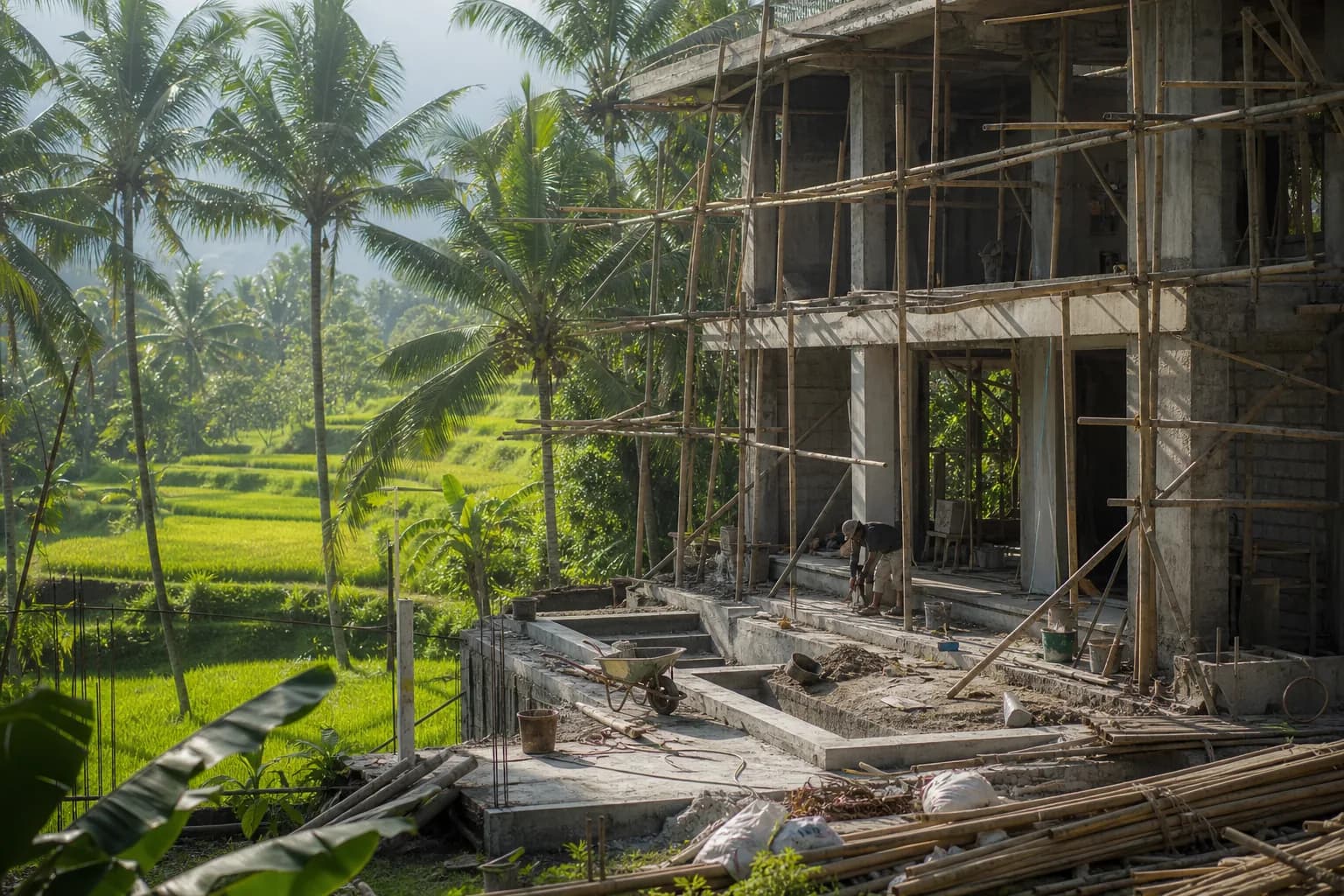
If you are moving to Bali, the rent vs buy question arrives fast — usually somewhere around the second year, when you realize how much you've transferred to a landlord and how long you actually plan to stay. The honest answer is that renting, buying an existing villa, and building your own each win under different conditions, and the deciding variables are ones you can actually estimate: how long you'll stay, how much certainty you have, and how much control you want over the asset.
This guide lays out the 2026 numbers for all three paths, a break-even framework you can adapt to your own case, and the failure modes of each — because the expensive mistake is not picking the "wrong" option, it's picking any option for the wrong length of stay.
Rent vs buy in Bali: the 2026 numbers
Start with what each path costs today.
Renting. Long-term villa rentals in Bali typically run about IDR 15–35 million per month (roughly $900–2,200) on a 12-month lease, with prime Canggu at or above the top of that range. Yearly contracts in Canggu start around IDR 170 million for a 2-bedroom villa, with larger 4–5 bedroom family villas from roughly IDR 480 million per year in sought-after pockets; Uluwatu spans widely, from about IDR 17 million monthly inland to IDR 60 million for premium clifftop homes. Yearly leases are normally paid entirely upfront — Bali's rental market front-loads cash even for tenants.
Buying an existing villa. Foreigners overwhelmingly buy leasehold — typically 25–30 years, extendable. You pay for the remaining lease term plus the building; prices vary enormously by area, remaining years, and build quality. What matters for this comparison: buying converts roughly 8–15+ years of prepaid rent into an asset you control, but demands due diligence on the lease, permits, and construction quality.
Building. You lease vetted land and construct exactly the villa you want. Construction in 2026 costs $600–800/m² at essential specification, $900–1,300/m² premium, and $1,400–2,000/m² luxury (construction only — land is separate), with most builds taking 8–16 months. Land pricing varies sharply: 2026 market surveys put prime Canggu land asking prices several times higher per are than Uluwatu or emerging areas, which is why the same villa budget buys very different addresses.
The break-even math, honestly done
Here is an illustrative comparison for a 3-bedroom villa in a good (not ultra-prime) location. Your numbers will differ — the structure of the math won't.
| Factor | Rent | Buy (leasehold) | Build (leasehold) |
|---|---|---|---|
| Cash out, year one | ~$20–35k (year paid upfront) | Full price at closing | Land lease + construction begins (milestone payments) |
| Years 2–10 annual cost | Rent, rising with the market | Holding costs only (maintenance, staff, taxes, utilities) | Holding costs only after handover |
| Asset at year 10 | Nothing | Remaining lease term + building, sellable | Remaining lease term + newer building, sellable |
| Flexibility | Leave any year-end | Resale takes months | Resale takes months; build takes 8–16 months first |
| Control over quality | None | Limited — you inherit the build | Full — specification, layout, permits from day one |
The intuition: if a villa rents for $25,000 a year and a comparable build (land lease plus construction) totals around $200,000–250,000, then ignoring appreciation and rental income, ownership costs converge with cumulative rent somewhere around eight to ten years. Three things swing that break-even earlier: rent inflation in popular areas (renters absorb it, owners don't), the option to rent your villa out when you travel — well-run Bali villas have historically netted around 7–12%, market context rather than a guarantee — and building at construction cost instead of buying at retail, since a developer's margin sits inside every finished-villa price. One thing swings it later: leaving early. Own for three years and transaction costs plus an illiquid exit can easily erase the theoretical savings.
Run your actual scenario — your area, size, and specification — through the villa cost calculator and put real numbers where this example uses placeholders.
When renting is the right answer
- You've been on the island under a year. Bali neighborhoods differ radically — Canggu, Pererenan, Uluwatu, Ubud, and Sanur are different lives, not different postcodes. Rent first, learn where you actually spend your time.
- Your horizon is under ~3–5 years or genuinely uncertain. Visas, work, family — if a move away is plausible, the flexibility premium of renting is worth paying.
- You don't have comfortable liquidity. Bali property is effectively a cash market for foreigners; stretching to buy leaves no buffer for the holding costs and surprises ownership brings.
Renting's real cost is compounding: rents in popular areas have risen substantially in recent years, and every yearly renewal is repriced to the current market. Renters fund the island's landlords; that's fine as a fee for flexibility — as long as you're aware you're paying it.
When buying an existing villa wins
- You know your area and your horizon is 5+ years. The math starts favoring ownership, and you're buying certainty over your housing costs.
- You want to move in now, not in 8–16 months — the one advantage an existing villa always has over building.
- You find a genuinely well-built villa with a long lease. They exist. So do beautifully staged villas with 12 years left, no SLF, and waterproofing that fails the first rainy season. The difference is invisible at a viewing and decisive over a decade — due diligence on the lease, permits, and construction is the entire game, and our buyer guides cover it step by step.
When building beats both
Building is the answer when your horizon is long, your requirements are specific, and you'd rather pay construction cost than someone's resale margin. You choose the plot — location, zoning, orientation — from options like Teville's catalog of 100+ legally vetted leasehold plots, each checked on certificate, zoning, and ownership chain. You set the specification: rental-optimized layout, energy efficiency, family needs. You get a full lease term from day one instead of inheriting a shortened one, permits done correctly from the start, and — with milestone-based payments — you pay as verified work progresses rather than handing over the full price on faith.
The trade-offs are real: you wait 8–16 months, you make decisions (or delegate them), and you need a contractor you can trust — especially if you're managing the build from abroad, which is routine with the right reporting structure and Power of Attorney arrangements. Browse the portfolio to calibrate what different specification tiers actually look like built.
A decision framework that survives contact with reality
- Year 0–1 in Bali: rent, almost regardless of wealth. You're buying information about where and how you want to live.
- Horizon under 3 years or uncertain: keep renting. The flexibility is worth more than the equity.
- Horizon 5+ years, area chosen, funds ready: own. Buy if you find a rigorously vetted existing villa with a long lease that fits; build if you want full control, a full lease term, and construction-cost economics.
- Whatever you choose, underwrite the exit: lease length, permits, and build quality determine what you can sell later — decide with the year-10 version of yourself in mind.
How Teville fits in
Teville is a general contractor, not a portal: land sourcing with full legal vetting, architecture, PBG/SLF permits, construction on a 6-stage milestone schedule, and turnkey furnished delivery with a lifetime structural guarantee — manageable entirely from abroad. If you've done your renting year and the math points to building, talk to the team about plots and numbers for your scenario.
FAQ: rent vs buy in Bali
How long should I rent in Bali before buying?
At least six to twelve months, across at least one full rainy season. That's long enough to learn which area fits your life, how traffic reshapes distances, and what a neighborhood feels like in low season. Buyers who skip this stage most often end up owning in the wrong area — an expensive preference to discover after closing.
What does it cost to rent a villa long-term in Bali in 2026?
Typical long-term villa rentals run about IDR 15–35 million per month ($900–2,200) on yearly contracts, usually paid upfront for the year. Canggu sits at the top of that range — 2-bedroom villas from roughly IDR 170 million per year — while Uluwatu and less central areas span from well below to well above depending on position and quality.
Can foreigners actually buy property in Bali?
Foreigners can't hold freehold, but they can hold long leaseholds — typically 25–30 years with extension rights — or use recognized structures such as a foreign-owned company for building-use rights. Leasehold is by far the most common route and is fully sellable. The essentials are proper notarial documentation and due diligence on the certificate, zoning, and ownership chain.
Is it cheaper to build than to buy a villa in Bali?
Per square meter, usually yes: building at 2026 construction costs of $600–2,000/m² (by specification tier) plus a land lease generally undercuts buying an equivalent finished villa, because resale prices include a developer's margin. The trade is time — 8–16 months of construction — and the need for a contractor with verifiable track record, milestone payments, and permits handled properly.
Essential Bali build & buy guides
- Bali villa construction cost per m² in 2026
- How much will your villa cost? Calculator
- Building a villa in Bali: the complete guide
- Buying land in Bali: step-by-step for foreigners
- Bali villa investment: yields, risks, returns
- Leasehold vs freehold: what foreigners can own
- Construction defect liability & 10-year warranty
- Bali building codes and construction standards
Related guides
North Bali Airport and Property Prices: What It Really Means for Lovina and Amed
A fact-first 2026 look at the North Bali airport project — what is confirmed versus announced — and what it genuinely means for land prices and buying decisions in Lovina, Kubutambahan and Amed.
7 min read
Where to Buy or Build a Villa in Bali in 2026: Area-by-Area Comparison
An honest 2026 comparison of Bali's five main buying areas — Canggu, Pererenan, Uluwatu, Ubud and Sanur — with indicative land prices, demand profiles, zoning risks and who each area actually suits.
7 min read
Building a Villa in Lombok or Sumba vs Bali: Construction Costs Compared (2026)
Land is cheaper on Lombok and Sumba — but is building there? Real 2026 construction cost comparison across Indonesia's villa islands: materials, labour, logistics and the numbers that surprise people.
3 min read