Airbnb in Bali Under the 2026 Permit Rules: Delisting Enforcement and What Hosts Must Have in Place

The Airbnb Bali rules in 2026 mark the year short-term rental regulation on the island grew teeth. Indonesia's Ministry of Tourism coordinated directly with major online travel platforms — Airbnb and Booking.com among them — to require that listed properties hold a verified NIB (Nomor Induk Berusaha, the national business identification number) with the correct business classification, with a compliance deadline of March 31, 2026. Platforms began collecting registration details from hosts in early 2026, and operators verified as unlicensed face removal from partner platforms in the enforcement wave that followed.
For anyone who owns or plans to build a rental villa, this is not a reason to panic — it is a reason to structure properly. This guide explains what changed, what a host must have in place, how enforcement actually works, and what it means for buyers weighing a rental-focused build. For the economics side, start with our villa cost calculator and guides.
What the 2026 Airbnb Bali rules actually require
Strip away the headlines and the requirement stack looks like this:
- A registered business with an NIB. Every commercially rented property must sit on a business registered in Indonesia's OSS (Online Single Submission) system, evidenced by an NIB. Platforms now ask hosts for this number and verify it.
- The correct KBLI business classification. The NIB must carry a business activity code that actually covers villa or short-stay accommodation — a registration for an unrelated activity does not qualify. Classification codes were updated recently, so have a consultant confirm your registration carries the current correct code rather than copying one from an old blog post.
- A tourism accommodation license appropriate to the operation. Small owner-operated homestay-style rentals use the pondok wisata regime; commercial villa rentals — including anything foreign-owned — require licensing through a company. Foreigners cannot personally hold a pondok wisata license.
- Tax registration and payment. Local tax registration, collection and remittance of regional hotel/accommodation tax on stays, and income or corporate tax on the earnings.
- Building compliance. The building itself needs its permit and function documentation in order (PBG building approval and SLF function certificate under the current regime) — a licensing application exposes a building that was never permitted.
None of these requirements is individually new. What is new in 2026 is verification at the platform level: the Ministry of Tourism maintains a register of compliant operators and shares data with the platforms, so an unlicensed listing is now visible to the regulator by default.
The timeline: deadline, then delisting
The sequence that matters to hosts:
- Early 2026: platforms began requesting NIB and business-classification details from hosts on Bali listings.
- March 31, 2026: the coordinated compliance deadline — listings were expected to show verified registration by this date.
- From mid-2026: enforcement moved to removal. Authorities announced that operators verified as unlicensed — reported at around 1,600 in the first tranche — face delisting from the partner platforms from August 2026.
Two clarifications the government itself has made. First, this is not an "Airbnb ban" — officials explicitly stated there is no ban on the platforms; the target is unregistered operators, not the channel. Second, enforcement is iterative: the first delisting wave targets verified non-compliant listings, and the register keeps growing. Betting on being missed is a strategy with a shortening lifespan.
What non-compliance costs
The consequences ladder, roughly in order of likelihood:
- Delisting. Removal from the platforms that generate most bookings — for many villas this is economically equivalent to closure.
- Fines and closure orders. Regional enforcement against unlicensed accommodation has produced substantial fines and forced closures; in high-profile cases involving illegal construction, buildings have been demolished — as happened with dozens of structures at Bingin Beach in 2025.
- Tax exposure. Back taxes with penalties once an operation surfaces in the registry data.
- Immigration consequences for foreigners. A foreigner running an unlicensed rental business risks violating both business and immigration rules — deportation and re-entry bans have been applied in enforcement cases.
Set against these, the cost of compliance — company maintenance, licensing, accounting — is real but bounded, and it buys something valuable: unlicensed competitors are being removed from the market you operate in.
The compliant path for a foreign owner
For a foreigner who owns (or is building) a Bali villa and wants to rent it short-term legally, the standard route is:
| Step | What happens | Notes |
|---|---|---|
| 1. Structure | Establish or use a PT PMA (foreign-owned Indonesian company) | The company, not you personally, operates the rental; capital requirements apply — confirm current thresholds with your consultant |
| 2. Register | Obtain NIB via OSS with the correct accommodation classification | The classification must match villa/short-stay accommodation |
| 3. License | Secure the tourism accommodation license and any risk-based permits for the operation | Requirements scale with operation size and risk category |
| 4. Building docs | Ensure PBG/SLF are in place for the building | Impossible to fix retroactively without cost if the villa was built informally — build permitted from day one |
| 5. Tax | Register for national and regional taxes; collect and remit accommodation tax on stays | Ongoing monthly/annual filings |
| 6. Platform verification | Submit NIB and details to Airbnb/OTAs | Keep registry details current |
An alternative some owners use: lease the villa to an already-licensed operator or management company, which lists it under its own licensed business. This outsources compliance but hands over margin and control — read the contract carefully, and confirm the operator's licensing is genuinely in order rather than assumed.
One more structural point: compliance starts with the land and the building. A villa on properly zoned land with a clean lease and full building permits can be licensed; a villa in the wrong zone, or built without permits, may simply be unlicensable at any price. This is why every plot we list on our land catalog is checked for zoning designation before it reaches a client, and why we build with PBG and SLF as part of the standard process.
What this means for buyers and builders in 2026
Counterintuitively, the enforcement wave is good news for anyone planning a legitimate rental villa:
- Less competing supply. Bali's short-term market had become saturated with informal listings. Every delisted operator shifts demand toward compliant villas.
- Compliance is now a valuation factor. A villa with clean land documents, permits and an operating license is worth more — to guests, to lenders of any kind, and to a future buyer — than an identical villa without them.
- Retrofitting is expensive; building right is not. Getting permits and licenses for a correctly built villa on correctly zoned land is process work. Legalizing an informally built villa in a questionable zone ranges from costly to impossible.
- Model license overhead into yields. Company maintenance, accounting and licensing add fixed annual costs — small relative to a well-performing villa's revenue, meaningful for a marginal one. Well-run Bali villas have historically netted around 7–12%; compliance costs are part of getting to a realistic net figure, not a footnote.
If you are choosing between buying existing stock and building, ask every seller for the NIB, license and building documents before discussing price. Silence answers the question. Our portfolio shows what purpose-built, fully documented rental villas look like in practice.
How Teville fits in
Teville builds villas that can actually be licensed: legally vetted land with confirmed zoning, full PBG/SLF permitting as part of the build, turnkey delivery, and optional rental setup so the operating side starts compliant. If you want a rental villa that survives 2026-era enforcement rather than dodges it, talk to our team.
If you are weighing the numbers, our villa cost calculator gives an instant range based on real 2026 build rates, the land catalog lists legally vetted leasehold plots, and the villa concepts show what different budgets actually buy. More practical guides live in the Bali construction library.
FAQ: Airbnb rules in Bali 2026
Is Airbnb banned in Bali in 2026?
No. The government has explicitly stated there is no ban on Airbnb or other booking platforms. What changed is enforcement: listings must sit on a verified registered business with the correct classification and licensing, and operators verified as unlicensed face removal from the platforms. Compliant hosts continue operating normally — with less informal competition than before.
Can I run an Airbnb in Bali as a foreigner?
Yes, legally — through an Indonesian company. Foreigners cannot personally hold the small-scale homestay (pondok wisata) license, so the compliant route is a PT PMA holding an NIB with the correct accommodation classification and the appropriate tourism license, with tax registration in place. Alternatively, you can lease your villa to an already-licensed operator who lists it under their business.
What happens if my listing has no NIB after the deadline?
Platforms coordinate with the Ministry of Tourism's registry, and listings verified as non-compliant face delisting — the first enforcement tranche covered roughly 1,600 operators identified as unlicensed. Beyond delisting, unlicensed operation risks fines, closure orders, back taxes, and for foreign operators immigration consequences. The registry grows over time, so early compliance beats waiting.
My villa was built without full permits — can I still get licensed?
Often not without fixing the underlying problem first. Licensing exposes the building's documentation, so missing building approval (PBG) or function certification (SLF), or land in a zone that does not permit tourism accommodation, can block the application entirely. Have a consultant assess regularization options honestly before spending on licensing — and if you are still choosing land, verify zoning before you sign anything.
Essential Bali build & buy guides
- Bali villa construction cost per m² in 2026
- How much will your villa cost? Calculator
- Building a villa in Bali: the complete guide
- Buying land in Bali: step-by-step for foreigners
- Bali villa investment: yields, risks, returns
- Leasehold vs freehold: what foreigners can own
- Construction defect liability & 10-year warranty
- Bali building codes and construction standards
Related guides

Bali Villa Management Companies: Fee Structures, Contract Clauses, and How to Stay in Control
Villa management in Bali typically costs 15–25% of gross rental income — but OTA commissions, maintenance reserves and add-ons push the real erosion past 40%. How fee models work, which contract clauses protect you, and how to choose and control a manager.
8 min read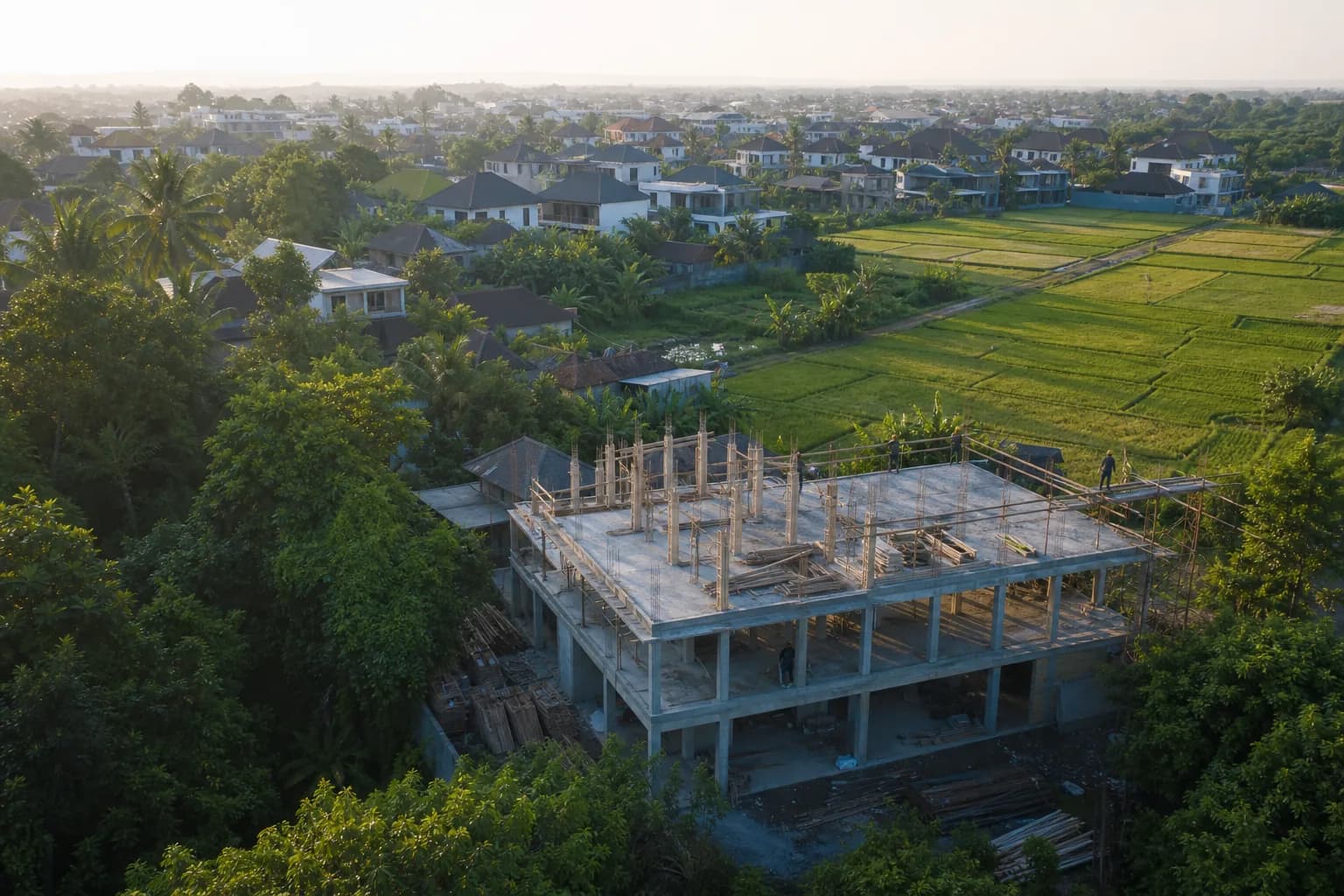
Bali Villa Oversupply in 2026: What Canggu's Saturation Means for Buyers — and Where Demand Holds
Bali's short-term villa inventory has grown far faster than demand, and generic properties in Canggu are feeling it. An honest look at what oversupply means for buyers in 2026 — and where, and how, villas still perform.
7 min read
Short-Term vs Long-Term Rental Strategy in Bali 2026: Gross vs Net, Seasonality, Regulation Risk
Short-term rentals in Bali promise higher headline income, but 2026 licensing rules, oversupply and operating costs change the math. A direct comparison of both strategies, with real numbers and a framework for choosing.
9 min read