Bali Villa Oversupply in 2026: What Canggu's Saturation Means for Buyers — and Where Demand Holds
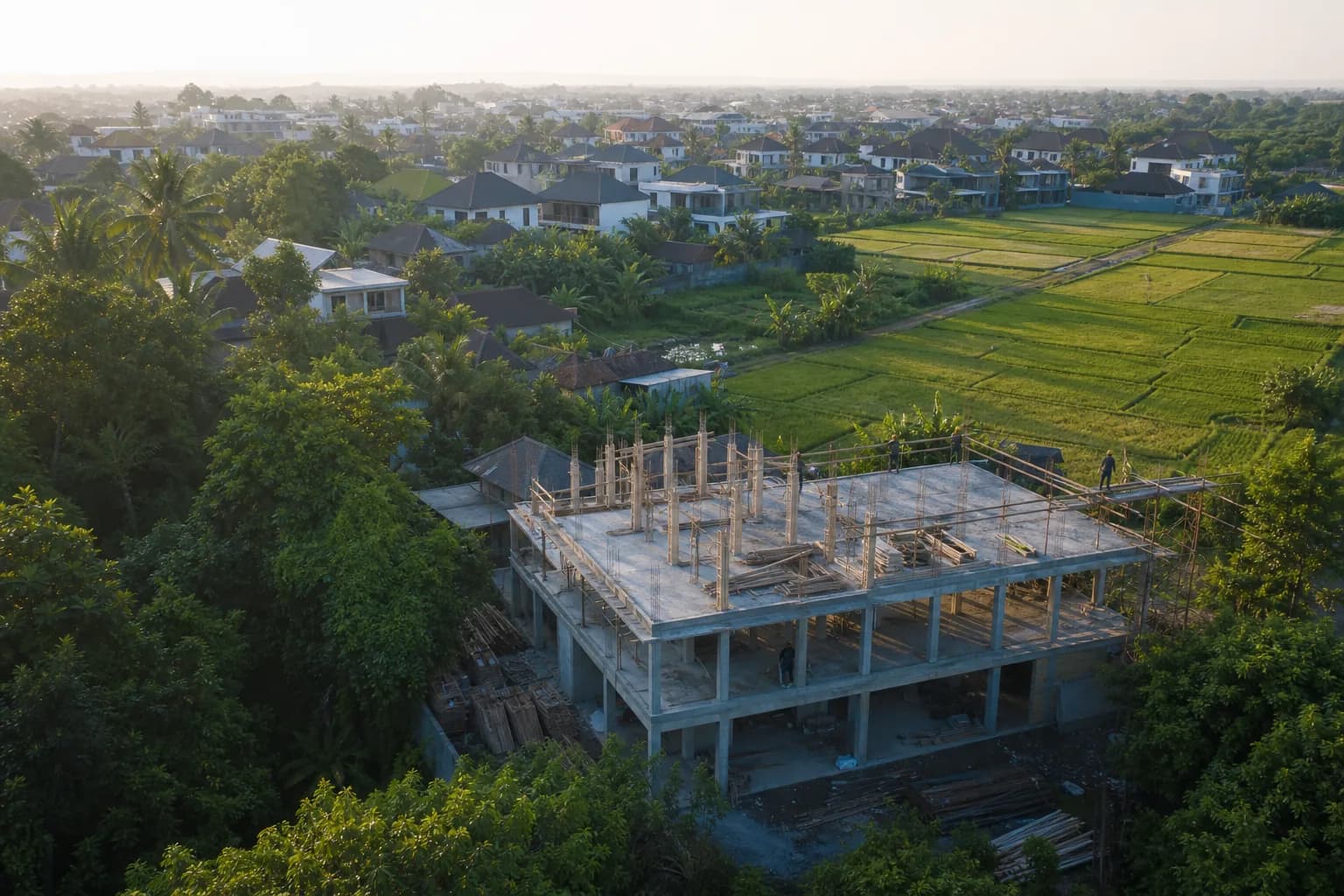
Bali villa oversupply stopped being a contrarian talking point in 2026 — it is now visible in the data. The island's short-term rental inventory has grown by more than 35% in three years, listings have kept climbing at double-digit annual rates, and tens of thousands of active short-term listings now compete for a tourist base that is growing far more slowly. In the most saturated pockets of Canggu, generic villas have seen occupancy fall toward the 40s while their owners discount 10–30% to stay booked.
Does that mean the Bali villa story is over? No — but it means the era of "buy anything, list it, collect 15%" is over. This article looks honestly at what oversupply is, where it bites, where demand still holds, and how a buyer in 2026 should adjust. It is exactly the kind of market context we think buyers deserve before they look at land or a construction budget.
Bali villa oversupply in numbers
The supply side is straightforward. Construction boomed from 2021 onward as post-pandemic tourism roared back and social media turned Bali villas into a global investment meme. The result by 2026:
- Island-wide short-term rental inventory up more than a third in three years, with recent listing growth still in the high teens year on year.
- Over 38,000 active short-term listings across the island by recent counts.
- Canggu and its surroundings absorbing a disproportionate share of new stock — some operators there report listing growth above 40% year on year.
Demand has grown too — Bali's tourist arrivals have continued to rise — but demand growth in the low-to-mid single digits cannot absorb supply growth in the double digits. The difference shows up as yield compression: lower occupancy, discounted rates, or both.
What saturation actually looks like in Canggu
Canggu is the case study because it had the steepest supply curve. The pattern in 2026:
- Occupancy split in two. Island-wide annual occupancy for average villas has fluctuated around 60–66%, but the average hides a widening gap. Well-managed, well-designed villas in strong micro-locations still reach 70–80%. Generic properties — the two-bedroom white-box villa with the same plunge pool as five hundred others — have dropped to 45–60% in shoulder seasons, and in the most saturated Canggu pockets median occupancy for undifferentiated stock has fallen to around 43%.
- Discount wars. To hold occupancy, many owners now price 10–30% below where comparable villas sat a few years ago. Discounting fills nights but destroys the yield assumptions those villas were bought on.
- Micro-location divergence. Within Canggu itself, walkable streets near Batu Bolong or Berawa beach still outperform, while villas 15 minutes inland by scooter compete purely on price.
None of this means Canggu is finished — it remains one of the deepest demand pools in Bali for both guests and long-term tenants. It means Canggu no longer forgives mediocre product.
Why oversupply punishes some villas and not others
Oversupply is not evenly distributed across property types. The pressure concentrates where supply is easiest to add: small generic villas. The 1–3 bedroom segment is where most new stock landed, so that is where competition is fiercest and rates have fallen hardest. Meanwhile several categories still see demand outrun supply:
- Larger villas (4+ bedrooms) for families and groups — harder to build, scarcer, and booked by guests who compare against hotels, not against other cheap villas.
- Genuinely designed properties — architecture, view, privacy and indoor-outdoor flow that photograph distinctively. In a feed of identical listings, differentiated product keeps pricing power.
- Licensed, professionally run villas. The 2026 platform-compliance push (verified business registration required for short-term listings, with delisting enforcement for unlicensed operators) is actively removing part of the competing supply. Compliant owners inherit that demand.
- Long-term rentals. Expat and remote-worker demand keeps long-term vacancy in prime areas in the mid single digits — oversupply is largely a short-term-rental phenomenon.
Where demand still holds in 2026
Geographically, the picture is a gradient, not a cliff. Broad strokes as of 2026:
| Area | Supply pressure | Demand picture for buyers |
|---|---|---|
| Canggu core (Batu Bolong, Berawa) | High | Deep demand but brutal competition; only strong product and micro-location win |
| Pererenan, Seseh, Cemagi | Rising | Absorbing Canggu's overflow of quality-seeking guests; still rewards early, well-designed builds |
| Uluwatu / Bingin / the Bukit | Moderate | Cliff and surf demand holds; licensed, view-led properties outperform |
| Ubud and surroundings | Moderate | Wellness and retreat demand distinct from beach market; less exposed to Canggu saturation |
| Sanur, east coast | Lower | Steadier, less speculative; family and long-stay demand |
| North and far east (Lovina, Amed) | Low | Cheap land but thin rental demand today — a land play, not a cash-flow play |
Treat this as orientation, not gospel — conditions vary street by street, and the right answer depends on your goals. What has become universally true: the location decision now matters more than at any point in Bali's modern property cycle, which is why every plot in our land catalog goes through zoning and legal due diligence before we list it.
What oversupply means for you as a buyer
Practical implications, in order of importance:
- Stress-test every projection. If a seller's pro-forma assumes 80% occupancy at premium rates in a saturated area, cut it and see if the deal survives. Model 55–65% occupancy and a 15% rate haircut. If it still works, you have margin. Well-run Bali villas have historically netted around 7–12% — anyone projecting far above that range in 2026 should be able to show you audited numbers.
- Buy or build differentiated product. The market pays for design, privacy, views and larger formats. It no longer pays for "a villa." Study what actually stands out — our portfolio shows the design directions we push clients toward and why.
- Consider building over buying finished stock. Much of the resale market is precisely the generic product that oversupply punishes, often priced on yesterday's yields. Building lets you choose an undersupplied format and micro-location at 2026 construction costs — roughly $600–800/m² essential, $900–1,300/m² premium, $1,400–2,000/m² luxury (construction only) — instead of paying a developer's markup on a compromised layout.
- Value licensing and operations. Compliance is now a moat. A properly licensed villa with professional management competes in a smaller pool.
- Think beyond nightly rentals. Long-term and monthly-stay demand remains strong. A villa designed to serve both markets carries less strategy risk.
Is oversupply a reason not to buy in Bali?
It is a reason not to buy carelessly. Property cycles like this one typically end the same way: weak product built on borrowed assumptions underperforms and eventually reprices, while scarce, well-located, well-run assets keep earning through the shakeout. Bali's underlying demand drivers — tourism growth, remote-work migration, a limited supply of genuinely prime coastal and view land — have not gone away.
The honest conclusion for 2026: average expectations should come down, and the gap between good and mediocre decisions has widened. That rewards buyers who do real due diligence on land, zoning and rental comparables — and punishes those who buy from an Instagram rendering. Our guides cover the due-diligence side in detail.
How Teville fits in
Teville builds villas on legally vetted land with fixed milestone payments — and in an oversupplied market, our job is increasingly to talk clients out of generic product and into locations and designs that hold demand. If you want a build strategy grounded in 2026 market reality rather than 2022 hype, get in touch.
If you are weighing the numbers, our villa cost calculator gives an instant range based on real 2026 build rates, the land catalog lists legally vetted leasehold plots, and the villa concepts show what different budgets actually buy. More practical guides live in the Bali construction library.
FAQ: Bali villa oversupply
Is the Bali villa market really oversupplied in 2026?
In parts, yes. Short-term rental inventory has grown more than 35% in three years — far faster than tourist demand — and the pressure concentrates in saturated pockets like central Canggu and in the generic 1–3 bedroom segment, where occupancy and rates have fallen. Larger, differentiated, well-located and properly licensed villas continue to perform well.
Should I avoid Canggu completely?
No, but you should stop treating "Canggu" as one market. Walkable core streets with strong micro-locations still command premium occupancy; inland, undifferentiated villas compete on price alone. If you buy or build in Canggu in 2026, the product must be distinctly better than the median listing — otherwise neighboring areas like Pererenan or a different strategy may serve you better.
What occupancy should I assume in my projections?
For a quality, professionally managed villa in a good location, 60–70% is a defensible planning assumption; well-run properties in prime spots reach 70–80%. For generic stock in saturated areas, recent medians have dropped toward 43–55%. Always model a downside case with lower occupancy and discounted rates before committing capital.
Does oversupply make building a villa a bad idea?
The opposite, if done right: building lets you target exactly the formats and locations that remain undersupplied — larger villas, distinctive design, emerging coastal areas — instead of buying resale stock that competes with thousands of near-identical listings. The build only makes sense on properly zoned, legally vetted land with realistic yield assumptions.
Essential Bali build & buy guides
- Bali villa construction cost per m² in 2026
- How much will your villa cost? Calculator
- Building a villa in Bali: the complete guide
- Buying land in Bali: step-by-step for foreigners
- Bali villa investment: yields, risks, returns
- Leasehold vs freehold: what foreigners can own
- Construction defect liability & 10-year warranty
- Bali building codes and construction standards
Related guides
Short-Term vs Long-Term Rental Strategy in Bali 2026: Gross vs Net, Seasonality, Regulation Risk
Short-term rentals in Bali promise higher headline income, but 2026 licensing rules, oversupply and operating costs change the math. A direct comparison of both strategies, with real numbers and a framework for choosing.
9 min read
Pondok Wisata License in Bali: Requirements, Costs and 2026 Enforcement for Short-Term Rentals
The Pondok Wisata is Bali's homestay licence — capped at five rooms and reserved for Indonesian citizens. Here is what it actually covers, why foreigners need a different route, and how 2026 enforcement and OTA delisting changed the stakes.
7 min read
Bali Villa Rental Income in 2026: Real Numbers by Area and Honest Net-Yield Math
What a Bali villa actually earns in 2026: nightly rates and occupancy by area, the oversupply pressure squeezing average properties, and a worked example from gross revenue down to honest net yield.
7 min read