Porcelain Tile Adhesive for Bali Pool Decks
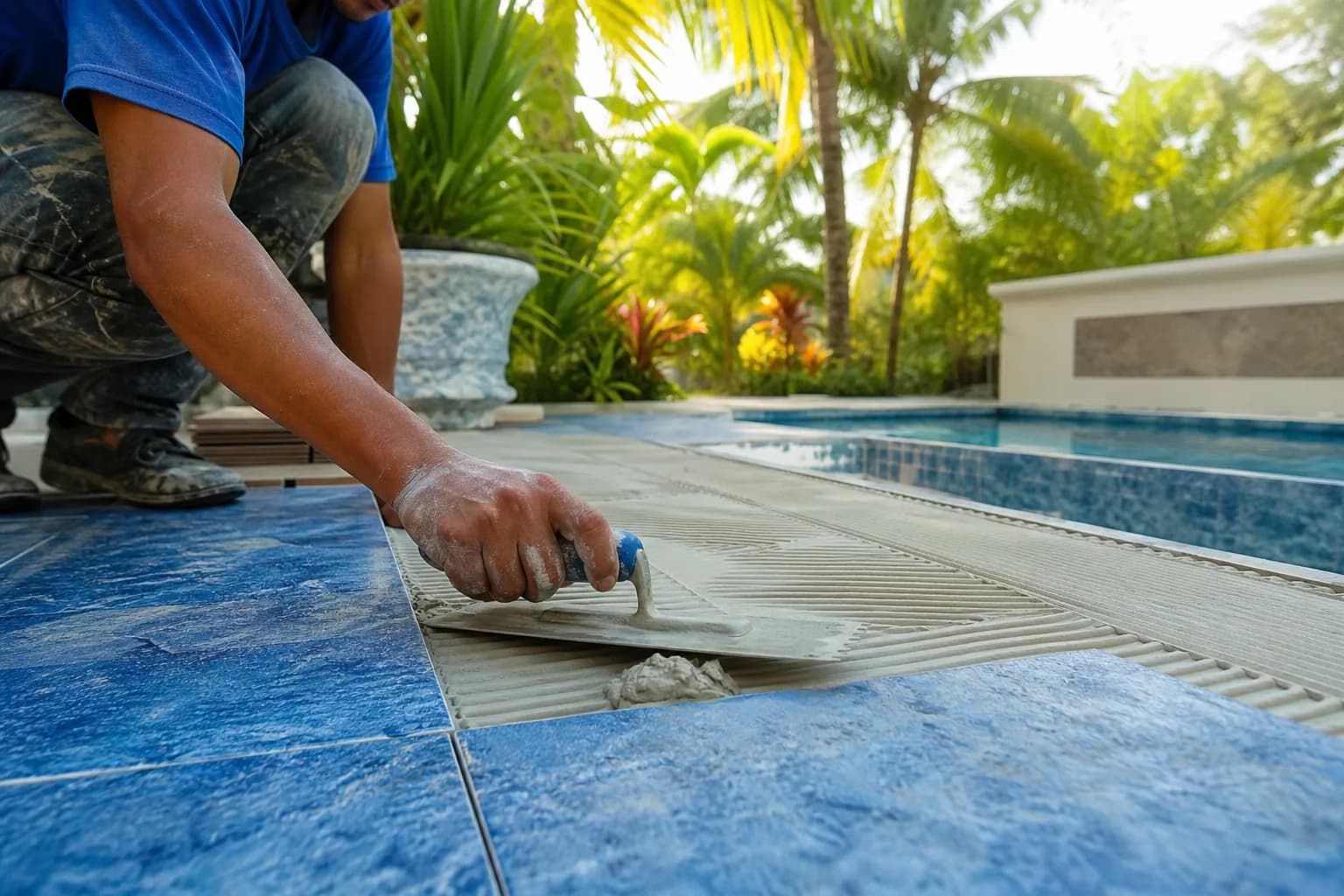
Why Pool Deck Adhesive Selection Determines Long-Term Durability in Bali’s Tropical Climate
Selecting the wrong porcelain tile adhesive for Bali pool deck installations represents one of the most common yet preventable failures in villa construction and renovation projects. The island’s unique combination of intense UV exposure, high humidity levels exceeding 80%, daily temperature fluctuations, and chlorinated water exposure creates an aggressive environment that rapidly degrades standard adhesive systems. Within 18-24 months, improperly bonded pool deck tiles begin exhibiting hollow sounds when tapped, edge lifting, grout line cracking, and eventual delamination—requiring complete reinstallation at significant expense. Professional Bali villa construction demands adhesive systems specifically engineered for submerged and splash zone applications, with flexible polymer-modified formulations that accommodate thermal expansion while maintaining waterproof integrity across Bali’s demanding coastal conditions.
Technical Requirements for Bali Pool Deck Adhesive Systems
The technical specifications for pool deck adhesive selection in Bali extend far beyond basic tile bonding. The substrate typically consists of reinforced concrete with waterproofing membranes, creating a non-porous surface that standard cement-based adhesives cannot adequately bond to. High-performance systems like BAL SPF S1 utilize advanced polymer modification achieving S1 classification under EN 12002 standards, indicating deformability greater than 2.5mm—essential for accommodating the thermal movement of large-format porcelain tiles exposed to direct tropical sunlight where surface temperatures regularly exceed 55°C.
The adhesive must demonstrate Class C2 performance (improved adhesive strength ≥1.0 N/mm²) with additional classifications for specific pool deck challenges. The “E” classification indicates extended open time exceeding 30 minutes—critical in Bali’s heat where standard adhesives skin over within 10-15 minutes, preventing proper tile embedment. The “S1” flexible classification allows the adhesive bed to absorb differential movement between the concrete substrate and porcelain tiles without transferring stress to the tile itself, which would cause cracking at grout joints or complete tile fracture.
Water resistance requirements for pool deck applications demand zero water absorption after curing. Standard cement-based adhesives remain porous, allowing chlorinated water, salt, and cleaning chemicals to penetrate the bond line, causing efflorescence, adhesive degradation, and eventual bond failure. Professional interior finishing Bali specifications require adhesives with complete hydrophobic properties after curing, typically achieved through high polymer content (15-20% by weight) creating a continuous waterproof matrix throughout the adhesive bed.
Chemical resistance becomes paramount in pool environments where pH levels fluctuate between 7.2-7.8, chlorine concentrations reach 3-5 ppm, and periodic acid washing introduces aggressive cleaning agents. The adhesive chemistry must resist alkaline attack from the concrete substrate (pH 12-13) while simultaneously withstanding acidic pool chemicals without softening, swelling, or losing bond strength. Epoxy-modified and high-polymer cementitious systems provide this dual resistance, maintaining structural integrity across the full pH spectrum encountered in pool maintenance.
Bali’s coastal locations introduce additional salt exposure considerations. Properties within 5km of the ocean experience salt-laden air that penetrates porous materials, causing crystallization pressure within the adhesive bed. This phenomenon, known as crypto-florescence, generates internal stresses exceeding 10 MPa—sufficient to debond tiles from substrates. Adhesive selection must account for this through dense, non-porous formulations with salt crystallization resistance verified through EN 12370 testing protocols.
Thermal cycling resistance represents another critical specification often overlooked in renovation Bali projects. Pool decks experience extreme temperature differentials: morning surface temperatures of 25°C rising to 55°C+ by midday, then dropping rapidly during afternoon rain showers. This creates expansion-contraction cycles exceeding 3mm per linear meter in large-format porcelain installations. The adhesive system must accommodate this movement through elastic deformation rather than rigid resistance, requiring Shore A hardness values between 60-75 after full cure—firm enough for load bearing yet flexible enough for thermal movement.
Material Standards and Product Specifications for Tropical Pool Installations
Professional villa construction in Bali requires adhesive products meeting specific international standards adapted for tropical applications. The baseline specification starts with EN 12004 Class C2TE S1—indicating improved cementitious adhesive (C2), extended open time (E), and flexible properties (S1). However, pool deck applications demand additional certifications including EN 12004 Class C2TE S2 for enhanced flexibility (≥5mm deformability) when installing large-format tiles exceeding 600x600mm.
BAL SPF S1 represents the benchmark specification for Bali pool deck installations, formulated specifically for swimming pool environments with approval for continuous water immersion. The product achieves 28-day adhesive strength exceeding 1.5 N/mm² on concrete substrates—50% higher than minimum C2 requirements—ensuring long-term bond integrity under hydrostatic pressure and thermal stress. The polymer-modified formulation provides S1 flexibility while maintaining sufficient rigidity for foot traffic and furniture loads across pool deck surfaces.
Alternative high-performance systems include ARDEX X77 Microtec, which utilizes microfiber reinforcement technology providing enhanced crack-bridging capabilities up to 3mm—valuable for pool decks over substrates prone to minor settlement or thermal movement. The rapid-setting formulation allows grouting after 3 hours and pool filling after 7 days, accelerating project timelines for renovation Bali schedules where extended pool closure impacts villa operations.
Substrate primers form an integral component of the adhesive system, particularly on dense concrete or existing waterproofing membranes. Acrylic-based primers like BAL Bond SBR create mechanical keys on smooth surfaces while reducing substrate porosity variations that cause differential adhesive curing. Application at 1:3 dilution (primer:water) and consumption rates of 0.15-0.20 kg/m² ensures proper surface preparation without creating impermeable barriers that prevent adhesive curing.
Grout selection must complement adhesive performance, requiring epoxy-based or high-polymer cementitious grouts with equivalent water and chemical resistance. Standard cement grouts absorb water, stain from organic matter, and provide pathways for water ingress behind tiles. Epoxy grouts like LATICRETE SpectraLOCK provide complete impermeability and stain resistance, though application requires specialized techniques and temperature control below 30°C—challenging in Bali’s climate without climate-controlled staging areas.
Step-by-Step Pool Deck Tile Installation Process Using High-Performance Adhesives
The installation sequence for pool deck porcelain tiles in Bali begins with comprehensive substrate evaluation and preparation—the foundation determining long-term performance regardless of adhesive quality. The concrete substrate must achieve minimum 28-day cure before tiling, with surface moisture content below 4% measured using calcium carbide testing. Surface preparation includes mechanical grinding to remove laitance, expose aggregate, and create CSP-3 profile (Concrete Surface Profile) providing adequate mechanical key for adhesive bonding.
Waterproofing membrane application precedes adhesive work, using two-component polyurethane or cementitious systems like ARDEX WPM 300 applied at 2.0-2.5 kg/m² across two coats with reinforcing mesh at all penetrations, corners, and substrate transitions. The membrane must cure completely (typically 48-72 hours in Bali humidity) before adhesive application, verified through water ponding tests maintaining 50mm water depth for 24 hours without leakage or moisture transmission.
Adhesive mixing requires precise water ratios—typically 5.5-6.0 liters per 20kg bag for products like BAL SPF S1—using forced-action mixing paddles at 400-600 RPM for 3-4 minutes until achieving lump-free, creamy consistency. Over-watering reduces polymer concentration and bond strength by 30-40%, while under-watering creates unworkable paste that cannot achieve proper tile embedment. Mixed adhesive must be used within 3-4 hours, with batch sizes limited to areas coverable within the product’s open time (typically 20-30 minutes in Bali temperatures).
Application technique employs the “buttering-floating” method for large-format porcelain tiles: adhesive applied to substrate using 10mm notched trowel at 45° angle creating uniform ridges, with additional adhesive back-buttered onto tile reverse using flat trowel. This dual application ensures 95%+ coverage—verified by periodically removing freshly laid tiles to inspect adhesive transfer. Insufficient coverage creates voids where water accumulates, causing freeze-thaw damage in temperature-controlled environments or providing space for salt crystallization in coastal installations.
Tile placement must occur within the adhesive’s open time, with each tile firmly embedded using rubber mallet or vibrating suction tools ensuring complete ridge collapse and air void elimination. The 3mm joint spacing maintained through cross-shaped spacers accommodates thermal expansion while providing sufficient grout width for structural contribution to the tile assembly. Lippage control systems become essential for large-format tiles, using leveling clips maintaining ±1mm surface variation across adjacent tiles—critical for pool deck safety and water drainage.
Curing protection in Bali’s climate requires shading newly installed tiles from direct sunlight and protecting from rain for 24-48 hours. Rapid moisture evaporation or premature water exposure disrupts the polymer film formation essential for waterproof properties and full bond strength development. Foot traffic restrictions remain in place for 24 hours, with full loading delayed 7 days and pool filling postponed 14-21 days depending on adhesive specifications and ambient conditions.
Grouting proceeds only after adhesive achieves sufficient strength—typically 24 hours for rapid-set products, 48-72 hours for standard formulations. Joint cleaning removes spacers and adhesive residue using vacuum and damp sponge, avoiding excessive water that could compromise uncured adhesive. Epoxy grout application requires temperature control, working in 1-2m² sections with immediate cleaning using damp sponge and diagonal wiping motion preventing grout removal from joints while clearing tile surfaces.
Final sealing applies penetrating sealers to cementitious grout joints (epoxy grouts require no sealing) and optional enhancing sealers to natural stone or textured porcelain surfaces. The sealer must be compatible with pool chemicals and UV exposure, typically siloxane-based formulations penetrating 3-5mm and providing 3-5 year protection before reapplication. Pool filling follows manufacturer’s specifications—generally 14 days minimum for standard adhesives, 7 days for rapid-set systems—with gradual filling (300mm per day) preventing hydrostatic pressure shock to curing adhesive.
Cost Analysis and Project Timeline for Bali Pool Deck Installations
Material costs for high-performance pool deck adhesive systems in Bali range from IDR 185,000-275,000 per 20kg bag (approximately USD 12-18), with coverage rates of 3-5 m² per bag depending on tile size and substrate flatness. A typical 40m² pool deck requires 8-12 bags of adhesive, representing IDR 1,480,000-3,300,000 (USD 95-215) in adhesive costs alone—approximately 15-20% of total material expenditure when including tiles, grout, primers, and sealers.
Complete material packages for professional furniture installation quality pool deck finishing include: substrate primer (IDR 450,000-650,000 for 40m²), waterproofing membrane (IDR 1,200,000-1,800,000), porcelain tiles (IDR 8,000,000-20,000,000 depending on quality), adhesive (IDR 1,500,000-3,300,000), grout (IDR 800,000-2,400,000 for epoxy systems), and sealers (IDR 400,000-600,000). Total material investment ranges from IDR 12,350,000-28,750,000 (USD 800-1,850) for a 40m² installation.
Labor costs for skilled villa utilities installation teams in Bali average IDR 350,000-550,000 per square meter for complete pool deck tiling including substrate preparation, waterproofing, adhesive application, and grouting. This represents IDR 14,000,000-22,000,000 (USD 900-1,420) for a 40m² deck—typically exceeding material costs and reflecting the specialized expertise required for durable tropical installations.
Project timelines for pool deck renovations span 12-18 days from substrate preparation to pool refilling: substrate preparation and waterproofing (3-4 days), waterproofing cure and testing (2-3 days), tile installation (2-3 days), adhesive curing (2-3 days), grouting and sealing (1-2 days), final cure before pool filling (7-14 days). Rapid-set systems can compress timelines to 8-10 days, valuable for operational villas where extended pool closure impacts guest experience.
Teville’s integrated approach to villa construction includes detailed cost estimation through our project planning process, ensuring adhesive specifications align with substrate conditions, tile selections, and long-term performance expectations. Our completed projects demonstrate the durability advantages of proper adhesive selection across Bali’s diverse microclimates.
Frequently Asked Questions About Pool Deck Adhesive Selection
Can standard tile adhesive be used for pool decks if tiles are sealed afterward?
No—sealing tiles does not compensate for inadequate adhesive performance. Standard adhesives lack the water resistance, chemical resistance, and flexibility required for pool environments. Water penetrates through grout joints and tile edges, attacking the adhesive bond line regardless of surface sealing. Pool-specific adhesives contain high polymer content creating waterproof matrices that standard products cannot achieve. The cost difference between standard and
 1from 198.000 USD
Private: Haridas Villas
 3180 m²7 month(s)from 142.000 USD
Vasudeva
 4344 m²16 month(s)from 290.000 USD
Radha
 172 m²8 month(s)from 120.000 USD
Keshava
 3124 m²6 month(s)from 123.000 USD
TALA 8
 2144 m²11 month(s)from 104.000 USD
Narayana
 3173 m²6 month(s)from 125.000 USD
TALA FOUR
 3127 m²9 month(s)from 177.000 USD
Mukunda
 3104 m²11 month(s)from 99.000 USD
TALA 100
 164 m²7 month(s)from 79.000 USD
Private: Haridas Villas, Tegallalang

Want to calculate?
164 m²7 month(s)from 79.000 USDTALA TWO
Start With Real Numbers, Not Guesses
Before finalizing your finishing works plan, check realistic cost ranges for your Bali villa project.
Available lands
 800 m²8 min$ 113300Bali, Ungasan
 2000 m²15 min$ 261700Bali, Babakan
 422 m²15 min$ 93547Bali, Kerobokan
 700 m²20 min$ 90517Bali, Cepaka
 585 m²8 min$ 165702Bali, Mengwi
 2230 m²15 min$ 410573Bali, Padonan
 3900 m²10 min$ 432266Bali, Tabanan
 2680 m²10 min$ 1732759Bali, Pererenan
 5815 m²5 min$ 815740Bali, Tabanan
 8313 m²15 min$ 716670Bali, Buduk
 7250 m²56 min$ 235714Bali, Tabanan
 2200 m²3 min$ 183842Bali, Berawa
 2500 m²5 min$ 609606Bali, Kedungu
 608 m²15 min$ 310377Bali, Seminyak
 1660 m²10 min$ 343448Bali, Kerobokan
Essential Bali build & buy guides
- Bali villa construction cost per m² in 2026
- How much will your villa cost? Calculator
- Building a villa in Bali: the complete guide
- Buying land in Bali: step-by-step for foreigners
- Bali villa investment: yields, risks, returns
- Leasehold vs freehold: what foreigners can own
- Construction defect liability & 10-year warranty
- Bali building codes and construction standards
Related guides
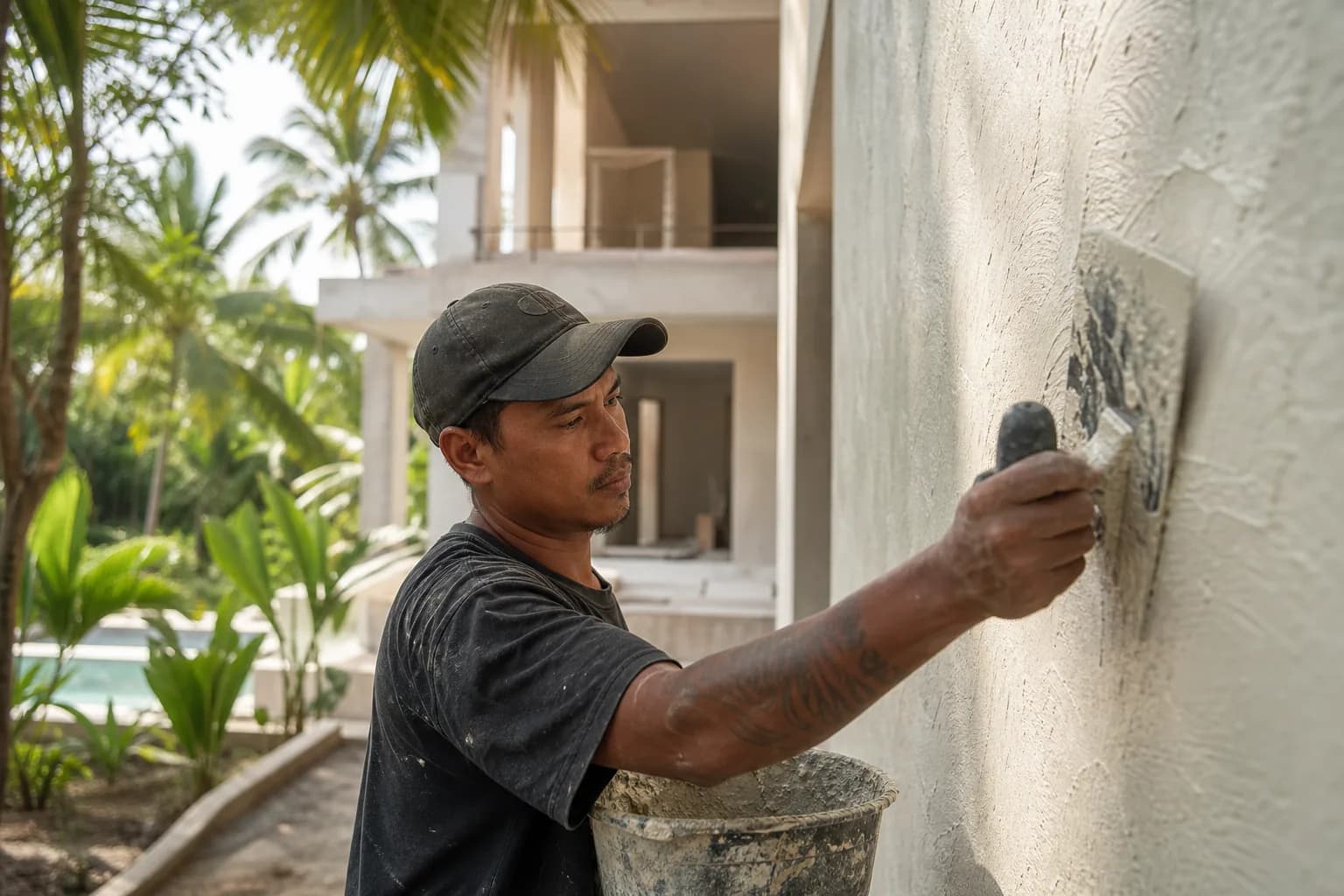
Resin-Infused Plaster Finishes: Anti-Salt Systems Bali
Expert technical guide: Resin-Infused Plaster Finishes: Anti-Salt Systems Bali
8 min read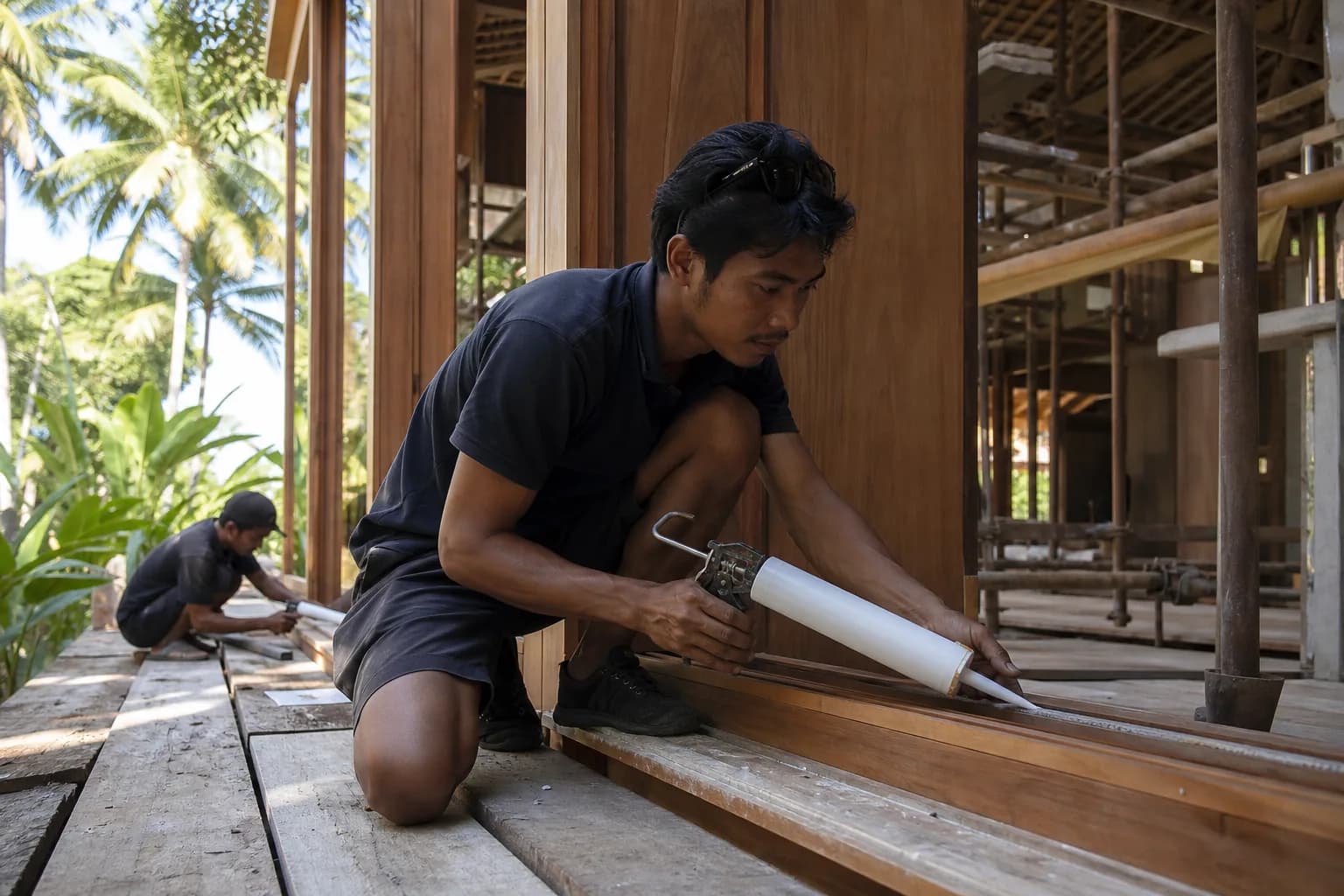
Prefinished Timber Joinery: Silicone Seals Fixings Bali
Professional prefinished timber joinery installation in Bali with silicone seals and fixings for durable weatherproof performance and a premium finish.
10 min read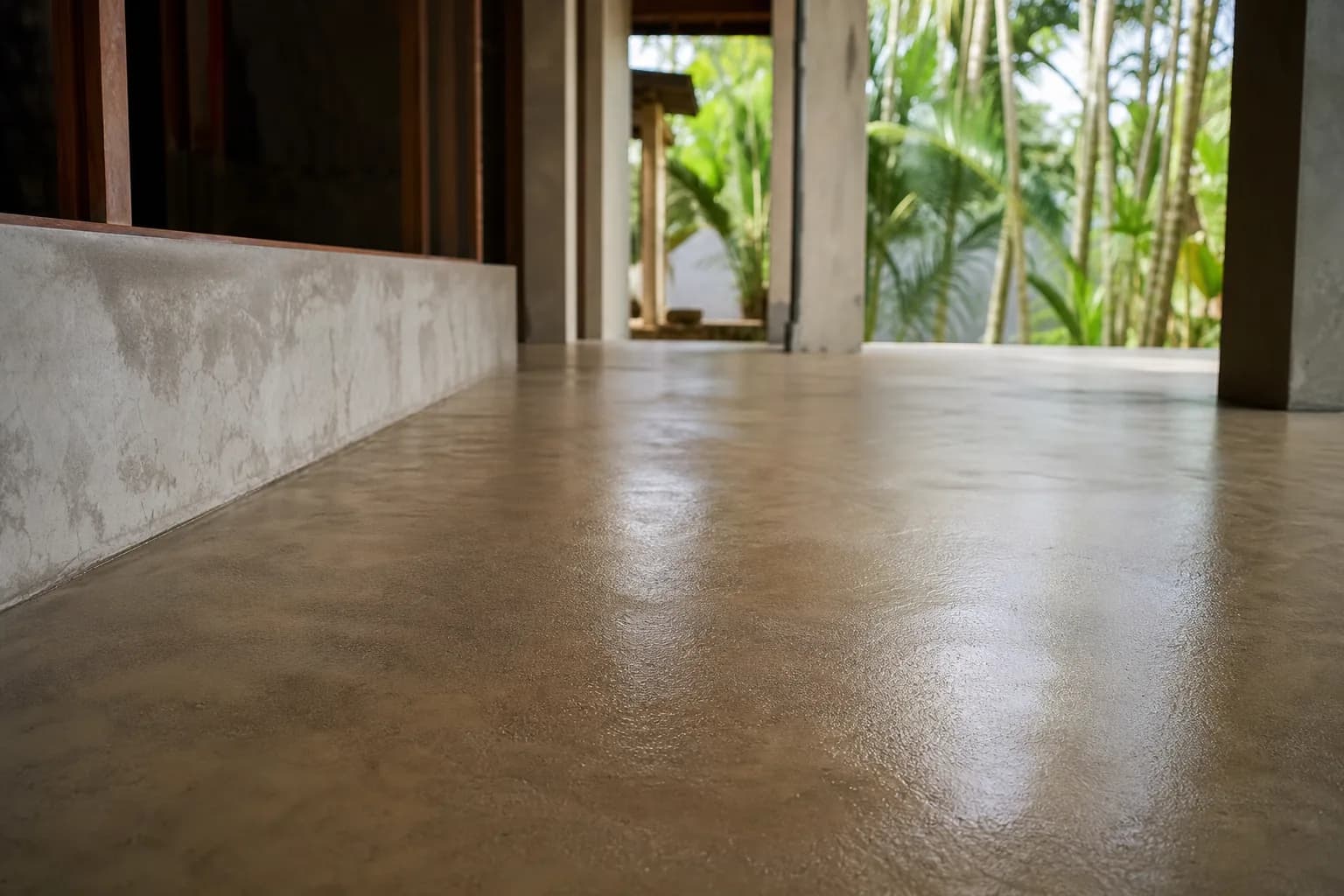
Polished Concrete Microtopping: Surface Prep Sealants Bali
Discover Bali s polished concrete microtopping: expert surface prep, durable sealants, and a flawless finish for modern floors with minimal maintenance.
9 min read