Sanur Groundwater Extraction Permits Borehole Drilling Costs Ba
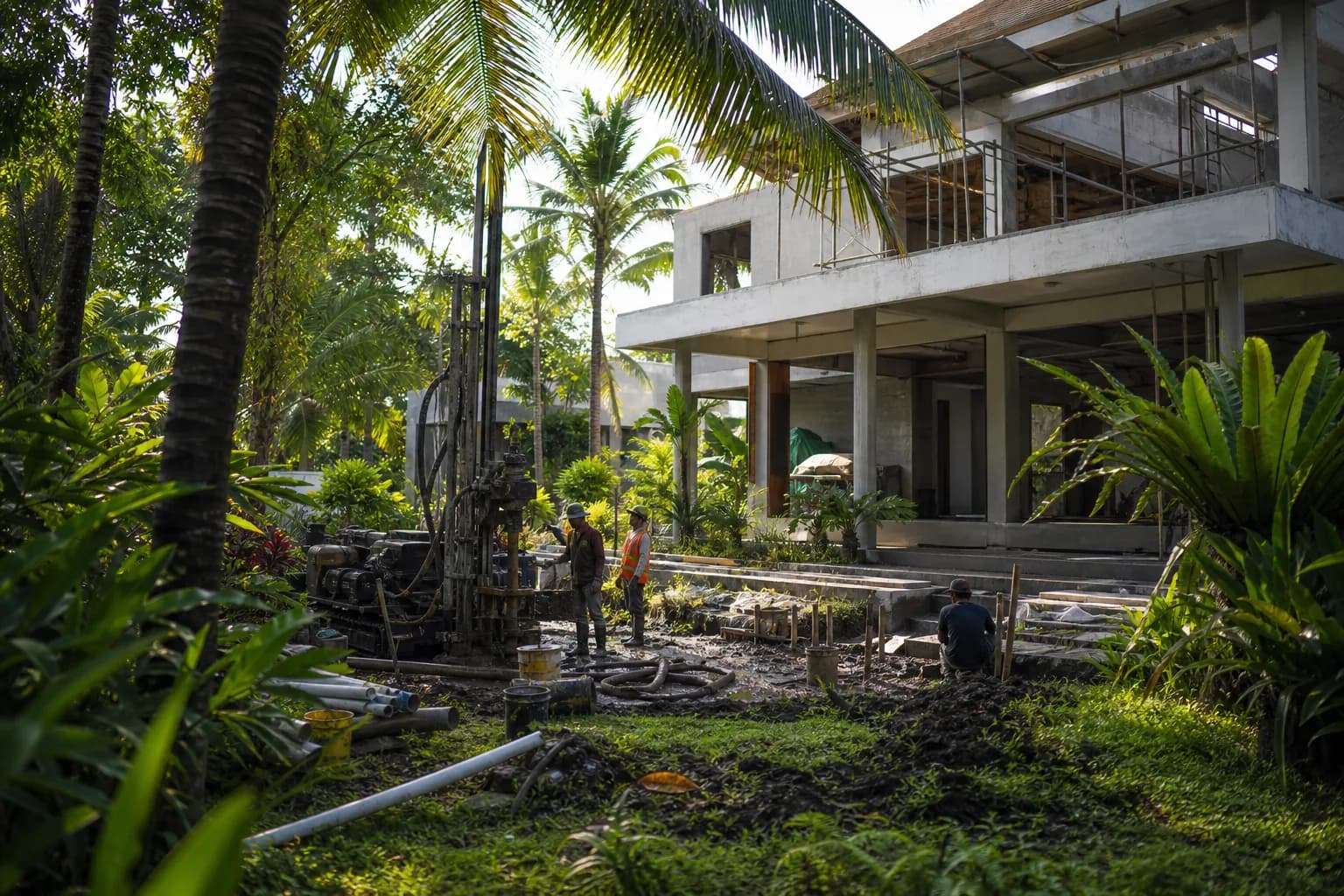
Why Sanur’s Groundwater Regulations Complicate Villa Construction Timelines
Sanur’s coastal aquifer system operates under stricter groundwater extraction controls than inland Bali regions, creating a specific permitting challenge that delays construction schedules by 8-12 weeks on average. The Denpasar Water Resources Department classifies Sanur as a “controlled extraction zone” due to saltwater intrusion risks, requiring enhanced SIPA (Surat Izin Pengambilan Air Tanah) documentation that includes hydrogeological impact assessments not mandated in Canggu or Ubud. For villa developers purchasing land in Sanur, the borehole drilling permit process involves three regulatory layers—village customary approval, district technical review, and provincial environmental clearance—each adding cost and complexity to what appears as straightforward infrastructure development.
Technical Requirements for Sanur Groundwater Extraction Permits
Sanur’s proximity to the coastline (most buildable plots sit within 1.5km of the beach) places groundwater extraction under Indonesia’s 2019 Water Resources Law with specific coastal zone amendments. The SIPA application for Sanur requires a certified hydrogeologist report demonstrating that proposed extraction rates won’t accelerate saltwater intrusion into the freshwater lens—a geological formation where rainwater floats above denser seawater in coastal aquifers.
The technical assessment must document existing groundwater salinity levels (measured in parts per million Total Dissolved Solids), proposed borehole depth (typically 40-80 meters in Sanur versus 20-40 meters inland), estimated daily extraction volume, and distance from existing registered boreholes. Sanur’s aquifer recharge rate is calculated at 180mm annually, significantly lower than Ubud’s 320mm, making extraction quotas more restrictive.
Borehole drilling specifications in Sanur must comply with SNI 03-2847-2019 standards, requiring PVC casing diameter of minimum 4 inches for residential use, gravel pack filtration zones, and sanitary seals extending 3 meters below surface to prevent contamination. The drilling contractor must hold a SIUJK (construction business license) with groundwater specialization classification—not all Bali drilling companies maintain this certification.
The permit distinguishes between three extraction categories: household use (under 100 liters/day, simplified process), commercial villa operations (100-2,000 liters/day, standard SIPA), and resort-scale developments (over 2,000 liters/day, requiring AMDAL environmental impact analysis). A typical 4-bedroom villa in Sanur with pool, garden irrigation, and staff facilities falls into the commercial category, triggering the full permitting sequence.
Sanur’s banjar (customary village) councils maintain informal veto power over borehole locations through the required “surat keterangan” (village statement letter). This document confirms the proposed drilling site doesn’t conflict with sacred water sources, traditional irrigation channels, or communal wells—considerations absent from purely technical engineering reviews but critical for permit approval. The banjar review adds 3-5 weeks to timelines and may require relocating the planned borehole by 10-15 meters, potentially conflicting with architectural site plans.
Water quality testing is mandatory post-drilling, with samples analyzed for 12 parameters including coliform bacteria, iron content, pH levels, and salinity. Sanur’s coastal geology frequently produces water with elevated iron (above 0.3mg/L threshold) and slight salinity (500-800 TDS), requiring treatment systems that add $2,800-$4,500 to infrastructure costs beyond the borehole itself.
Hidden Risks in Sanur’s Groundwater Permitting Process
The most expensive mistake occurs when developers drill boreholes before securing SIPA approval, assuming permits can be obtained retroactively. Sanur’s district office has increased enforcement since 2024, with penalties reaching 150 million IDR ($9,400) plus mandatory borehole sealing for unpermitted extraction. Unlike building permit violations that sometimes receive administrative warnings, groundwater violations trigger immediate enforcement due to environmental protection priorities.
Land purchase agreements in Sanur rarely include groundwater feasibility clauses, leaving buyers to discover post-acquisition that their plot sits within 50 meters of an existing registered borehole—the minimum separation distance that automatically disqualifies new SIPA applications. The Land Certificate (SHM or Hak Pakai) doesn’t indicate nearby groundwater permits, requiring separate due diligence through the Water Resources Department’s registry, which maintains paper-based records with 6-8 week search timeframes.
Seasonal variations dramatically affect Sanur borehole performance. Dry season (May-October) water table drops of 4-7 meters can render shallow boreholes (under 50 meters) unreliable, forcing mid-construction drilling of secondary deeper boreholes at $6,500-$8,200 additional cost. Initial hydrogeological assessments conducted during wet season (November-April) often underestimate dry season extraction challenges, particularly in Sanur’s southern coastal sections where aquifer thickness decreases.
The permit renewal requirement catches villa owners unprepared—SIPA validity runs 5 years, requiring re-application with updated water quality testing and usage documentation. Failure to renew before expiration requires restarting the full application process, potentially leaving completed villas without legal water access during the 2-3 month renewal gap.
Step-by-Step Process for Sanur Groundwater Permits
Phase 1: Pre-Application Assessment (Weeks 1-3)
Engage a certified hydrogeologist (minimum S1 degree in hydrogeology or civil engineering with groundwater specialization) to conduct site assessment. The consultant reviews geological maps, measures distance to coastline and existing boreholes, estimates aquifer depth through resistivity testing, and determines feasibility. Cost: $850-$1,400. Simultaneously, obtain the banjar surat keterangan by presenting land ownership documents and site plans to the village council, typically requiring attendance at monthly banjar meetings. This step cannot be expedited and depends on meeting schedules.
Phase 2: Technical Documentation (Weeks 4-6)
The hydrogeologist prepares the technical report including aquifer characteristics, proposed extraction volume calculations, environmental impact mitigation measures, and drilling specifications. This document must be stamped by a certified engineer (Insinyur Profesional certification). Compile supporting documents: land certificate copy, IMB (building permit) or proof of IMB application, applicant identity documents (KTP for Indonesian citizens, KITAS/KITAP for foreigners using nominee structures), and company registration documents if applying under PT or PT PMA structure.
Phase 3: SIPA Application Submission (Weeks 7-8)
Submit complete application package to Dinas Pekerjaan Umum dan Penataan Ruang (Public Works and Spatial Planning Department) at the Denpasar district office. Applications submitted incomplete are rejected entirely, not held pending additional documents. The department conducts administrative review (1-2 weeks) before scheduling site inspection. Application fees: 500,000-750,000 IDR ($31-$47) depending on extraction category.
Phase 4: Site Inspection and Technical Review (Weeks 9-11)
Government inspectors visit the proposed drilling location to verify banjar approval, measure distances to existing water sources, assess environmental conditions, and confirm technical report accuracy. The inspection must occur during property owner or legal representative presence. Following inspection, the technical committee reviews all documentation in monthly meetings—missing a meeting cycle adds 4 weeks to the timeline. Committee may request modifications to drilling depth, location, or extraction volumes.
Phase 5: Permit Issuance and Drilling (Weeks 12-16)
Upon approval, SIPA document is issued with specific conditions including maximum daily extraction volume, required water meter installation, and quarterly reporting obligations. Only after receiving SIPA can drilling commence. Select drilling contractors holding valid SIUJK with groundwater classification—verify certification directly with LPJK (Construction Services Development Board). Drilling duration: 3-5 days for standard 60-meter residential borehole. Post-drilling water quality testing (mandatory): 1-2 weeks for laboratory analysis.
Phase 6: Completion Documentation (Weeks 17-18)
Submit drilling completion report including actual depth achieved, geological layers encountered, water yield test results, and laboratory water quality analysis to the Water Resources Department. Install the required water meter (flow meter) and register meter serial number with authorities. Receive final extraction authorization—only at this stage is groundwater use legally permitted.
Realistic Cost Breakdown for Sanur Borehole Projects
Permitting Costs: Hydrogeological assessment: $850-$1,400 | Banjar administrative fees: $60-$120 | SIPA application fees: $31-$47 | Engineer certification stamps: $180-$280 | Total permitting: $1,120-$1,850
Drilling Costs: Standard 60-meter borehole with 4-inch PVC casing: $3,800-$5,200 | Deeper 80-meter borehole (often necessary in southern Sanur): $5,500-$7,200 | Submersible pump installation (0.5-1 HP for residential): $650-$950 | Pressure tank and distribution system: $480-$720 | Total drilling and equipment: $4,930-$9,070
Water Treatment (if required): Iron removal system: $1,200-$1,800 | Salinity reduction (reverse osmosis for drinking water): $1,600-$2,700 | UV sterilization: $380-$580
Compliance and Testing: Post-drilling water quality laboratory analysis: $220-$340 | Flow meter installation and registration: $280-$420 | Annual water usage reporting (consultant fees): $150-$250
Total Investment Range: Basic compliant system: $6,050-$11,270 | Full system with treatment: $9,630-$16,160. These figures exclude contingencies for drilling complications (hitting rock layers requiring specialized equipment adds $1,800-$3,200) or secondary borehole requirements.
Frequently Asked Questions: Sanur Groundwater Permits
Can I use my Sanur villa’s borehole while the SIPA application is still processing?
No. Groundwater extraction before SIPA issuance constitutes illegal extraction under Indonesian environmental law, regardless of application status. Enforcement in Sanur has intensified with monthly inspections by district environmental officers who can issue immediate cease-operations orders and financial penalties. The risk extends beyond fines—unpermitted extraction discovered during villa construction can delay IMB final approval (Certificate of Proper Function) since water infrastructure legality is verified during final inspections. Construction schedules must account for the full 12-16 week permitting timeline before groundwater becomes available for concrete mixing, curing, and other construction water needs.
Does purchasing land with an existing borehole transfer the SIPA permit to the new owner?
SIPA permits are not automatically transferred with land ownership changes. The new owner must apply for permit transfer (Peralihan SIPA) within 30 days of land title transfer, submitting the original SIPA document, new land certificate, sale-purchase deed (AJB), and updated water usage plans. The transfer process takes 4-6 weeks and costs $180-$320 in administrative fees. If the previous owner’s SIPA has expired or the borehole wasn’t properly permitted, the new owner must apply for a new SIPA as if drilling from scratch. During land purchase due diligence, verify SIPA validity, check the permit holder name matches the seller, and confirm the borehole location matches SIPA documentation—discrepancies are common in older Sanur properties.
How does Sanur’s saltwater intrusion risk affect long-term borehole viability?
Sanur’s coastal aquifer experiences gradual saltwater intrusion at approximately 12-18 meters per year in areas with intensive extraction, particularly in beachfront zones. Boreholes drilled to minimum depths (40-50 meters) may show increasing salinity over 5-8 years, with TDS levels rising from acceptable 400-500 range to problematic 1,200-1,500 range. This requires either drilling deeper replacement boreholes or installing desalination systems. The hydrogeological assessment should project 10-year salinity trends based on your specific location—properties within 800 meters of the beach face higher intrusion risk. Teville’s construction planning process factors long-term water infrastructure viability into site utility design, sometimes recommending deeper initial drilling (70-80 meters) despite higher upfront costs to ensure 15-20 year borehole lifespan.
What happens if water quality testing reveals contamination after drilling?
Post-drilling water quality failures don’t invalidate the SIPA permit but require remediation before the borehole can be legally used. Common Sanur issues include bacterial contamination (requiring chlorination and UV treatment), elevated iron (requiring oxidation filtration), or excessive salinity (requiring reverse osmosis for potable water). The SIPA permit specifies water quality standards that must be maintained—using contaminated water violates permit conditions even if extraction volumes stay within limits. Remediation costs ($1,500-$4,800) become the property owner’s responsibility. In severe cases where contamination cannot be economically treated, the borehole may need to be sealed and a new location drilled, requiring a SIPA amendment application. This scenario emphasizes the value of thorough pre-drilling hydrogeological assessment that includes test boring to sample water quality before committing to full borehole drilling.
Can villa construction proceed before the groundwater permit is secured?
Foundation and structural work can proceed, but construction phases requiring significant water volume (concrete pouring, curing, finishing work) face complications without permitted groundwater access. Contractors can temporarily purchase water deliveries by truck (at $45-$65 per 5,000-liter load), but
 1from 198.000 USD
Private: Haridas Villas
 172 m²8 month(s)from 120.000 USD
Keshava
 4344 m²16 month(s)from 290.000 USD
Radha
 2144 m²11 month(s)from 104.000 USD
Narayana
 3124 m²6 month(s)from 123.000 USD
TALA 8

Want to calculate?
 3127 m²9 month(s)from 177.000 USD
Mukunda
 3104 m²11 month(s)from 99.000 USD
TALA 100
 3180 m²7 month(s)from 142.000 USD
Vasudeva
 164 m²7 month(s)from 79.000 USD
Private: Haridas Villas, Tegallalang
 3173 m²6 month(s)from 125.000 USD
TALA FOUR
164 m²7 month(s)from 79.000 USDTALA TWO
Start With Real Numbers, Not Guesses
Before buying land or finalizing a design, check the realistic build cost range for your project in Bali.
Our team reviews your inputs and gives a grounded estimate.
Available lands
 911 m²15 min$ 248217Bali, Pererenan
 5000 m²8 min$ 424877Bali, Ungasan
 7500 m²5 min$ 206281Bali, Kedungu
 1600 m²32 min$ 266010Bali, Tabanan
 2000 m²15 min$ 110837Bali, Karangasem
 1700 m²10 min$ 632257Bali, Kuta
 600 m²12 min$ 101970Bali, Mengwi
 700 m²15 min$ 162500Bali, Tabanan
 800 m²10 min$ 307882Bali, Tibubeneng
 7900 m²25 min$ 413485Bali, Tabanan
 6000 m²30 min$ 55419Bali, Tabanan
 1100 m²8 min$ 280419Bali, Ungasan
 1000 m²5 min$ 350431Bali, Drupadi
 1362 m²15 min$ 335468Bali, Tumbak
 700 m²7 min$ 400000Bali, Canggu
Essential Bali build & buy guides
- Bali villa construction cost per m² in 2026
- How much will your villa cost? Calculator
- Building a villa in Bali: the complete guide
- Buying land in Bali: step-by-step for foreigners
- Bali villa investment: yields, risks, returns
- Leasehold vs freehold: what foreigners can own
- Construction defect liability & 10-year warranty
- Bali building codes and construction standards
Related guides
Bali Property Contracts and Indonesian Language Law: Dual-Language Pitfalls That Void Deals
Indonesian law requires property agreements with Indonesian parties to exist in Indonesian — and the two language versions can quietly diverge. What the language law demands in 2026, the real court history, and the dual-language pitfalls that damage Bali deals.
8 min read
Bali Land Certificates Decoded: SHM, HGB, Hak Pakai and Girik Explained for Buyers
A buyer's decoder for Bali land certificates: what SHM, HGB, Hak Pakai and girik actually mean, why girik lost standalone legal force in February 2026, and how to verify a title before you commit.
9 min read
Inheritance of Bali Property for Foreigners: Leasehold, PT PMA Shares and Wills
What happens to your Bali villa when you die: why a leasehold passes to heirs only if the deed says so, how PT PMA shares are inherited, the one-year rule for foreign heirs of freehold land, and the Indonesian notarial will that makes it all work.
7 min read