Underfloor Heating: Tile vs Concrete Subfloors in Bali
# Underfloor Heating Viability: Tile vs Concrete Subfloors in Bali Villa Construction
The Tropical Climate Heating Paradox: Why Bali Villas Need Underfloor Systems
Many assume underfloor heating is unnecessary in Bali’s tropical climate, yet villa owners increasingly request this finishing system for specific zones—bathrooms, air-conditioned bedrooms, and spa areas where tile floors feel uncomfortably cold against bare feet. The critical question isn’t whether to install underfloor heating, but which subfloor configuration delivers optimal performance in Bali’s high-humidity environment. At Teville, our villa construction projects demonstrate that the choice between tile-over-concrete versus direct concrete finishing fundamentally affects system efficiency, installation complexity, and long-term durability in tropical conditions.
Technical Deep Dive: Subfloor Configurations and Heat Transfer Dynamics
Understanding underfloor heating viability in Bali villa construction requires examining the thermal conductivity properties of both tile and concrete subfloors, particularly how these materials behave in 80-95% humidity environments typical of tropical Indonesia.
Tile Subfloor Systems: Rapid Response Heating
Ceramic and porcelain tiles possess thermal conductivity ratings between 1.0-1.3 W/mK, making them exceptional heat conductors for interior finishing Bali projects. When electric heating cables or hydronic mats are embedded in the adhesive layer beneath tiles (typically 10-15mm thick), heat transfers efficiently through the tile surface within 20-30 minutes of activation. This rapid response time suits Bali’s usage patterns where heating is needed intermittently rather than continuously.
The layered construction for tile systems includes: structural concrete slab (100-150mm), waterproofing membrane (critical in Bali’s wet climate), insulation board (10-20mm extruded polystyrene), heating element layer, flexible adhesive bed (10-15mm), and finish tiles (8-12mm). Total build-up height reaches 140-210mm, which must be calculated during the construction process to maintain consistent floor levels throughout the villa.
The primary advantage for renovation Bali projects is that tile systems add minimal height—essential when retrofitting existing structures where door clearances and transitions to adjacent rooms cannot be modified. Tiles also provide immediate visual feedback of heating zones through slight temperature variations, allowing precise control in multi-zone villa layouts.
Concrete Subfloor Systems: Thermal Mass Performance
Polished or sealed concrete floors function differently as both subfloor and finish surface. Concrete’s thermal mass properties (thermal conductivity 0.8-1.4 W/mK depending on aggregate composition) mean it absorbs heat slowly but radiates warmth for extended periods—typically 2-4 hours after system shutdown. This characteristic makes concrete ideal for continuously occupied spaces in villa utilities design.
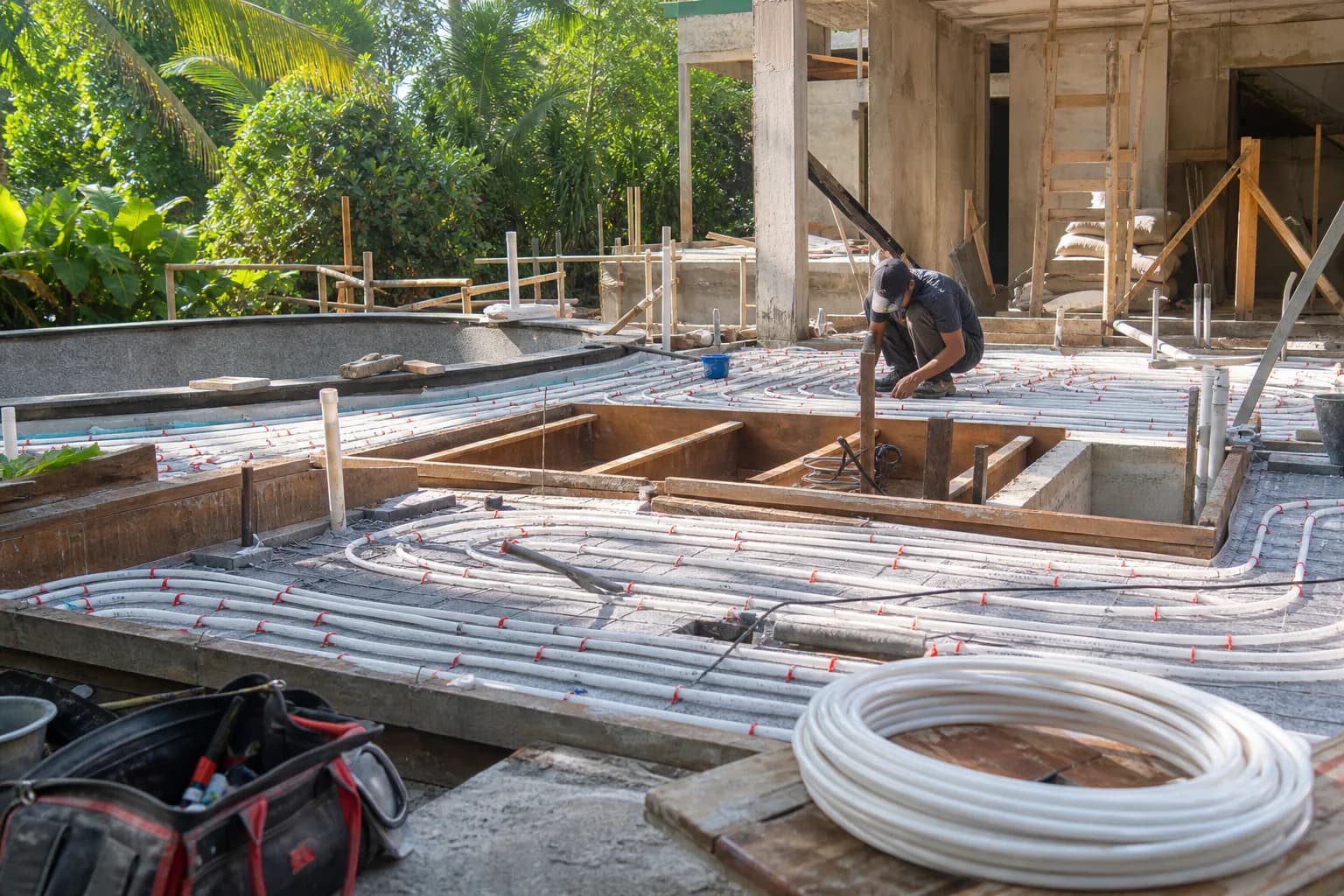
For new construction, heating cables are cast directly into the concrete slab during pouring, positioned 50-75mm above the reinforcement mesh and 30-50mm below the finished surface. This embedding provides maximum thermal contact but requires precise installation coordination—once concrete cures, system modifications become impossible without demolishing the entire floor.
In Bali’s climate, concrete subfloors present specific challenges: the material’s porosity in tropical humidity can cause moisture migration from ground contact, potentially affecting heating element longevity. Proper vapor barriers beneath the slab and adequate curing time (minimum 28 days before heating activation) are non-negotiable for Teville’s quality standards. The thermal lag—60-90 minutes to reach target temperature—requires programmable controls that anticipate usage patterns rather than respond to immediate comfort needs.
Comparative Performance in Tropical Conditions
Bali’s ambient temperatures (24-32°C) mean underfloor heating operates at lower intensities (25-35°C surface temperature) compared to temperate climates (28-40°C). Tile systems excel in this range, providing perceptible warmth without excessive energy consumption. Concrete systems, while more energy-intensive initially, maintain comfortable temperatures longer—beneficial for master suites and spa bathrooms where consistent warmth is prioritized.
Humidity interaction differs significantly: tiles with proper waterproofing remain unaffected by moisture, while concrete requires sealed surfaces (epoxy or polyurethane coatings) to prevent water absorption that reduces heating efficiency and promotes mold growth in grout lines or surface imperfections.
Materials and Standards for Tropical Installation
Selecting appropriate materials for underfloor heating in Bali requires balancing international standards with local climate realities and material availability through furniture installation and finishing suppliers.
Heating Elements
Electric resistance cables (150-200W/m² for tile, 100-150W/m² for concrete) dominate Bali installations due to simpler installation and lower upfront costs compared to hydronic systems. Twin-conductor cables with PTFE insulation rated for tropical environments (minimum IP67 waterproofing) prevent corrosion from humidity exposure. Hydronic systems using cross-linked polyethylene (PEX) tubing offer superior energy efficiency for large villas but require dedicated boiler rooms and professional maintenance—considerations that affect overall cost estimation.
Insulation Requirements
Extruded polystyrene (XPS) boards with minimum 30 psi compressive strength and closed-cell structure resist moisture absorption—critical for ground-floor installations in Bali where water table levels fluctuate seasonally. Insulation thickness (10mm minimum for upper floors, 20mm for ground contact) directly impacts system efficiency; inadequate insulation causes heat loss into structural concrete rather than upward into living spaces, increasing operating costs by 30-50%.
Tile Specifications
Porcelain tiles (water absorption <0.5%) outperform ceramic alternatives in heated applications, maintaining dimensional stability through thermal cycling. Tile thickness affects heat-up time: 8-10mm tiles reach temperature 15-20% faster than 12-15mm options, though thicker tiles provide better impact resistance for high-traffic villa areas. Large-format tiles (600x600mm or larger) require back-buttering during installation to ensure complete adhesive contact—air pockets create cold spots that compromise heating uniformity.
Adhesives and Grouts
Flexible, polymer-modified adhesives (S1 or S2 classification per EN 12004) accommodate thermal expansion without cracking—standard cement adhesives fail within 18-24 months under heating cycles in Bali’s climate. Epoxy grouts resist moisture penetration and maintain structural integrity better than cement-based alternatives, though installation requires specialized skills available through Teville’s experienced finishing teams.
Step-by-Step Installation Process
Phase 1: Substrate Preparation (Days 1-3)
For tile systems, begin with structural slab inspection—surface must be level within 3mm per 2 meters, clean of dust, oils, and curing compounds. Apply liquid waterproofing membrane in two coats (minimum 1.5mm total thickness), extending 150mm up adjacent walls. This step is non-negotiable in Bali villa construction where groundwater and rain penetration risks are constant. Allow 24-48 hours curing before proceeding.
Concrete systems require vapor barrier installation (minimum 0.2mm polyethylene sheeting) with 300mm overlaps and sealed edges, followed by perimeter insulation strips (8-10mm thick, full slab height) to prevent thermal bridging at walls. Position reinforcement mesh on plastic spacers maintaining 50mm coverage from all edges.
Phase 2: Heating Element Installation (Days 4-6)
For tile applications, lay XPS insulation boards with staggered joints, taping seams with aluminum foil tape. Install heating mats or cables according to manufacturer’s spacing requirements—typically 100-150mm centers for bathrooms, 150-200mm for bedrooms. Use hot-melt glue or double-sided tape to secure cables, never staples or nails that could puncture insulation. Position floor sensors in conduit tubes between cable runs, 300-500mm from walls for accurate temperature readings.
Concrete installations require cable attachment to reinforcement mesh using plastic zip ties at 300mm intervals, maintaining minimum 50mm spacing between parallel runs. Install junction boxes and thermostats before concrete pour—post-installation modifications require extensive demolition. Conduct continuity testing (megohmmeter at 500V DC) before and after concrete placement to verify system integrity.
Phase 3: Embedding and Curing (Days 7-35)
Tile systems receive 10-15mm flexible adhesive layer applied with 10mm notched trowel, working in 1-2m² sections to prevent skinning. Back-butter large tiles and beat into place with rubber mallet, checking coverage exceeds 95% when tiles are lifted for inspection. Maintain 2-3mm grout joints for thermal expansion. Do not activate heating for minimum 21 days to allow complete adhesive cure—premature heating causes bond failure and tile delamination.
Concrete pours must achieve minimum 30 MPa compressive strength, using 10-12mm aggregate maximum size to ensure proper cable encapsulation. Vibrate concrete thoroughly around heating elements without displacing cables from design positions. Apply curing compound immediately after finishing to prevent rapid moisture loss in Bali’s heat. Wait full 28 days before initial heating activation, then ramp temperature gradually (5°C per day) to operating level over one week.
Phase 4: Finishing and Commissioning (Days 36-42)
Tile installations require epoxy grouting with complete joint filling, removing excess within 20 minutes before hardening. Apply penetrating sealer to natural stone tiles (travertine, marble) to prevent thermal stress cracking. Concrete floors need diamond grinding to expose aggregate (if polished finish desired) or application of epoxy/polyurethane sealers for moisture protection—critical in Bali’s humidity.
Commission systems by programming thermostats for zone-specific schedules, typically 2-3 hour pre-heating before occupancy. Install GFCI protection on all circuits and provide owners with system documentation including cable layout drawings—essential for future renovation Bali work where drilling or cutting might occur.
Costs and Timeline Considerations
Underfloor heating costs for interior finishing Bali projects vary significantly based on subfloor choice and villa size. Tile-based systems typically range IDR 850,000-1,200,000 per square meter including materials, labor, and controls—the premium reflects layered installation complexity and specialized adhesives required for tropical performance.
Concrete subfloor systems cost IDR 650,000-950,000 per square meter when integrated during new construction, as heating elements are installed during scheduled concrete pours without additional labor mobilization. Retrofit concrete installations increase costs 40-60% due to surface preparation, insulation overlay, and self-leveling compound requirements before heating mat placement.
Material procurement affects timelines: quality heating cables and controls require 3-4 weeks import lead time through Jakarta suppliers, while locally-available alternatives often lack tropical climate ratings and void warranties. Teville maintains relationships with certified suppliers ensuring material availability aligns with project schedules.
Installation duration for 50m² bathroom zone: tile system requires 12-15 working days from substrate preparation through final commissioning; concrete system needs 8-10 days active work but 35-42 days total elapsed time including curing periods. These timelines assume no weather delays—monsoon season (November-March) can extend schedules 20-30% due to humidity affecting adhesive curing and concrete placement windows.
Operating costs favor tile systems in Bali’s climate: rapid heat-up and cool-down allows on-demand usage averaging 2-3 hours daily, consuming approximately 15-25 kWh monthly per 10m² zone. Concrete systems’ thermal mass requires longer operation (4-6 hours daily for consistent comfort) consuming 30-45 kWh monthly for equivalent area, though this provides more continuous warmth suitable for master suites and spa areas.
Frequently Asked Questions
Can underfloor heating be installed in existing Bali villas without major renovation?
Yes, but with significant constraints. Tile systems can overlay existing floors if you accept 40-50mm height increase—this affects door clearances, transitions to adjacent rooms, and toilet flange heights requiring professional replumbing. Concrete systems require complete floor removal and reconstruction. For renovation Bali projects, Teville recommends limiting underfloor heating to bathrooms and specific zones where height changes can be managed through threshold transitions rather than whole-villa installations that necessitate extensive modifications.
Which subfloor type works better for outdoor-indoor transition areas common in Bali villas?
Tile systems excel in semi-outdoor spaces (covered terraces, pavilions) because tiles handle moisture exposure and temperature fluctuations better than sealed concrete. The waterproofing membrane beneath tiles prevents water ingress during heavy rains, while concrete’s porous nature—even when sealed—allows moisture migration that degrades heating elements over 3-5 years in exposed conditions. Design heating zones to stop 500mm before fully outdoor areas to prevent energy waste and system strain.
How does Bali’s voltage fluctuation affect underfloor heating system longevity?
Critical consideration often overlooked: Bali’s electrical grid experiences 5-10% voltage variations and occasional spikes during storms. Install voltage stabilizers (minimum 3kVA capacity) dedicated to heating circuits, and specify heating
 1from 198.000 USD
Private: Haridas Villas
 3104 m²11 month(s)from 99.000 USD
TALA 100
 172 m²8 month(s)from 120.000 USD
Keshava
 3180 m²7 month(s)from 142.000 USD
Vasudeva
 164 m²7 month(s)from 79.000 USD
TALA TWO
 2144 m²11 month(s)from 104.000 USD
Narayana

Want to calculate?
 3127 m²9 month(s)from 177.000 USD
Mukunda
 3173 m²6 month(s)from 125.000 USD
TALA FOUR
164 m²7 month(s)from 79.000 USDPrivate: Haridas Villas, Tegallalang
 3124 m²6 month(s)from 123.000 USD
TALA 8
 4344 m²16 month(s)from 290.000 USD
Radha
Start With Real Numbers, Not Guesses
Before finalizing your finishing works plan, check realistic cost ranges for your Bali villa project.
Available lands
 10000 m²19 min$ 232759Bali, Buleleng
 2800 m²2 min$ 713793Bali, Kedungu
 1000 m²10 min$ 184729Bali, Kutuh South Bali
 6000 m²30 min$ 55419Bali, Tabanan
 1350 m²5 min$ 283467Bali, Pecatu
 200 m²11 min$ 89286Bali, Tabanan
 325 m²15 min$ 44472Bali, Ungasan
 550 m²15 min$ 164594Bali, Mengwi
 1000 m²10 min$ 230911Bali, Kerobokan
 200 m²5 min$ 59113Bali, Bukit
 250 m²15 min$ 40025Bali, Munggu
 660 m²10 min$ 175567Bali, Mengwi
 3900 m²10 min$ 432266Bali, Tabanan
 3800 m²15 min$ 100616Bali, Pererenan
 2850 m²15 min$ 315887Bali, Tabanan
Essential Bali build & buy guides
- Bali villa construction cost per m² in 2026
- How much will your villa cost? Calculator
- Building a villa in Bali: the complete guide
- Buying land in Bali: step-by-step for foreigners
- Bali villa investment: yields, risks, returns
- Leasehold vs freehold: what foreigners can own
- Construction defect liability & 10-year warranty
- Bali building codes and construction standards
Related guides
Visas and Bali Property: What Ownership Does and Does Not Give You
Buying a Bali villa does not grant you residency — a persistent myth that sells property. What the investor KITAS and the second-home visa actually require in 2026, how property fits into each pathway, and how to plan a build alongside a visa strategy.
8 min read
Bali Property Contracts and Indonesian Language Law: Dual-Language Pitfalls That Void Deals
Indonesian law requires property agreements with Indonesian parties to exist in Indonesian — and the two language versions can quietly diverge. What the language law demands in 2026, the real court history, and the dual-language pitfalls that damage Bali deals.
8 min read
Bali Land Certificates Decoded: SHM, HGB, Hak Pakai and Girik Explained for Buyers
A buyer's decoder for Bali land certificates: what SHM, HGB, Hak Pakai and girik actually mean, why girik lost standalone legal force in February 2026, and how to verify a title before you commit.
9 min read