Land Purchase in Bali: Your Complete Guide to Buying Property

# Land Purchase in Bali: Complete Legal Guide for Foreign Property Investors in 2026
Understanding Foreign Property Ownership in Bali’s Evolving Legal Landscape
Bali’s property market has undergone significant regulatory transformation, particularly affecting foreign investors seeking to purchase land in Indonesia’s most coveted island destination. As of 2026, the legal framework governing land purchase Bali operations has become more structured, offering legitimate pathways for international buyers while simultaneously tightening enforcement against illegal ownership schemes. For construction companies like Teville, navigating these regulations is fundamental to delivering legally compliant, structurally sound projects that protect client investments.
The Indonesian government’s recent policy updates have introduced clearer guidelines for foreign ownership, linking property value thresholds to residency eligibility and implementing stricter zoning verification processes. Understanding these mechanisms isn’t merely about legal compliance—it directly impacts construction feasibility, project timelines, financing options, and long-term asset security. Whether you’re planning a luxury villa development in Canggu, a boutique resort in Ubud, or a residential compound in Seminyak, the foundation of any successful Bali construction project begins with proper land acquisition and title verification.
The Critical Problem: Why Most Foreign Land Purchases in Bali Fail
Despite Bali’s magnetic appeal to international investors, approximately 40% of foreign property transactions encounter significant legal complications within the first five years of ownership. The primary issue stems from fundamental misunderstandings about Indonesian land law, which operates on entirely different principles than Western property systems. Many foreign buyers discover too late that their “ownership” exists only on paper, with no legal standing in Indonesian courts.
The most dangerous pitfall involves nominee arrangements—illegal structures where Indonesian citizens hold property titles on behalf of foreigners. While these schemes were historically tolerated, recent enforcement actions have resulted in property confiscations, with foreign investors losing their entire investment. The Indonesian government has explicitly criminalized nominee structures, yet unscrupulous agents continue promoting these arrangements to unsuspecting buyers.
Beyond legal risks, improper land acquisition creates cascading construction problems. Properties purchased without proper due diligence often face zoning violations, preventing building permit issuance. Coastal properties may violate setback regulations, hillside plots might lack geological stability certifications, and rice field conversions frequently encounter agricultural protection restrictions. These issues don’t surface during purchase negotiations—they emerge when construction teams apply for IMB (building permits), causing project delays measured in months or complete project abandonment.
The financial implications extend beyond the initial purchase price. Properties with questionable legal status cannot secure Indonesian bank financing, limiting construction budgets to cash reserves. Insurance companies refuse coverage for structures built on improperly titled land, and resale becomes virtually impossible. For construction firms, these complications translate to payment disputes, contract terminations, and reputational damage when projects cannot proceed as planned.
Technical Framework: Legal Property Ownership Structures for Foreigners in Bali
Indonesian land law recognizes several distinct title types, each carrying specific rights, limitations, and suitability for foreign ownership. Understanding these technical distinctions is essential for making informed land purchase Bali decisions that support viable construction projects.
Hak Milik (Freehold Title): Indonesian Citizens Only
Hak Milik represents absolute ownership rights, equivalent to freehold title in Western jurisdictions. This title type grants perpetual ownership with full rights to sell, lease, mortgage, or transfer property. However, Indonesian law explicitly restricts Hak Milik to Indonesian citizens and Indonesian-owned legal entities. Foreigners cannot directly hold Hak Milik titles under any circumstances. Any arrangement claiming to provide foreigners with Hak Milik ownership through nominee structures is illegal and unenforceable, regardless of supporting documentation or notarized agreements.
Hak Pakai (Right to Use): Direct Foreign Ownership Option
Hak Pakai provides foreigners with legal property rights for residential purposes, representing the most straightforward foreign ownership structure. This title grants usage rights for an initial period of 30 years, with options to extend for additional 20-year periods, potentially reaching 80 years total duration. Hak Pakai holders can construct buildings, occupy the property, and lease it to third parties, but cannot subdivide the land or change its designated use classification.
From a construction perspective, Hak Pakai titles support full building permit applications and allow standard architectural designs within zoning parameters. The title must be registered with the local Land Office (BPN – Badan Pertanahan Nasional), and the property value must meet minimum thresholds established by regional regulations—typically ranging from IDR 5-10 billion (approximately USD 320,000-640,000) depending on location. Properties below these thresholds cannot convert to Hak Pakai for foreign ownership.
Hak Sewa (Leasehold): Long-Term Rental Agreements
Hak Sewa constitutes a leasehold arrangement rather than ownership, where foreigners rent land from Indonesian title holders for extended periods, typically 25-30 years with renewal options. While this structure provides legal occupancy rights, it offers less security than Hak Pakai since the underlying title remains with the Indonesian lessor. Construction on leasehold properties requires explicit permission from the title holder, and any improvements technically become property of the landowner unless contractually specified otherwise.
Leasehold arrangements work best for commercial developments or situations where the property value falls below Hak Pakai thresholds. However, construction financing becomes more complex, as banks view leasehold as higher risk. Building designs must consider the finite lease term—investing in 100-year construction materials for a 25-year lease creates economic inefficiency. Teville typically recommends leasehold only when PT PMA structures prove impractical or when the property’s strategic location justifies the ownership limitations.
PT PMA (Foreign Investment Company): The Gold Standard for Foreign Property Investment
Establishing a PT PMA (Perseroan Terbatas Penanaman Modal Asing)—a foreign-owned Indonesian company—represents the most secure and flexible method for foreign property ownership in Bali. A PT PMA can hold Hak Guna Bangunan (HGB) or “Right to Build” titles, which grant 30-year ownership periods (extendable to 80 years total) with full construction, leasing, and commercial usage rights.
The PT PMA structure provides several critical advantages for construction projects. First, HGB titles held by PT PMA entities can secure Indonesian bank financing, dramatically expanding project budgets beyond personal cash reserves. Second, the corporate structure separates personal liability from property assets, protecting investors from construction-related legal claims. Third, PT PMA ownership facilitates property transfers through share sales rather than title transfers, reducing transaction costs and tax implications.
From a construction feasibility standpoint, PT PMA-held properties face fewer bureaucratic obstacles during permit applications. Government agencies view corporate entities as more stable than individual foreign owners, expediting approvals for complex projects. The structure also supports multiple property holdings under a single corporate entity, creating economies of scale for investors developing property portfolios across Bali.
However, PT PMA establishment requires significant upfront investment and ongoing compliance. Minimum capital requirements typically start at IDR 10 billion (approximately USD 640,000), though this can be satisfied through property value rather than cash deposits. The company must maintain proper accounting records, file annual tax returns, and employ at least one Indonesian worker for every foreign employee. These operational requirements add approximately IDR 50-80 million (USD 3,200-5,100) in annual administrative costs.
Recent 2026 Regulatory Changes Affecting Land Purchase
The Indonesian government has implemented several significant policy updates affecting foreign property ownership in Bali. New regulations explicitly link property value to residency visa eligibility—foreigners purchasing properties valued above IDR 5 billion can now qualify for extended stay permits, while those below this threshold face more restrictive visa options. This creates a practical minimum investment threshold for foreign buyers seeking to reside in their Bali properties.
Zoning enforcement has intensified dramatically, with local governments conducting systematic audits of property titles against spatial planning documents (RTRW – Rencana Tata Ruang Wilayah). Properties that violate zoning classifications face building permit denials or, in extreme cases, demolition orders. Coastal properties must now demonstrate compliance with 100-meter setback regulations from the high-tide line, while hillside properties require geological stability certifications before construction permits are issued.
Perhaps most significantly, five types of land documents are losing legal recognition in 2026: Letter C certificates, Petok D documents, Girik records, Pipil certificates, and Verponding records. These historical documents, common in rural Bali, must be converted to modern BPN-registered titles before property transactions can proceed. This conversion process can take 6-18 months and may reveal ownership disputes or zoning violations that weren’t apparent during initial property evaluations.
Risk Assessment: Legal and Construction Hazards in Bali Land Acquisition
Every land purchase Bali transaction carries inherent risks that directly impact construction feasibility and project success. Professional risk assessment before purchase commitment can prevent catastrophic financial losses and project failures.
Title Verification and Ownership Chain Risks
Indonesian property records are not centralized or digitized to Western standards, making title verification a manual, time-intensive process. Fraudulent title documents are surprisingly common, with sophisticated forgeries that appear legitimate to untrained observers. The ownership chain must be traced back through multiple generations, as Indonesian inheritance law can create dozens of fractional owners for a single property, each requiring consent for sale transactions.
Properties in customary land areas (tanah adat) face additional complications, as traditional village councils (banjar) may claim usage rights that supersede registered titles. These customary claims don’t appear in official land records but can halt construction through community opposition or legal challenges. Teville’s due diligence process includes banjar consultations and community leader interviews to identify potential customary claims before purchase completion.
Zoning and Spatial Planning Violations
Bali’s spatial planning regulations (RTRW) designate specific land uses for every parcel—residential, commercial, agricultural, conservation, or mixed-use. Properties purchased with one zoning classification cannot be developed for incompatible uses, regardless of the buyer’s intentions. Agricultural land (sawah) faces particularly strict conversion restrictions, with many regencies prohibiting any conversion of productive rice fields to residential use.
Coastal properties must comply with complex setback regulations that vary by regency but typically prohibit construction within 100 meters of the high-tide line. These setbacks are measured from natural coastline features, not current beach positions, meaning erosion or sand accumulation doesn’t change the legal setback boundary. Hillside properties above 15% slope require geological surveys and may face construction limitations to prevent landslides during Bali’s intense monsoon seasons.
Environmental and Infrastructure Limitations
Many attractive Bali properties lack essential infrastructure connections, creating significant construction cost implications. Properties without PLN (state electricity) connections may require diesel generators or expensive grid extension projects costing USD 10,000-50,000 depending on distance. Water availability varies dramatically across Bali, with some areas experiencing severe dry-season shortages that make year-round occupancy impractical without deep wells (50-100 meters) costing USD 5,000-15,000.
Septic system regulations have tightened considerably, with new requirements for bio-septic systems in areas without municipal sewage connections. Properties in water catchment zones face additional restrictions on wastewater discharge, potentially requiring advanced treatment systems that add USD 8,000-20,000 to construction budgets. Flood-prone areas require elevated foundations and specialized drainage systems, while properties near rivers must maintain setback buffers that reduce usable building area.
Nominee Structure Enforcement Risks
Despite widespread historical use, nominee arrangements now carry severe legal consequences. The Indonesian government has prosecuted both foreign buyers and Indonesian nominees under anti-corruption and fraud statutes, with penalties including property confiscation, deportation, and criminal charges. Even “friendly” nominee arrangements deteriorate when the Indonesian title holder faces divorce, bankruptcy, or death—situations where the foreigner’s investment becomes subject to Indonesian family law with no legal protection.
Banks and insurance companies increasingly refuse services for properties with suspected nominee structures, limiting financing options and leaving buildings uninsured against fire, earthquake, or construction defects. When disputes arise, In
 4344 m²16 month(s)from 290.000 USD
Radha
 2144 m²11 month(s)from 104.000 USD
Narayana
 1from 198.000 USD
Private: Haridas Villas
 3180 m²7 month(s)from 142.000 USD
Vasudeva
 164 m²7 month(s)from 79.000 USD
Private: Haridas Villas, Tegallalang
 3173 m²6 month(s)from 125.000 USD
TALA FOUR
 3104 m²11 month(s)from 99.000 USD
TALA 100

Want to calculate?
164 m²7 month(s)from 79.000 USDTALA TWO
 3127 m²9 month(s)from 177.000 USD
Mukunda
 172 m²8 month(s)from 120.000 USD
Keshava
 3124 m²6 month(s)from 123.000 USD
TALA 8
Start With Real Numbers, Not Guesses
Before buying land or finalizing a design, check the realistic build cost range for your project in Bali.
Our team reviews your inputs and gives a grounded estimate.
Available lands
 1700 m²10 min$ 392549Bali, Nusadua
 2200 m²3 min$ 183842Bali, Berawa
 1000 m²10 min$ 280788Bali, Pecatu
 600 m²12 min$ 101970Bali, Mengwi
 1720 m²2 min$ 241478Bali, Tabanan
 600 m²10 min$ 206897Bali, Canggu
 2230 m²15 min$ 410573Bali, Padonan
 5028 m²10 min$ 361000Bali, Ubud
 585 m²8 min$ 165702Bali, Mengwi
 1375 m²10 min$ 447044Bali, Canggu
 2400 m²7 min$ 496552Bali, Canggu
 608 m²15 min$ 310377Bali, Seminyak
 300 m²55 min$ 32475Bali, Tegelalang
 3000 m²15 min$ 1246921Bali, Tabanan
 800 m²10 min$ 307882Bali, Tibubeneng
Planning a build in Bali?
Get a feasibility view, budget range and timeline from Teville.
Related guides
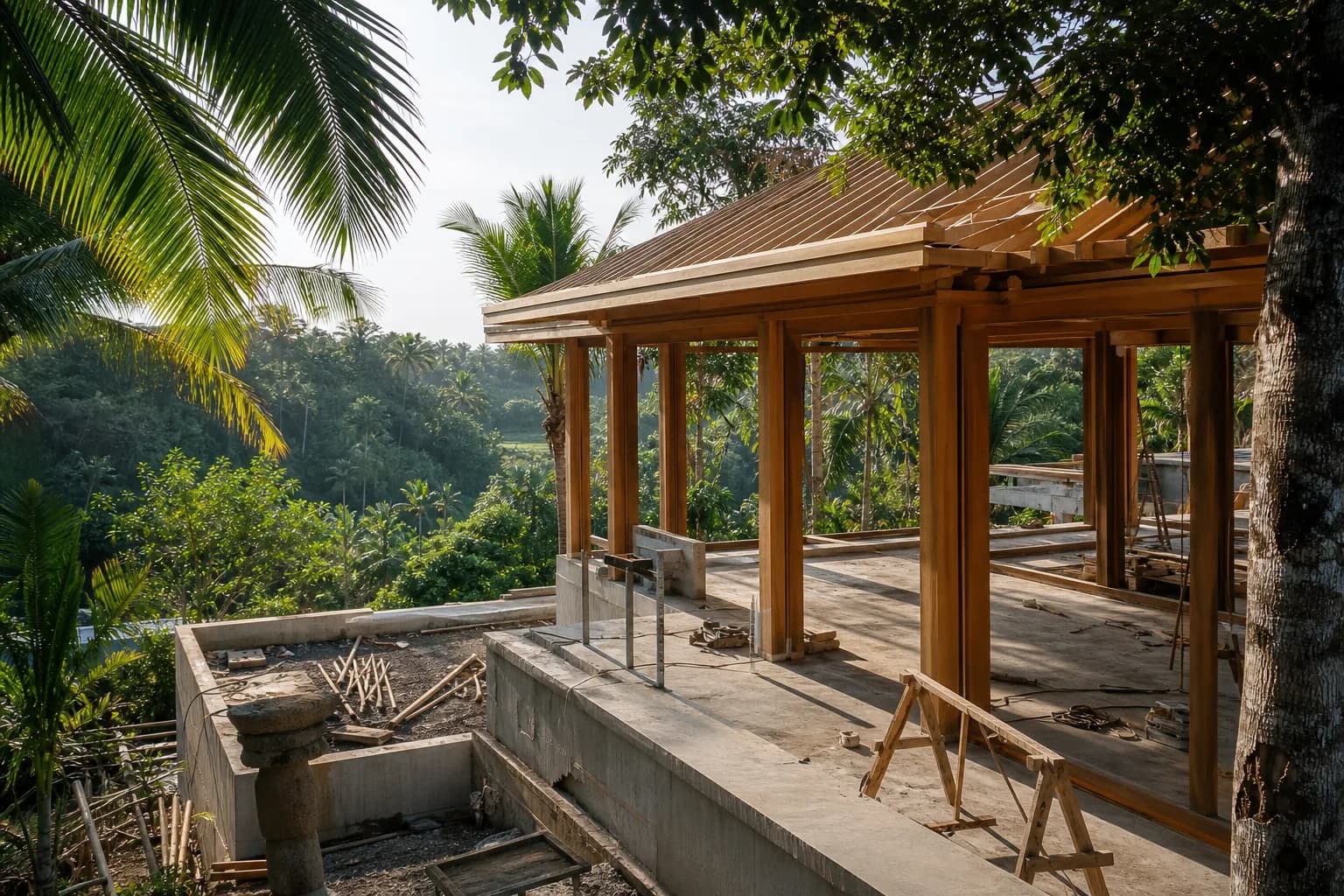
Leasehold vs Freehold in Bali: What Foreigners Can Actually Own in 2026
Foreigners cannot own freehold in Bali — but a well-structured leasehold, Hak Pakai, or PT PMA route is fully legal. What each title really gives you in 2026, side by side.
8 min read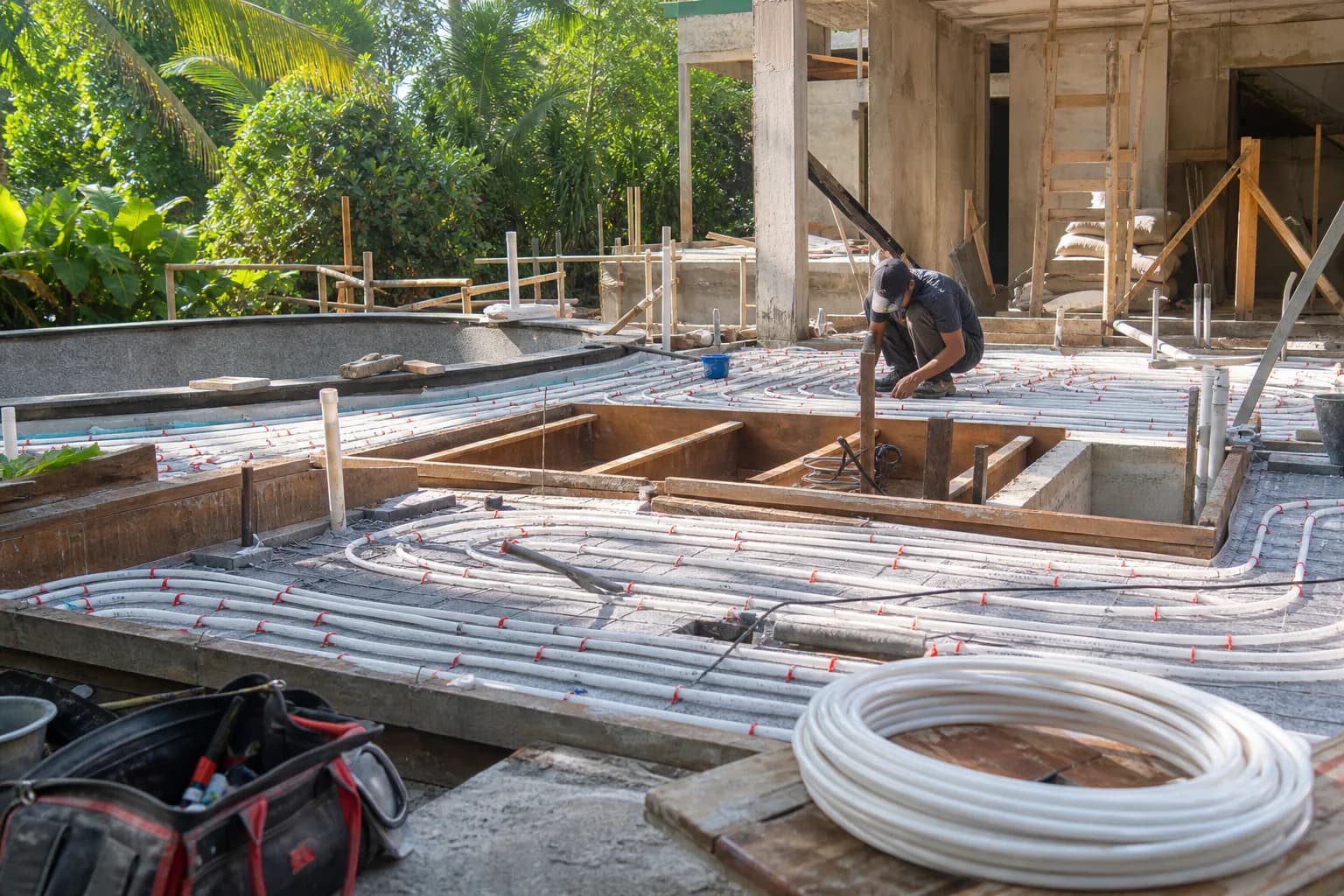
Underfloor Heating: Tile vs Concrete Subfloors in Bali
Compare underfloor heating options for tile and concrete subfloors in Bali. Learn viability, costs, and best practices for tropical climates.
10 min read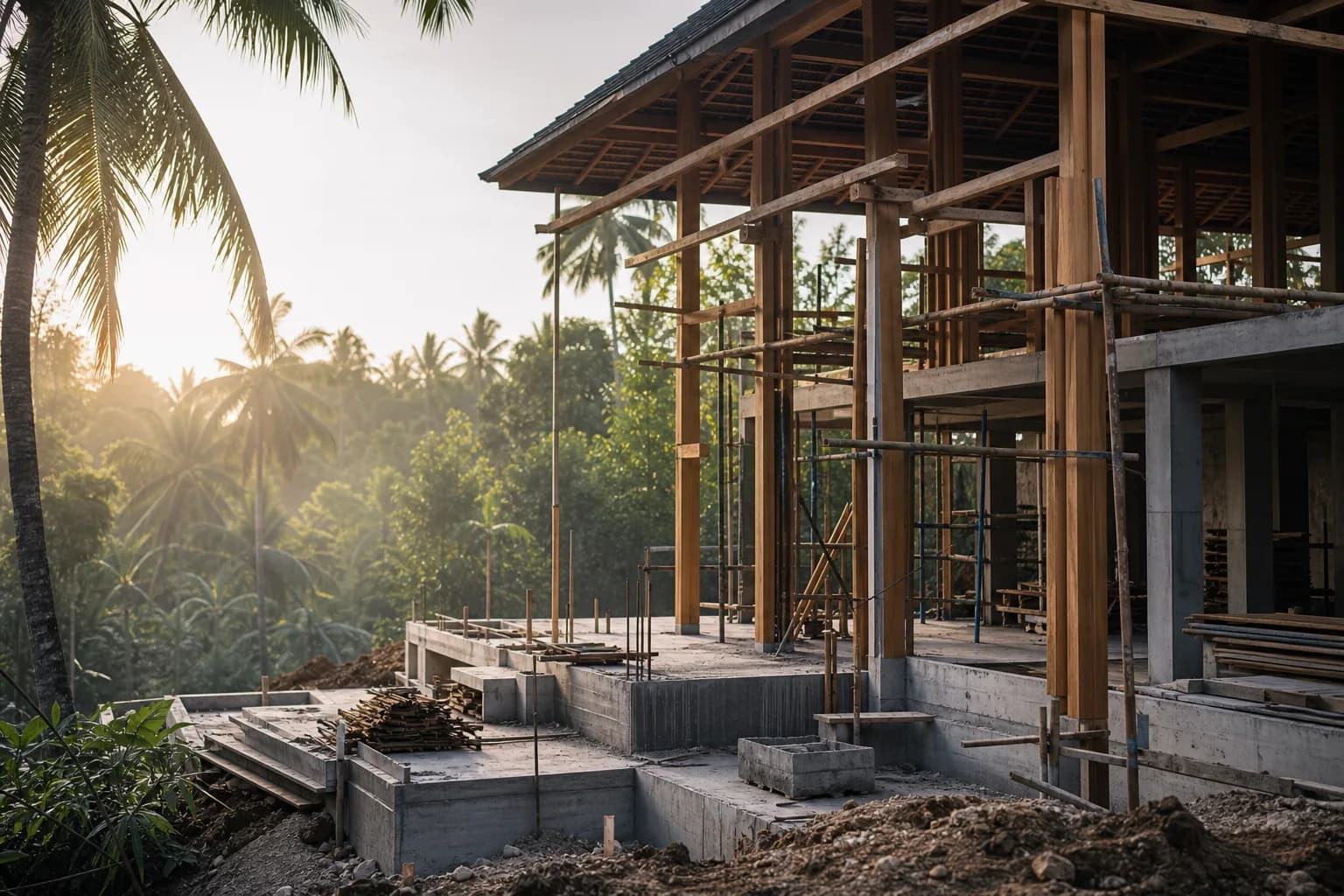
IMB Building Permit Timeline: Foundation to CO in Bali
Complete IMB building permit timeline from foundation to Certificate of Occupancy in Bali regencies. Expert guide on approval stages and requirements.
10 min read