Bukit Peninsula Slope Gradient Limits Terracing Costs Bali
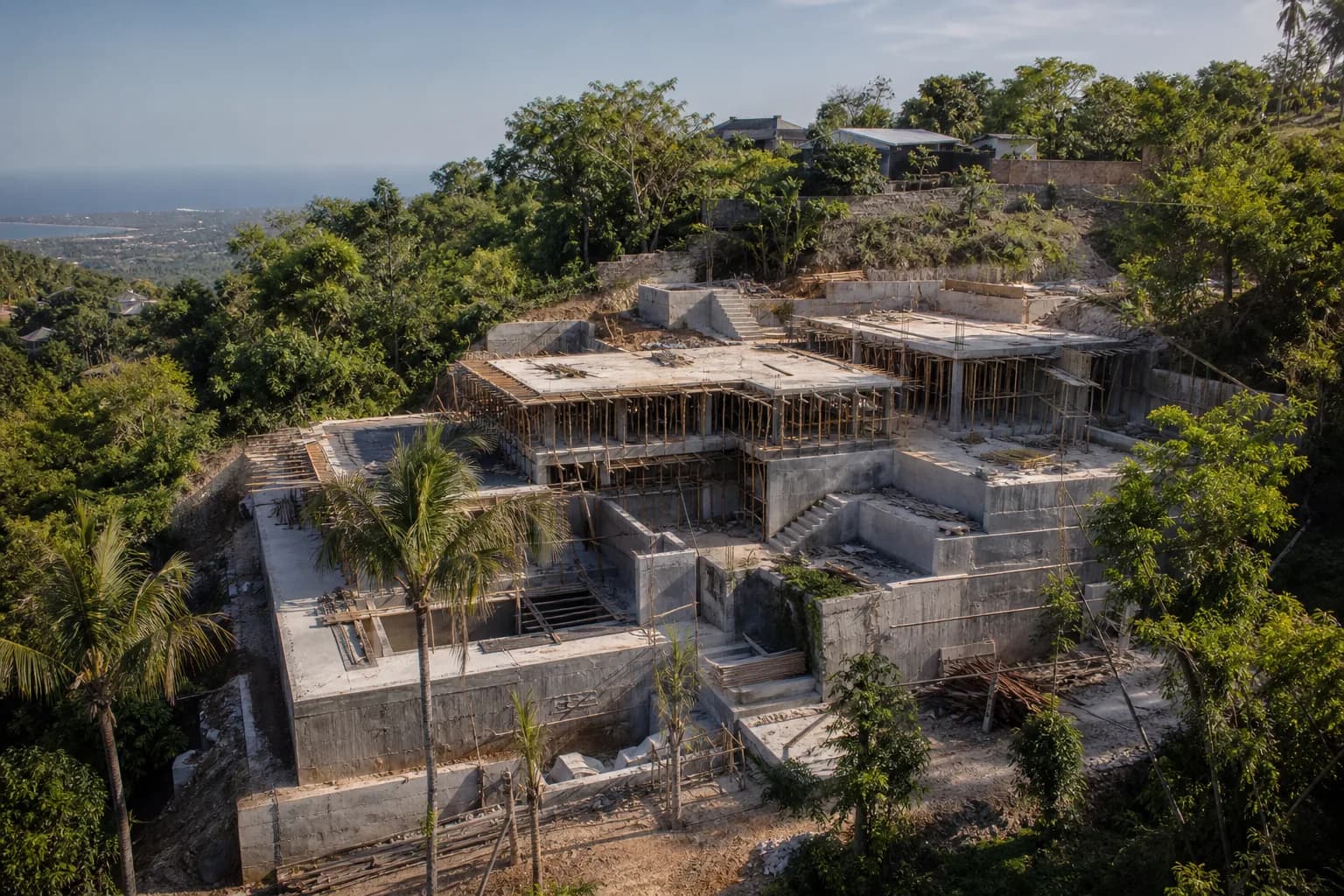
Why Bukit Peninsula Slope Gradient Limits Determine Your Construction Budget Before You Buy Land
The Bukit Peninsula’s dramatic clifftop views come with a hidden engineering challenge that most land buyers discover too late: slope gradient restrictions that can add $40,000-$120,000 in terracing and retaining wall costs to your construction budget. Unlike flat land in Canggu or Seminyak, Bukit’s topography requires specialized geotechnical analysis, slope stabilization permits, and engineered terracing systems that directly impact both your building footprint and total project cost. The critical threshold is 25-30% gradient—beyond this point, Indonesian building regulations require extensive soil testing, structural engineering certifications, and terracing permits that can extend your timeline by 4-6 months. Understanding these slope-specific requirements before land purchase prevents the common scenario where buyers commit to clifftop parcels only to discover their buildable area is 40% smaller than anticipated, or that retaining wall costs exceed the land price itself.
Technical Engineering Standards for Bukit Peninsula Slope Construction
Bukit Peninsula’s geological composition—primarily limestone karst with pockets of clay and volcanic soil—creates specific engineering challenges that Indonesian building codes address through gradient-based construction classifications. The fundamental regulatory framework divides slope construction into three categories: gentle slopes (0-15% gradient), moderate slopes (15-25% gradient), and steep slopes (25%+ gradient), each requiring progressively more complex permitting and engineering documentation.
Slope Gradient Measurement and Classification
Indonesian construction regulations measure slope gradient as rise-over-run percentage, not degrees. A 25% gradient means 25 meters of vertical rise per 100 meters of horizontal distance. For Bukit Peninsula specifically, local building authorities (DPMPTSP Badung Regency) require topographic surveys conducted by licensed Indonesian surveyors (with BNSP certification) showing contour lines at 1-meter intervals for any land exceeding 10% gradient. This survey becomes the foundational document for all subsequent permitting.
The critical regulatory threshold is 25% gradient. Below this, standard PBG (Building Permit Guarantee) processes apply with minimal additional requirements. Above 25%, you enter “steep slope construction” classification requiring: geotechnical soil investigation reports, structural engineer certifications for retaining walls, slope stability calculations, drainage engineering plans, and separate terracing construction permits issued before foundation work begins.
Terracing System Requirements and Engineering Standards
For slopes exceeding 25% gradient, Indonesian building codes mandate terraced construction with maximum 3-meter vertical drops between terrace levels. Each terrace requires engineered retaining walls designed to withstand: lateral earth pressure (calculated using Rankine or Coulomb methods), hydrostatic pressure from tropical rainfall (Bali receives 1,500-2,000mm annually), seismic loads (Bali is Zone 3 seismic classification), and long-term soil creep.
Retaining wall specifications for Bukit Peninsula typically require: reinforced concrete minimum 200mm thickness for walls under 2 meters height, increasing to 300-400mm for 3-meter walls; steel reinforcement minimum #10 rebar at 200mm spacing both directions; proper drainage systems including weep holes every 2 meters and gravel backfill; and foundation depth minimum 800mm below finished grade, extending to competent limestone or engineered fill.
The engineering calculations must be stamped by an Indonesian-licensed civil engineer (Insinyur Sipil with LPJK certification). This engineer becomes legally responsible for structural performance, making their selection critical. Teville’s construction process includes in-house structural engineering specifically experienced with Bukit’s karst geology and slope conditions, documented across our completed clifftop projects.
Permit Documentation for Slope Construction
The terracing permit process operates parallel to but separate from standard building permits. Required documentation includes: certified topographic survey showing existing contours and proposed finish grades; geotechnical investigation report with soil bearing capacity, shear strength parameters, and groundwater analysis; structural calculations for all retaining walls signed by licensed engineer; drainage engineering plan showing surface water management and subsurface drainage systems; and environmental impact assessment for slopes exceeding 35% gradient or within 100 meters of cliff edges.
Processing time for slope-specific permits adds 6-10 weeks to standard PBG timelines. Costs range from Rp 15,000,000-Rp 35,000,000 ($950-$2,200 USD) depending on site complexity and total terracing area, separate from standard building permit fees.
Hidden Risks Buyers Miss When Evaluating Sloped Bukit Land
The most expensive mistake in Bukit land purchase is calculating buildable area using total land size rather than slope-adjusted buildable footprint. A 500-square-meter clifftop parcel with 30% gradient may yield only 280-320 square meters of actual buildable terrace area after accounting for setbacks, retaining wall footprints, and access requirements. This 40% reduction in usable space fundamentally changes project economics.
Second critical oversight: underestimating retaining wall costs. Standard construction cost estimates of $1,000-$1,800 per square meter apply to building structure only—they don’t include site preparation and terracing. For steep Bukit sites, retaining walls can add $250-$450 per square meter of building footprint, effectively increasing total construction cost by 20-30%. A 200-square-meter villa might require $50,000-$90,000 in retaining walls and terracing before foundation work begins.
Third risk: drainage engineering complexity. Bukit’s limestone geology creates unpredictable groundwater flow patterns. During rainy season, water emerges from unexpected locations in cliff faces and slopes. Inadequate drainage design leads to hydrostatic pressure behind retaining walls, causing structural failure within 2-3 years. Proper subsurface drainage systems (French drains, perforated pipes, gravel layers) add $8,000-$15,000 to site preparation but prevent catastrophic wall failure.
Fourth issue: access road engineering. Steep Bukit sites often require private access roads with gradients exceeding 15%, necessitating concrete paving (asphalt fails on steep tropical slopes), proper drainage channels, and sometimes switchback designs. Budget $25,000-$60,000 for engineered access on challenging sites—costs rarely disclosed during land purchase negotiations.
Step-by-Step Process for Slope Construction Permitting on Bukit Peninsula
Phase 1: Pre-Purchase Due Diligence (2-3 weeks)
Before committing to land purchase, commission an independent topographic survey from a licensed Indonesian surveyor. Cost: Rp 8,000,000-Rp 15,000,000 ($500-$950). This survey reveals actual gradient percentages and identifies regulatory classification. Simultaneously, engage a structural engineer for preliminary site assessment—Teville provides this as part of our verified land consultation service, evaluating buildable area and estimating terracing costs before purchase commitment.
Request soil investigation data if available from previous owners, or budget for preliminary geotechnical testing (3-5 test borings, Rp 12,000,000-Rp 20,000,000 / $750-$1,250). This reveals soil bearing capacity and groundwater conditions that determine retaining wall design complexity.
Phase 2: Detailed Engineering Design (6-8 weeks)
After land acquisition, commission comprehensive geotechnical investigation meeting Indonesian SNI standards (SNI 8460:2017 for geotechnical investigation). This includes: minimum 3 test borings to 6-meter depth or refusal on limestone; laboratory testing for soil classification, shear strength, and bearing capacity; groundwater monitoring; and engineer’s report with foundation recommendations.
Simultaneously, structural engineer develops terracing design including: retaining wall layouts and heights; structural calculations for each wall section; drainage system design; and construction sequencing plan. This engineering package becomes the basis for permit applications and contractor bidding.
Phase 3: Permit Application and Approval (8-12 weeks)
Submit terracing permit application to DPMPTSP Badung Regency including all engineering documentation. This process runs parallel to standard PBG application but requires separate review by structural engineering department. Expect one round of revisions addressing drainage details or wall reinforcement specifications.
Upon approval, receive terracing construction permit (IMB Terasering) valid for 24 months. This permit must be obtained before excavation begins—starting work without it risks stop-work orders and potential demolition of non-compliant structures.
Phase 4: Construction Execution and Inspection (12-20 weeks for terracing)
Terracing construction proceeds in stages: excavation and rough grading; retaining wall foundation installation; wall construction with proper reinforcement and drainage; backfill with engineered materials; and finish grading. Each stage requires inspection by supervising engineer before proceeding.
Upon terracing completion, schedule inspection by building authority before beginning foundation work for main structure. This inspection verifies compliance with approved plans and issues clearance for vertical construction. Teville’s construction process integrates these inspections into project scheduling, preventing delays from missed compliance steps.
Realistic Cost Ranges and Timeline Expectations for Bukit Slope Projects
Terracing and retaining wall costs vary significantly based on gradient severity and total height of cuts. For moderate slopes (15-25% gradient) requiring 1-2 meter retaining walls, budget $180-$280 per linear meter of wall including engineering, materials, and construction. A typical 200-square-meter building footprint might require 40-60 linear meters of retaining walls, totaling $7,200-$16,800.
For steep slopes (25-35% gradient) requiring 2-3 meter walls with more complex engineering, costs increase to $350-$550 per linear meter. The same 200-square-meter footprint might need 60-80 linear meters of walls across multiple terrace levels, totaling $21,000-$44,000.
Extreme slopes (35%+ gradient) or clifftop sites requiring 3+ meter walls with specialized foundation systems (micropiles, rock anchors) can reach $650-$900 per linear meter, with total terracing costs of $50,000-$90,000 for a 200-square-meter villa footprint.
Additional slope-related costs include: geotechnical investigation $750-$1,250; structural engineering design $2,500-$4,500; terracing permits $950-$2,200; drainage systems $8,000-$15,000; and access road engineering $25,000-$60,000 for challenging sites. Total site preparation for steep Bukit land can reach $80,000-$150,000 before building construction begins.
Timeline additions: slope permitting adds 6-10 weeks to standard schedules; terracing construction requires 12-20 weeks depending on complexity; and total project duration for steep-slope villas extends to 16-20 months versus 12-14 months for flat sites. Request detailed cost estimation through Teville’s build cost calculator with slope-specific parameters.
Frequently Asked Questions: Bukit Peninsula Slope Construction
What is the maximum allowable slope gradient for residential construction on Bukit Peninsula?
Indonesian building regulations don’t prohibit construction on any specific gradient, but slopes exceeding 40% require extraordinary engineering measures including environmental impact assessments and often prove economically unfeasible. The practical limit for cost-effective villa construction is 30-35% gradient. Beyond this, terracing and retaining wall costs often exceed the value of the completed structure. Sites with gradients of 25-30% represent the optimal balance—dramatic views with manageable engineering costs. Always commission topographic surveys before purchase to verify actual gradient percentages rather than relying on visual estimates, which typically underestimate slope severity by 30-40%.
How much do terracing permits cost separately from standard building permits in Badung Regency?
Terracing construction permits (IMB Terasering) are issued separately from standard PBG building permits when retaining walls exceed 1.5 meters height or total terraced area exceeds 100 square meters. Permit fees range from Rp 15,000,000 to Rp 35,000,000 ($950-$2,200 USD) based on total retaining wall area and structural complexity. This cost is separate from standard PBG fees of approximately Rp 25,000,000-Rp 45,000,000 for villa construction. Processing time adds 6-10 weeks to project schedules. The permit requires stamped structural engineering drawings, geotechnical reports, and drainage plans—documentation costs of $3,000-$5,500 additional. Budget total permitting costs of $5,000-$8,000 for slope construction projects versus $2,500-$4,000 for flat sites.
Can I build a villa on Bukit clifftop land with 30% gradient, and what are the real costs?
Yes, 30% gradient is buildable but requires engineered terracing systems and adds significant costs. For a 200-square-meter villa on 30% slope, expect: retaining walls totaling $35,000-$55,000; geotechnical investigation and engineering $4,000-$6,500; slope-specific permits $2,000-$3,500; enhanced drainage systems $10,000-$15,000; and access road engineering $20,000-$40,000. Total site preparation: $71,000-$120,000 before building construction begins. This represents 25-35% additional cost versus flat land construction. However, clifftop Bukit locations command premium positioning—the engineering investment is justified when total project budget and long-term structural performance are properly planned. Review Teville’s completed clifftop projects for realistic scope examples.
What happens if I start construction without slope-specific permits on Bukit Peninsula?
Constructing retaining walls or terracing without proper pe
 1from 198.000 USD
Private: Haridas Villas
 164 m²7 month(s)from 79.000 USD
TALA TWO
 3180 m²7 month(s)from 142.000 USD
Vasudeva
 3124 m²6 month(s)from 123.000 USD
TALA 8
164 m²7 month(s)from 79.000 USDPrivate: Haridas Villas, Tegallalang
 2144 m²11 month(s)from 104.000 USD
Narayana
 172 m²8 month(s)from 120.000 USD
Keshava
 3104 m²11 month(s)from 99.000 USD
TALA 100
 4344 m²16 month(s)from 290.000 USD
Radha
 3173 m²6 month(s)from 125.000 USD
TALA FOUR

Want to calculate?
 3127 m²9 month(s)from 177.000 USD
Mukunda
Start With Real Numbers, Not Guesses
Before buying land or finalizing a design, check the realistic build cost range for your project in Bali.
Our team reviews your inputs and gives a grounded estimate.
Available lands
 2200 m²15 min$ 508005Bali, Canggu
 18900 m²2 min$ 6912931Bali, Pecatu
 7000 m²36 min$ 284483Bali, Gianyar
 6000 m²30 min$ 55419Bali, Tabanan
 500 m²15 min$ 124692Bali, Kaba Kaba
 260 m²5 min$ 51872Bali, Kedungu
 3100 m²15 min$ 257697Bali, Tegallalang
 7500 m²5 min$ 206281Bali, Kedungu
 928 m²15 min$ 910123Bali, Pererenan
 200 m²11 min$ 89286Bali, Tabanan
 444 m²10 min$ 111000Bali, Tabanan
 1000 m²5 min$ 350431Bali, Drupadi
 2130 m²10 min$ 495776Bali, Pecatu
 1200 m²2 min$ 155172Bali, Klungkung
 3300 m²15 min$ 449889Bali, Tabanan
Essential Bali build & buy guides
- Bali villa construction cost per m² in 2026
- How much will your villa cost? Calculator
- Building a villa in Bali: the complete guide
- Buying land in Bali: step-by-step for foreigners
- Bali villa investment: yields, risks, returns
- Leasehold vs freehold: what foreigners can own
- Construction defect liability & 10-year warranty
- Bali building codes and construction standards
Related guides
Bali Property Contracts and Indonesian Language Law: Dual-Language Pitfalls That Void Deals
Indonesian law requires property agreements with Indonesian parties to exist in Indonesian — and the two language versions can quietly diverge. What the language law demands in 2026, the real court history, and the dual-language pitfalls that damage Bali deals.
8 min read
Bali Land Certificates Decoded: SHM, HGB, Hak Pakai and Girik Explained for Buyers
A buyer's decoder for Bali land certificates: what SHM, HGB, Hak Pakai and girik actually mean, why girik lost standalone legal force in February 2026, and how to verify a title before you commit.
9 min read
Inheritance of Bali Property for Foreigners: Leasehold, PT PMA Shares and Wills
What happens to your Bali villa when you die: why a leasehold passes to heirs only if the deed says so, how PT PMA shares are inherited, the one-year rule for foreign heirs of freehold land, and the Indonesian notarial will that makes it all work.
7 min read