Villa Renovation Costs in Bali: Complete 2025 Guide
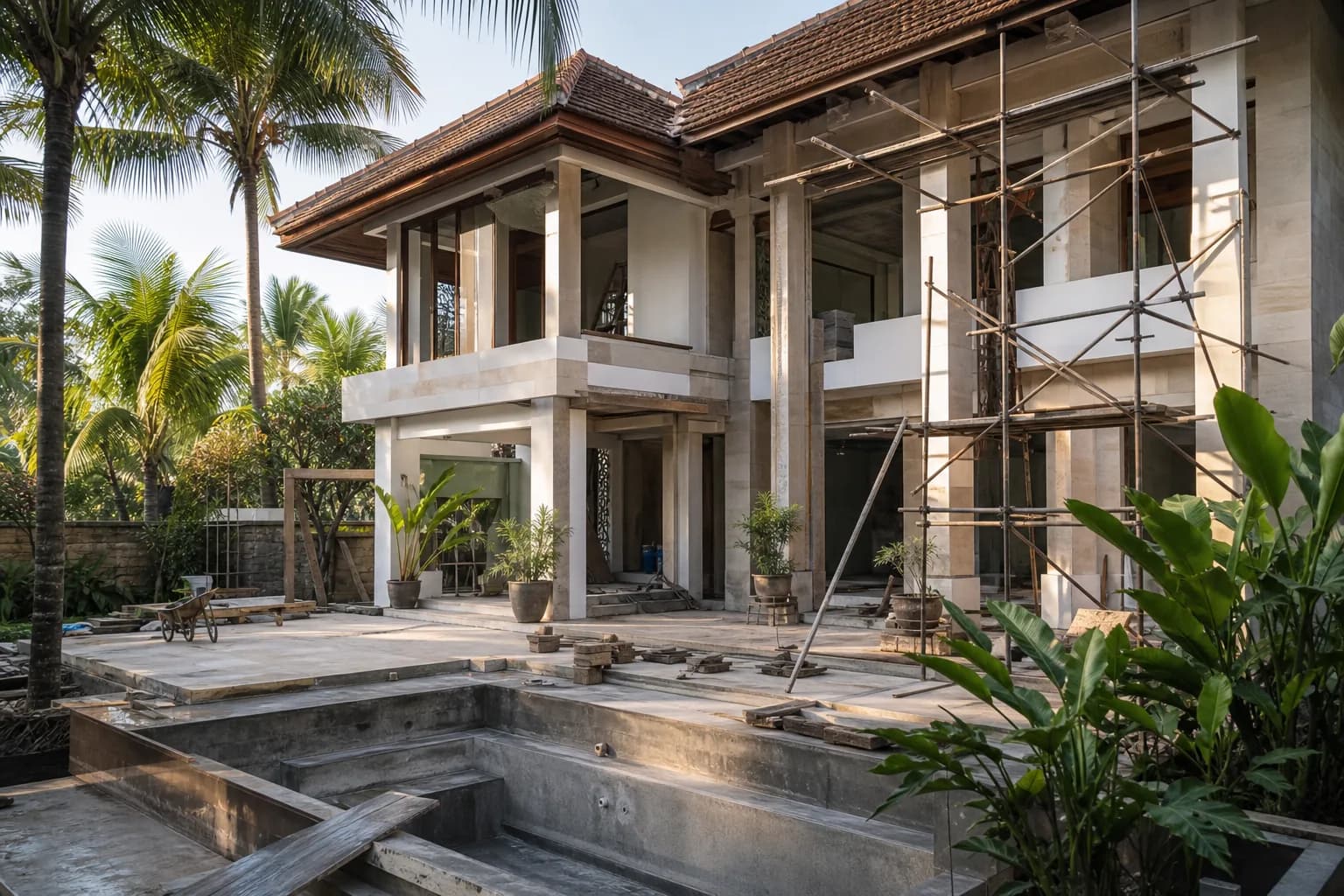
Understanding Villa Renovation Costs in Bali: A Comprehensive Guide for Property Owners
Renovating a villa in Bali requires careful financial planning and a thorough understanding of local construction costs, regulatory requirements, and market conditions. As property owners increasingly seek to upgrade aging infrastructure or modernize existing properties, understanding villa renovation costs Bali has become essential for making informed investment decisions. This comprehensive guide provides detailed cost breakdowns, timeline estimates, and practical advice for managing renovation projects in Bali’s unique construction environment.
The Balinese construction market operates differently from Western markets, with distinct pricing structures, material availability considerations, and regulatory frameworks that directly impact renovation budgets. Current market data indicates that villa renovation costs Bali range from $1,000 to $1,800 per square meter for investment-grade finishes, though actual costs vary significantly based on renovation scope, existing conditions, and specification levels.
Defining Your Renovation Scope: Cosmetic Versus Structural Work
Before establishing a budget, property owners must clearly define their renovation scope. The distinction between cosmetic and structural work fundamentally affects cost projections, timeline requirements, and regulatory compliance needs.
Cosmetic Renovations
Cosmetic renovations address surface-level improvements without altering the villa’s structural integrity or major systems. These projects typically include repainting, flooring replacement, fixture updates, soft furnishing replacement, and landscape refreshing. Cosmetic work generally requires minimal permitting, shorter timelines, and lower budgets compared to structural interventions.
Common cosmetic renovation elements include wall finishes and paint application, tile replacement in bathrooms and kitchens, lighting fixture upgrades, cabinet refacing or replacement, window treatment installation, and outdoor furniture and decor updates. These improvements can significantly enhance a property’s appearance and functionality without the complexity of structural modifications.
Structural Renovations
Structural renovations involve modifications to load-bearing elements, major system replacements, or significant spatial reconfigurations. These projects require engineering assessments, building permits, and compliance with Indonesian construction standards. Structural work includes foundation repairs, roof replacement or modification, wall removal or addition, plumbing system overhauls, electrical system upgrades, and pool reconstruction or installation.
Structural renovations demand professional engineering oversight and typically extend project timelines by several months. The permitting process alone can require 4-8 weeks, depending on the scope and local administrative efficiency. Property owners should budget additional contingency funds for structural projects, as hidden conditions frequently emerge during demolition phases.
Villa Renovation Cost Ranges: Minor, Medium, and Major Projects
Understanding villa renovation costs Bali requires categorizing projects by scope and intensity. The following cost ranges reflect current market conditions for 2026 and assume standard construction practices with mid-range to upper-mid-range finishes.
Minor Refresh (Cosmetic Updates)
Minor refreshes typically cost between $150-$350 per square meter and focus on surface improvements without structural modifications. A 200-square-meter villa would require approximately $30,000-$70,000 for a comprehensive cosmetic update.
This budget level covers interior and exterior repainting, flooring replacement in select areas, bathroom fixture updates, kitchen cabinet refacing, lighting upgrades, landscape maintenance and replanting, and minor plumbing and electrical repairs. Timeline expectations range from 4-8 weeks, depending on material availability and contractor scheduling.
Minor refreshes prove most effective for properties with sound structural conditions requiring aesthetic modernization. These projects deliver immediate visual impact with minimal disruption and relatively predictable budgets.
Medium Renovation (Selective Structural Work)
Medium renovations cost approximately $500-$900 per square meter and combine cosmetic improvements with selective structural modifications. For a 200-square-meter villa, budgets typically range from $100,000-$180,000.
This scope includes complete interior repainting and finishing, full bathroom renovations with new fixtures and waterproofing, kitchen renovation with new cabinetry and appliances, selective flooring replacement throughout, roof repairs or partial replacement, pool resurfacing and equipment upgrades, electrical panel upgrades and rewiring in specific areas, and plumbing system repairs and fixture replacement.
Medium renovations require 3-5 months for completion and necessitate building permits for structural elements. These projects address deferred maintenance while implementing functional improvements that extend the property’s useful life.
Major Overhaul (Comprehensive Renovation)
Major overhauls represent the highest investment level, with villa renovation costs Bali ranging from $1,000-$1,800 per square meter. A 200-square-meter villa requires $200,000-$360,000 for comprehensive renovation.
Major projects encompass complete structural assessment and repairs, full roof replacement with upgraded materials, comprehensive electrical system replacement, complete plumbing system overhaul, all bathroom and kitchen renovations, flooring replacement throughout, window and door replacement, pool reconstruction or major renovation, landscape redesign and implementation, and exterior facade restoration or modification.
These projects require 6-10 months for completion and involve extensive permitting processes. Major overhauls essentially create a new villa within the existing footprint, addressing all deferred maintenance and implementing contemporary standards throughout.
Room-by-Room Cost Breakdown
Detailed cost analysis by room type provides property owners with granular budget planning capabilities. The following breakdowns reflect mid-range to upper-mid-range specifications using quality materials and experienced contractors.
Kitchen Renovations
Kitchen renovations represent one of the highest cost-per-square-meter areas in villa projects. A standard 15-square-meter kitchen renovation costs between $12,000-$30,000, depending on specification levels.
Budget allocations typically include custom cabinetry at $3,000-$8,000, countertops (granite, quartz, or engineered stone) at $1,500-$4,000, appliances (refrigerator, stove, hood, dishwasher) at $3,000-$8,000, plumbing fixtures and installation at $1,500-$3,000, electrical work and lighting at $1,000-$2,500, flooring at $800-$2,000, and backsplash and wall finishes at $1,200-$2,500.
Kitchen renovations require careful coordination between multiple trades and typically span 4-6 weeks. Material lead times, particularly for imported appliances and custom cabinetry, often determine project schedules. Property owners should specify appliance models early in the design phase to ensure availability and accurate budget allocation.
Bathroom Renovations
Bathroom renovations cost approximately $8,000-$18,000 for a standard 6-square-meter space. These projects involve extensive waterproofing requirements and coordination between plumbing, electrical, and finishing trades.
Typical cost components include waterproofing and substrate preparation at $800-$1,500, tile work (floors and walls) at $2,000-$4,500, sanitaryware (toilet, sink, shower fixtures) at $1,500-$4,000, vanity and storage at $1,200-$3,000, shower enclosure or bathtub at $1,000-$2,500, plumbing rough-in and installation at $1,000-$2,000, electrical work and lighting at $800-$1,500, and ventilation system at $500-$1,000.
Proper waterproofing represents the most critical technical requirement in bathroom renovations. Inadequate waterproofing causes long-term structural damage and costly remediation. Experienced contractors allocate 3-4 days for proper membrane application and testing before proceeding with tile installation.
Bedroom Renovations
Bedroom renovations typically cost $3,000-$8,000 per room for cosmetic updates and $6,000-$15,000 when including structural modifications or built-in furniture.
Standard bedroom renovation budgets cover painting and wall finishes at $600-$1,200, flooring replacement at $1,200-$3,000, built-in wardrobes at $2,000-$5,000, electrical upgrades and lighting at $800-$2,000, window treatments at $400-$1,200, air conditioning replacement or upgrade at $1,000-$2,500, and door replacement at $500-$1,200.
Bedroom renovations offer flexibility in phasing, allowing property owners to complete work incrementally if budget constraints exist. However, completing all bedrooms simultaneously often reduces overall costs through material bulk purchasing and continuous contractor engagement.
Living Areas and Common Spaces
Living area renovations vary significantly based on size and specification but typically cost $150-$400 per square meter. A 50-square-meter open-plan living area requires $7,500-$20,000 for comprehensive renovation.
Budget considerations include flooring replacement at $3,000-$8,000, wall finishes and painting at $1,500-$3,500, ceiling work and lighting at $2,000-$5,000, window and door replacement at $1,500-$4,000, built-in furniture and storage at $2,000-$6,000, and electrical upgrades at $1,000-$2,500.
Living areas often require structural assessment when property owners desire open-plan configurations. Removing walls necessitates engineering evaluation and beam installation, adding $3,000-$8,000 to project costs depending on span requirements.
Hidden Costs and Unexpected Expenses
Experienced property owners budget substantial contingencies for hidden costs that emerge during renovation projects. Understanding common unexpected expenses helps establish realistic financial planning for villa renovation costs Bali.
Permits and Regulatory Compliance
Building permits in Bali cost between $2,000-$8,000 depending on project scope and property location. The permitting process involves multiple government agencies and requires architectural drawings, structural calculations, and environmental assessments for significant projects.
Additional regulatory costs include IMB (building permit) processing fees, environmental impact assessments for major projects, fire safety compliance for commercial-use properties, occupancy certificates upon completion, and professional fees for architects and engineers to prepare permit documentation.
Permit processing timelines range from 4-12 weeks, with variations based on local administrative capacity and project complexity. Property owners should initiate permit applications early in the planning phase to avoid construction delays.
Utilities Infrastructure Upgrades
Aging villas frequently require utilities infrastructure upgrades that weren’t apparent during initial assessments. Electrical panel upgrades cost $2,000-$5,000, water pressure system installation ranges from $1,500-$4,000, septic system replacement requires $3,000-$8,000, and water treatment system installation costs $1,500-$4,000.
Properties in rural areas may require well drilling or water source development, adding $3,000-$10,000 to project budgets. Internet and communication infrastructure upgrades, increasingly important for rental properties, cost $500-$2,000 depending on location and service availability.
Structural Issues Discovered During Demolition
Concealed structural deficiencies represent the most significant budget risk in renovation projects. Common discoveries include foundation settlement or cracking, termite damage in wooden structural elements, roof truss deterioration, inadequate waterproofing causing concrete degradation, and substandard original construction requiring remediation.
Property owners should budget 15-25% contingency for structural surprises in properties over 10 years old. Pre-renovation structural assessments by qualified engineers cost $800-$2,000 but provide valuable risk identification before committing to project budgets.
Timeline Estimates by Renovation Level
Accurate timeline projections enable property owners to plan occupancy, rental income interruptions, and cash flow requirements. The following estimates reflect typical project durations under normal conditions with experienced contractors.
Minor Cosmetic Refresh Timeline
Minor refreshes require 4-8 weeks from commencement to completion. Week 1 involves site preparation and material procurement, weeks 2-3 cover painting and surface preparation, weeks 4-5 include flooring installation and fixture replacement, weeks 6-7 encompass finishing work and detail completion, and week 8 provides final cleaning and handover.
These timelines assume material availability and continuous contractor engagement. Delays commonly occur due to custom material orders, weather interruptions during exterior work, and contractor scheduling conflicts during peak construction seasons.
Medium Renovation Timeline
Medium renovations span 3-5 months with distinct phases. Month 1 includes permit processing, detailed planning, and demolition work. Month 2 covers rough-in work for plumbing and electrical systems, structural repairs, and substrate preparation. Month 3 involves tile installation, cabinetry installation, and major fixture placement. Month 4 includes painting, flooring installation, and finishing work. Month 5 provides final installations, testing, and project closeout.
Medium projects require careful trade coordination to maintain schedule efficiency. Critical path activities include permit approval, custom millwork fabrication, and imported material delivery. Property owners should maintain regular communication with project managers to address scheduling conflicts proactively.
Major Overhaul Timeline
Major overhauls require 6-10 months for completion, with extended timelines for complex projects or properties with significant structural issues. Months 1-2 involve engineering assessments, permit processing, detailed design development, and demolition. Months 3-4 cover structural repairs, foundation work, roof replacement, and major system installations. Months 5-6 include rough-in completion, waterproofing, and substrate preparation. Months 7-8 encompass finishing work, cabinetry and fixture installation, and tile work. Months 9-10 provide painting, final installations, landscape work, and comprehensive testing.
Major projects face extended timelines due to permit complexity, material lead times for high-specification items, weather impacts on exterior work, and sequential trade dependencies. Property owners should avoid compressed schedules that compromise quality or create contractor coordination challenges.
Budgeting Strategies and Contingency Planning
Effective budget management separates successful renovation projects from financially troubled ones. Professional approaches to villa renovation costs Bali incorporate realistic contingencies, phased funding, and disciplined change order management.
Establishing Base Budgets
Base budgets should reflect detailed quantity takeoffs and current market pricing for materials and labor. Experienced property owners obtain multiple quotations for major work packages and verify contractor pricing against independent cost estimates.
Budget development begins with architectural drawings showing renovation scope, detailed specifications for materials and finishes, comprehensive scope of work documents, and allowances for owner-selected items like fixtures and appliances. This documentation enables accurate contractor bidding and reduces misunderstandings during construction.
Contingency Allocation
Appropriate contingency percentages vary by project type and property condition. Minor cosmetic projects require 10-15% contingency, medium renovations need 15-20% contingency, and major overhauls demand 20-30% contingency for properties over 15 years old.
Contingency funds address unforeseen conditions, owner-initiated changes, material price fluctuations, and schedule extensions requiring additional contractor time. Disciplined property owners resist the temptation to reallocate contingency funds to scope upgrades, maintaining reserves for genuine unexpected conditions.
Payment Scheduling
Payment schedules should align with project milestones and deliverables rather than arbitrary time intervals. Typical payment structures include 10-15% deposit upon contract signing, 25-30% upon completion of demolition and rough-in work, 30-35% upon completion of waterproofing and substrate preparation, 20-25% upon substantial completion of finishing work, and 5-10% retention upon final completion and defect rectification.
This structure protects property owners while providing contractors with adequate cash flow for material procurement and labor payments. Avoid front-loading payments or releasing final retention before comprehensive defect inspection and correction.
Contractor Selection and Management
Contractor selection represents the most critical decision affecting project outcomes, costs, and quality. The Balinese construction market includes contractors ranging from informal operators to established firms with documented processes and quality systems.
Evaluation Criteria
Property owners should evaluate contractors based on documented project history, financial stability, technical capabilities, quality control systems, and communication practices. Request references from recent projects of similar scope and conduct site visits to assess workmanship quality.
Established firms like Teville provide transparent processes, documented construction methodologies, and comprehensive project management. Review their construction approach and examine completed projects to assess quality standards and design capabilities.
Contract Documentation
Comprehensive contracts protect both parties and establish clear expectations for scope, quality, timeline, and payment. Essential contract elements include detailed scope of work with specifications, payment schedule tied to milestones, timeline with completion date and liquidated damages provisions, warranty terms for workmanship and materials, change order procedures with pricing methodology, dispute resolution mechanisms, and insurance and liability provisions.
Contracts should reference architectural drawings, specifications, and material schedules as integral documents. Ambiguous contracts create disputes and cost overruns; invest in proper documentation before commencing work.
Project Monitoring
Active project monitoring enables early identification of issues and maintains schedule momentum. Property owners or their representatives should conduct weekly site inspections, review progress against schedule, verify material deliveries match specifications, document work quality through photo
 1from 198.000 USD
Private: Haridas Villas
 3173 m²6 month(s)from 125.000 USD
TALA FOUR
 3124 m²6 month(s)from 123.000 USD
TALA 8
 3180 m²7 month(s)from 142.000 USD
Vasudeva
 2144 m²11 month(s)from 104.000 USD
Narayana
 3104 m²11 month(s)from 99.000 USD
TALA 100
 164 m²7 month(s)from 79.000 USD
Private: Haridas Villas, Tegallalang
 172 m²8 month(s)from 120.000 USD
Keshava
164 m²7 month(s)from 79.000 USDTALA TWO
 3127 m²9 month(s)from 177.000 USD
Mukunda

Want to calculate?
 4344 m²16 month(s)from 290.000 USD
Radha
Start With Real Numbers, Not Guesses
Check realistic build cost range for your Bali project.
Available lands
 550 m²15 min$ 164594Bali, Mengwi
 515 m²7 min$ 570813Bali, Canggu
 220 m²2 min$ 66565Bali, Cemagi
 500 m²15 min$ 124692Bali, Kaba Kaba
 5028 m²10 min$ 361000Bali, Ubud
 1660 m²10 min$ 343448Bali, Kerobokan
 889 m²15 min$ 145612Bali, Cepaka
 2200 m²15 min$ 508005Bali, Canggu
 4270 m²10 min$ 394397Bali, Ubud
 2130 m²10 min$ 495776Bali, Pecatu
 610 m²10 min$ 165271Bali, Seminyak
 1200 m²2 min$ 155172Bali, Klungkung
 3100 m²20 min$ 272968Bali, Tabanan
 800 m²8 min$ 113300Bali, Ungasan
 10000 m²19 min$ 232759Bali, Buleleng
Essential Bali build & buy guides
- Bali villa construction cost per m² in 2026
- How much will your villa cost? Calculator
- Building a villa in Bali: the complete guide
- Buying land in Bali: step-by-step for foreigners
- Bali villa investment: yields, risks, returns
- Leasehold vs freehold: what foreigners can own
- Construction defect liability & 10-year warranty
- Bali building codes and construction standards
Related guides
Milestone Payment Schedules in Bali Construction: How Staged Payments Protect You
Milestone-based payment schedules are a Bali builder's best client protection: what a healthy 6-stage structure looks like, how to verify progress remotely, and which payment terms to refuse.
7 min read
Financing a Bali Villa: Why the Market Is Cash-Only for Foreigners — and the Realistic Alternatives
Why foreign buyers in Bali almost always pay cash, the narrow 2026 bank options for residents, and the realistic alternatives — from home-country equity to milestone-staged construction payments.
7 min read
Bali Rental Income Tax and Compliance Costs: The 10% Rule and the Real Math
How Bali rental income is really taxed in 2026 — the 10% final tax, the 20% non-resident trap, PB1, licensing overhead — and a worked example showing what a villa owner actually keeps.
7 min read