Concrete Batching Plant vs Ready-Mix: Cost Per m³ Bali
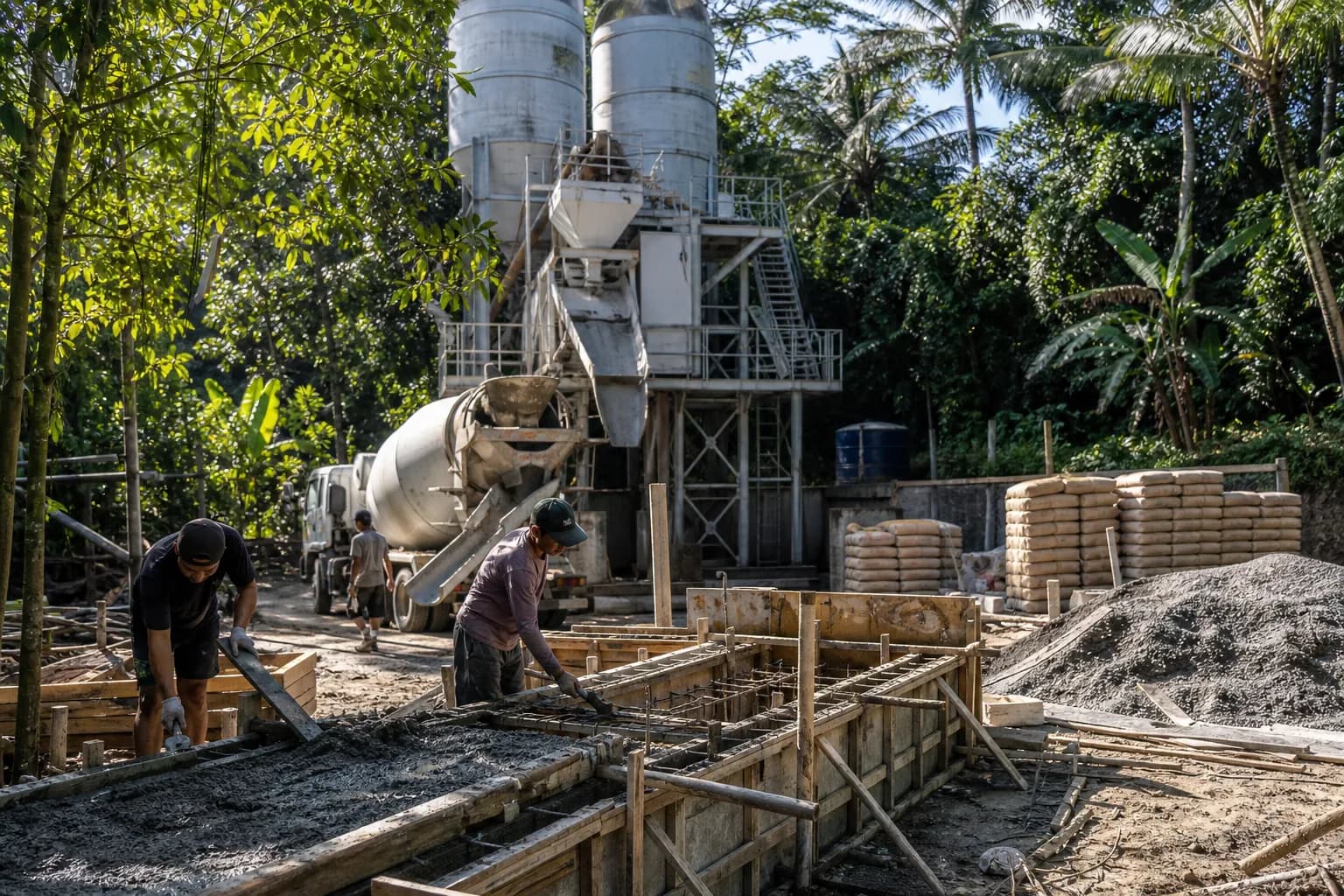
The Hidden Cost Differential: Why Your Concrete Sourcing Decision Impacts Villa Construction Cost Bali by 18-35%
When planning villa construction in Bali, most developers focus on architectural design and land purchase costs, overlooking a critical engineering decision that can shift project economics by hundreds of millions of rupiah: concrete sourcing strategy. For projects requiring 200m³ or more of concrete—typical for a three-bedroom villa with pool—the choice between establishing an on-site batching plant versus procuring ready-mix concrete creates a cost differential of Rp 180,000-320,000 per cubic meter. This isn’t merely a procurement question; it’s a structural engineering and logistics challenge unique to Bali’s infrastructure constraints, where narrow access roads in Canggu or Uluwatu can add 40% to ready-mix delivery costs, and where tropical humidity affects concrete curing differently than temperate climates. The decision requires analyzing break-even volumes, quality control capabilities, and the hidden operational costs that transform initial price comparisons into long-term project economics.
Technical Engineering Analysis: Batching Plant vs Ready-Mix Economics for Bali Projects
The fundamental cost structure of concrete sourcing in Bali diverges significantly from mainland Southeast Asian markets due to three engineering factors: material import dependencies, transportation infrastructure limitations, and tropical climate quality control requirements.
On-Site Batching Plant Capital and Operational Structure
A concrete batching plant suitable for villa construction projects in Bali typically requires a 30-50m³/hour capacity system. The capital investment for a CP30 or equivalent mobile batching plant ranges from USD $35,000-65,000 (Rp 560-1,040 million) for basic models, with automated systems reaching USD $85,000-120,000. However, the total establishment cost extends beyond equipment purchase:
- Site preparation and foundation: Rp 45-75 million for concrete pad, drainage, and stabilization suitable for Bali’s volcanic soil conditions
- Material storage infrastructure: Rp 30-50 million for covered aggregate bins, cement silos with moisture protection, and admixture storage meeting tropical humidity standards
- Water supply and quality control: Rp 15-25 million for filtration systems ensuring consistent water chemistry, critical for concrete strength in high-chloride coastal environments
- Electrical infrastructure: Rp 20-35 million for three-phase power installation, backup generator capacity, and voltage stabilization
- Quality testing equipment: Rp 12-18 million for slump testing, cube molds, and basic laboratory equipment required for structural compliance
The operational cost per cubic meter for on-site batching includes raw material procurement, labor, equipment depreciation, and quality control. For a standard K-300 structural concrete mix (30 MPa compressive strength) commonly specified in Bali villa construction, the component costs break down as:
- Portland cement (350kg/m³): Rp 385,000-420,000 (Rp 1,100-1,200/kg for locally produced cement)
- Fine aggregate/sand (680kg/m³): Rp 170,000-210,000 (sourcing from approved quarries with consistent gradation)
- Coarse aggregate (1,100kg/m³): Rp 220,000-280,000 (volcanic stone with proper crushing and washing)
- Water and admixtures: Rp 35,000-50,000 (including plasticizers for tropical workability and retarders for extended placement time)
- Direct labor (batching operator, quality control): Rp 45,000-60,000 per m³
- Equipment operation (fuel, maintenance, depreciation): Rp 55,000-75,000 per m³
This yields a total production cost of Rp 910,000-1,095,000 per cubic meter for on-site batching, before accounting for the amortized capital investment. The break-even analysis requires dividing total capital expenditure by the cost differential versus ready-mix, typically achieving payback at 350-500m³ of concrete production.
Ready-Mix Concrete Delivered Cost Structure in Bali
Ready-mix concrete suppliers in Bali operate from centralized plants in Denpasar, Tabanan, and Gianyar, creating a delivery radius challenge for projects in Uluwatu, Canggu, or northern coastal areas. The delivered cost structure for K-300 concrete includes:
- Base concrete price: Rp 1,150,000-1,350,000 per m³ ex-plant
- Transportation surcharge: Rp 120,000-450,000 per m³ depending on distance (15-45km typical range) and road accessibility
- Minimum order requirements: Most suppliers enforce 3-5m³ minimum per delivery, creating waste costs for small pours
- Waiting time charges: Rp 250,000-400,000 per hour beyond the standard 30-minute unloading window, critical for sites with difficult access requiring concrete pumping
- Weekend/holiday premiums: 15-25% surcharge for deliveries outside standard working hours
The total delivered cost for ready-mix concrete in Bali villa projects typically ranges from Rp 1,270,000-1,800,000 per cubic meter, with the upper range applying to remote locations or projects requiring specialized delivery scheduling. This creates a cost differential of Rp 175,000-705,000 per m³ compared to on-site batching, but eliminates capital investment and transfers quality control responsibility to the supplier.
Quality Control and Structural Performance Considerations
The engineering decision extends beyond cost to structural integrity. Ready-mix concrete in Bali’s tropical climate faces a critical challenge: the time between batching and placement. Transit times exceeding 90 minutes in Bali’s traffic conditions can reduce concrete workability by 40-60mm slump, requiring additional water addition that compromises 28-day compressive strength by 8-15%. On-site batching eliminates transit time, allowing precise control over water-cement ratio and admixture dosing for optimal tropical performance. However, it requires qualified batching operators and consistent quality testing protocols—capabilities that Teville’s construction process integrates through dedicated quality control personnel on every project.
Hidden Risks and Common Calculation Mistakes in Concrete Sourcing Decisions
The most expensive errors in concrete sourcing analysis occur when developers focus exclusively on per-cubic-meter pricing without accounting for project-specific variables that can reverse the economic advantage.
Underestimating Total Project Volume Requirements
Initial architectural estimates frequently understate actual concrete requirements by 12-18% due to inadequate accounting for structural elements. A typical 250m² villa with pool requires approximately 180-220m³ of concrete across foundations, columns, beams, slabs, and pool structure. However, this excludes site retaining walls (common on sloped Bali land), septic system structures, boundary walls, and contingency volume for rejected batches or testing. Accurate volume calculation requires structural engineering drawings with reinforcement details, not architectural floor plans. Projects that commit to batching plant investment based on underestimated volumes fail to reach break-even thresholds, leaving capital equipment underutilized.
Ignoring Temporal Concentration of Concrete Demand
Villa construction concrete requirements concentrate in specific construction phases: foundation pours (15-25% of total volume), structural frame (45-55%), and pool construction (12-18%). Between these phases, concrete demand drops to minimal volumes for minor elements. On-site batching plants sitting idle for 3-6 weeks between major pours incur fixed costs (security, maintenance, material storage) without production revenue. Ready-mix procurement allows demand-matched ordering without idle capacity costs. The economic analysis must account for the project’s concrete demand timeline, not just total volume.
Overlooking Bali-Specific Logistical Constraints
Many developers analyze concrete costs using generic construction economics without adjusting for Bali’s unique constraints. Access roads in premium villa areas like Bingin or Balangan often cannot accommodate standard 7m³ ready-mix trucks, requiring smaller 3-4m³ vehicles at 20-30% cost premiums. Alternatively, concrete pumping from road-accessible locations adds Rp 350,000-600,000 per pour for pump rental and operation. On-site batching plants require similar access for initial equipment delivery and ongoing material supply, but eliminate per-delivery access challenges. The land characteristics directly impact concrete sourcing economics in ways that generic cost comparisons miss.
Miscalculating Quality Control and Testing Costs
On-site batching transfers quality control responsibility from supplier to builder, requiring investment in testing equipment, trained personnel, and documentation systems. Each concrete pour requires slump testing, air content measurement, and cube sampling for 7-day and 28-day compression testing. Laboratory testing costs Rp 450,000-650,000 per set of test cubes, with structural elements requiring multiple test sets. Projects producing 200m³ of concrete across 15-20 separate pours incur Rp 6.75-13 million in testing costs alone. Ready-mix suppliers include basic quality certification in their pricing, though independent verification testing remains advisable for structural elements. The quality control cost differential often amounts to Rp 35,000-65,000 per cubic meter for on-site batching operations.
Step-by-Step Decision Framework for Concrete Sourcing Strategy
Step 1: Quantify Total Project Concrete Requirements with Engineering Precision
Begin with structural engineering drawings, not architectural plans. Calculate concrete volumes for each structural element: strip footings, pile caps, grade beams, columns, ring beams, floor slabs, roof slabs, stairs, and pool structure. Add 8-12% contingency for testing samples, spillage, and over-excavation. For a typical 300m² two-story villa with 60m² pool, expect 240-280m³ total concrete requirement. Document the breakdown by structural element and construction phase to understand temporal demand distribution.
Step 2: Analyze Site-Specific Logistics and Access Constraints
Conduct physical site assessment for concrete delivery access. Measure access road width (minimum 3.5m for standard ready-mix trucks), turning radius at site entrance, overhead clearance (power lines, tree branches), and road surface condition for heavy vehicle traffic. Identify whether direct truck access to pour locations is possible or if concrete pumping will be required. For on-site batching consideration, assess space availability for plant setup (minimum 15m x 8m footprint), material storage (additional 20m x 10m for aggregate stockpiles), and truck access for material delivery. Sites with excellent access favor ready-mix; constrained sites may favor on-site batching despite higher capital costs.
Step 3: Calculate Break-Even Volume Threshold
Determine the concrete volume at which on-site batching capital investment equals the cumulative cost savings versus ready-mix procurement. Use the formula: Break-even volume = Total capital investment ÷ (Ready-mix cost per m³ – Batching plant production cost per m³). For typical Bali conditions with Rp 650 million total batching plant setup and Rp 450,000 per m³ cost differential, break-even occurs at approximately 1,445m³. Single villa projects rarely justify dedicated batching plants; developers building multiple villas sequentially or large resort projects achieve economies of scale. Consider whether your project pipeline supports batching plant utilization beyond the immediate project.
Step 4: Evaluate Quality Control Capabilities and Risk Tolerance
Assess your construction team’s technical capacity for concrete quality management. On-site batching requires personnel trained in batching plant operation, mix design adjustment for tropical conditions, slump and air content testing, and cube sampling procedures. It also requires establishing relationships with certified testing laboratories for compression testing and maintaining detailed quality documentation for building permit compliance. Ready-mix suppliers provide certified concrete with quality guarantees, transferring technical risk. For developers without experienced construction management teams, ready-mix procurement reduces quality-related structural risks. Teville’s engineering-driven approach includes in-house quality control capabilities that enable effective on-site batching management for large-scale projects.
Step 5: Model Total Cost of Ownership Across Project Timeline
Create comprehensive cost models for both scenarios across the complete construction timeline. For on-site batching, include capital equipment purchase, site preparation, material procurement, labor, testing, maintenance, and equipment removal/resale value. For ready-mix, include delivered concrete costs with realistic transportation surcharges, waiting time allowances, weekend delivery premiums, and pumping costs where required. Model the temporal distribution of concrete demand to capture idle capacity costs for batching plants. Include financing costs if capital equipment requires loan funding. The scenario with lower total cost of ownership over the complete project duration represents the economically optimal choice, not simply the lower per-cubic-meter price.
Realistic Cost Ranges and Economic Thresholds for Bali Villa Projects 2026
Based on current Bali construction market conditions and material costs, the economic thresholds for concrete sourcing decisions break down as follows:
Single Villa Projects (180-280m³ total concrete): Ready-mix procurement delivers lower total cost in 85% of scenarios. Total concrete cost ranges from Rp 228-504 million depending on site location and access. On-site batching requires capital investment of Rp 650-850 million that cannot be amortized over single-project volumes, resulting in 45-65% higher total costs unless equipment can be redeployed to subsequent projects within 6-9 months.
Multi-Villa D 2144 m²11 month(s)from 104.000 USD
Narayana
 3180 m²7 month(s)from 142.000 USD
Vasudeva
 3124 m²6 month(s)from 123.000 USD
TALA 8
 172 m²8 month(s)from 120.000 USD
Keshava
 164 m²7 month(s)from 79.000 USD
Private: Haridas Villas, Tegallalang
 4344 m²16 month(s)from 290.000 USD
Radha

Want to calculate?
164 m²7 month(s)from 79.000 USDTALA TWO
 3127 m²9 month(s)from 177.000 USD
Mukunda
 3173 m²6 month(s)from 125.000 USD
TALA FOUR
 1from 198.000 USD
Private: Haridas Villas
 3104 m²11 month(s)from 99.000 USD
TALA 100
Start With Real Numbers, Not Guesses
Before buying land or finalizing a design, check the realistic build cost range for your project in Bali.
Our team reviews your inputs and gives a grounded estimate.
Available lands
 5028 m²10 min$ 361000Bali, Ubud
 3100 m²20 min$ 272968Bali, Tabanan
 1660 m²10 min$ 343448Bali, Kerobokan
 889 m²15 min$ 145612Bali, Cepaka
 680 m²15 min$ 110751Bali, Pererenan
 700 m²8 min$ 165517Bali, Umalas
 6000 m²30 min$ 55419Bali, Tabanan
 500 m²10 min$ 107143Bali, Tabanan
 1000 m²10 min$ 184729Bali, Kutuh South Bali
 615 m²15 min$ 113608Bali, Tabanan
 2000 m²15 min$ 261700Bali, Babakan
 29000 m²6 min$ 3857143Bali, Tabanan
 1230 m²15 min$ 132543Bali, Tegallalang
 2850 m²15 min$ 315887Bali, Tabanan
 1600 m²32 min$ 266010Bali, Tabanan
Essential Bali build & buy guides
- Bali villa construction cost per m² in 2026
- How much will your villa cost? Calculator
- Building a villa in Bali: the complete guide
- Buying land in Bali: step-by-step for foreigners
- Bali villa investment: yields, risks, returns
- Leasehold vs freehold: what foreigners can own
- Construction defect liability & 10-year warranty
- Bali building codes and construction standards
Related guides
Leasehold Depreciation in Bali: How Remaining Term Affects Resale Value — and What Offsets It
A Bali leasehold is a depreciating right on land plus an ageing building — but the loss of value is neither linear nor unmanageable. How remaining term drives resale price, where the danger lines sit, and the clauses and decisions that protect your exit.
7 min read
Annual Holding Costs of a Bali Villa: A Realistic Owner's Budget
The purchase price is only the entry ticket. Here is what a Bali villa actually costs to hold each year — staff, utilities, pool, maintenance, insurance, taxes and management — with realistic 2026 numbers and a sample budget.
7 min read
Transferring Money to Indonesia for a Property Purchase: Banking, Documentation and Safe Practice
Moving six figures across borders is the least glamorous part of buying in Bali, and the part most buyers under-prepare for. This guide covers the rupiah rule, notary escrow, transfer documentation, and the paper trail that protects a future exit.
8 min read