Recessed Lighting Costs: Concrete vs Bamboo Ceilings Bali
{
“article”: {
“title”: “Recessed Lighting Installation Costs: Concrete vs Bamboo Ceilings Bali”,
“content”: “
The Critical Ceiling Material Decision for Recessed Lighting in Bali Villas
\n\n
When planning interior finishing Bali projects, villa owners face a fundamental question: how does ceiling material affect recessed lighting installation costs and long-term performance? In Bali’s tropical climate, the choice between concrete and bamboo ceilings dramatically impacts not just initial installation expenses—ranging from $180 to $450 per fixture depending on material—but also structural requirements, moisture resistance, and maintenance cycles. At Teville, our villa construction projects consistently demonstrate that understanding these material-specific installation challenges prevents costly retrofits and ensures lighting systems perform reliably through Bali’s intense humidity and seasonal variations.
\n\n
Technical Installation Requirements: Material-Specific Challenges
\n\n
The installation methodology for recessed lighting in Bali villa construction differs fundamentally between concrete and bamboo ceiling substrates, each presenting unique structural and electrical considerations that directly impact project costs and timelines.
\n\n
Concrete Ceiling Installation Specifications
\n\n
Concrete ceilings in Bali villas require precision core drilling and specialized housing systems. The installation process demands 100-120mm diameter core bits for standard 4-inch fixtures, with drilling depths of 150-200mm to accommodate housing cans and thermal insulation requirements. Concrete’s density necessitates hammer drill equipment and diamond-tipped bits, particularly when encountering rebar reinforcement common in Bali’s seismic-zone construction standards.
\n\n
The structural advantage of concrete lies in its load-bearing capacity and fire resistance—critical for meeting Indonesian building codes (SNI 03-6572-2001). However, the material’s impermeability creates heat dissipation challenges. LED fixtures rated for concrete applications must include dedicated thermal management systems, typically aluminum heat sinks with minimum 40mm fin depth. Without proper heat management, fixture lifespan reduces from 50,000 hours to under 20,000 hours in Bali’s ambient temperatures averaging 28-32°C.
\n\n
Moisture barrier installation becomes essential in concrete applications. Bali’s 75-85% humidity levels cause concrete to retain moisture, creating condensation around cooler LED fixtures. Professional installations require vapor barriers, typically 6-mil polyethylene sheeting, sealed with moisture-resistant caulking rated for tropical climates. This additional weatherproofing adds 15-20% to material costs but prevents the electrical failures we’ve documented in improperly sealed installations.
\n\n
Bamboo Ceiling Installation Dynamics
\n\n
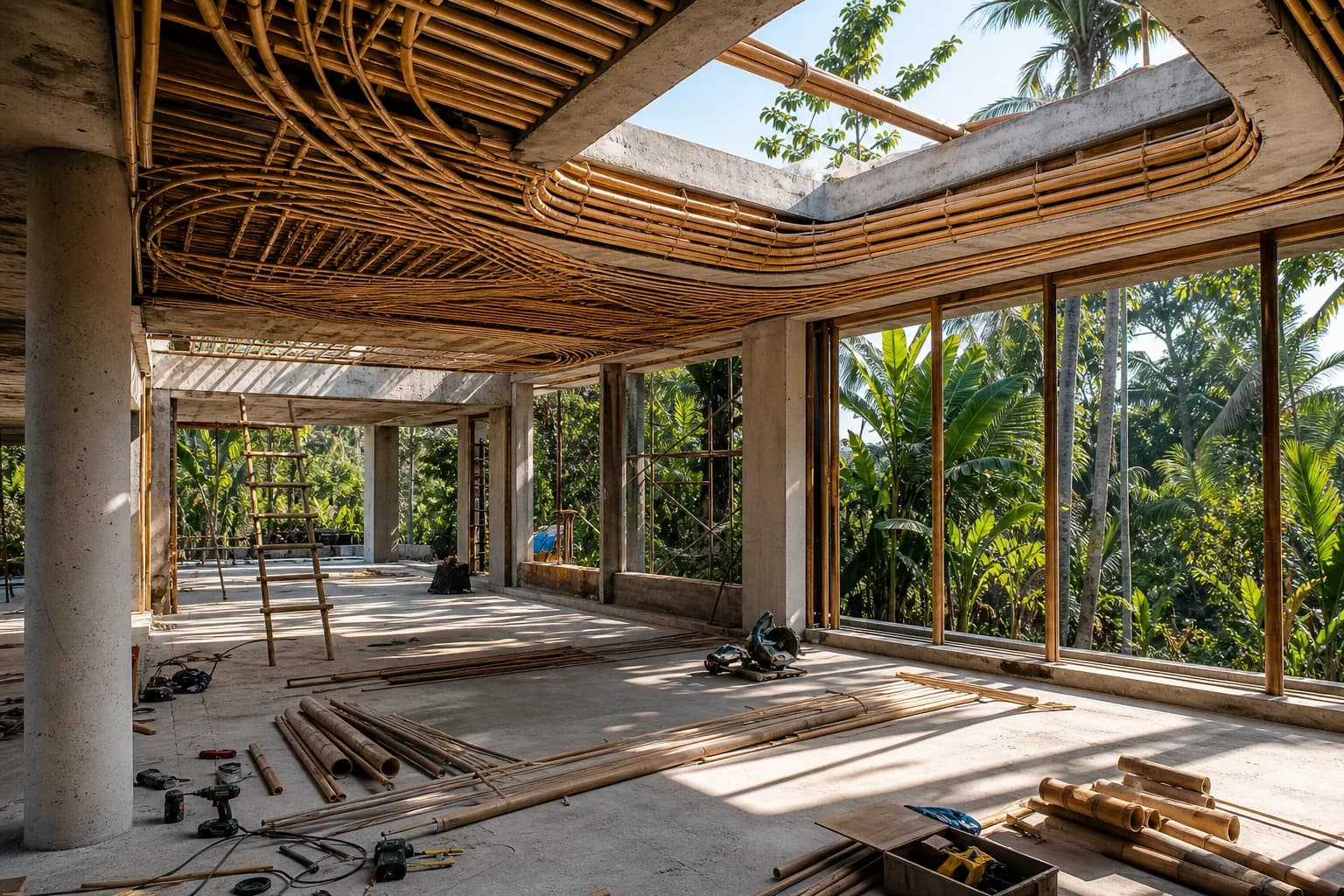
Bamboo ceiling systems present entirely different installation parameters. These suspended or applied ceiling treatments typically consist of woven bamboo panels (15-25mm thickness) mounted to wooden or metal framework positioned 200-400mm below the structural ceiling. This cavity space simplifies electrical rough-in but introduces structural load considerations absent in concrete applications.
\n\n
The primary technical challenge involves load distribution. Bamboo panels support approximately 2-3 kg per square meter, while recessed lighting fixtures with housing assemblies weigh 1.5-2.5 kg each. Installations require independent support structures—typically galvanized steel hanging wire (minimum 2mm diameter) attached directly to the structural ceiling above, bypassing the bamboo entirely. Each fixture needs minimum four-point suspension to prevent sagging and maintain alignment.
\n\n
Cutting bamboo for fixture openings demands different techniques than concrete. Circular hole saws (100-110mm) with fine-tooth blades prevent splitting and fraying. The natural fiber structure of bamboo requires sealed edges—we apply marine-grade polyurethane to all cut surfaces, preventing moisture absorption that causes dimensional changes. Unsealed bamboo edges can expand 3-5mm during rainy season, creating visible gaps around fixtures.
\n\n
Thermal considerations differ significantly. Bamboo’s natural ventilation properties actually benefit LED heat dissipation, but the material’s flammability requires fixtures with IC (Insulation Contact) ratings and minimum 50mm clearance from bamboo surfaces. Indonesian fire safety standards mandate this separation, and inspections verify compliance before electrical certification.
\n\n
Material Standards and Fixture Specifications for Tropical Applications
\n\n
Selecting appropriate materials for renovation Bali lighting projects requires understanding how tropical conditions affect both ceiling substrates and electrical components over 15-20 year service lives.
\n\n
Concrete Ceiling Material Requirements
\n\n
Structural concrete for recessed lighting applications should meet minimum K-250 strength classification (250 kg/cm² compressive strength) per Indonesian standards. Lower-grade concrete increases drilling difficulty and creates unstable fixture mounting. The concrete mix should incorporate waterproofing admixtures—we specify Sika or BASF products that reduce permeability by 40-60%, essential for Bali’s monsoon exposure.
\n\n
Fixture housings for concrete must be airtight, IC-rated aluminum or steel construction with powder-coated finishes. Stainless steel spring clips (minimum 1.2mm thickness) provide secure mounting against concrete surfaces. Gasket seals should be EPDM rubber rated for continuous 60°C exposure and resistant to tropical mold growth.
\n\n
Bamboo Ceiling Material Standards
\n\n
Quality bamboo ceiling materials for lighting integration should be kiln-dried to 8-12% moisture content and treated with boron-based preservatives against insects and fungal decay. We specify Dendrocalamus asper (petung bamboo) or Gigantochloa apus species, both offering superior dimensional stability compared to smaller diameter varieties.
\n\n
Support framework requires either pressure-treated hardwood (minimum Class III durability) or powder-coated galvanized steel channels. Aluminum framing systems, while lightweight, can corrode in coastal Bali locations due to salt air exposure. All metal components need minimum G90 zinc coating (275 g/m²) for adequate corrosion resistance.
\n\n
LED Fixture Specifications
\n\n
Regardless of ceiling material, LED fixtures for Bali installations must meet IP44 minimum ingress protection—sealed against moisture and dust intrusion. Driver components should be remotely mounted in ventilated junction boxes rather than integrated into fixture housings, extending electronic lifespan in high-temperature environments. Color temperature selection typically ranges 2700-3000K for residential applications, with CRI (Color Rendering Index) minimum 90 for accurate material color representation in villa interiors.
\n\n
Step-by-Step Installation Process: Concrete vs Bamboo Methodology
\n\n
Concrete Ceiling Installation Sequence
\n\n
Phase 1: Planning and Layout (Day 1)
\nElectrical plans are marked directly on concrete surfaces using chalk lines and measuring from fixed reference points. Fixture spacing follows 1.5-meter intervals for general illumination or task-specific layouts for kitchen and bathroom zones. Rebar detection using electromagnetic scanners prevents drilling into structural reinforcement—critical for maintaining concrete integrity.
\n\n
Phase 2: Core Drilling (Day 1-2)
\nDiamond core drilling proceeds at 800-1000 RPM with continuous water cooling to prevent concrete spalling and bit overheating. Each hole requires 15-25 minutes depending on concrete density and rebar encounters. Dust extraction systems are mandatory—concrete dust contains silica hazards requiring respiratory protection. Holes are drilled 5mm oversize (105mm for 100mm housings) allowing adjustment during installation.
\n\n
Phase 3: Electrical Rough-In (Day 2-3)
\nElectrical conduit (minimum 16mm PVC) routes from junction boxes to each fixture location. Bali building codes require all concealed wiring in rigid conduit—no romex or loose cable permitted. Pull wires (2.5mm² copper minimum) are installed with 300mm service loops at each fixture location. Ground wires connect to rebar grid using approved clamps, utilizing concrete reinforcement as supplementary grounding.
\n\n
Phase 4: Housing Installation (Day 3-4)
\nAirtight housings are positioned with thermal barriers facing upward. Expanding foam sealant fills gaps between housing and concrete, creating moisture and thermal barriers. Spring clips engage concrete edges—proper installation requires 8-10mm compression for secure retention. Each housing is leveled using shims before foam application cures.
\n\n
Phase 5: Trim and Testing (Day 4-5)
\nLED modules install into housings after ceiling finishing (painting/plastering) completes. Trim rings compress against finished surfaces with integrated gaskets. Complete electrical testing includes insulation resistance (minimum 1 megohm), ground continuity, and thermal imaging after 2-hour operation verifying proper heat dissipation.
\n\n
Bamboo Ceiling Installation Sequence
\n\n
Phase 1: Framework Installation (Day 1-2)
\nSupport framework mounts to structural ceiling using expansion anchors (M8 minimum) at 600mm centers. Framework creates level plane 250-350mm below structure, providing cavity for electrical distribution and fixture housings. Laser levels ensure framework accuracy within 3mm tolerance across entire ceiling plane.
\n\n
Phase 2: Electrical Distribution (Day 2-3)
\nElectrical conduit installs within ceiling cavity, supported independently from bamboo framework. Junction boxes position above planned fixture locations with 400mm flexible conduit drops to each fixture. This approach allows bamboo panel installation without electrical interference and simplifies future maintenance access.
\n\n
Phase 3: Bamboo Panel Installation (Day 3-5)
\nBamboo panels attach to framework using stainless steel screws or clips, leaving fixture locations open. Panels are pre-cut to accommodate fixture openings with 2-3mm clearance. Edge sealing with polyurethane occurs immediately after cutting, before panel installation, preventing moisture absorption during construction.
\n\n
Phase 4: Fixture Mounting (Day 5-6)
\nIndependent support wires suspend fixture housings from structural ceiling, passing through bamboo openings without contact. Housings position flush with bamboo surface using adjustable hangers. Trim rings overlap bamboo edges by 10-15mm, concealing gaps while allowing bamboo movement. Final electrical connections and testing proceed identically to concrete installations.
\n\n
Cost Analysis and Project Timeline Expectations
\n\n
Understanding the complete cost structure for recessed lighting installation helps villa owners budget accurately for villa construction cost bali projects and avoid mid-project surprises.
\n\n
Concrete Ceiling Cost Breakdown
\n\n
Material costs per fixture: LED fixture and housing ($45-85), electrical wire and conduit ($12-18), mounting hardware and sealants ($8-15). Labor costs: core drilling ($35-50 per hole), electrical rough-in ($40-60 per fixture), installation and finishing ($30-45 per fixture). Total per-fixture cost ranges $180-280 for standard installations, increasing to $320-450 for high-specification fixtures or complex layouts requiring extensive rebar navigation.
\n\n
Bamboo Ceiling Cost Breakdown
\n\n
Material costs per fixture: LED fixture and housing ($45-85), support framework allocation ($25-40 per fixture), bamboo panel material ($15-30 per fixture area), electrical components ($12-18). Labor costs: framework installation ($30-45 per fixture), bamboo cutting and installation ($25-40 per fixture), electrical and fixture installation ($35-50 per fixture). Total per-fixture cost ranges $195-310, with premium bamboo species and complex weave patterns pushing costs toward $350-420.
\n\n
Timeline Considerations
\n\n
Concrete installations typically require 5-7 working days for 15-20 fixtures, with curing time for sealants adding 24-48 hours before final testing. Bamboo installations span 6-9 working days for equivalent fixture counts, with additional time for bamboo acclimatization (48-72 hours on-site before installation) preventing post-installation movement. Our construction process integrates these timelines into overall project schedules, coordinating lighting installation with plastering, painting, and final finishing phases.
\n\n
Frequently Asked Questions: Recessed Lighting Installation in Bali
\n\n
Which ceiling material provides better long-term value for recessed lighting?
\n\n
Concrete ceilings offer superior durability and require virtually no maintenance over 20+ year periods, making them cost-effective for permanent installations despite higher initial costs. Bamboo ceilings require periodic inspection and potential panel replacement every 10-15 years but provide aesthetic warmth and better acoustic properties. For renovation Bali projects prioritizing longevity, concrete proves more economical; for design-focused villas emphasizing natural materials, bamboo’s aesthetic value justifies the maintenance requirements.
\n\n
Can existing concrete ceilings be retrofitted with recessed lighting?
\n\n
Yes, but retrofit installations cost 20-35% more than new construction integration due to finished surface protection requirements, dust containment, and limited access for electrical routing. Existing concrete may contain unknown rebar patterns requiring additional scanning and potential layout modifications. We recommend retrofit projects during comprehensive renovations when other ceiling work justifies the disruption and cost.
\n\n
How does Bali’s humidity affect different ceiling materials and lighting?
\n\n
Concrete’s moisture retention requires enhanced vapor barriers and sealed fixtures to prevent condensation-related electrical failures. Bamboo’s hygroscopic nature causes 2-4mm dimensional changes seasonally, requiring flexible mounting systems and oversized fixture openings. Both materials demand IP44-rated fixtures min
 3180 m²7 month(s)from 142.000 USD
Vasudeva
 164 m²7 month(s)from 79.000 USD
TALA TWO
 3127 m²9 month(s)from 177.000 USD
Mukunda
 3173 m²6 month(s)from 125.000 USD
TALA FOUR
 1from 198.000 USD
Private: Haridas Villas
164 m²7 month(s)from 79.000 USDPrivate: Haridas Villas, Tegallalang
 4344 m²16 month(s)from 290.000 USD
Radha
 2144 m²11 month(s)from 104.000 USD
Narayana
 172 m²8 month(s)from 120.000 USD
Keshava
 3104 m²11 month(s)from 99.000 USD
TALA 100

Want to calculate?
 3124 m²6 month(s)from 123.000 USD
TALA 8
Start With Real Numbers, Not Guesses
Before finalizing your finishing works plan, check realistic cost ranges for your Bali villa project.
Available lands
 1533 m²5 min$ 165666Bali, Cepaka
 1000 m²8 min$ 134544Bali, Bukit
 1000 m²10 min$ 303571Bali, Tabanan
 2500 m²5 min$ 609606Bali, Kedungu
 680 m²15 min$ 110751Bali, Pererenan
 1100 m²8 min$ 280419Bali, Ungasan
 600 m²10 min$ 206897Bali, Canggu
 2130 m²10 min$ 495776Bali, Pecatu
 1600 m²32 min$ 266010Bali, Tabanan
 3300 m²15 min$ 449889Bali, Tabanan
 18900 m²2 min$ 6912931Bali, Pecatu
 2000 m²10 min$ 243842Bali, Mengwi
 1720 m²2 min$ 241478Bali, Tabanan
 1300 m²10 min$ 312192Bali, Kutuh South Bali
 5815 m²5 min$ 815740Bali, Tabanan
Essential Bali build & buy guides
- Bali villa construction cost per m² in 2026
- How much will your villa cost? Calculator
- Building a villa in Bali: the complete guide
- Buying land in Bali: step-by-step for foreigners
- Bali villa investment: yields, risks, returns
- Leasehold vs freehold: what foreigners can own
- Construction defect liability & 10-year warranty
- Bali building codes and construction standards
Related guides
Leasehold Depreciation in Bali: How Remaining Term Affects Resale Value — and What Offsets It
A Bali leasehold is a depreciating right on land plus an ageing building — but the loss of value is neither linear nor unmanageable. How remaining term drives resale price, where the danger lines sit, and the clauses and decisions that protect your exit.
7 min read
Annual Holding Costs of a Bali Villa: A Realistic Owner's Budget
The purchase price is only the entry ticket. Here is what a Bali villa actually costs to hold each year — staff, utilities, pool, maintenance, insurance, taxes and management — with realistic 2026 numbers and a sample budget.
7 min read
Transferring Money to Indonesia for a Property Purchase: Banking, Documentation and Safe Practice
Moving six figures across borders is the least glamorous part of buying in Bali, and the part most buyers under-prepare for. This guide covers the rupiah rule, notary escrow, transfer documentation, and the paper trail that protects a future exit.
8 min read