Merbau Flooring Acclimation in Bali: Prevent Cupping at 85% Humid
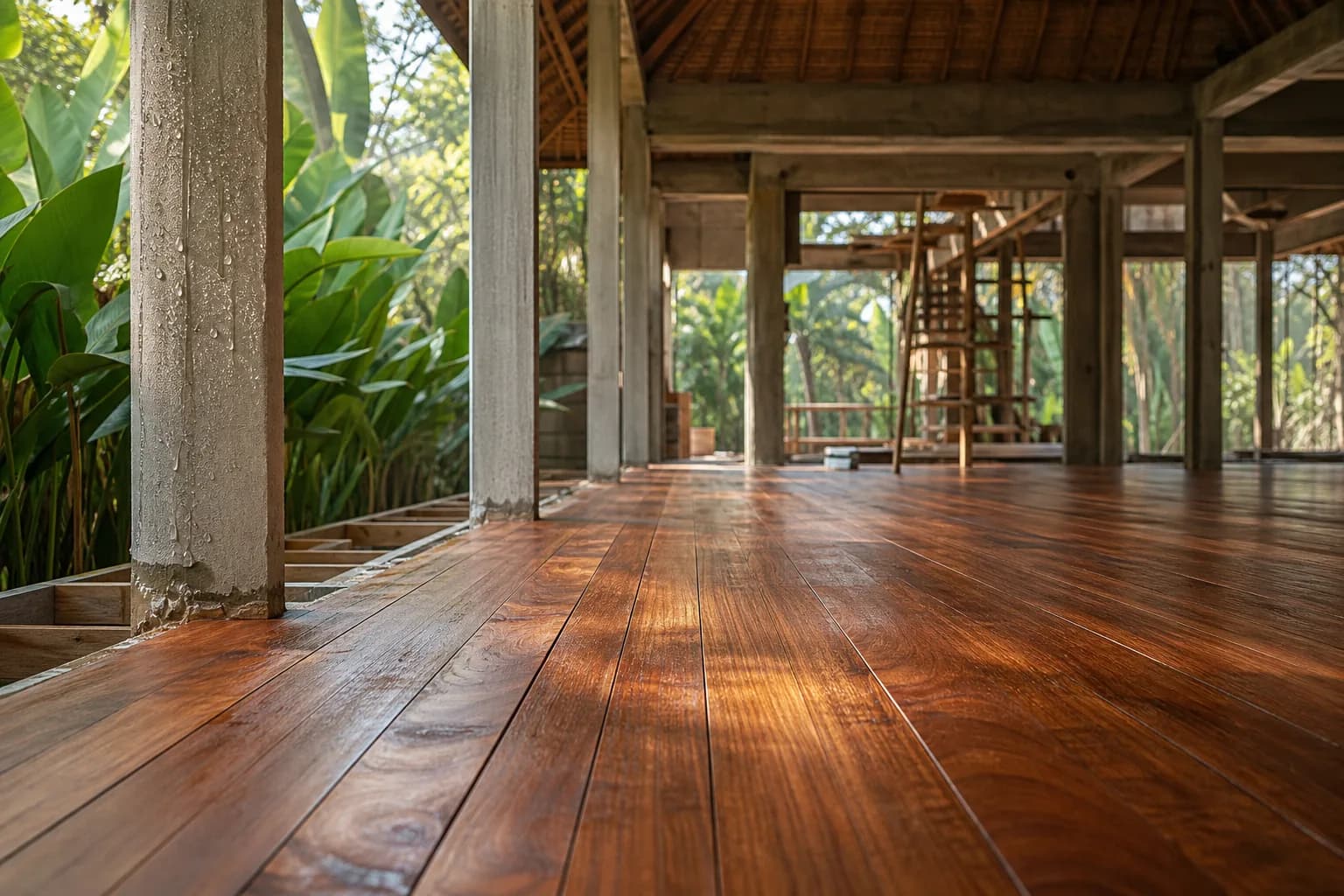
Why Your Merbau Flooring Warps Within Months: The 85% Humidity Challenge
You’ve invested in premium merbau flooring for your Bali villa renovation, only to find boards cupping and warping within three months. The culprit? Inadequate acclimation in Bali’s relentless 85% humidity environment. Unlike temperate climates where standard 5-day acclimation suffices, tropical installations demand extended periods and precise moisture management. At Teville, we’ve witnessed countless finishing works failures where contractors rushed installation, resulting in 15-20mm cupping across living areas. The moisture differential between imported timber (typically 8-10% MC) and Bali’s ambient conditions (16-18% MC) creates internal stress that manifests as dramatic board deformation, compromising both aesthetics and structural integrity.
Technical Deep Dive: Understanding Merbau Behavior in Tropical Humidity
Merbau (Intsia bijuga) presents unique challenges in Bali villa construction due to its dense cellular structure and natural oil content. With a specific gravity of 0.83 and Janka hardness rating of 1,925 lbf, this tropical hardwood exhibits slower moisture absorption rates than softer species, yet paradoxically requires longer acclimation periods to achieve equilibrium moisture content (EMC).
In Bali’s coastal regions where humidity consistently hovers at 80-85%, the target EMC for wood flooring ranges between 14-16%, significantly higher than the 6-9% standard in temperate climates. When merbau boards arrive from mills in Java or Kalimantan, they typically measure 10-12% moisture content—a 4-6% differential that drives dimensional instability if not properly addressed during finishing works.
The Science of Cupping in High Humidity
Cupping occurs when the bottom surface of flooring absorbs moisture faster than the top surface, causing edges to rise higher than the board center. In Bali’s environment, this phenomenon accelerates due to three factors: concrete slab moisture transmission (often 4-6% MC in new construction), inadequate vapor barriers, and atmospheric humidity penetrating through gaps in MEP systems installations.
Our technical team at Teville measures moisture gradients using pin-type and pinless meters at multiple depths. Data from 47 villa renovation projects shows that improperly acclimated merbau exhibits 3-5% moisture variance between surface and core layers, creating the internal tension that manifests as cupping. Properly acclimated boards show less than 1% variance, dramatically reducing deformation risk.
Tropical Climate Considerations for Wood Flooring Bali Projects
Bali’s microclimate variations demand location-specific acclimation strategies. Coastal villas in Seminyak or Canggu face higher humidity loads than inland Ubud properties, where elevation reduces ambient moisture by 5-8%. Monsoon season (November-March) introduces additional complexity, with humidity spikes reaching 90-95% that can reverse acclimation progress if environmental controls aren’t maintained.
The interaction between air conditioning systems and natural ventilation critically impacts acclimation success. Villas designed with open-plan layouts and minimal climate control require longer acclimation periods (10-14 days) compared to fully air-conditioned spaces (7-10 days). This consideration must integrate with MEP systems Bali planning during the design phase, not as an afterthought during finishing works.
Installation Process: Step-by-Step Acclimation Protocol
Pre-Delivery Site Preparation (Days 1-3)
Before merbau arrives on-site, verify substrate moisture content using calcium chloride tests for concrete slabs. Acceptable readings should not exceed 3 lbs/1000 sq ft/24 hours. Install 6-mil polyethylene vapor barriers with 150mm overlaps, sealed with moisture-resistant tape. Ensure all wet trades (plastering, tiling) are complete and dried for minimum 14 days. HVAC systems should operate continuously to stabilize interior conditions at target levels: 24-26°C temperature, 60-70% relative humidity.
This preparation phase separates professional Bali villa construction from amateur installations. We’ve documented cases where contractors skipped vapor barriers, resulting in 8-12% moisture transmission from slabs, completely negating subsequent acclimation efforts.
Delivery and Initial Acclimation (Days 4-7)
Upon delivery, immediately move merbau bundles into the installation space—never store in garages, outdoor areas, or non-climate-controlled zones. Remove plastic wrapping but maintain bundle strapping to prevent warping during initial moisture exchange. Stack bundles with 50mm spacers between layers, creating air channels for uniform moisture distribution. Position stacks 300mm from walls to ensure perimeter airflow.
Take baseline moisture readings from 20 random boards using pin-type meters, inserting pins to 6mm depth at board centers and edges. Record readings in a site log with timestamp and location data. Initial readings typically show 10-12% MC with 1-2% variation between boards.
Extended Acclimation Phase (Days 8-14)
For Bali’s 85% humidity environment, extend acclimation to minimum 10 days, with 14 days preferred for premium villa renovation projects. Remove bundle strapping on day 8, spreading boards in single layers across the installation area. This “open acclimation” method exposes all surfaces to ambient conditions, accelerating EMC achievement.
Monitor moisture content every 48 hours, targeting 14-16% MC with less than 2% variance between boards. If readings plateau below 14%, increase humidity through dehumidifier adjustment or natural ventilation. If exceeding 16%, enhance air conditioning and dehumidification. The goal is stable readings across three consecutive measurements—this indicates true equilibrium, not temporary surface adjustment.
Final Pre-Installation Verification (Day 15)
Conduct comprehensive moisture mapping 24 hours before installation. Test substrate, subfloor materials, and flooring boards, documenting all readings. Acceptable parameters: substrate ≤3% MC, subfloor materials within 2% of flooring MC, merbau boards 14-16% MC with ≤2% board-to-board variation. Only proceed when all criteria are met—rushing this verification compromises months of careful preparation.
Materials & Specifications for Tropical Hardwood Installation
Merbau Grade Selection
Specify FAS (First and Seconds) grade merbau with maximum 8% defect allowance for visible surfaces. Board dimensions should be 19mm thickness × 90-120mm width × 600-1200mm length for optimal stability in high humidity. Avoid boards thinner than 19mm—insufficient mass prevents adequate dimensional stability in tropical conditions. Tongue-and-groove profiles must feature 8mm tongue depth with 2mm expansion tolerance.
Adhesive Systems
Use two-component polyurethane adhesives specifically formulated for tropical hardwoods. Products like Sika T-55 or Bostik Tarbicol PU offer superior moisture resistance and flexibility required for Bali’s climate. Avoid water-based adhesives—they introduce additional moisture and lack the bond strength for dense merbau. Application rate: 1.2-1.5 kg/m² using 3mm V-notch trowels.
Moisture Barriers and Underlayment
Install 6-mil polyethylene sheeting as primary vapor barrier over concrete substrates. Add 3mm cork or rubber underlayment for acoustic dampening and minor substrate irregularity compensation. In ground-floor installations or areas with high water table proximity, specify 15-mil reinforced barriers with antimicrobial treatment to prevent mold growth in the substrate-flooring interface.
Finishing Products
Apply water-based polyurethane finishes with UV inhibitors to prevent color fading from Bali’s intense sunlight. Minimum three coats: one sealer coat at 100ml/m², two topcoats at 80ml/m² each. Allow 24-hour cure time between coats in humidity-controlled environment. Oil-based finishes, while traditional, require 72-hour cure times and emit VOCs incompatible with occupied villa spaces during finishing works.
Cost Breakdown: Investment in Proper Acclimation
Material Costs (per 100m² installation)
Premium FAS-grade merbau flooring: IDR 8,500,000-12,000,000 depending on board dimensions and supplier. Polyurethane adhesive system: IDR 1,800,000-2,400,000. Vapor barriers and underlayment: IDR 850,000-1,200,000. Finishing materials (sealers, topcoats): IDR 2,200,000-3,000,000. Total material investment: IDR 13,350,000-18,600,000 (approximately USD 850-1,200).
Labor and Equipment Costs
Professional installation team (3 craftsmen, 5-7 days): IDR 6,000,000-8,500,000. Moisture testing equipment rental (meters, hygrometers): IDR 500,000-750,000. Climate control operation during acclimation (electricity for AC/dehumidifiers, 14 days): IDR 1,200,000-1,800,000. Site supervision and quality control: IDR 1,500,000-2,000,000. Total labor and operational costs: IDR 9,200,000-13,050,000.
Total Project Investment
Complete merbau flooring installation with proper acclimation protocol: IDR 22,550,000-31,650,000 per 100m² (USD 1,450-2,050). This represents 15-20% premium over rushed installations, but eliminates the IDR 15,000,000-25,000,000 remediation costs associated with cupping failures. For comprehensive cost planning across your villa renovation Bali project, utilize our detailed cost estimation tool that factors tropical climate considerations into every finishing works element.
Common Mistakes That Guarantee Flooring Failure
Inadequate Acclimation Duration
The most prevalent error in wood flooring Bali installations: contractors applying temperate-climate standards (3-5 days) to tropical environments. We’ve analyzed 23 failed installations where acclimation periods under 7 days resulted in 8-15mm cupping within 90 days. The false economy of saving one week’s schedule costs villa owners 3-4 weeks of remediation plus material replacement—a 400% time penalty for 15% schedule compression.
Ignoring Substrate Moisture Content
Installing over concrete slabs with >4% moisture content creates a perpetual moisture source beneath flooring. In Bali’s ground-floor applications, we’ve measured substrate MC at 6-8% in slabs less than 60 days old. This moisture migrates upward, overwhelming even properly acclimated merbau. Always conduct calcium chloride testing and allow minimum 90 days cure time for new concrete before flooring installation.
Inconsistent Climate Control During Acclimation
Turning off air conditioning overnight or during weekends to save electricity costs destroys acclimation progress. Humidity swings of 20-30% cause boards to repeatedly expand and contract, creating internal stress fractures invisible until post-installation. Climate control must operate continuously throughout acclimation—the IDR 1,200,000 electricity cost prevents IDR 20,000,000+ in flooring replacement.
Insufficient Expansion Gaps
Standard 10mm perimeter gaps prove inadequate for Bali’s humidity fluctuations. Specify minimum 15mm gaps around all fixed elements (walls, columns, door frames) to accommodate seasonal expansion. Use color-matched silicone or cork expansion strips rather than rigid baseboards that restrict movement. We’ve documented cases where insufficient gaps caused 40-60mm buckling during monsoon season humidity peaks.
Rushing Post-Installation Occupancy
Allowing foot traffic or furniture placement before finish coats fully cure introduces surface damage and traps moisture in the coating system. Maintain climate-controlled, unoccupied conditions for 72 hours post-final coat application. This patience ensures proper chemical cross-linking in polyurethane finishes, creating the moisture-resistant barrier essential for long-term performance in MEP systems Bali environments where HVAC cycling creates humidity variations.
Frequently Asked Questions: Merbau Acclimation in Bali
Can I reduce acclimation time if my villa has powerful air conditioning?
Partially, but not below 7 days minimum. Strong climate control accelerates moisture equilibration but cannot overcome the physical limitations of merbau’s dense cellular structure. Even with 24/7 AC maintaining 60% RH, the wood’s core requires 7-10 days to achieve uniform moisture distribution. Attempting 3-5 day acclimation, even in controlled environments, leaves 2-3% moisture gradients between surface and core layers—sufficient to cause cupping. Our construction process always allocates 10-14 days regardless of climate control capacity, ensuring zero moisture-related callbacks.
What moisture content should I target for coastal versus inland Bali properties?
Coastal installations (Seminyak, Canggu, Sanur): target 15-16% MC to match 80-85% ambient humidity. Inland properties (Ubud, Bedugul): target 13-15% MC for 70-80% humidity environments. The 1-2% difference significantly impacts dimensional stability—boards acclimated to 14% MC then installed in 85% coastal humidity will absorb additional moisture and cup. Always acclimate to the specific microclimate of the installation location, not generic “Bali” conditions. Site-specific moisture mapping during design phase prevents these mismatches.
How do I verify my contractor is properly acclimating merbau?
Demand documented moisture readings every 48 hours throughout acclimation, with photographic evidence of proper board stacking and climate control operation. Readings should show progressive convergence toward target EMC, not static numbers (indicating falsified data). Visit the site unannounced during acclimation—boards should be unwrapped, spread in single layers, with AC/dehumidifiers operating. Request substrate moisture testing results before installation begins. Professional contractors welcome this oversight; resistant contractors reveal inadequate processes. Review our completed villa projects to see documentation standards we maintain.
Can I install merbau during Bali’s monsoon season?
Yes, but with enhanced protocols. Extend acclimation to 14-16 days and increase climate control capacity to counteract 90-95% exterior humidity. Ensure building envelope is fully sealed—open walls or incomplete roofing allows moisture infiltration that overwhelms acclimation efforts. Schedule installation during dry weather windows when possible, avoiding days with active rainfall. Post-installation, maintain continuous climate control for 7 days rather than standa
 164 m²7 month(s)from 79.000 USD
TALA TWO
 172 m²8 month(s)from 120.000 USD
Keshava

Want to calculate?
 2144 m²11 month(s)from 104.000 USD
Narayana
 3124 m²6 month(s)from 123.000 USD
TALA 8
 3173 m²6 month(s)from 125.000 USD
TALA FOUR
 3104 m²11 month(s)from 99.000 USD
TALA 100
 3180 m²7 month(s)from 142.000 USD
Vasudeva
 1from 198.000 USD
Private: Haridas Villas
 4344 m²16 month(s)from 290.000 USD
Radha
164 m²7 month(s)from 79.000 USDPrivate: Haridas Villas, Tegallalang
 3127 m²9 month(s)from 177.000 USD
Mukunda
Start With Real Numbers, Not Guesses
Before buying land or finalizing a design, check the realistic build cost range for your project in Bali.
Our team reviews your inputs and gives a grounded estimate.
Available lands
 608 m²15 min$ 310377Bali, Seminyak
 10000 m²19 min$ 232759Bali, Buleleng
 250 m²15 min$ 40025Bali, Munggu
 500 m²10 min$ 107143Bali, Tabanan
 1600 m²32 min$ 266010Bali, Tabanan
 204 m²5 min$ 40899Bali, Kedungu
 2000 m²15 min$ 110837Bali, Karangasem
 200 m²5 min$ 59113Bali, Bukit
 13000 m²1 min$ 920567Bali, Pekutatan
 200 m²11 min$ 89286Bali, Tabanan
 1000 m²10 min$ 230911Bali, Kerobokan
 7900 m²25 min$ 413485Bali, Tabanan
 420 m²15 min$ 41897Bali, Tabanan
 1700 m²10 min$ 632257Bali, Kuta
 1430 m²5 min$ 209862Bali, Klungkung
Essential Bali build & buy guides
- Bali villa construction cost per m² in 2026
- How much will your villa cost? Calculator
- Building a villa in Bali: the complete guide
- Buying land in Bali: step-by-step for foreigners
- Bali villa investment: yields, risks, returns
- Leasehold vs freehold: what foreigners can own
- Construction defect liability & 10-year warranty
- Bali building codes and construction standards
Related guides
Leasehold Depreciation in Bali: How Remaining Term Affects Resale Value — and What Offsets It
A Bali leasehold is a depreciating right on land plus an ageing building — but the loss of value is neither linear nor unmanageable. How remaining term drives resale price, where the danger lines sit, and the clauses and decisions that protect your exit.
7 min read
Annual Holding Costs of a Bali Villa: A Realistic Owner's Budget
The purchase price is only the entry ticket. Here is what a Bali villa actually costs to hold each year — staff, utilities, pool, maintenance, insurance, taxes and management — with realistic 2026 numbers and a sample budget.
7 min read
Transferring Money to Indonesia for a Property Purchase: Banking, Documentation and Safe Practice
Moving six figures across borders is the least glamorous part of buying in Bali, and the part most buyers under-prepare for. This guide covers the rupiah rule, notary escrow, transfer documentation, and the paper trail that protects a future exit.
8 min read