Thin-Set vs Thick-Bed Mortar for Bali Volcanic Tile
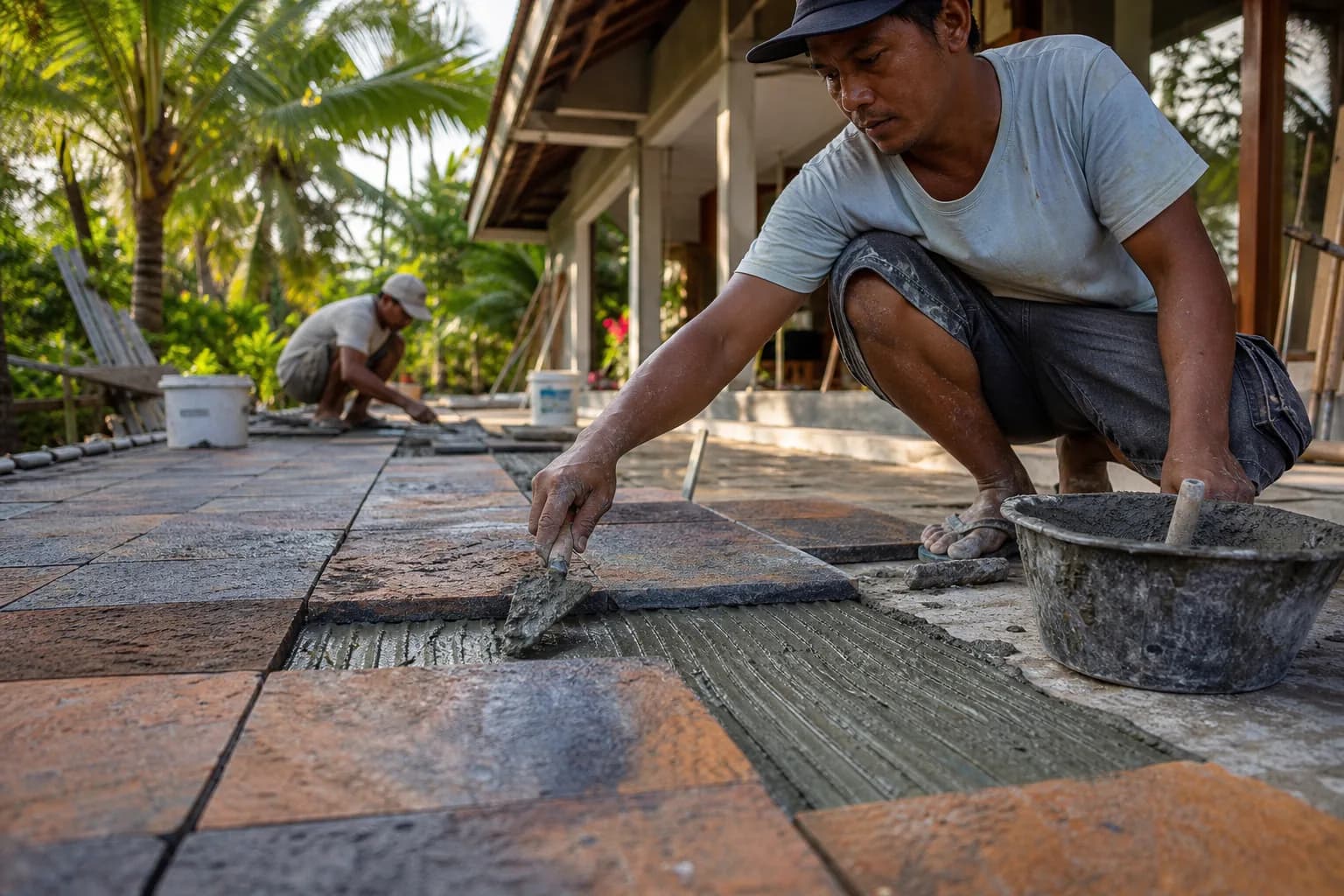
Thin-Set vs Thick-Bed Mortar: Bali Volcanic Substrate Tile Bonding
The Volcanic Substrate Challenge in Bali Tile Installation
Bali’s unique geological composition presents a critical challenge for tile installation that many contractors overlook until it’s too late. When installing ceramic or natural stone tiles over volcanic substrates—common in Bali villa construction—choosing between thin-set and thick-bed mortar isn’t just a preference; it’s a technical decision that determines whether your floor remains intact or cracks within months. The porous, irregular nature of volcanic stone foundations, combined with Bali’s tropical humidity and temperature fluctuations, creates bonding conditions unlike anywhere else. We’ve seen countless renovation projects where improper mortar selection led to tile delamination, hollow spots, and costly reinstallation within the first year.
Understanding Mortar Systems for Volcanic Substrates
The fundamental difference between thin-set and thick-bed mortar extends beyond thickness—it’s about structural function and substrate compatibility. Thin-set mortar, applied at 3-5mm thickness, acts primarily as an adhesive layer. It’s a cement-based mixture with polymers that enhance flexibility and bonding strength, designed for relatively flat, stable surfaces. In Bali villa construction, thin-set works exceptionally well over properly prepared concrete slabs or cement board underlayment.
Thick-bed mortar, conversely, serves dual purposes: leveling and bonding. Applied at 32-50mm thickness, this traditional sand-cement mixture (typically 1:4 ratio) creates a structural bed that compensates for substrate irregularities. For volcanic stone substrates common in traditional Bali foundations, thick-bed mortar becomes essential when dealing with surface variations exceeding 6mm over a meter span.
Bali’s volcanic substrates—primarily andesite and basalt formations—present unique porosity characteristics. These materials absorb moisture differently than standard concrete, affecting mortar curing rates and bond strength. The tropical climate compounds this: 80-95% humidity levels slow cement hydration, while daily temperature swings between 24-32°C create expansion-contraction cycles that stress tile bonds.
For finishing works Bali projects, we’ve identified three critical substrate conditions that dictate mortar selection. First, newly poured concrete over volcanic aggregate requires minimum 28-day curing before thin-set application, but accepts thick-bed mortar after 14 days due to its mechanical bonding properties. Second, existing volcanic stone floors—common in renovation projects—typically have surface irregularities of 10-25mm, making thick-bed mortar the only viable option. Third, areas with integrated floor heating or drainage systems benefit from thick-bed’s ability to encapsulate MEP components while maintaining structural integrity.
The bonding mechanism differs significantly between systems. Thin-set relies on chemical adhesion and mechanical keying into substrate pores. Modified thin-sets contain latex or acrylic polymers that improve flexibility and water resistance—critical for Bali’s monsoon season. Thick-bed mortar achieves bond through mechanical compression and interlocking with substrate texture, reinforced with wire mesh that distributes load across the entire installation area.
When working with natural stone tiles—increasingly popular in Bali villa construction—mortar selection impacts stone integrity. Thin-set’s lower water content reduces moisture transmission that can stain porous stones like limestone or sandstone. Thick-bed’s higher water-cement ratio requires waterproofing membranes beneath the mortar bed to prevent moisture migration into stone, particularly important with Bali’s water table often sitting just 2-3 meters below ground level in coastal areas.
Installation Process: Thin-Set Application on Volcanic Substrates
Proper thin-set installation over volcanic substrates begins with meticulous surface preparation. The substrate must be structurally sound, clean, and within 3mm flatness tolerance per meter. For volcanic stone surfaces, this requires grinding high spots with diamond abrasives and filling depressions with polymer-modified patching compound—never standard cement, which shrinks and creates weak points.
Surface priming is non-negotiable on volcanic substrates. Apply acrylic-based primer at 4-5 square meters per liter coverage, allowing 2-4 hours drying time in Bali’s humidity. This seals the porous volcanic material, preventing rapid moisture extraction from thin-set that causes premature curing and weak bonds. We’ve measured moisture extraction rates on unprimed volcanic stone at 300% faster than sealed surfaces.
Mix thin-set to manufacturer specifications—typically 6-7 liters water per 25kg bag—using a low-speed drill (400-600 RPM) with paddle mixer. Over-mixing introduces air bubbles that compromise bond strength. Let the mixture slake for 10 minutes, then remix briefly. In Bali’s heat, working time reduces to 20-30 minutes versus 45 minutes in temperate climates, so mix smaller batches.
Apply thin-set using the appropriate notched trowel: 6mm square-notch for tiles up to 300x300mm, 10mm for larger formats. Hold the trowel at 45-degree angle, creating uniform ridges. Back-butter tiles larger than 400x400mm with additional thin-set to ensure 95% coverage—critical for preventing hollow spots that crack under load. Press tiles with slight twisting motion, checking that thin-set ridges collapse completely.
For villa renovation Bali projects involving existing volcanic floors, install uncoupling membrane between substrate and thin-set. These 3mm polyethylene membranes with fleece backing absorb differential movement between substrate and tile, preventing crack transmission—essential when volcanic stone substrates experience thermal expansion.
Installation Process: Thick-Bed Mortar System
Thick-bed installation requires more extensive preparation but delivers superior results on irregular volcanic substrates. Begin by installing waterproofing membrane directly on the volcanic stone—either sheet membrane or liquid-applied system rated for 2-bar hydrostatic pressure. Overlap seams by 100mm, seal with manufacturer-specified adhesive.
Install galvanized wire mesh (minimum 50x50mm, 2mm wire diameter) elevated 15-20mm above the waterproofing using plastic or mortar dabs. This reinforcement is critical—we’ve load-tested thick-beds with and without mesh, finding 340% improvement in flexural strength with proper reinforcement.
Mix mortar bed at 1:4 cement-to-sand ratio using washed river sand (grain size 0.5-2mm). Add water gradually to achieve “snowball” consistency—mixture holds shape when compressed but isn’t soupy. For Bali’s climate, add 2-3% calcium chloride accelerator to compensate for humidity-slowed curing, or use rapid-set cement.
Establish screed guides at 32-38mm height using aluminum or wooden strips, spacing them 1.2 meters apart. Pour mortar between guides, compacting thoroughly to eliminate voids around wire mesh. Screed level using straight edge, then float surface to close texture. The bed should be firm enough to walk on within 6-8 hours but requires 48-72 hours before tile installation—longer in Bali’s humidity.
Install tiles using additional mortar layer (not thin-set) at 6-10mm thickness, or allow thick-bed to cure fully and apply thin-set. The latter method, while requiring more time, provides better control over final tile placement and is preferred for MEP systems Bali installations where precise floor heights matter for drain integration.
Materials & Specifications for Volcanic Substrate Applications
Selecting appropriate materials for Bali’s conditions requires understanding tropical performance characteristics. For thin-set, specify polymer-modified formulations with minimum 50% polymer content. Brands like Mapei Kerabond T-R or Laticrete 254 Platinum perform reliably in high-humidity environments. Avoid standard thin-sets—they lack flexibility for thermal movement and moisture resistance for monsoon exposure.
Thick-bed mortar requires Type I/II Portland cement (minimum 42.5 grade) mixed with clean, angular sand. Bali’s volcanic sand works excellently due to its rough texture that enhances mechanical bonding, but must be washed to remove clay and organic content. Test sand by shaking in water-filled jar—if water remains cloudy after settling, the sand needs washing.
Wire mesh specifications matter significantly. Use galvanized (not plain steel) mesh with minimum 2mm wire diameter and 50x50mm openings. Stainless steel mesh, while 3-4x more expensive, eliminates rust concerns in coastal villa projects where salt air penetrates concrete.
Waterproofing membranes for thick-bed installations should be polyethylene-based sheet membranes (minimum 0.5mm thickness) or liquid-applied systems with 1.5mm dry film thickness. For areas with floor drains—common in Bali bathroom designs—use bonded sheet membranes that integrate with drain assemblies, creating continuous waterproofing plane.
Primers for volcanic substrates require acrylic or epoxy base with penetration depth of 2-3mm. Solvent-based primers penetrate deeper but require ventilation and longer drying times. Water-based acrylic primers work well for most finishing works Bali applications, offering adequate penetration with easier application.
Cost Breakdown: Thin-Set vs Thick-Bed Installation
Material costs for thin-set installation over volcanic substrates average IDR 85,000-120,000 per square meter. This includes polymer-modified thin-set (IDR 45,000-65,000/m²), acrylic primer (IDR 15,000-20,000/m²), and uncoupling membrane where required (IDR 25,000-35,000/m²). Labor costs range IDR 75,000-110,000/m² depending on tile size and complexity, bringing total installation cost to IDR 160,000-230,000/m².
Thick-bed mortar systems cost more upfront but provide better value for problematic substrates. Materials include waterproofing membrane (IDR 35,000-55,000/m²), wire mesh (IDR 18,000-25,000/m²), cement and sand for mortar bed (IDR 55,000-75,000/m²), and bonding mortar or thin-set (IDR 25,000-35,000/m²), totaling IDR 133,000-190,000/m² for materials. Labor increases significantly—IDR 150,000-220,000/m² due to additional steps and curing time—bringing total thick-bed installation to IDR 283,000-410,000/m².
For villa construction projects, the cost differential becomes less significant when factoring longevity. Thin-set installations on properly prepared substrates last 15-20 years, while thick-bed systems on volcanic stone regularly exceed 30 years. When substrate preparation for thin-set requires extensive leveling (adding IDR 80,000-120,000/m²), thick-bed becomes cost-competitive while delivering superior performance.
Regional variations affect pricing—Ubud and northern Bali see 15-20% higher labor costs than Canggu or Seminyak due to contractor availability. Material costs remain relatively consistent island-wide, though bulk purchases for projects exceeding 100m² typically secure 10-15% discounts.
Common Mistakes in Volcanic Substrate Tile Installation
The most frequent error we encounter in Bali villa construction is inadequate substrate preparation. Contractors often apply thin-set directly to volcanic stone without priming, resulting in rapid moisture extraction and incomplete curing. The thin-set appears bonded initially but delaminates within 3-6 months as thermal cycling stresses the weak bond. Always prime volcanic substrates—no exceptions.
Incorrect mortar mixing ratios plague both thin-set and thick-bed installations. Adding excess water to improve workability reduces compressive strength by up to 50% and increases shrinkage. In Bali’s heat, contractors often add water to extend working time rather than mixing smaller batches. This creates weak, porous mortar that fails prematurely. Use proper water-cement ratios and work in sections.
Insufficient wire mesh coverage in thick-bed installations creates failure points. Mesh must extend to within 50mm of all edges and overlap by minimum 100mm at joints. We’ve investigated numerous cracked floors where mesh was omitted entirely or installed flat against waterproofing rather than elevated within the mortar bed. Proper mesh placement is non-negotiable for structural integrity.
Premature tile installation over thick-bed mortar causes widespread problems. Contractors under schedule pressure install tiles before mortar achieves adequate strength, typically after just 24 hours. In Bali’s humidity, thick-bed mortar requires 72 hours minimum before tile installation. Early installation traps moisture, prevents proper curing, and creates soft spots that crack under load.
Neglecting expansion joints in large-format tile installations over volcanic substrates leads to tenting and cracking. Thermal expansion in Bali’s climate requires expansion joints every 4-5 meters in both directions, filled with compressible foam and sealed with flexible sealant. Many villa renovation Bali projects omit these joints, resulting in tile failure within the first year as seasonal temperature changes stress the installation.
Frequently Asked Questions
Can I use thin-set mortar directly on volcanic stone floors in existing Bali villas?
Thin-set can be used on volcanic stone floors only if the surface is structurally sound, clean, and within 3mm flatness tolerance per meter. The volcanic stone must be primed with acrylic-based primer to seal porosity and prevent rapid moisture extraction. If the floor has irregularities exceeding 6mm or shows signs of movement, thick-bed mortar with wire mesh reinforcement is required. For most renovation projects involving original volcanic stone floors, thick-bed provides more reliable long-term performance despite higher initial cost.
How does Bali’s humidity affect mortar curing times compared to standard specifications?
Bali’s 80-95% humidity extends curing times by 30-50% compared to manufacturer specifications based on temperate climates. Thin-set that normally cures in 24 hours requires 36-48 hours before grouting. Thick-bed mortar needs 72-96 hours before tile installation rather than the standard 48 hours. During monsoon season (November-March), add another 24 hours to all curing times. Using rapid-set cement or adding 2-3% calcium chloride accelerator compensates for humidity-slowed curing without compromising strength.<
 2144 m²11 month(s)from 104.000 USD
Narayana

Want to calculate?
 164 m²7 month(s)from 79.000 USD
TALA TWO
164 m²7 month(s)from 79.000 USDPrivate: Haridas Villas, Tegallalang
 3180 m²7 month(s)from 142.000 USD
Vasudeva
 3104 m²11 month(s)from 99.000 USD
TALA 100
 3124 m²6 month(s)from 123.000 USD
TALA 8
 3127 m²9 month(s)from 177.000 USD
Mukunda
 172 m²8 month(s)from 120.000 USD
Keshava
 3173 m²6 month(s)from 125.000 USD
TALA FOUR
 1from 198.000 USD
Private: Haridas Villas
 4344 m²16 month(s)from 290.000 USD
Radha
Start With Real Numbers, Not Guesses
Before buying land or finalizing a design, check the realistic build cost range for your project in Bali.
Our team reviews your inputs and gives a grounded estimate.
Available lands
 700 m²8 min$ 165517Bali, Umalas
 4270 m²10 min$ 394397Bali, Ubud
 200 m²11 min$ 89286Bali, Tabanan
 220 m²2 min$ 66565Bali, Cemagi
 1158 m²12 min$ 291996Bali, Mengwi
 1660 m²10 min$ 343448Bali, Kerobokan
 300 m²55 min$ 32475Bali, Tegelalang
 2850 m²15 min$ 315887Bali, Tabanan
 515 m²7 min$ 570813Bali, Canggu
 770 m²5 min$ 163578Bali, Kedungu
 2700 m²30 min$ 314224Bali, Sidemen
 5815 m²5 min$ 815740Bali, Tabanan
 500 m²15 min$ 124692Bali, Kaba Kaba
 800 m²10 min$ 307882Bali, Tibubeneng
 1600 m²32 min$ 266010Bali, Tabanan
Essential Bali build & buy guides
- Bali villa construction cost per m² in 2026
- How much will your villa cost? Calculator
- Building a villa in Bali: the complete guide
- Buying land in Bali: step-by-step for foreigners
- Bali villa investment: yields, risks, returns
- Leasehold vs freehold: what foreigners can own
- Construction defect liability & 10-year warranty
- Bali building codes and construction standards
Related guides
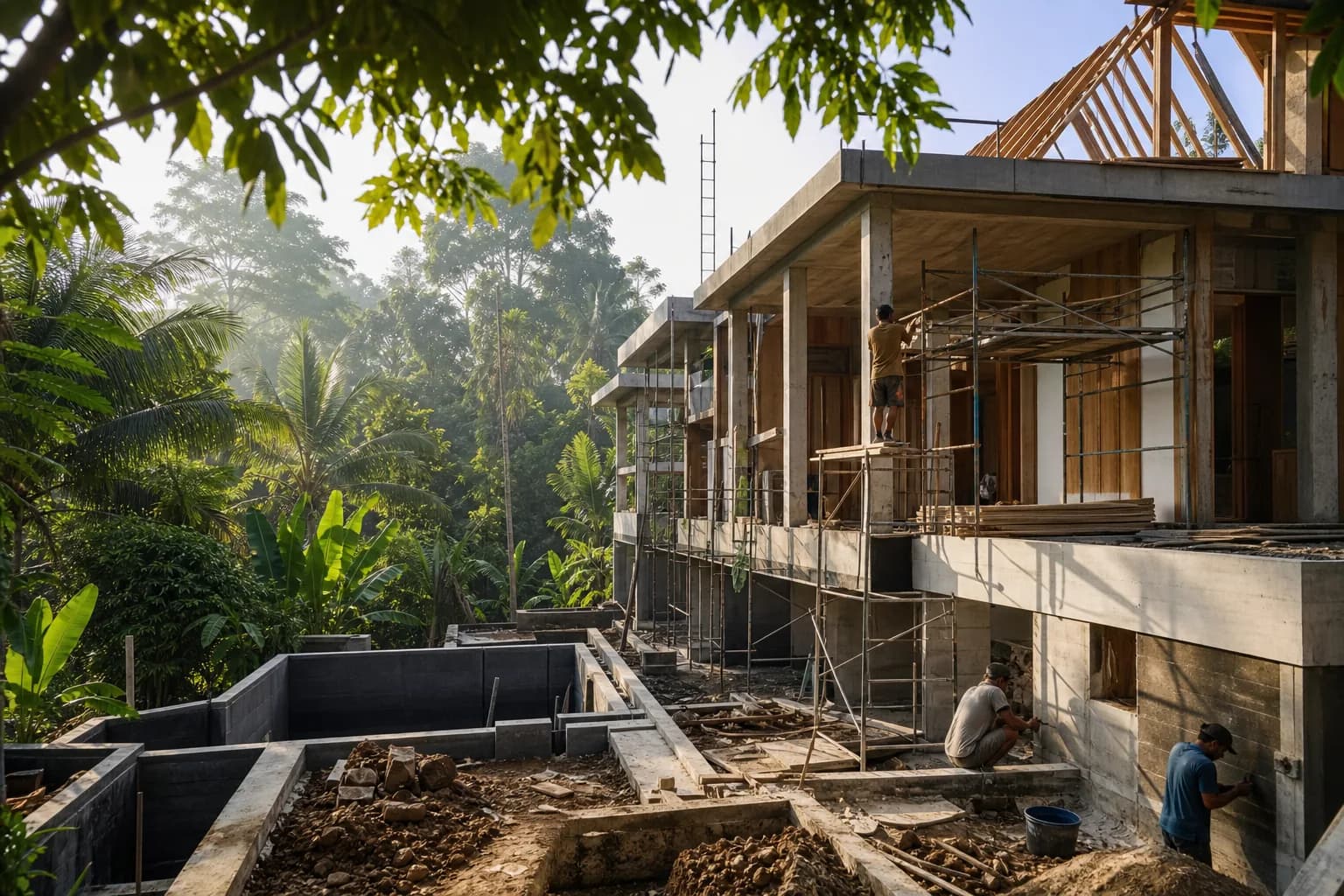
True Closing Costs of a Bali Purchase: Notary, Taxes and Fees on Top of the Price
What you really pay on top of a Bali property price in 2026: notary fees, transfer and lease taxes, VAT on developer units — with realistic totals for each deal type and a worked example.
7 min read
Bali Property Taxes for Foreigners: BPHTB, PPh and PBB-P2 — Who Pays What and When
A clear 2026 breakdown of the three taxes every foreign buyer meets in Bali — BPHTB, PPh and PBB-P2 — with who pays what, on which value, and at which point in the deal.
9 min read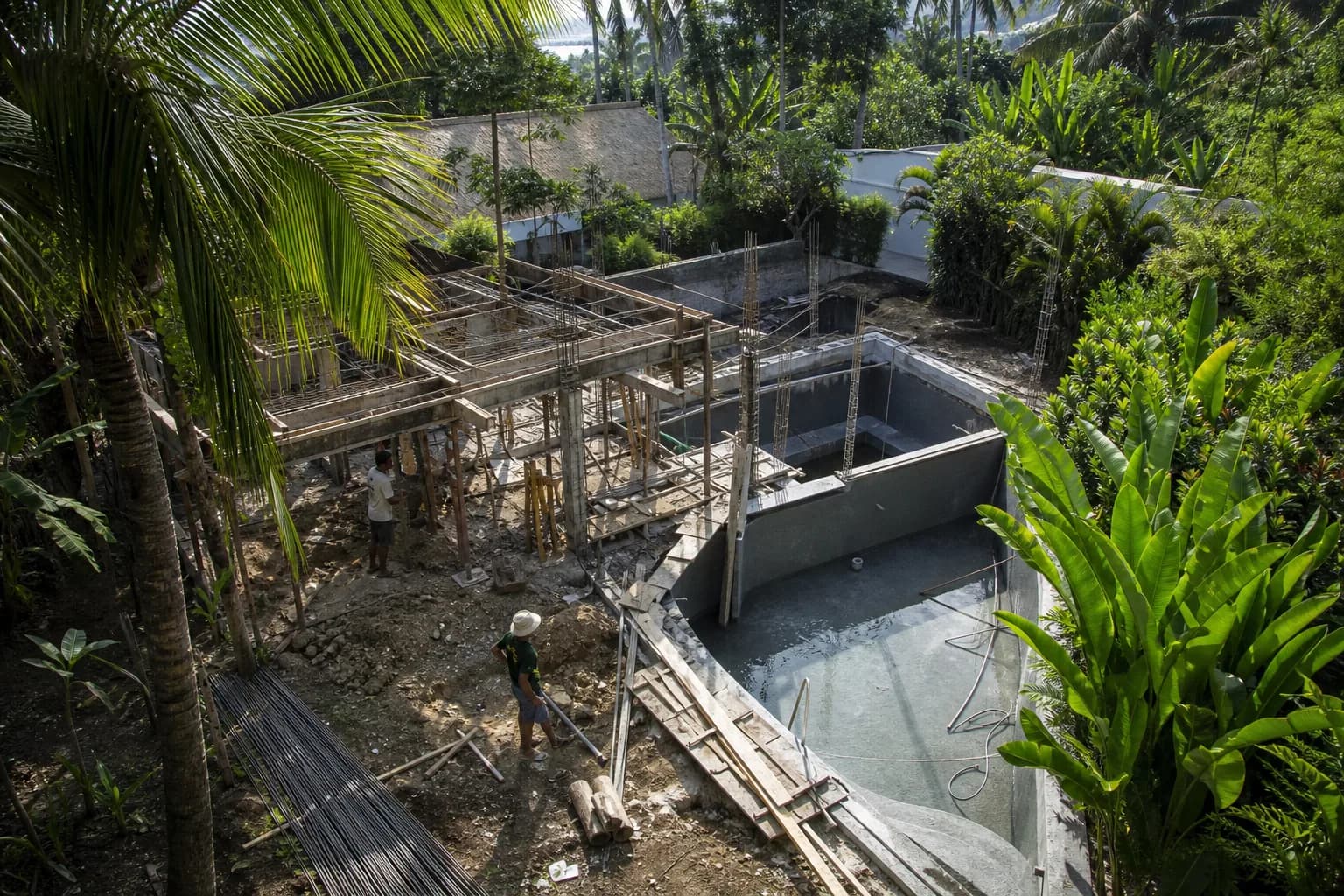
Swimming Pool Construction Cost in Bali (2026): Real Prices by Size and Type
What a swimming pool really costs to build in Bali in 2026 — by size, structure and finish — plus running costs, common quote traps and where pools go wrong in the tropics.
3 min read