Terracotta vs Ceramic Tile Thermal Expansion in Bali
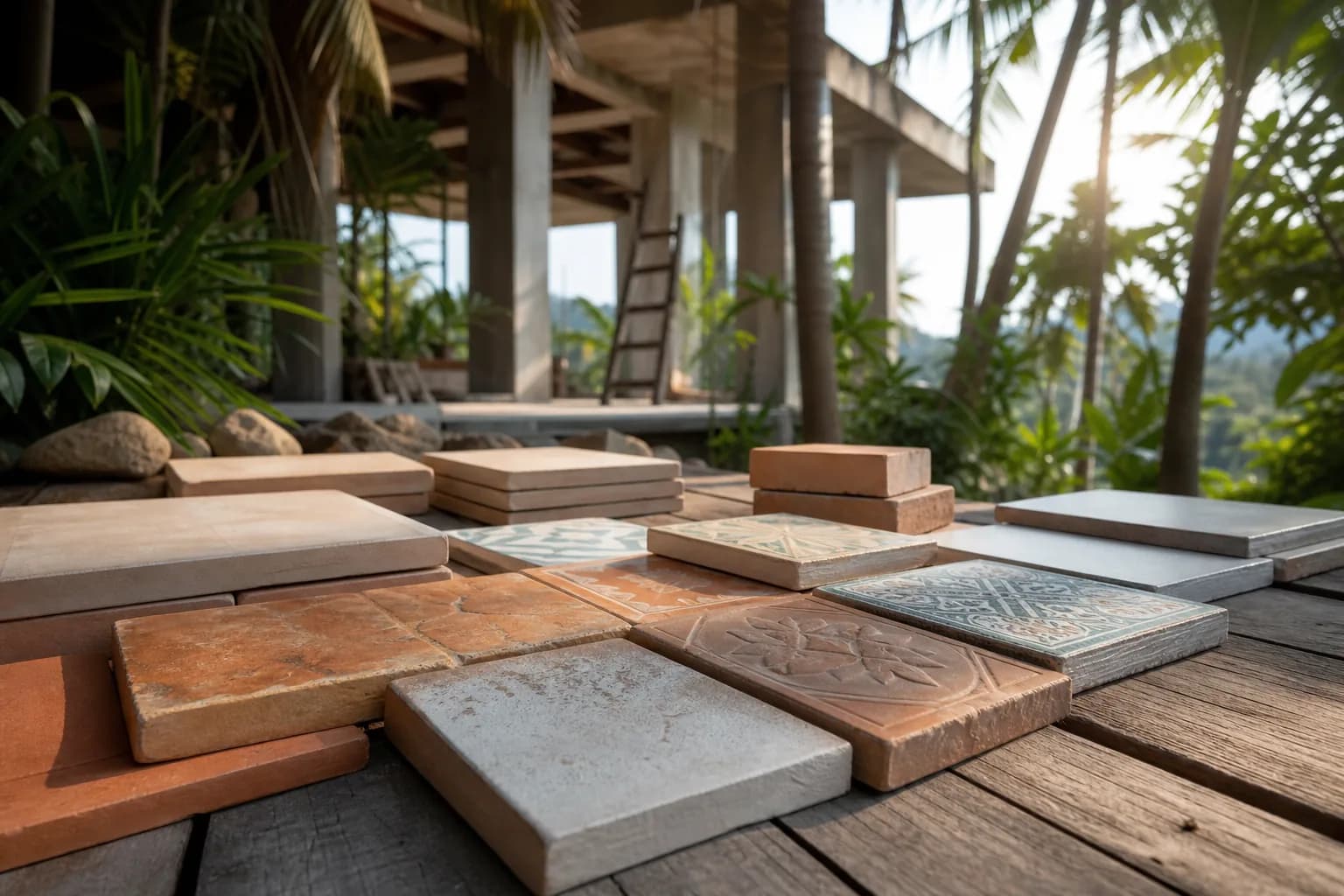
Why Thermal Expansion Matters for Bali Outdoor Tile Installations
When installing outdoor tiles around Bali villa pools, terraces, and garden pathways, many property owners discover cracked tiles and lifted corners within the first year—not from poor workmanship, but from ignoring thermal expansion coefficients. Bali’s tropical climate creates surface temperatures ranging from 25°C at dawn to 55°C on sun-exposed tiles by midday, causing materials to expand and contract daily. Terracotta tiles expand approximately 0.000006-0.000008 inches per degree Fahrenheit, while ceramic and porcelain tiles expand at only 0.000004 inches per degree—a seemingly small difference that translates to significant movement across large outdoor surfaces. This technical reality demands different installation approaches, joint spacing, and substrate preparation for each material type in Bali’s intense tropical environment.
Technical Deep Dive: Understanding Thermal Expansion in Tropical Outdoor Applications
The coefficient of thermal expansion (CTE) determines how much a material grows or shrinks with temperature changes. For finishing works Bali projects, this scientific principle becomes critically practical when tiles experience Bali’s dramatic temperature swings. Ceramic tiles, fired at temperatures exceeding 1200°C, achieve a dense, vitrified structure with minimal porosity and a CTE of approximately 4×10⁻⁶ per °C. Terracotta, fired at lower temperatures (900-1000°C), retains a more porous structure with a CTE ranging from 5.5-8×10⁻⁶ per °C depending on clay composition and manufacturing process.
In practical terms, a 10-meter terrace installation using terracotta tiles could experience 4-6mm of linear expansion during peak heat compared to 2-3mm for ceramic tiles under identical conditions. This difference compounds across large surfaces, creating substantial stress at tile edges, grout lines, and perimeter transitions. Teville’s construction teams document surface temperatures on actual Bali villa construction sites regularly exceeding 50°C on dark-colored tiles in direct sunlight, with substrate temperatures reaching 45°C even on shaded installations due to radiant heat transfer.
The porous nature of terracotta introduces additional complexity beyond pure thermal expansion. Terracotta absorbs 6-12% moisture by weight compared to ceramic’s 0.5-3%, and this absorbed water expands when heated, creating hygroscopic expansion that compounds thermal movement. During Bali’s wet season, terracotta tiles can absorb significant moisture overnight, then experience rapid heating and drying during morning sun exposure—a cycle that accelerates material fatigue and joint failure if not properly accommodated in the installation design.
Substrate interaction amplifies these expansion differentials. Concrete substrates commonly used in villa renovation Bali projects have a CTE of approximately 10×10⁻⁶ per °C—higher than both tile types. When concrete expands more than the tile surface, it creates compressive stress that can cause tiles to tent or delaminate. Conversely, if the tile expands more than the substrate (particularly with terracotta), tensile stress develops at the adhesive bond line. Professional installations must account for this three-layer expansion system: substrate, adhesive, and tile surface.
Bali’s coastal environment adds salt exposure and humidity factors that affect long-term thermal performance. Salt crystallization within terracotta’s porous structure can create internal pressure points that reduce the material’s ability to flex with thermal cycles. Teville’s technical teams specify sealed terracotta for all coastal installations within 2km of the ocean, adding a protective barrier that reduces moisture absorption by 60-70% while maintaining the material’s natural aesthetic appeal.
The color and finish of tiles significantly impacts surface temperature and resulting expansion. Dark terracotta tiles absorb 70-80% of solar radiation, reaching temperatures 15-20°C higher than light-colored ceramic alternatives. Glazed ceramic tiles with reflective finishes can reduce surface temperatures by 10-15°C compared to matte terracotta, directly reducing thermal expansion stress. This consideration becomes critical for pool deck installations where barefoot comfort and material longevity intersect with design preferences.
Professional Installation Process for Thermal Expansion Management
Proper installation begins with substrate preparation designed specifically for the tile type and expected thermal movement. For terracotta installations on Bali villa construction projects, Teville specifies a minimum 100mm reinforced concrete base with 150mm compacted aggregate sub-base. The concrete must cure for minimum 28 days and achieve moisture content below 4% before tile installation begins—critical in Bali’s humid environment where concrete retains moisture longer than in temperate climates.
Movement joint placement differs substantially between materials. Ceramic tile installations require expansion joints every 4-6 meters in both directions, positioned to create roughly square sections. Terracotta demands more frequent joints—every 3-4 meters maximum—with additional joints at all perimeter transitions, doorways, and material changes. These joints must penetrate through the tile, adhesive, and substrate to function effectively, typically 10-12mm wide for terracotta versus 6-8mm for ceramic applications.
Adhesive selection critically impacts thermal performance. Teville’s finishing works Bali specifications require flexible, polymer-modified thin-set mortars with minimum S1 classification (≥2.5mm deformability) for ceramic tiles and S2 classification (≥5mm deformability) for terracotta. The adhesive bed thickness varies: 6-8mm for ceramic using 10mm notched trowel, and 8-10mm for terracotta using 12mm notched trowel. This additional thickness for terracotta provides greater flexibility to accommodate movement while maintaining bond strength.
Back-buttering technique becomes mandatory for tiles larger than 300×300mm in outdoor installations. Each tile receives a thin layer of adhesive on its reverse side in addition to the notched substrate application, ensuring 95%+ coverage and eliminating voids where thermal stress can concentrate. For terracotta tiles, which often have irregular back surfaces due to traditional manufacturing, back-buttering compensates for surface variations and improves bond consistency.
Joint spacing and grouting procedures differ significantly. Ceramic tiles can be installed with 3-4mm joints using standard sanded grout, while terracotta requires 6-8mm joints filled with flexible, polymer-modified grout or specialized epoxy grout for high-movement applications. The wider joints provide space for thermal expansion while maintaining visual proportion with terracotta’s typically larger format and rustic aesthetic. All grout joints must be sealed with penetrating sealers that allow vapor transmission while blocking liquid water and contaminants.
Perimeter detailing requires particular attention in tropical installations. All tile fields must maintain 10-15mm expansion gaps at walls, columns, and fixed structures, filled with compressible foam backer rod and topped with flexible polyurethane or silicone sealant. These perimeter joints accommodate both thermal expansion and structural movement from the building itself—particularly important in Bali where seismic activity and foundation settlement create additional movement variables beyond pure thermal expansion.
Curing and protection procedures extend longer for outdoor installations in Bali’s climate. Tiles must remain protected from direct sun exposure for 72 hours after installation to prevent rapid moisture loss from adhesive and grout, which can compromise bond strength and flexibility. Light foot traffic can begin after 48 hours for ceramic, 72 hours for terracotta, with full loading delayed until 7 days post-installation to allow complete adhesive cure.
Materials & Specifications for Tropical Outdoor Tile Installations
Ceramic tile selection for Bali outdoor applications should prioritize porcelain varieties with water absorption below 0.5% and minimum breaking strength of 1300N. Rectified edges allow tighter joint spacing while maintaining expansion capacity, and through-body coloration ensures chips and wear remain less visible over time. Teville specifies slip-resistance ratings of R11 or higher (DIN 51130) for pool surrounds and R10 minimum for covered terraces, ensuring safety in wet tropical conditions.
Terracotta tiles suitable for villa renovation Bali outdoor installations must be machine-made with consistent thickness (±2mm tolerance) rather than handmade varieties that introduce installation complications. Minimum density of 1.8g/cm³ indicates adequate firing and durability, while water absorption should not exceed 10% even for unsealed terracotta. Pre-sealed terracotta products offer significant advantages in Bali’s environment, arriving with factory-applied penetrating sealers that provide immediate protection during and after installation.
Adhesive specifications must account for tropical heat and humidity. Polymer-modified thin-set mortars with extended open time (minimum 30 minutes) accommodate Bali’s rapid evaporation rates, while high-flexibility formulations (S2 classification) provide the deformability necessary for thermal movement. White adhesives prevent show-through on light-colored tiles, while gray formulations suit darker terracotta tones. All adhesives must be stored in climate-controlled conditions and mixed in small batches to prevent premature setting in Bali’s heat.
Grout selection balances flexibility, stain resistance, and aesthetic requirements. Polymer-modified cement grouts with flexural strength exceeding 5 MPa suit most ceramic installations, while terracotta benefits from epoxy grouts in high-traffic or pool-adjacent areas where chemical resistance and superior flexibility justify the additional cost. Color-stable grouts prevent the fading common in tropical UV exposure, maintaining appearance over years of service.
Sealers represent the final critical material specification. Penetrating sealers that don’t form surface films allow vapor transmission while blocking liquid water, essential for terracotta’s breathability. Ceramic tiles typically require only grout joint sealing, while terracotta demands full surface sealing with products specifically formulated for clay tiles. Reapplication schedules vary: every 2-3 years for terracotta in full sun exposure, 3-5 years for shaded installations.
Cost Breakdown for Bali Outdoor Tile Installations
Material costs for ceramic tile installations in Bali range from Rp 180,000-450,000 per square meter for quality porcelain tiles suitable for outdoor use, with premium brands and specialized finishes reaching Rp 600,000-800,000/m². Terracotta tiles cost Rp 250,000-500,000/m² for machine-made varieties, with pre-sealed options adding Rp 50,000-80,000/m² to material costs. These prices reflect 2026 market conditions for Bali villa construction projects with proper import duties and quality certifications.
Installation labor costs differ based on material complexity and joint requirements. Ceramic tile installation by Teville’s certified teams costs Rp 150,000-200,000/m² including substrate preparation, adhesive, and grouting. Terracotta installation commands Rp 180,000-250,000/m² due to wider joint requirements, additional sealing steps, and more frequent movement joint installation. These rates include proper surface preparation, waterproofing where required, and initial sealing applications.
Substrate preparation represents significant cost variation depending on existing conditions. New concrete substrates add Rp 350,000-450,000/m² including formwork, reinforcement, and finishing. Renovation projects requiring existing tile removal and substrate repair cost Rp 120,000-180,000/m² for demolition and surface preparation. Waterproofing membranes for pool surrounds and wet areas add Rp 85,000-120,000/m² to project costs but prove essential for long-term performance.
Movement joint materials and installation add Rp 25,000-40,000 per linear meter for proper foam backer rod and flexible sealant installation. A typical 50m² terrace requires approximately 30-40 linear meters of expansion joints, adding Rp 750,000-1,600,000 to total project cost—an expense that prevents far more costly repair work when thermal expansion isn’t properly accommodated.
For comprehensive finishing works Bali projects, expect total installed costs of Rp 680,000-1,200,000/m² for ceramic tile systems and Rp 850,000-1,400,000/m² for terracotta installations including all preparation, materials, labor, and sealing. Premium projects with specialized tiles, complex patterns, or challenging site conditions can reach Rp 1,800,000-2,200,000/m². Teville provides detailed cost estimates through our project estimation service, accounting for specific site conditions and material selections.
Common Mistakes in Thermal Expansion Management
The most frequent error in Bali outdoor tile installations involves inadequate or improperly positioned movement joints. Many contractors apply residential interior standards to outdoor tropical installations, spacing expansion joints every 8-10 meters or omitting them entirely. This oversight guarantees tile failure within 6-18 months as accumulated thermal stress exceeds material strength. Teville’s remediation projects frequently involve complete reinstallation because movement joints cannot be effectively added after initial installation—the joints must penetrate through all layers to function properly.
Substrate moisture content represents another critical failure point often overlooked in Bali’s humid environment. Installing tiles over concrete with moisture content exceeding 4% traps water beneath the tile surface, where it expands during thermal cycles and creates hydraulic pressure that debonds tiles. Professional installations require moisture testing with calibrated meters before tile work begins, with additional drying time specified when readings exceed acceptable limits—a delay that prevents expensive failures.
Adhesive coverage deficiencies cause premature failure in outdoor installations subject to thermal stress. Spot-bonding or coverage below 80% creates voids where tiles can flex independently from the substrate, concentrating stress at bonded points and
 164 m²7 month(s)from 79.000 USD
TALA TWO
 1from 198.000 USD
Private: Haridas Villas
 3180 m²7 month(s)from 142.000 USD
Vasudeva
164 m²7 month(s)from 79.000 USDPrivate: Haridas Villas, Tegallalang
 172 m²8 month(s)from 120.000 USD
Keshava
 2144 m²11 month(s)from 104.000 USD
Narayana
 3127 m²9 month(s)from 177.000 USD
Mukunda

Want to calculate?
 4344 m²16 month(s)from 290.000 USD
Radha
 3124 m²6 month(s)from 123.000 USD
TALA 8
 3104 m²11 month(s)from 99.000 USD
TALA 100
 3173 m²6 month(s)from 125.000 USD
TALA FOUR
Start With Real Numbers, Not Guesses
Before buying land or finalizing a design, check the realistic build cost range for your project in Bali.
Our team reviews your inputs and gives a grounded estimate.
Available lands
 700 m²15 min$ 90517Bali, Central Bali
 3800 m²15 min$ 100616Bali, Pererenan
 550 m²15 min$ 164594Bali, Mengwi
 3100 m²20 min$ 272968Bali, Tabanan
 2130 m²10 min$ 495776Bali, Pecatu
 3700 m²15 min$ 738177Bali, Tabanan
 3254 m²5 min$ 631800Bali, All
 3900 m²10 min$ 432266Bali, Tabanan
 700 m²8 min$ 165517Bali, Umalas
 2400 m²7 min$ 496552Bali, Canggu
 4270 m²10 min$ 394397Bali, Ubud
 200 m²11 min$ 89286Bali, Tabanan
 1200 m²2 min$ 155172Bali, Klungkung
 1300 m²10 min$ 348214Bali, Tabanan
 500 m²10 min$ 107143Bali, Tabanan
Essential Bali build & buy guides
- Bali villa construction cost per m² in 2026
- How much will your villa cost? Calculator
- Building a villa in Bali: the complete guide
- Buying land in Bali: step-by-step for foreigners
- Bali villa investment: yields, risks, returns
- Leasehold vs freehold: what foreigners can own
- Construction defect liability & 10-year warranty
- Bali building codes and construction standards
Related guides
Leasehold Depreciation in Bali: How Remaining Term Affects Resale Value — and What Offsets It
A Bali leasehold is a depreciating right on land plus an ageing building — but the loss of value is neither linear nor unmanageable. How remaining term drives resale price, where the danger lines sit, and the clauses and decisions that protect your exit.
7 min read
Annual Holding Costs of a Bali Villa: A Realistic Owner's Budget
The purchase price is only the entry ticket. Here is what a Bali villa actually costs to hold each year — staff, utilities, pool, maintenance, insurance, taxes and management — with realistic 2026 numbers and a sample budget.
7 min read
Transferring Money to Indonesia for a Property Purchase: Banking, Documentation and Safe Practice
Moving six figures across borders is the least glamorous part of buying in Bali, and the part most buyers under-prepare for. This guide covers the rupiah rule, notary escrow, transfer documentation, and the paper trail that protects a future exit.
8 min read