Tabanan Rice Field Foundation Costs: Soft Soil Piling Budget Bali
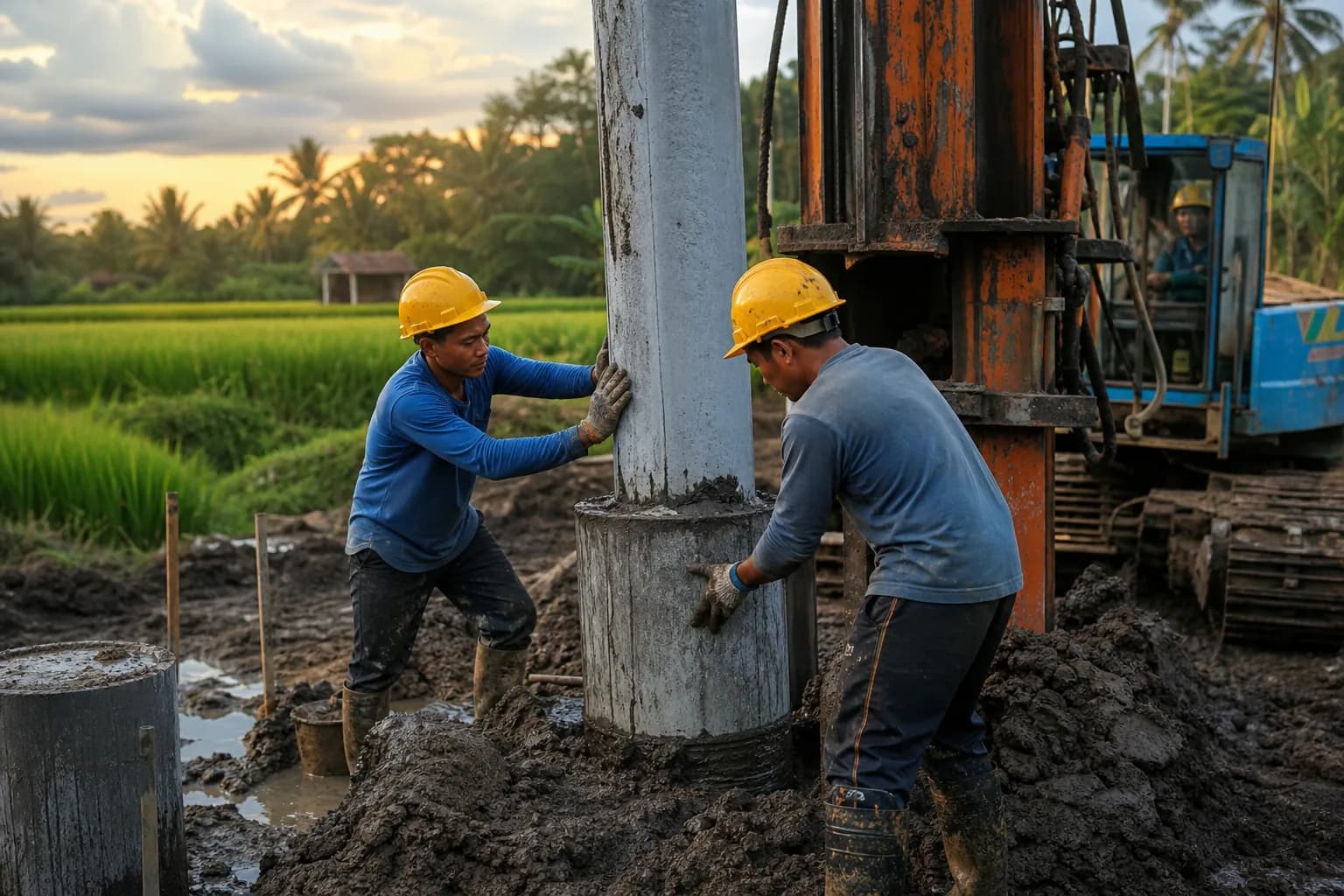
The Hidden Foundation Challenge: Why Tabanan Rice Fields Require Specialized Piling Budgets
Tabanan’s iconic rice terraces represent some of Bali’s most visually stunning building sites—and some of its most technically demanding foundation challenges. The same saturated clay and organic-rich soil that sustains centuries of rice cultivation creates compressible, low-bearing-capacity ground conditions that standard shallow foundations cannot safely support. Developers purchasing rice field parcels in Tabanan districts like Kediri, Penebel, and Kerambitan frequently underestimate foundation costs by 40-60%, discovering only during soil testing that their $80,000 foundation budget requires $140,000-$180,000 in deep piling systems. This isn’t a construction upsell—it’s structural physics responding to soil conditions that differ fundamentally from Bali’s volcanic hillside or coastal sand sites.
Engineering Reality: Why Tabanan Rice Field Soil Demands Deep Foundation Systems
Tabanan rice fields occupy alluvial plains with soil profiles characterized by 3-8 meters of soft clay, silt, and decomposed organic matter overlaying more competent bearing strata. Standard geotechnical investigations in active and recently retired rice fields consistently reveal:
- Bearing capacity: 0.5-1.2 kg/cm² in upper 4 meters (compared to 2.5-4.0 kg/cm² required for conventional footings)
- Moisture content: 45-70% in saturated clay layers, creating consolidation settlement risks
- Organic content: 8-15% in topsoil zones, contributing to long-term decomposition settlement
- Water table: 0.5-2.0 meters below surface during wet season, rising to surface level during peak irrigation
These conditions create two critical engineering requirements. First, foundations must transfer structural loads through weak surface layers to competent bearing strata at 6-12 meter depths. Second, the system must resist differential settlement as organic materials decompose and clay layers consolidate under building weight over 5-15 year timeframes.
Bored cast-in-place concrete piles represent the standard solution for Tabanan rice field construction. The process involves augering 300-400mm diameter holes to refusal depth (typically 8-12 meters), installing steel reinforcement cages, and casting concrete columns that function as deep foundation elements. For a typical 250m² two-story villa, engineers specify 20-35 piles arranged in a grid pattern beneath load-bearing walls and columns.
The alternative—micro-piles or helical piles—suits renovation projects or sites with access constraints but costs 15-25% more per linear meter due to specialized equipment and installation complexity. Driven precast piles, common in urban Indonesian construction, prove impractical in Tabanan rice fields due to vibration impacts on adjacent irrigation infrastructure and the difficulty of achieving consistent penetration through variable clay layers.
Indonesian building code SNI 8460:2017 mandates pile load testing for projects exceeding 200m² floor area. This requires installing test piles 30 days before production piling to allow concrete curing, then applying hydraulic loads to 200% of design capacity while measuring settlement. The test costs $1,800-$2,400 but provides the only reliable verification that your foundation system will perform as engineered—critical insurance when building on compressible soil.
Tabanan’s regulatory environment adds specific requirements. The local Public Works department (Dinas PU) requires foundation designs stamped by Indonesian-licensed structural engineers, with calculations demonstrating adequate safety factors for both ultimate bearing capacity and serviceability settlement limits. Projects within 50 meters of active irrigation channels require additional hydraulic impact assessments to ensure piling operations don’t compromise subak (traditional water management) infrastructure—a review process adding 3-4 weeks to permit timelines.
Critical Oversights: What Rice Field Buyers Miss Before Breaking Ground
The most expensive mistake occurs when developers budget for foundations before conducting geotechnical investigations. A $1,200 soil boring program reveals actual bearing strata depth, but buyers often skip this step during land due diligence, assuming “all Tabanan sites are similar.” In reality, bearing depth varies dramatically—even within single parcels. A 2,000m² rice field might require 8-meter piles on the upslope portion and 12-meter piles where the terrace drops, creating a $15,000-$22,000 cost differential that wasn’t budgeted.
Seasonal water table fluctuation creates the second hidden risk. Rice fields maintain saturated conditions during cultivation cycles, but many buyers visit during dry season when water tables drop 1-2 meters. They observe “dry” soil and assume standard foundation approaches will work. When construction begins during wet season, contractors encounter standing water at 0.5-meter depth, requiring dewatering systems, extended concrete curing periods, and waterproofing measures that add $8,000-$12,000 to foundation costs.
The third oversight involves access logistics. Rice field parcels often connect to public roads via narrow agricultural paths (1.5-2.0 meters wide) that cannot accommodate truck-mounted drilling rigs. Contractors must use smaller, slower equipment or construct temporary access roads—adding 4-6 days of work and $3,500-$5,000 in mobilization costs that standard quotes don’t include.
Finally, buyers underestimate the interaction between foundation work and irrigation systems. Tabanan rice fields integrate into centuries-old subak networks with underground channels, bamboo pipes, and earthen berms that aren’t visible during site visits. Piling operations that accidentally puncture irrigation infrastructure create legal liability under customary adat law and can halt construction for weeks while repairs and community consultations occur.
Engineered Implementation: The Tabanan Rice Field Foundation Process
Phase 1: Pre-Construction Soil Investigation (Week 1-2)
Commission a geotechnical investigation with minimum three boring points for parcels under 1,000m², five points for larger sites. Specify borings to 15-meter depth or until encountering two consecutive meters of competent bearing strata (N-SPT value >20). The investigation should include laboratory testing for moisture content, Atterberg limits, and organic content in upper soil layers. Budget $1,200-$1,800 for standard investigations, $2,400-$3,200 for sites with complex topography or suspected variable conditions.
Phase 2: Foundation Engineering Design (Week 3-4)
Engage an Indonesian-licensed structural engineer to design the pile foundation system based on soil data and architectural loads. The engineer calculates required pile diameter, depth, spacing, and reinforcement, then produces stamped drawings and calculations for permit submission. This phase costs $1,800-$2,800 for residential villas, more for commercial structures. Ensure the engineer specifies pile load testing requirements and acceptance criteria.
Phase 3: Site Preparation and Access (Week 5-6)
Before mobilizing drilling equipment, verify access routes can accommodate 8-10 ton truck-mounted rigs. If existing agricultural paths are inadequate, construct temporary access using geotextile fabric and crushed stone (budget $2,500-$4,000 for 30-50 meter access roads). Coordinate with subak leadership to map underground irrigation infrastructure and establish protection protocols. Install dewatering wells if water table is within 1 meter of planned pile cap elevation—typically 2-4 wells at $800-$1,200 each including pumps.
Phase 4: Test Pile Installation and Loading (Week 7-9)
Install 1-2 test piles at locations representing worst-case soil conditions. Allow 28 days for concrete to achieve design strength, then conduct static load testing using hydraulic jacks and reaction frames. The test applies loads incrementally to 200% of design capacity while measuring settlement with dial gauges. Acceptance criteria typically limit settlement to 10mm at design load, 40mm at ultimate load. If test piles fail, the engineer revises the design—potentially increasing pile depth, diameter, or quantity.
Phase 5: Production Piling (Week 10-12)
After successful load testing, proceed with production pile installation. Drilling crews typically complete 6-8 piles per day in favorable conditions, slower in wet season or when encountering buried obstacles. Each pile requires steel reinforcement cage installation (typically 6-8 longitudinal bars with spiral ties) before concrete placement. Use concrete minimum K-300 grade (25 MPa) with slump appropriate for tremie placement in wet holes. Document each pile with depth logs and concrete batch tickets for permit compliance.
Phase 6: Pile Cap and Grade Beam Construction (Week 13-14)
After pile concrete cures 7-10 days, excavate for pile caps and grade beams that connect pile heads into an integrated foundation system. This requires careful excavation around pile tops to expose reinforcement for doweling into caps. In high water table conditions, maintain dewatering throughout this phase. The pile cap and grade beam work typically consumes 35-45m³ of concrete for a 250m² villa, with reinforcement densities of 80-100 kg/m³.
Budget Reality: Tabanan Rice Field Foundation Cost Components
For a representative 250m² two-story villa on Tabanan rice field land, expect these foundation cost ranges:
- Geotechnical investigation: $1,200-$1,800 (3-5 borings to 15m depth)
- Foundation engineering: $1,800-$2,800 (structural design and permit drawings)
- Site preparation/access: $2,500-$5,000 (temporary roads, dewatering if needed)
- Test pile program: $1,800-$2,400 (installation and load testing)
- Production piling: $45,000-$75,000 (25-35 piles, 8-12m depth, including materials and labor)
- Pile caps and grade beams: $12,000-$18,000 (excavation, formwork, concrete, reinforcement)
- Waterproofing and drainage: $3,500-$5,500 (below-grade waterproofing, perimeter drains)
Total foundation system cost: $68,000-$110,000, representing 22-28% of total construction budget for rice field sites. This compares to $35,000-$55,000 (12-16% of budget) for similar villas on competent hillside soil in areas like Ubud or Canggu.
Timeline from soil investigation to completed foundation: 14-16 weeks in dry season, 18-22 weeks if construction spans wet season months (December-March) when water table management extends schedules.
Frequently Asked Questions: Tabanan Rice Field Foundation Specifics
Can I reduce foundation costs by building a smaller structure or using lightweight materials?
Reducing building weight helps but doesn’t eliminate deep foundation requirements on soft rice field soil. A single-story 150m² villa might require 18-25 piles instead of 30-35, saving $15,000-$25,000, but you still need piles to competent bearing strata. Lightweight materials like timber framing reduce loads by 20-30% compared to concrete/masonry, potentially allowing smaller pile diameters (300mm vs 400mm) but not shallower depths—the weak surface soil remains regardless of building weight. The most cost-effective approach combines modest building footprint with efficient structural design that minimizes pile quantity while maintaining safety factors.
How do I verify a contractor’s piling cost quote is accurate for Tabanan rice field conditions?
Request itemized quotes separating mobilization, per-meter drilling costs, materials (concrete, reinforcement), and load testing. Typical rates: $35-$55 per linear meter for drilling/installation, $180-$240 per cubic meter for pile concrete, $1.20-$1.60 per kg for reinforcement steel. Verify the quote includes pile depths matching your geotechnical report—not assumed depths. Confirm load testing is included (many initial quotes omit this $1,800-$2,400 item). Ask for references from recent Tabanan rice field projects and verify the contractor has truck-mounted drilling rigs suitable for 10-12 meter depths—smaller equipment takes twice as long and costs more despite lower daily rates.
What happens if we discover worse soil conditions than the initial investigation indicated?
Geotechnical investigations sample specific points, so encountering localized soft zones during production piling is possible. Reputable contractors include contingency clauses for additional pile depth at pre-agreed rates (typically $40-$60 per additional meter). If conditions differ dramatically from the investigation, stop work and commission supplementary borings—continuing with inadequate foundations creates structural risks and future liability. Budget 10-15% contingency for foundation work on rice field sites. This scenario reinforces the value of thorough initial investigations with adequate boring density—spending an extra $600 on additional test holes can prevent $15,000 in change orders.
Do Tabanan rice field foundations require ongoing maintenance or monitoring?
Properly engineered pile foundations on rice field sites require minimal maintenance but benefit from settlement monitoring during the first 2-3 years. Install benchmark points on the structure and measure elevations annually—total settlement should stabilize under 15-20mm. Excessive or continuing settlement indicates foundation problems requiring engineering assessment. Maintain perimeter drainage systems to prevent water accumulation against pile caps, which can cause concrete deterioration over decades. If you convert surrounding land from rice cultivation to landscaping, monitor for settlement changes—removing irrigation water can cause clay consolidation that affects even piled foundations through negative skin friction. Annual visual inspections cost nothing but provide early warning of issues.
Can I use the same foundation design for multiple villas on adjacent rice field parcels?
Only if geotechnical investigations confirm similar soil profiles across all parcels. Rice field soil conditions vary significantly over short distances due to historical cultivation patterns, irrigation channel locations, and underlying geology. A design optimized for 9-meter pile depth on one parcel might require 12-meter depth 50 meters away, creating cost and safety issues. The economi
 1from 198.000 USD
Private: Haridas Villas
 2144 m²11 month(s)from 104.000 USD
Narayana
 3180 m²7 month(s)from 142.000 USD
Vasudeva
 164 m²7 month(s)from 79.000 USD
TALA TWO

Want to calculate?
 3173 m²6 month(s)from 125.000 USD
TALA FOUR
 172 m²8 month(s)from 120.000 USD
Keshava
 3127 m²9 month(s)from 177.000 USD
Mukunda
164 m²7 month(s)from 79.000 USDPrivate: Haridas Villas, Tegallalang
 3124 m²6 month(s)from 123.000 USD
TALA 8
 4344 m²16 month(s)from 290.000 USD
Radha
 3104 m²11 month(s)from 99.000 USD
TALA 100
Start With Real Numbers, Not Guesses
Before buying land or finalizing a design, check the realistic build cost range for your project in Bali.
Our team reviews your inputs and gives a grounded estimate.
Available lands
 1230 m²15 min$ 132543Bali, Tegallalang
 2400 m²7 min$ 496552Bali, Canggu
 250 m²15 min$ 40025Bali, Munggu
 8313 m²15 min$ 716670Bali, Buduk
 928 m²15 min$ 910123Bali, Pererenan
 1950 m²7 min$ 150092Bali, Tabanan
 550 m²15 min$ 164594Bali, Mengwi
 400 m²15 min$ 67192Bali, Tabanan
 1100 m²8 min$ 280419Bali, Ungasan
 3900 m²10 min$ 432266Bali, Tabanan
 1350 m²5 min$ 283467Bali, Pecatu
 615 m²15 min$ 113608Bali, Tabanan
 13000 m²1 min$ 920567Bali, Pekutatan
 220 m²2 min$ 66565Bali, Cemagi
 700 m²8 min$ 165517Bali, Umalas
Essential Bali build & buy guides
- Bali villa construction cost per m² in 2026
- How much will your villa cost? Calculator
- Building a villa in Bali: the complete guide
- Buying land in Bali: step-by-step for foreigners
- Bali villa investment: yields, risks, returns
- Leasehold vs freehold: what foreigners can own
- Construction defect liability & 10-year warranty
- Bali building codes and construction standards
Related guides
Milestone Payment Schedules in Bali Construction: How Staged Payments Protect You
Milestone-based payment schedules are a Bali builder's best client protection: what a healthy 6-stage structure looks like, how to verify progress remotely, and which payment terms to refuse.
7 min read
Financing a Bali Villa: Why the Market Is Cash-Only for Foreigners — and the Realistic Alternatives
Why foreign buyers in Bali almost always pay cash, the narrow 2026 bank options for residents, and the realistic alternatives — from home-country equity to milestone-staged construction payments.
7 min read
Bali Rental Income Tax and Compliance Costs: The 10% Rule and the Real Math
How Bali rental income is really taxed in 2026 — the 10% final tax, the 20% non-resident trap, PB1, licensing overhead — and a worked example showing what a villa owner actually keeps.
7 min read