Seminyak Underground Utility Connection Fees Permit Costs Bali
The Hidden Infrastructure Cost That Derails Seminyak Villa Budgets
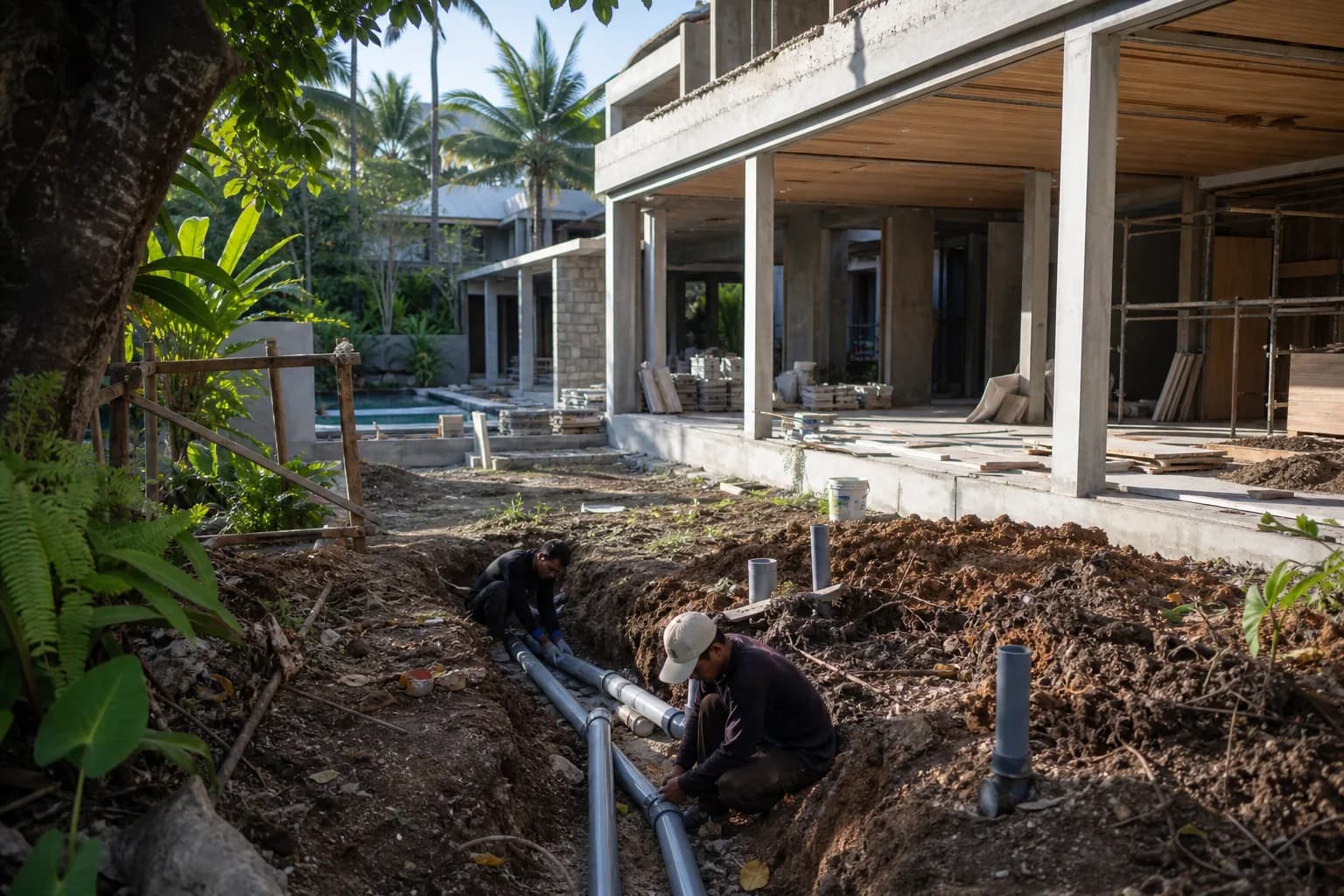
When purchasing land in Seminyak’s premium zones—particularly along Jalan Petitenget, Jalan Drupadi, or near the beach corridors—most buyers focus on land price, IMB permit costs, and construction rates per square meter. Yet one of the most unpredictable budget variables remains underground utility connection fees and trench permit costs. Unlike established residential areas with visible infrastructure, Seminyak’s rapid development means utility access varies dramatically street-by-street. A plot 50 meters from a main road may require IDR 80-120 million in additional trenching, conduit installation, and multi-agency permits that never appeared in initial feasibility studies. This isn’t about connecting a wire—it’s about navigating Seminyak’s complex underground infrastructure regulations, coordinating with PLN (electricity), PDAM (water), Telkom (telecommunications), and securing excavation permits from multiple government layers while avoiding damage to existing luxury villa utilities beneath your access route.
Technical Infrastructure Reality: Seminyak’s Underground Utility Framework
Seminyak operates under Badung Regency jurisdiction, where underground utility installation requires coordination across four distinct systems: electrical grid connection (PLN), municipal water supply (PDAM Badung), telecommunications infrastructure (Telkom/fiber providers), and drainage/wastewater management. Unlike older Bali regions with overhead cabling, Seminyak’s tourism-focused development increasingly mandates underground installation to preserve aesthetic standards—particularly in gang (alley) access properties common throughout Petitenget and Oberoi areas.
The electrical connection process begins with PLN’s technical survey determining distance from the nearest transformer. Seminyak’s grid operates on 20kV medium-voltage distribution, requiring step-down transformers for residential supply. If your land sits beyond 200 meters from existing infrastructure, you’ll fund transformer installation (IDR 45-75 million) plus underground cabling. Standard 5,500VA residential connections cost IDR 12-18 million for the meter and basic hookup, but trenching from street to property boundary adds IDR 3,500-5,500 per linear meter depending on excavation depth and surface restoration requirements.
PDAM water connection fees in Seminyak range IDR 8-15 million for standard residential service, but the critical cost lies in pipeline extension. If municipal mains don’t reach your gang entrance, you’re responsible for funding pipeline installation to the nearest distribution point—potentially IDR 25-40 million for 100+ meter extensions through neighboring properties. This requires easement negotiations and restoration of paving, landscaping, and existing infrastructure along the route.
Trench permit costs (Izin Galian) from Badung’s Public Works department vary by location and scope. Main road excavations (Jalan Petitenget, Jalan Kayu Aya) require traffic management plans and cost IDR 15-25 million for permits alone, plus mandatory security deposits (IDR 10-20 million, refundable upon proper restoration). Gang excavations cost less (IDR 5-8 million permit fees) but require neighbor consent documentation and coordinated timing to minimize access disruption.
The engineering challenge intensifies in Seminyak’s high water table zones (0.8-1.5 meters below surface near Petitenget Beach). Underground conduit installation requires dewatering systems, concrete-encased PVC conduits rated for submersion, and waterproof junction boxes—adding 40-60% to standard trenching costs. Fiber optic and telecommunications trenching must maintain separate conduits from electrical (minimum 30cm separation per Indonesian Electrical Installation Standards), effectively doubling excavation width and restoration costs.
Seminyak’s luxury villa density creates another technical constraint: existing underground utilities. A 2024 survey indicated 70% of gang properties in central Seminyak have undocumented utility runs beneath access routes. Your trench excavation may encounter neighboring villa drainage lines, electrical feeds, or irrigation systems—triggering damage claims, repair obligations, and project delays. Professional ground-penetrating radar surveys (IDR 8-12 million) have become standard risk mitigation for projects requiring 50+ meter utility runs.
Hidden Risks: What Feasibility Studies Miss in Seminyak Utility Planning
The most expensive mistake occurs when buyers assume “utilities available” in land listings means connection-ready infrastructure. In Seminyak, this often means utilities exist within 500 meters—not at your property boundary. A Petitenget gang property may show PLN poles 200 meters away, but underground routing through private land requires individual easement agreements with 8-12 property owners, each potentially demanding compensation (IDR 5-15 million per easement). These negotiations can add 4-8 months and IDR 60-100 million to budgets.
Permit sequencing creates another trap. Badung requires completed IMB (building permit) before issuing trench permits for permanent utility installation, yet PLN demands confirmed electrical capacity before IMB approval. This circular dependency forces temporary overhead connections (IDR 8-12 million) that must be removed and replaced with underground systems post-construction—effectively paying twice for electrical infrastructure.
Seasonal timing dramatically impacts costs. Seminyak’s October-March wet season makes trenching 50-80% more expensive due to continuous dewatering, trench collapse risks, and extended restoration timelines. A 60-meter trench costing IDR 18 million in dry season may reach IDR 32 million during peak rains. Yet permit processing times (8-12 weeks) mean projects starting feasibility in July face wet-season execution regardless of planning.
The restoration obligation catches foreign buyers unfamiliar with Indonesian liability standards. You’re responsible for restoring all surfaces to original or better condition—including boutique paving, landscape walls, and drainage systems along your entire trench route. A 100-meter gang excavation may require replacing IDR 25-35 million in custom paving that wasn’t part of initial utility budgets.
Step-by-Step Process: Securing Underground Utility Connections in Seminyak
Phase 1: Infrastructure Assessment (Weeks 1-3)
Commission professional utility surveys identifying exact distances to PLN transformers, PDAM mains, and Telkom distribution points. Engage licensed surveyors (IDR 6-10 million) who provide stamped documentation required for permit applications. Request ground-penetrating radar scans if trenching exceeds 40 meters through developed areas. Simultaneously, obtain written confirmation from PLN regarding available capacity at nearest transformer—Seminyak’s tourist zones frequently operate at 85-95% capacity, requiring grid upgrades you may fund partially.
Phase 2: Easement Negotiation (Weeks 4-12)
If utility routing crosses private property, initiate easement discussions early. Indonesian law doesn’t grant automatic utility access rights—each property owner negotiates independently. Engage local facilitators familiar with Seminyak property dynamics (fees: 10-15% of total easement costs). Document all agreements in notarized contracts specifying route, depth, maintenance access, and compensation. Budget IDR 8-15 million per property for standard residential easements, more for commercial frontages.
Phase 3: Permit Application Compilation (Weeks 8-14)
Submit trench permit applications (Izin Galian) to Badung Public Works with complete documentation: land certificate copies, IMB approval, utility provider endorsement letters, technical drawings showing trench routes/depths, traffic management plans (if applicable), and restoration specifications. Applications require 15-20 supporting documents with official translations. Processing takes 6-10 weeks for gang locations, 10-14 weeks for main road excavations. Permit fees: IDR 5-8 million (gang), IDR 15-25 million (main roads), plus security deposits.
Phase 4: Utility Provider Coordination (Weeks 12-18)
Secure formal connection agreements from each utility provider. PLN requires separate applications for temporary construction power (Daya Sementara) and permanent connection (Sambungan Tetap). PDAM applications need water quality test results and septic system approval. Telkom fiber installations require building completion certificates. Each provider operates independent timelines—coordinate applications to align with construction milestones, not permit issuance dates.
Phase 5: Excavation Execution (Weeks 20-26)
Hire licensed excavation contractors with Seminyak experience and utility damage insurance (minimum IDR 500 million coverage). Proper execution includes: daily dewatering (high water table zones), hand-excavation within 1 meter of known utilities, concrete-encased conduits in submersion-risk areas, separate trenches for power/data (30cm minimum separation), and photographic documentation at each phase for permit closure. Coordinate with neighboring properties for access disruption—Seminyak’s narrow gangs often require temporary access arrangements.
Phase 6: Inspection and Restoration (Weeks 26-30)
Schedule multi-agency inspections: Public Works (trench compliance), PLN (electrical installation), PDAM (water connection), and local banjar (community organization) for access restoration approval. Restoration must match or exceed original conditions—budget for premium paving materials common in Seminyak’s upscale gangs. Final permit closure requires signed acceptance from all affected property owners along trench route, photographic evidence of completed restoration, and utility provider activation confirmations.
Realistic Cost Breakdown: Seminyak Underground Utility Connection Budget
Electrical Connection (PLN): Standard 5,500VA residential meter and connection: IDR 12-18 million. Underground cable installation from street transformer: IDR 3,500-5,500 per linear meter (includes excavation, conduit, cable, restoration). Transformer contribution (if required): IDR 45-75 million prorated among benefiting properties. Total for 80-meter connection: IDR 40-65 million.
Water Connection (PDAM): Standard residential connection fee: IDR 8-15 million. Pipeline extension (if required): IDR 2,800-4,200 per linear meter. Pressure testing and activation: IDR 3-5 million. Total for 60-meter extension: IDR 28-45 million.
Trench Permits: Gang excavation permit: IDR 5-8 million. Main road permit: IDR 15-25 million. Security deposit (refundable): IDR 10-20 million. Survey and documentation: IDR 6-10 million. Total permitting: IDR 21-43 million depending on route complexity.
Easement Costs: Per-property easement compensation: IDR 8-15 million. Legal documentation per easement: IDR 2-3 million. Facilitation fees: 10-15% of total easement costs. For 5-property route: IDR 50-90 million total.
Execution Costs: Licensed excavation contractor: IDR 4,500-7,000 per linear meter (includes dewatering, safety, insurance). Surface restoration: IDR 2,500-4,500 per linear meter (gang standard paving). Premium restoration (boutique areas): IDR 6,000-9,000 per linear meter. Ground-penetrating radar survey: IDR 8-12 million. Total execution for 100-meter route: IDR 65-110 million.
Realistic Total Budget: Simple gang property with utilities within 50 meters: IDR 55-85 million. Standard Seminyak property requiring 80-100 meter utility runs: IDR 120-180 million. Complex scenarios with main road crossings and multiple easements: IDR 200-280 million. Timeline: 20-30 weeks from survey to final activation.
Frequently Asked Questions: Seminyak Underground Utility Connections
Can I use overhead electrical connections to avoid underground trenching costs in Seminyak?
Temporary overhead connections are permitted during construction (Daya Sementara from PLN, costing IDR 8-12 million), but Badung Regency increasingly requires underground permanent connections in Seminyak’s tourism zones, particularly within 500 meters of main roads. Your IMB final inspection may be conditional on underground utility compliance. Some interior gang properties still permit overhead permanent connections, but this is location-specific and subject to local banjar regulations. Verify requirements during IMB application—retrofitting from overhead to underground post-construction costs 60-80% more than initial underground installation due to landscape disruption and permit reprocessing.
Who pays for utility infrastructure if multiple new villas need the same transformer or pipeline extension?
Indonesian utility law requires cost-sharing among benefiting properties, but implementation is negotiation-based, not automatic. If your project triggers transformer installation or pipeline extension that serves neighboring undeveloped plots, you’ll fund 100% upfront, then negotiate reimbursement as neighbors develop—a process requiring legal agreements and often years to recover costs. PLN and PDAM don’t mediate these disputes. Alternatively, form a consortium with neighboring landowners before infrastructure installation, sharing costs proportionally. This requires significant coordination but prevents single-party funding of shared infrastructure. Teville’s verified land consultation includes infrastructure cost-sharing analysis for multi-plot developments.
What happens if my trench excavation damages a neighboring villa’s underground utilities?
You bear full liability for damage to existing infrastructure along your trench route, regardless of whether utilities were documented or properly installed. This includes immediate repair costs, consequential damages (water damage from broken pipes, business interruption for commercial properties), and legal fees. Liability can reach IDR 50-150 million for significant damage to luxury villa systems. Mitigation strategies: require contractors to carry minimum IDR 500 million utility damage insurance, conduct ground-penetrating radar surveys before excavation, use hand-digging within 1 meter of known utility corridors, and document pre-existing conditions photographically with neighboring property owners present. Include damage liability clauses in contractor agreements with penalty provisions.
 4344 m²16 month(s)from 290.000 USD
Radha
 3173 m²6 month(s)from 125.000 USD
TALA FOUR
 164 m²7 month(s)from 79.000 USD
TALA TWO
 1from 198.000 USD
Private: Haridas Villas

Want to calculate?
 172 m²8 month(s)from 120.000 USD
Keshava
164 m²7 month(s)from 79.000 USDPrivate: Haridas Villas, Tegallalang
 3180 m²7 month(s)from 142.000 USD
Vasudeva
 2144 m²11 month(s)from 104.000 USD
Narayana
 3104 m²11 month(s)from 99.000 USD
TALA 100
 3124 m²6 month(s)from 123.000 USD
TALA 8
 3127 m²9 month(s)from 177.000 USD
Mukunda
Start With Real Numbers, Not Guesses
Before buying land or finalizing a design, check the realistic build cost range for your project in Bali.
Our team reviews your inputs and gives a grounded estimate.
Available lands
 3300 m²15 min$ 449889Bali, Tabanan
 2230 m²15 min$ 410573Bali, Padonan
 3000 m²15 min$ 738916Bali, Cepaka
 4270 m²10 min$ 394397Bali, Ubud
 5028 m²10 min$ 361000Bali, Ubud
 2000 m²10 min$ 243842Bali, Mengwi
 1300 m²10 min$ 348214Bali, Tabanan
 1375 m²10 min$ 447044Bali, Canggu
 750 m²15 min$ 187038Bali, Kerobokan
 1000 m²5 min$ 350431Bali, Drupadi
 6000 m²10 min$ 1330049Bali, Kutuh South Bali
 3254 m²5 min$ 631800Bali, All
 2000 m²5 min$ 738916Bali, Ungasan
 1000 m²10 min$ 230911Bali, Kerobokan
 2000 m²5 min$ 1440887Bali, Pecatu
Essential Bali build & buy guides
- Bali villa construction cost per m² in 2026
- How much will your villa cost? Calculator
- Building a villa in Bali: the complete guide
- Buying land in Bali: step-by-step for foreigners
- Bali villa investment: yields, risks, returns
- Leasehold vs freehold: what foreigners can own
- Construction defect liability & 10-year warranty
- Bali building codes and construction standards
Related guides
Milestone Payment Schedules in Bali Construction: How Staged Payments Protect You
Milestone-based payment schedules are a Bali builder's best client protection: what a healthy 6-stage structure looks like, how to verify progress remotely, and which payment terms to refuse.
7 min read
Financing a Bali Villa: Why the Market Is Cash-Only for Foreigners — and the Realistic Alternatives
Why foreign buyers in Bali almost always pay cash, the narrow 2026 bank options for residents, and the realistic alternatives — from home-country equity to milestone-staged construction payments.
7 min read
Bali Rental Income Tax and Compliance Costs: The 10% Rule and the Real Math
How Bali rental income is really taxed in 2026 — the 10% final tax, the 20% non-resident trap, PB1, licensing overhead — and a worked example showing what a villa owner actually keeps.
7 min read