Sanur Dewatering Pump Rental Groundwater Costs Bali
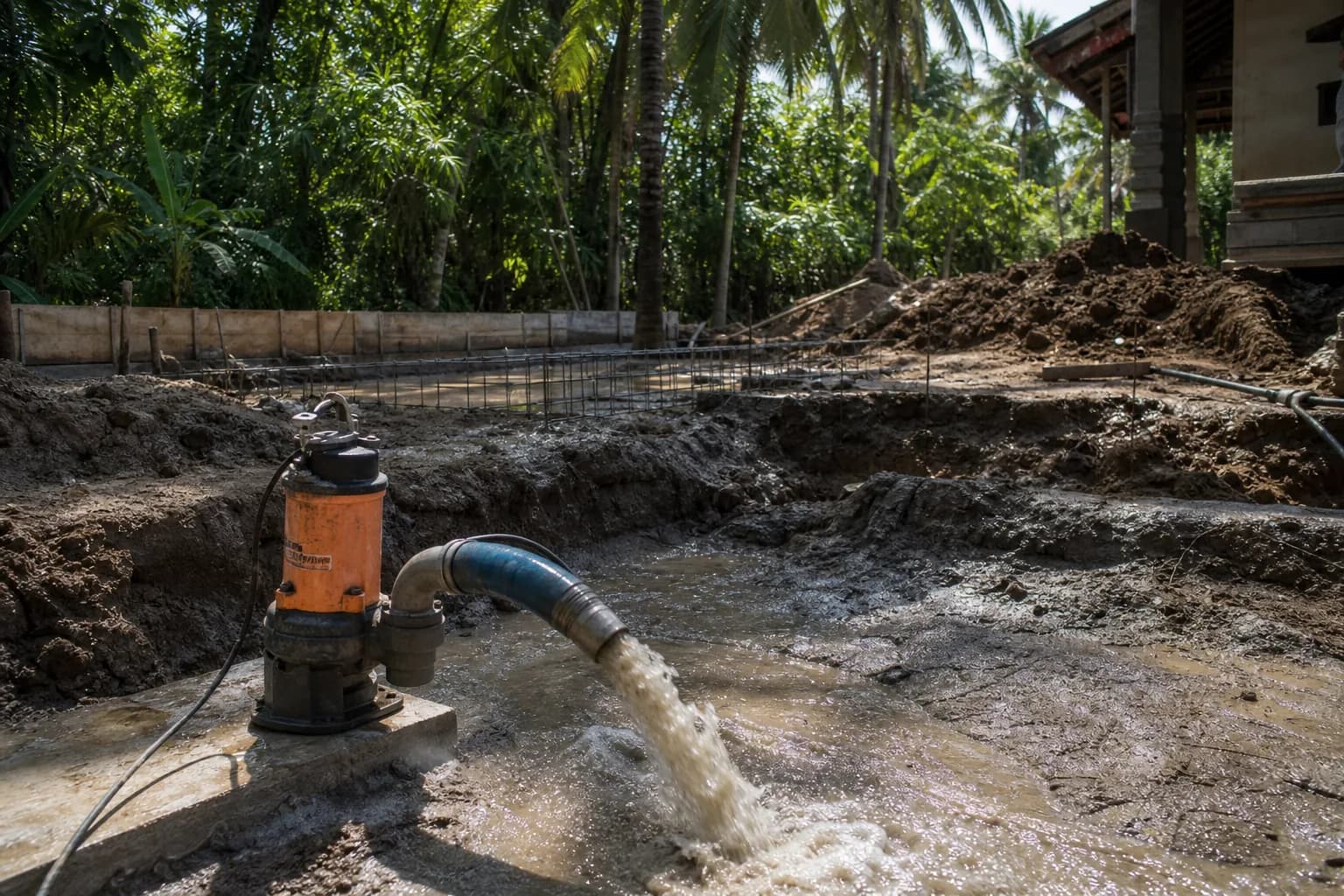
Why Sanur’s High Groundwater Table Demands Specialized Dewatering Engineering
Sanur’s coastal proximity creates a persistent construction challenge: groundwater tables frequently sit 1-2 meters below surface level, rising even higher during monsoon seasons. When excavating for villa foundations, basements, or underground utilities, builders encounter saturated soil conditions that compromise structural integrity, delay timelines, and escalate costs. Without proper dewatering systems, foundation work becomes impossible—concrete cannot cure in waterlogged conditions, excavation walls collapse, and equipment fails. The question isn’t whether dewatering is necessary in Sanur, but rather which pump rental configuration provides adequate capacity without inflating your construction budget by 15-25% through inefficient equipment selection or extended rental periods.
Technical Engineering Requirements for Sanur Dewatering Systems
Sanur’s geological profile consists of sandy loam topsoil transitioning to coral limestone substrata with high permeability coefficients (K-values ranging 10⁻³ to 10⁻⁴ cm/sec). This hydrogeological context demands specific dewatering approaches that differ significantly from inland Bali locations like Ubud or Canggu.
Groundwater Behavior in Coastal Sanur Conditions
The water table in Sanur exhibits tidal influence within 500 meters of the coastline, creating fluctuations of 30-50cm during spring tide cycles. Construction sites located in central Sanur (Jalan Danau Tamblingan, Jalan Bypass Ngurah Rai corridor) typically encounter static water tables at 1.5-2.5 meters depth during dry season (April-October), dropping to 0.8-1.5 meters during peak monsoon (December-February). These conditions require continuous pumping capacity rather than intermittent dewatering, fundamentally affecting rental duration and pump specification.
Soil permeability testing conducted by geotechnical consultants reveals that Sanur’s sandy substrata allows lateral groundwater recharge at rates of 2-4 cubic meters per hour per linear meter of excavation perimeter. A typical 15m x 20m villa foundation excavation (300 sqm footprint, 1.5m depth) generates inflow rates of 8-15 m³/hour depending on seasonal conditions and proximity to irrigation channels or rice field systems that act as groundwater reservoirs.
Pump System Configurations for Villa Construction
Sanur dewatering projects typically deploy one of three system types, each with distinct cost implications:
- Sump pumping systems: Submersible pumps placed in collection sumps at excavation low points. Suitable for shallow excavations (under 2 meters) with moderate inflow rates. Requires 2-4 pumps with 50-100 m³/hour capacity each, plus backup units.
- Wellpoint systems: Perimeter-installed suction wells connected to vacuum pumps. Effective for excavations 3-6 meters depth, lowering water table across entire site. Requires specialized installation crew and header pipe infrastructure.
- Deep well systems: Bored wells with submersible pumps for excavations exceeding 6 meters or basement construction. Necessary for multi-level villa designs with underground parking or wine cellars.
For standard single-level villa construction in Sanur—the most common scenario—sump pumping with 3-4 submersible units (each 75 m³/hour capacity) provides adequate dewatering while maintaining cost efficiency. The system must operate 18-22 hours daily during active excavation and foundation work, reducing to 8-12 hours during concrete curing phases.
Discharge Management and Environmental Compliance
Bali’s 2019 Governor Regulation No. 47 regarding groundwater management prohibits direct discharge of dewatering effluent into stormwater systems without sediment filtration. Sanur’s municipal infrastructure requires builders to implement settlement tanks (minimum 2 cubic meter capacity) before discharge into designated drainage channels. Failure to comply results in construction stop-work orders and fines ranging IDR 25-50 million.
Pumped water typically contains suspended sediments (150-400 mg/L) that must settle to below 50 mg/L before discharge. This necessitates either dual-tank systems allowing alternating settlement cycles, or continuous filtration units that add IDR 3-5 million to monthly operational costs. The discharge point location significantly impacts system design—sites with rear-lane drainage access simplify logistics compared to properties requiring 50+ meter discharge lines to street-level systems.
Hidden Risks Property Developers Overlook in Dewatering Planning
The most expensive dewatering mistakes occur during project planning, not execution. Developers frequently underestimate three critical risk factors specific to Sanur’s conditions:
Seasonal Timing and Rental Duration Miscalculation
Contractors often budget dewatering for the excavation phase only (typically 2-3 weeks), failing to account for foundation curing requirements. Concrete foundations in waterlogged conditions require continuous dewatering for 14-21 days post-pour to achieve proper curing strength. Starting foundation work in November-January extends dewatering needs by 40-60% due to monsoon groundwater recharge rates. A project budgeted for 4 weeks of pump rental realistically requires 7-9 weeks when accounting for weather delays and curing protocols.
Neighboring Property Impact and Legal Liability
Aggressive dewatering can lower groundwater tables in adjacent properties within a 25-40 meter radius, potentially causing foundation settlement in existing structures or drying out landscape vegetation. Sanur’s dense villa development patterns mean most construction sites have neighbors within this impact zone. Pre-construction condition surveys and written neighbor agreements are essential but frequently omitted, creating legal exposure when cracks appear in adjacent buildings during your dewatering operations.
Pump Capacity Undersizing
Rental companies often recommend minimum-capacity pumps to reduce costs, but Sanur’s high recharge rates punish undersized systems. A pump configuration that barely keeps pace with inflow during dry conditions becomes overwhelmed during unexpected rain events, flooding excavations and halting work for 3-5 days while water levels are restored. The cost difference between adequate and undersized systems is IDR 2-3 million monthly, but a single flooding event costs IDR 15-25 million in lost time, equipment damage, and remediation.
Step-by-Step Dewatering System Implementation Process
Phase 1: Geotechnical Assessment and System Design (Week 1-2)
Engage a geotechnical consultant to conduct soil boring and permeability testing at your Sanur site. Standard assessment includes 3-4 bore holes to 6-meter depth, laboratory permeability analysis, and groundwater monitoring over 7-14 days. Cost: IDR 18-28 million. This data determines required pump capacity, system type, and realistic dewatering duration. Teville’s construction process integrates geotechnical assessment during site evaluation phases, ensuring dewatering requirements inform foundation design rather than becoming costly surprises during excavation.
Phase 2: Pump Rental Specification and Contractor Selection (Week 2-3)
Request detailed quotations from minimum three Bali-based pump rental companies, specifying: total flow capacity (m³/hour), backup pump provision, fuel supply arrangements, maintenance response time, and discharge infrastructure. Verify rental companies maintain spare parts inventory in Bali—equipment breakdowns requiring parts from Jakarta add 3-5 day delays. Confirm 24-hour emergency service availability, critical during monsoon season when pump failures can flood excavations overnight.
Phase 3: Site Preparation and System Installation (Week 3-4)
Prior to excavation, install discharge infrastructure including settlement tanks, filtration systems, and discharge lines to approved drainage points. Obtain necessary discharge permits from Sanur’s environmental office (typically 7-10 day processing). Coordinate with excavation contractor to position sump locations at excavation low points, typically 0.5-0.8 meters below final foundation depth. Install pumps with automatic float switches to prevent dry-running damage during low-flow periods.
Phase 4: Active Dewatering and Monitoring (Week 4-10)
Commence pumping 24-48 hours before excavation begins, allowing water table drawdown. Monitor discharge water quality daily, adjusting settlement tank cycles to maintain compliance. Document daily runtime hours, fuel consumption, and any equipment issues. During foundation concrete pours, maintain continuous pumping for minimum 14 days post-pour, adjusting to 12-hour daily cycles after initial 7-day curing period. Coordinate with structural engineer to confirm concrete strength testing before dewatering cessation.
Phase 5: System Demobilization and Site Restoration (Week 10-11)
Gradually reduce pumping frequency over 3-5 days, monitoring for foundation movement or cracking as groundwater table recovers. Remove pumps and discharge infrastructure only after backfilling around foundations is complete and compacted. Restore discharge points and settlement tank locations, ensuring no standing water remains that could attract mosquito breeding.
Realistic Cost Ranges for Sanur Dewatering Projects
Dewatering costs for typical Sanur villa construction (250-400 sqm building footprint, single-level with shallow foundations) break down as follows:
- Pump rental (3-4 units, 75 m³/hour each): IDR 8-12 million per month
- Fuel costs (diesel, 18-hour daily operation): IDR 4-6 million per month
- Discharge infrastructure (tanks, filtration, piping): IDR 6-9 million one-time setup
- Operator/monitoring (if not included in contractor services): IDR 3-5 million per month
- Environmental permits and compliance: IDR 2-3 million one-time
Total project cost for 8-week dewatering operation: IDR 35-55 million (approximately USD 2,200-3,500 at 2026 exchange rates). This represents 2-3% of total construction costs for a mid-range villa project. Projects requiring wellpoint or deep well systems see costs increase to IDR 65-95 million due to specialized installation requirements and higher equipment rental rates.
Monsoon season projects (November-March) should budget an additional 30-40% contingency for extended rental periods and increased fuel consumption due to higher inflow rates and weather-related delays.
Frequently Asked Questions: Sanur Dewatering Systems
How does Sanur’s groundwater table compare to other Bali construction areas?
Sanur’s coastal location results in groundwater tables 1-2 meters shallower than inland areas like Ubud (3-5 meters depth) or elevated locations like Jimbaran hills (4-8 meters). However, Sanur’s conditions are less challenging than beachfront Seminyak or Canggu, where water tables can reach 0.5-1 meter depth with stronger tidal influence. The key difference is recharge rate—Sanur’s permeable sandy soils allow faster groundwater recovery than clay-heavy areas, requiring higher pump capacity but shorter overall dewatering duration compared to locations with slower drainage.
Can I reduce dewatering costs by using smaller pumps for longer periods?
This approach typically increases total costs rather than reducing them. Undersized pumps struggle to lower water tables adequately, extending excavation timelines and risking excavation wall collapse. The labor cost of delayed excavation (IDR 8-12 million per week for crew standby) quickly exceeds pump rental savings. Additionally, pumps running at maximum capacity 24 hours daily experience higher failure rates and fuel consumption per cubic meter pumped. Properly sized systems operating 18-20 hours daily prove more cost-effective and reliable than undersized systems running continuously.
What happens if dewatering pumps fail during foundation concrete pouring?
Pump failure during active concrete work creates serious structural risks. If groundwater infiltrates fresh concrete within the first 6-8 hours post-pour, it compromises cement hydration, reducing final strength by 20-40% and creating permanent weak points. The foundation section must be demolished and re-poured, costing IDR 25-45 million depending on affected area. This risk necessitates backup pump provision in rental contracts—reputable suppliers include redundant units at 15-20% additional monthly cost, far less than failure remediation expenses. Teville’s construction protocols require backup dewatering capacity on all coastal projects to prevent this scenario.
Do I need different dewatering systems for villas with basements or pools?
Yes, significantly different approaches are required. Standard villa foundations (0.8-1.5 meter depth) use sump pumping systems, but basement construction (2.5-4 meter depth) requires wellpoint or deep well systems to lower the water table below excavation depth. Underground pool construction in Sanur is particularly challenging—the pool shell acts as a permanent groundwater barrier requiring either continuous underdrain systems with sump pumps, or structural waterproofing with hydrostatic pressure relief valves. Basement projects in Sanur typically add IDR 85-150 million to construction costs specifically for dewatering and waterproofing, compared to IDR 35-55 million for standard foundation dewatering.
How do Sanur’s environmental regulations affect dewatering operations?
Bali’s 2019 groundwater regulations and Sanur’s status as a heritage tourism zone impose stricter discharge requirements than other areas. All dewatering discharge must pass through settlement systems reducing sediment to below 50 mg/L, and discharge volumes exceeding 15 m³/hour require environmental impact notifications to local authorities. Sanur’s banjar (community associations) actively monitor construction sites, and non-compliant discharge generates community complaints that can halt construction permits. Budget IDR 6-9 million for proper settlement tank systems and factor 7-10 days for discharge permit processing. Sites within 200 meters of Sanur Beach face additional coastal protection requirements that may mandate specific discharge routing away from beach drainage systems.
Expert Engineering Perspective on Sanur Dewatering Investment
Dewatering represents unavoidab
 3104 m²11 month(s)from 99.000 USD
TALA 100
 3127 m²9 month(s)from 177.000 USD
Mukunda
 3173 m²6 month(s)from 125.000 USD
TALA FOUR
 4344 m²16 month(s)from 290.000 USD
Radha

Want to calculate?
 3180 m²7 month(s)from 142.000 USD
Vasudeva
 164 m²7 month(s)from 79.000 USD
TALA TWO
 1from 198.000 USD
Private: Haridas Villas
164 m²7 month(s)from 79.000 USDPrivate: Haridas Villas, Tegallalang
 3124 m²6 month(s)from 123.000 USD
TALA 8
 172 m²8 month(s)from 120.000 USD
Keshava
 2144 m²11 month(s)from 104.000 USD
Narayana
Start With Real Numbers, Not Guesses
Before buying land or finalizing a design, check the realistic build cost range for your project in Bali.
Our team reviews your inputs and gives a grounded estimate.
Available lands
 500 m²15 min$ 124692Bali, Kaba Kaba
 700 m²20 min$ 90517Bali, Cepaka
 750 m²15 min$ 187038Bali, Kerobokan
 1000 m²10 min$ 303571Bali, Tabanan
 1100 m²8 min$ 280419Bali, Ungasan
 7900 m²25 min$ 413485Bali, Tabanan
 1000 m²10 min$ 280788Bali, Pecatu
 2130 m²10 min$ 495776Bali, Pecatu
 700 m²7 min$ 400000Bali, Canggu
 3100 m²15 min$ 257697Bali, Tegallalang
 615 m²15 min$ 113608Bali, Tabanan
 29000 m²6 min$ 3857143Bali, Tabanan
 1950 m²7 min$ 150092Bali, Tabanan
 1200 m²2 min$ 155172Bali, Klungkung
 250 m²15 min$ 40025Bali, Munggu
Essential Bali build & buy guides
- Bali villa construction cost per m² in 2026
- How much will your villa cost? Calculator
- Building a villa in Bali: the complete guide
- Buying land in Bali: step-by-step for foreigners
- Bali villa investment: yields, risks, returns
- Leasehold vs freehold: what foreigners can own
- Construction defect liability & 10-year warranty
- Bali building codes and construction standards
Related guides
Milestone Payment Schedules in Bali Construction: How Staged Payments Protect You
Milestone-based payment schedules are a Bali builder's best client protection: what a healthy 6-stage structure looks like, how to verify progress remotely, and which payment terms to refuse.
7 min read
Financing a Bali Villa: Why the Market Is Cash-Only for Foreigners — and the Realistic Alternatives
Why foreign buyers in Bali almost always pay cash, the narrow 2026 bank options for residents, and the realistic alternatives — from home-country equity to milestone-staged construction payments.
7 min read
Bali Rental Income Tax and Compliance Costs: The 10% Rule and the Real Math
How Bali rental income is really taxed in 2026 — the 10% final tax, the 20% non-resident trap, PB1, licensing overhead — and a worked example showing what a villa owner actually keeps.
7 min read