Refrigerant Line Insulation Thickness: Prevent Condensation in Ba
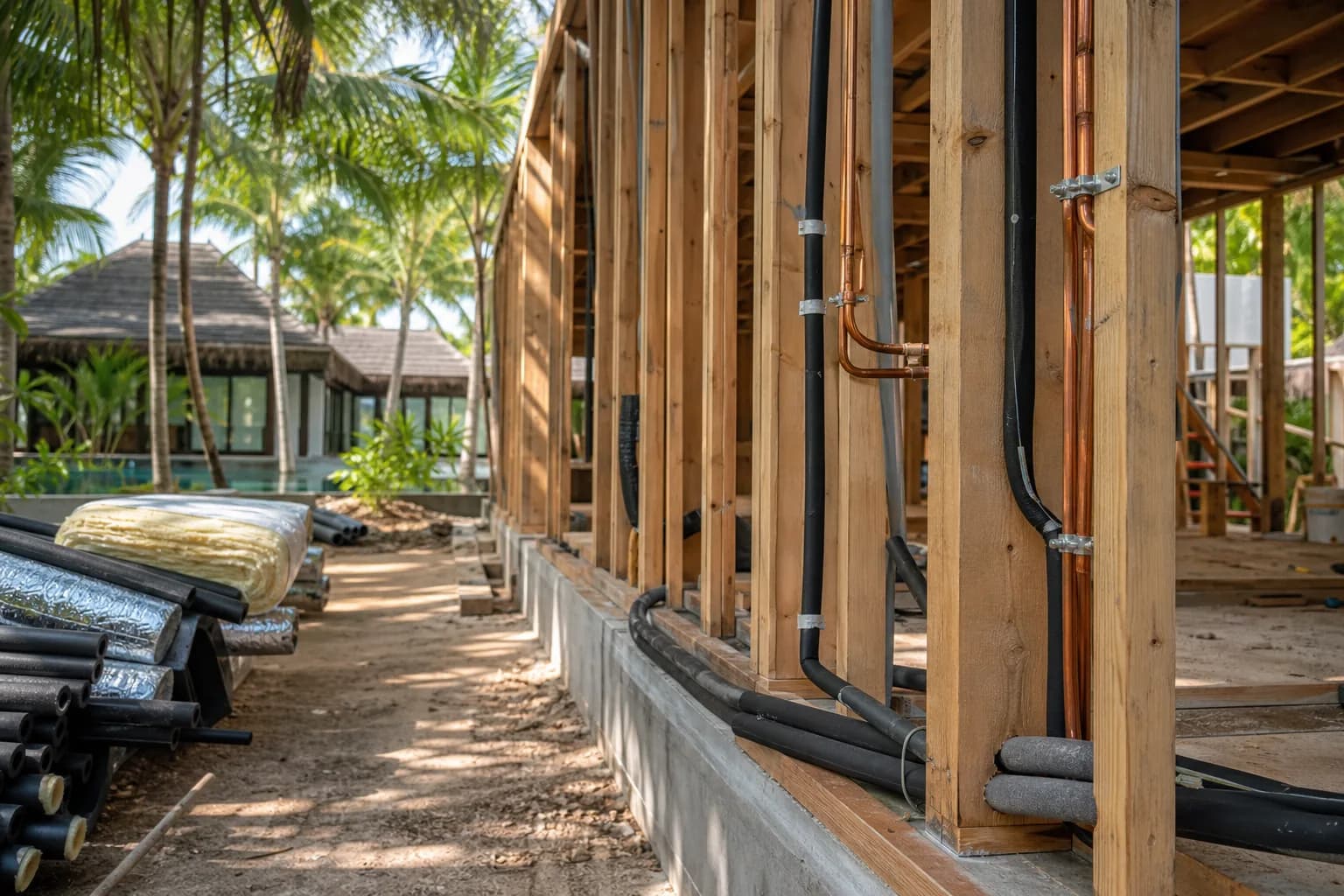
Why Refrigerant Lines Drip Water in Bali’s Tropical Climate
Walk through any Bali villa during the wet season, and you’ll likely spot water stains on walls beneath air conditioning lines, puddles forming around copper pipes, or worse—mold growth spreading from improperly insulated refrigerant connections. The problem isn’t the AC unit itself; it’s inadequate insulation thickness on refrigerant lines exposed to Bali’s relentless 80-90% humidity levels. When cold refrigerant flows through copper pipes at temperatures as low as 5-10°C, and ambient air sits at 28-32°C with moisture saturation, condensation forms aggressively on any exposed metal surface. Standard 6mm insulation—common in temperate climates—simply cannot create sufficient thermal barrier in tropical conditions, leading to continuous dripping, structural water damage, and compromised system efficiency that costs villa owners thousands in repairs.
Technical Requirements for Tropical Refrigerant Line Insulation
Refrigerant line insulation in Bali’s climate demands fundamentally different specifications than standard installations. The physics are straightforward: when the surface temperature of insulation drops below the dew point of surrounding air, condensation occurs. In Bali, with typical conditions of 30°C and 85% relative humidity, the dew point hovers around 27°C. Your insulation must maintain an outer surface temperature above this threshold while the refrigerant inside flows at 5-10°C for suction lines.
For air conditioning Bali installations, minimum insulation thickness should be 19mm (3/4 inch) for suction lines up to 1/2 inch diameter, and 25mm (1 inch) for lines 5/8 inch and larger. Liquid lines require minimum 13mm (1/2 inch) thickness. These specifications exceed standard recommendations because Bali’s combination of high ambient temperature and extreme humidity creates the worst-case scenario for condensation formation.
Material selection matters equally. Closed-cell elastomeric foam insulation with thermal conductivity (k-value) of 0.036-0.040 W/mK at 24°C provides optimal performance. The closed-cell structure prevents moisture infiltration—critical because any water absorption dramatically reduces insulation effectiveness. Look for materials with water vapor permeability below 0.5 perm-inch and service temperature range from -50°C to +105°C.
The insulation must also resist UV degradation for outdoor installations. Bali’s intense equatorial sun breaks down inferior materials within 18-24 months, creating cracks where moisture penetrates. UV-resistant elastomeric foam or additional protective jacketing extends service life to 10-15 years. For villa construction Bali projects, this longevity calculation directly impacts lifecycle costs and maintenance schedules.
Vapor barrier integrity represents the most critical factor. Even microscopic gaps in insulation seams allow humid air to contact cold pipes. Professional installations require continuous vapor barriers with all joints sealed using manufacturer-specified adhesive—not generic construction glue. The adhesive must bond permanently to create hermetic seals that prevent moisture migration through capillary action.
Thermal bridging at support brackets and wall penetrations creates localized cold spots where condensation concentrates. Proper design includes insulated standoffs that maintain minimum 10mm clearance between pipe and mounting surface, with insulation wrapping completely around support points. Wall penetrations need oversized sleeves filled with non-absorptive insulation to eliminate thermal bridges.
Step-by-Step Installation Process for Bali Conditions
Professional refrigerant line insulation installation for MEP systems Bali follows a precise sequence that addresses tropical climate challenges at every stage.
Surface Preparation and Measurement
Begin by thoroughly cleaning copper refrigerant lines with isopropyl alcohol to remove oils, dust, and contaminants that prevent adhesive bonding. Measure exact pipe diameters and run lengths, adding 10% for fittings and overlaps. For split AC systems, suction lines typically range from 3/8 to 5/8 inch diameter, while liquid lines run 1/4 to 3/8 inch. Calculate insulation requirements based on actual measured dimensions, not nominal pipe sizes.
Material Conditioning
Store insulation materials in air-conditioned space for 24 hours before installation. Elastomeric foam becomes pliable at 20-25°C, allowing proper expansion and adhesive activation. Installing cold or heat-stressed insulation creates gaps as materials normalize to ambient temperature. This step is frequently skipped in Bali installations, causing premature failure.
Cutting and Fitting
Cut insulation tubes to length using sharp utility knife, making clean perpendicular cuts without crushing cell structure. For bends and elbows, use pre-formed fittings rather than attempting to bend straight tubes—this prevents compression that reduces effective thickness. Slit one side of tube lengthwise to slip over existing pipe, or install during initial pipe assembly for new construction.
Adhesive Application
Apply manufacturer-specified contact adhesive to both mating surfaces of longitudinal seams and end joints. Use brush or roller for even coverage, following specified open time (typically 3-5 minutes) before pressing surfaces together. In Bali’s humidity, adhesive curing takes 20-30% longer than manufacturer specifications based on temperate climates. Allow minimum 2 hours cure time before system operation.
Seam Sealing
Press longitudinal seams firmly together, working from one end to eliminate air pockets. Seal all seams with 50mm-wide pressure-sensitive vapor barrier tape, overlapping tape ends by 25mm. This creates redundant moisture barrier—the primary defense against Bali’s humidity. Pay special attention to joints, elbows, and tee connections where multiple insulation pieces meet.
Support and Protection
Install pipe supports at maximum 1.5-meter intervals for horizontal runs, using insulated saddles or standoffs. Never compress insulation with support straps—this creates thermal bridges and moisture traps. For outdoor installations, apply UV-protective jacketing or paint with acrylic coating rated for tropical exposure. White or reflective finishes reduce solar heat gain that accelerates insulation degradation.
Penetration Sealing
At wall penetrations, maintain continuous insulation through openings. Use oversized sleeves (minimum 50mm larger than insulated pipe diameter) and fill gaps with closed-cell foam insulation. Seal both interior and exterior penetration points with weatherproof mastic to prevent water infiltration and insect entry—a common problem in villa renovation Bali projects.
Material Specifications and Product Selection
Selecting appropriate insulation materials for Bali’s climate requires understanding performance characteristics beyond basic thermal resistance.
Recommended Insulation Types
Closed-cell elastomeric foam (Armaflex, Aeroflex, K-Flex brands) provides optimal performance with thermal conductivity 0.036-0.040 W/mK, service temperature -50°C to +105°C, and water vapor permeability below 0.5 perm-inch. Available in pre-slit tubes from 6mm to 32mm wall thickness. For Bali installations, specify minimum 19mm thickness for suction lines, 13mm for liquid lines.
Polyethylene foam offers lower cost but inferior moisture resistance and durability. Acceptable only for indoor installations in climate-controlled spaces, not recommended for typical Bali villa applications where lines run through unconditioned areas.
Adhesives and Sealants
Use only manufacturer-matched contact adhesives formulated for elastomeric foam. Generic construction adhesives lack flexibility and moisture resistance, leading to bond failure. Specify solvent-based adhesives for Bali’s humidity—water-based products don’t cure properly in high-moisture environments. Budget 100ml adhesive per 3 meters of insulated pipe.
Vapor barrier tape must be pressure-sensitive with acrylic adhesive, minimum 50mm width, and rated for continuous outdoor exposure. Aluminum foil-backed tape provides additional UV protection for exposed installations.
UV Protection
For outdoor refrigerant lines, apply UV-resistant jacketing (PVC or aluminum) or protective coating. Acrylic-based insulation paint in white or reflective colors extends service life from 2-3 years to 10+ years in Bali’s intense sun. Apply two coats at 0.2mm thickness for adequate protection.
Materials to Avoid
Fiberglass insulation absorbs moisture and loses all insulating value in humid conditions. Open-cell foam allows moisture migration. Rubber foam without proper vapor barriers fails within 12-18 months. Standard 6mm or 9mm thickness—common in temperate climates—provides insufficient thermal resistance for tropical condensation control.
Cost Breakdown for Professional Installation
Understanding material and labor costs helps budget accurately for finishing works Bali projects involving AC system installation.
Material Costs (2026 Pricing)
Elastomeric foam insulation tubes: Rp 45,000-75,000 per meter for 19mm thickness, Rp 60,000-95,000 per meter for 25mm thickness, depending on pipe diameter and brand. Quality brands (Armaflex, K-Flex) cost 30-40% more than generic products but provide significantly better performance and longevity.
Contact adhesive: Rp 180,000-250,000 per 500ml container, covering approximately 15-20 meters of seams. Vapor barrier tape: Rp 85,000-120,000 per 25-meter roll (50mm width). UV protective coating: Rp 350,000-450,000 per liter, covering 8-10 square meters.
Labor Costs
Professional MEP technician installation: Rp 150,000-250,000 per split AC unit for standard residential systems (5-8 meters total line length). Complex installations with multiple wall penetrations, long runs, or difficult access increase labor 50-100%. Installation time: 2-3 hours per unit including surface preparation, adhesive curing, and sealing.
Typical Project Costs
Single split AC unit (3-meter line set): Rp 450,000-650,000 total including materials and labor. Three-bedroom villa (4 units, average 5-meter runs): Rp 2,400,000-3,200,000. Large villa with 8+ units and extended line runs: Rp 5,500,000-8,000,000. These costs represent 3-5% of total AC system installation but prevent 80% of moisture-related failures.
Long-term Value
Proper insulation eliminates condensation damage (Rp 2-5 million in typical repairs), improves AC efficiency 8-12% (reducing electricity costs Rp 300,000-600,000 annually per unit), and extends system lifespan 3-5 years. The investment pays for itself within 18-24 months through energy savings and avoided repairs.
Common Installation Mistakes and Prevention
Even experienced contractors make critical errors when adapting temperate-climate techniques to Bali’s tropical conditions.
Insufficient Insulation Thickness
Using standard 6mm or 9mm insulation—adequate for dry climates—fails completely in Bali’s humidity. Surface temperature remains below dew point, causing continuous condensation. Solution: Specify minimum 19mm thickness for suction lines, 13mm for liquid lines, calculated for local conditions rather than generic standards.
Incomplete Seam Sealing
Skipping vapor barrier tape or inadequate adhesive application allows moisture infiltration at seams. Even 1mm gaps permit humid air contact with cold pipes. Solution: Apply adhesive to all mating surfaces, press seams firmly, and seal with proper vapor barrier tape overlapping all joints by 25mm minimum.
Compressed Insulation at Supports
Tightening support straps directly over insulation crushes cell structure, reducing effective thickness and creating thermal bridges. Solution: Use insulated standoffs or saddles that maintain 10mm clearance between pipe and mounting surface, with insulation wrapping completely around support points.
Thermal Bridging at Penetrations
Cutting insulation flush with walls creates cold spots where pipes enter buildings. Moisture condenses at these transitions, causing interior water damage. Solution: Extend insulation through wall penetrations using oversized sleeves, maintaining continuous thermal barrier from outdoor unit to indoor evaporator.
Inadequate UV Protection
Exposed insulation degrades rapidly in Bali’s equatorial sun, cracking within 18-24 months and allowing moisture penetration. Solution: Apply UV-resistant jacketing or two coats of acrylic insulation paint to all outdoor installations, with white or reflective finish to reduce solar heat gain.
Wrong Adhesive Selection
Using generic construction adhesive or water-based products results in bond failure in high humidity. Seams separate, creating moisture pathways. Solution: Specify only manufacturer-matched solvent-based contact adhesive formulated for elastomeric foam, allowing proper cure time before system operation.
Frequently Asked Questions
What insulation thickness do I need for a standard 1.5HP split AC in Bali?
For typical 1.5HP split systems with 3/8-inch suction line and 1/4-inch liquid line, use minimum 19mm (3/4 inch) thickness on the suction line and 13mm (1/2 inch) on the liquid line. This provides adequate thermal resistance to maintain surface temperature above Bali’s 27°C dew point. Larger capacity systems (2HP+) with 1/2-inch or 5/8-inch suction lines require 25mm (1 inch) thickness. Never use standard 6mm or 9mm insulation—it’s insufficient for tropical humidity control.
How long does properly installed refrigerant line insulation last in Bali?
Quality closed-cell elastomeric foam insulation with proper UV protection lasts 10-15 years in Bali’s climate when professionally installed. Indoor installations in climate-controlled spaces may last 15-20 years. Outdoor installations without UV protection degrade within 2-3 years. Key longevity factors include complete vapor barrier sealing, UV-resistant coating or jacketing, and proper support without compression. Budget for inspection every 3-4 years and recoating outdoor installations every 5-6 years to maximize service life.
Can I install refrigerant line insulation myself or should I hire professionals?
While DIY installation is possible for mechanically-inclined homeowners, professional installati
 172 m²8 month(s)from 120.000 USD
Keshava
 1from 198.000 USD
Private: Haridas Villas
 3173 m²6 month(s)from 125.000 USD
TALA FOUR
 3104 m²11 month(s)from 99.000 USD
TALA 100
 3180 m²7 month(s)from 142.000 USD
Vasudeva

Want to calculate?
 3124 m²6 month(s)from 123.000 USD
TALA 8
 3127 m²9 month(s)from 177.000 USD
Mukunda
 4344 m²16 month(s)from 290.000 USD
Radha
 164 m²7 month(s)from 79.000 USD
TALA TWO
164 m²7 month(s)from 79.000 USDPrivate: Haridas Villas, Tegallalang
 2144 m²11 month(s)from 104.000 USD
Narayana
Start With Real Numbers, Not Guesses
Before buying land or finalizing a design, check the realistic build cost range for your project in Bali.
Our team reviews your inputs and gives a grounded estimate.
Available lands
 3100 m²15 min$ 257697Bali, Tegallalang
 1600 m²32 min$ 266010Bali, Tabanan
 1000 m²10 min$ 280788Bali, Pecatu
 7000 m²36 min$ 284483Bali, Gianyar
 5815 m²5 min$ 815740Bali, Tabanan
 3254 m²5 min$ 631800Bali, All
 7500 m²5 min$ 206281Bali, Kedungu
 1350 m²5 min$ 283467Bali, Pecatu
 2800 m²2 min$ 713793Bali, Kedungu
 608 m²15 min$ 310377Bali, Seminyak
 1000 m²8 min$ 134544Bali, Bukit
 7250 m²56 min$ 235714Bali, Tabanan
 200 m²11 min$ 89286Bali, Tabanan
 7900 m²25 min$ 413485Bali, Tabanan
 1158 m²12 min$ 291996Bali, Mengwi
Essential Bali build & buy guides
- Bali villa construction cost per m² in 2026
- How much will your villa cost? Calculator
- Building a villa in Bali: the complete guide
- Buying land in Bali: step-by-step for foreigners
- Bali villa investment: yields, risks, returns
- Leasehold vs freehold: what foreigners can own
- Construction defect liability & 10-year warranty
- Bali building codes and construction standards
Related guides
True Closing Costs of a Bali Purchase: Notary, Taxes and Fees on Top of the Price
What you really pay on top of a Bali property price in 2026: notary fees, transfer and lease taxes, VAT on developer units — with realistic totals for each deal type and a worked example.
7 min read
Bali Property Taxes for Foreigners: BPHTB, PPh and PBB-P2 — Who Pays What and When
A clear 2026 breakdown of the three taxes every foreign buyer meets in Bali — BPHTB, PPh and PBB-P2 — with who pays what, on which value, and at which point in the deal.
9 min read
Swimming Pool Construction Cost in Bali (2026): Real Prices by Size and Type
What a swimming pool really costs to build in Bali in 2026 — by size, structure and finish — plus running costs, common quote traps and where pools go wrong in the tropics.
3 min read