Pecatu Limestone Quarry Transport Costs Road Access Fees Bali
Why Pecatu Limestone Quarry Transport Costs Determine Your Villa Foundation Budget
When engineering teams specify Pecatu limestone for villa foundations in Uluwatu, Bingin, or Padang Padang, the material cost represents only 40-50% of the delivered price. The remaining budget disappears into transport logistics, road access fees, and quarry gate charges that most foreign villa developers never see itemized until invoices arrive. A single foundation pour requiring 80 cubic meters of crushed limestone can incur IDR 15-22 million in transport costs alone—separate from material pricing—due to the specific road conditions, village access protocols, and quarry operational fees governing Pecatu’s limestone extraction zones. Understanding these hidden logistics costs before finalizing structural engineering specifications prevents budget overruns that typically emerge during the critical foundation phase when construction schedules are least flexible.
Technical Engineering Context: Pecatu Limestone in Bali Villa Construction
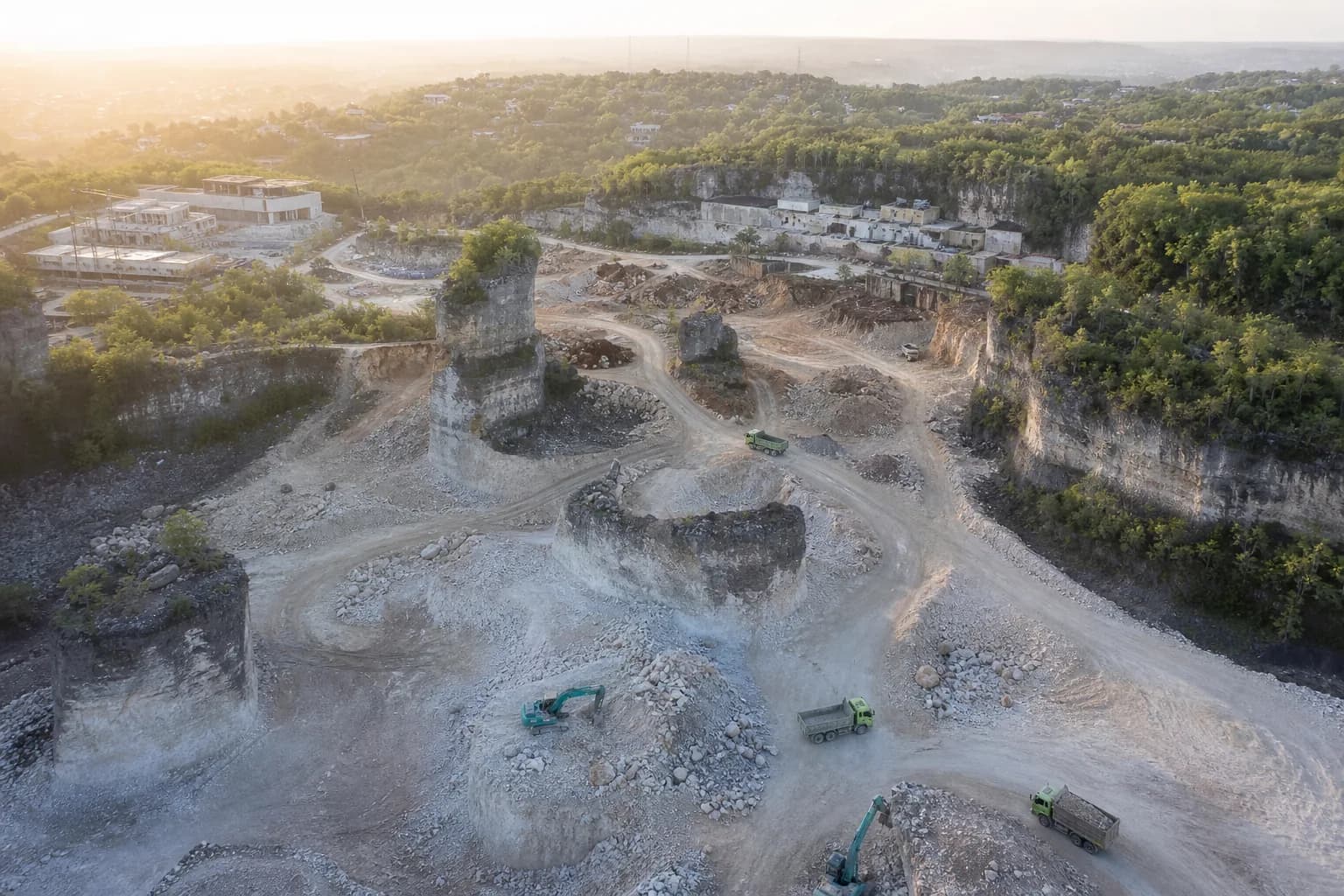
Pecatu limestone quarries supply the primary aggregate material for villa foundations across the Bukit Peninsula, where coral limestone bedrock creates both construction challenges and material opportunities. The geological formation—uplifted Pleistocene reef limestone—provides crushed aggregate with excellent drainage properties and natural alkalinity that resists tropical soil acidity, making it structurally superior to river stone for foundation work in high-water-table coastal zones.
The quarry operations concentrate in the Pecatu administrative area, approximately 3-8 kilometers inland from the coastal villa development zones of Uluwatu, Bingin, Padang Padang, and Suluban. This proximity appears advantageous on paper, but the transport logistics involve navigating narrow village roads (jalan desa) with 2.5-3 meter width restrictions, steep gradients reaching 18-22% on certain access routes, and village boundary crossings that trigger customary access fees separate from government road permits.
Structural engineering specifications for villa foundations in this region typically require 3-5 different limestone products from Pecatu quarries: base course aggregate (40-60mm), crushed limestone fill (20-40mm), fine aggregate for concrete mixing (5-20mm), limestone dust for compaction layers, and occasionally larger riprap (100-200mm) for erosion control on sloped sites. Each product category has different loading densities affecting truck capacity utilization—a critical factor in transport cost calculation.
The standard transport vehicle is the dump truck (truk bak), available in three capacity classes relevant to villa construction: 5 cubic meter (truk engkel), 8 cubic meter (truk double), and 12 cubic meter (truk fuso). However, actual usable capacity on Pecatu-to-construction-site routes often reduces by 20-30% due to road gradient limitations, village road width restrictions preventing full-size vehicles, and load securing requirements for steep descents toward coastal villa sites.
Quarry operational protocols add complexity. Most Pecatu limestone quarries operate 06:00-17:00 Monday-Saturday, with Friday operations sometimes restricted 11:30-13:30 for prayer times. Loading queues during peak construction season (April-October) can extend truck waiting time to 2-4 hours, directly impacting daily delivery capacity and labor costs. The quarry gate fee structure—separate from material purchase—typically charges per truck exit rather than per cubic meter, creating cost optimization challenges when partial loads are required for smaller foundation pours or site access limitations prevent full-size truck entry.
Hidden Cost Factors: What Villa Developers Miss in Transport Budgeting
The most significant hidden cost emerges from village road access fees (biaya akses jalan desa), which operate outside formal government permitting systems. When dump trucks transit through traditional village boundaries (banjar territories) between Pecatu quarries and coastal construction sites, customary fees apply—typically IDR 50,000-150,000 per truck depending on the specific village, road condition impact assessment, and whether the route crosses temple zones requiring ceremonial considerations. A foundation project requiring 15 truckloads can accumulate IDR 750,000-2,250,000 in village access fees that never appear in initial material quotations.
Road condition penalties represent another invisible cost multiplier. The narrow village roads connecting Pecatu to Uluwatu’s villa zones deteriorate rapidly under heavy truck traffic, particularly during rainy season (November-March). Village authorities increasingly implement road maintenance contribution fees (iuran pemeliharaan jalan) ranging IDR 100,000-300,000 per truck for routes showing visible damage. These fees are negotiated at the village level, lack standardized rate cards, and can increase mid-project if road conditions worsen.
Truck waiting time and demurrage charges catch developers off-guard. If site conditions prevent immediate unloading—inadequate access for truck maneuvering, incomplete foundation excavation, or concurrent trades blocking delivery zones—truck rental charges continue accruing at IDR 150,000-250,000 per hour beyond the standard 30-minute unloading allowance. On constrained villa sites with single-lane access, this can add IDR 500,000-1,200,000 per delivery day.
Fuel surcharges fluctuate independently of base transport rates. Diesel price volatility in Bali creates 8-15% cost variation quarter-to-quarter, and transport contractors typically reserve the right to adjust rates with 7-14 days notice when fuel prices exceed agreed baseline rates (usually pegged to Pertamina’s published industrial diesel price for Bali).
Step-by-Step Process: Securing Accurate Pecatu Limestone Transport Costs
Phase 1: Site Access Assessment (Pre-Quotation)
Before requesting transport quotations, conduct a documented site access survey measuring actual road widths along the entire route from Pecatu quarry to your construction site. Identify gradient sections exceeding 15%, sharp turning radii under 8 meters, overhead obstructions (temple gates, utility lines) below 4 meters clearance, and bridge or culvert load ratings. This data determines maximum feasible truck size—the primary variable in per-cubic-meter transport cost. Photograph GPS-tagged access constraints to share with transport contractors, preventing post-contract disputes about vehicle size limitations.
Map village boundary crossings along your specific route. In the Pecatu-to-Uluwatu corridor, trucks typically cross 2-4 banjar territories depending on exact site location. Visit each banjar office (or engage your local project coordinator) to inquire about current truck access fee structures, payment protocols (per-truck vs. monthly flat rate for projects), and any ceremonial calendar restrictions (odalan temple anniversary dates when heavy vehicle traffic may be prohibited on certain roads).
Phase 2: Integrated Quotation Request
Request transport quotations that explicitly itemize: base transport rate per cubic meter per kilometer, quarry gate fee per truck, village access fees by specific banjar, fuel baseline price and adjustment mechanism, waiting time allowances and demurrage rates, and minimum order quantities. Reputable suppliers like Bali Limestone provide integrated quotations covering material plus transport, but verify that village access fees are included—many suppliers exclude these as “owner responsibility” costs.
Specify your project’s delivery schedule requirements. Continuous foundation pours requiring same-day multi-truck deliveries command 10-15% premium rates compared to flexible scheduling allowing suppliers to optimize truck routing across multiple projects. For villa foundations, the structural engineering typically requires 60-120 cubic meters of limestone products delivered over 3-5 days during the foundation preparation phase—communicate this timeline for accurate cost modeling.
Phase 3: Village Access Negotiation
Engage a local project coordinator or your construction management team (like Teville’s site supervision teams) to formalize village access agreements before material delivery begins. Best practice involves meeting with each banjar’s kelian (village head) to negotiate project-duration access rates rather than per-truck fees. A typical villa construction might negotiate IDR 3-5 million flat fee for 6-month access covering all material deliveries, versus IDR 8-12 million in cumulative per-truck fees. Document agreements in writing with banjar stamps, preventing mid-project fee renegotiations.
Phase 4: Delivery Coordination and Documentation
Establish site readiness protocols ensuring trucks can unload immediately upon arrival. For foundation limestone deliveries, this means completed excavation to specified depth, formwork positioned to allow direct discharge, and clear vehicle maneuvering zones. Implement delivery logging documenting truck arrival time, material quantity (cubic meters), unloading completion time, and any access issues. This documentation proves essential if transport cost disputes arise or if village access fees are challenged.
Realistic Cost Ranges: Pecatu Limestone Transport Economics 2025-2026
Current market rates for Pecatu limestone quarry to Uluwatu/Bingin villa sites (4-7 kilometer typical distance) range IDR 85,000-140,000 per cubic meter for transport alone, separate from material costs. This breaks down approximately: base transport IDR 60,000-95,000/m³, quarry gate fee IDR 15,000-25,000/m³ equivalent, village access fees IDR 10,000-20,000/m³ equivalent when amortized across typical delivery volumes.
For a standard 200-square-meter villa foundation requiring 80 cubic meters of crushed limestone base course, total transport costs typically reach IDR 6,800,000-11,200,000 (USD 430-710 at current exchange rates). This represents 18-24% of total foundation material costs when limestone is priced at IDR 280,000-350,000/m³ delivered.
Distance significantly impacts economics. Sites in Padang Padang (2-3 km from Pecatu quarries) may achieve transport costs as low as IDR 65,000-90,000/m³, while remote Nyang Nyang locations (12-15 km) can exceed IDR 180,000-220,000/m³ due to extended travel time, additional village crossings, and more challenging road conditions.
Seasonal variation affects availability more than pricing. During peak construction season (May-September), quarry capacity constraints and truck availability can extend delivery lead times from 2-3 days to 7-10 days, potentially delaying foundation schedules. Some suppliers implement 5-10% peak season surcharges, though this is less common than simple capacity allocation to established clients.
Frequently Asked Questions: Pecatu Limestone Transport Logistics
Can I reduce transport costs by using smaller, more frequent deliveries?
Counterintuitively, no. Transport economics favor maximum truck capacity utilization. A 5-cubic-meter truck costs approximately 60-70% as much per trip as a 10-cubic-meter truck, but delivers only 50% the volume. The per-cubic-meter cost increases 20-40% when using smaller vehicles. The only scenario favoring smaller trucks is when site access physically prevents larger vehicle entry—common on older Bingin villa plots with 2-meter-wide access lanes. In these cases, the transport cost penalty is unavoidable and should be factored into initial feasibility budgeting.
Are village access fees legally enforceable or negotiable?
Village access fees operate within Bali’s customary law (adat) framework, which holds legal standing parallel to national civil law under Indonesia’s recognition of traditional governance structures. These fees are legally enforceable within banjar territories, and attempting to bypass payment creates project risks including physical road blockages, community relations damage affecting labor availability, and potential involvement of village security (pecalang) preventing site access. The fees are negotiable in structure (per-truck vs. project flat rate) and sometimes in amount, but not eliminable. Experienced construction managers like Teville’s project teams maintain established relationships with village authorities, facilitating fair rate negotiations based on actual road impact rather than opportunistic pricing.
What happens if limestone delivery damages village roads during my project?
Road damage liability typically falls on the project owner unless explicitly transferred to the transport contractor in written agreements. Village authorities conduct informal road condition assessments before and after major construction projects, documenting damage through photographs and community witness statements. If damage exceeds normal wear expectations—particularly pothole formation, edge collapse, or drainage structure damage—the banjar may levy repair contribution fees ranging IDR 5-15 million depending on severity. Prevent disputes by conducting your own documented pre-project road condition survey with GPS-tagged photographs, and negotiate damage liability caps in village access agreements. Some developers establish road maintenance escrow funds (IDR 3-5 million) held by the banjar and returned upon project completion if no excessive damage occurred.
Can I source limestone from alternative quarries to avoid Pecatu transport costs?
Alternative limestone sources exist in Karangasem (east Bali) and Jembrana (west Bali), but transport distances of 45-80 kilometers make delivered costs 40-70% higher than Pecatu sources for Bukit Peninsula projects. The only cost-competitive alternative is recycled concrete aggregate from Denpasar crushing facilities, priced 15-20% below Pecatu limestone delivered. However, recycled aggregate lacks the drainage properties and alkalinity of natural limestone, making it structurally inferior for high-water-table coastal sites. Structural engineers typically specify natural limestone for primary foundation layers, potentially allowing recycled aggregate only for non-critical fill applications. The material specification decision should be engineering-driven, not purely cost-driven, to ensure long-term foundation performance in tropical coastal conditions.
How do I verify I’m receiving the correct limestone volume delivered?
Volume verification challenges are common in loose aggregate deliveries. Best practice involves three verification methods: truck capacity certification (demand written documentati
 4344 m²16 month(s)from 290.000 USD
Radha
 3104 m²11 month(s)from 99.000 USD
TALA 100
 3127 m²9 month(s)from 177.000 USD
Mukunda
 1from 198.000 USD
Private: Haridas Villas
 3173 m²6 month(s)from 125.000 USD
TALA FOUR
 3180 m²7 month(s)from 142.000 USD
Vasudeva
 172 m²8 month(s)from 120.000 USD
Keshava
 3124 m²6 month(s)from 123.000 USD
TALA 8

Want to calculate?
 2144 m²11 month(s)from 104.000 USD
Narayana
 164 m²7 month(s)from 79.000 USD
Private: Haridas Villas, Tegallalang
164 m²7 month(s)from 79.000 USDTALA TWO
Start With Real Numbers, Not Guesses
Before buying land or finalizing a design, check the realistic build cost range for your project in Bali.
Our team reviews your inputs and gives a grounded estimate.
Available lands
 500 m²10 min$ 107143Bali, Tabanan
 7500 m²5 min$ 206281Bali, Kedungu
 260 m²5 min$ 51872Bali, Kedungu
 1100 m²8 min$ 280419Bali, Ungasan
 2680 m²10 min$ 1732759Bali, Pererenan
 600 m²10 min$ 206897Bali, Canggu
 200 m²11 min$ 89286Bali, Tabanan
 6000 m²30 min$ 55419Bali, Tabanan
 1300 m²10 min$ 312192Bali, Kutuh South Bali
 585 m²8 min$ 165702Bali, Mengwi
 5028 m²10 min$ 361000Bali, Ubud
 18900 m²2 min$ 6912931Bali, Pecatu
 2700 m²30 min$ 314224Bali, Sidemen
 615 m²15 min$ 113608Bali, Tabanan
 6000 m²10 min$ 1330049Bali, Kutuh South Bali
Essential Bali build & buy guides
- Bali villa construction cost per m² in 2026
- How much will your villa cost? Calculator
- Building a villa in Bali: the complete guide
- Buying land in Bali: step-by-step for foreigners
- Bali villa investment: yields, risks, returns
- Leasehold vs freehold: what foreigners can own
- Construction defect liability & 10-year warranty
- Bali building codes and construction standards
Related guides
Milestone Payment Schedules in Bali Construction: How Staged Payments Protect You
Milestone-based payment schedules are a Bali builder's best client protection: what a healthy 6-stage structure looks like, how to verify progress remotely, and which payment terms to refuse.
7 min read
Financing a Bali Villa: Why the Market Is Cash-Only for Foreigners — and the Realistic Alternatives
Why foreign buyers in Bali almost always pay cash, the narrow 2026 bank options for residents, and the realistic alternatives — from home-country equity to milestone-staged construction payments.
7 min read
Bali Rental Income Tax and Compliance Costs: The 10% Rule and the Real Math
How Bali rental income is really taxed in 2026 — the 10% final tax, the 20% non-resident trap, PB1, licensing overhead — and a worked example showing what a villa owner actually keeps.
7 min read