Gianyar Rainwater Harvesting Tank Permits Costs Bali
Why Gianyar Rainwater Harvesting Tank Permits Matter More Than You Think
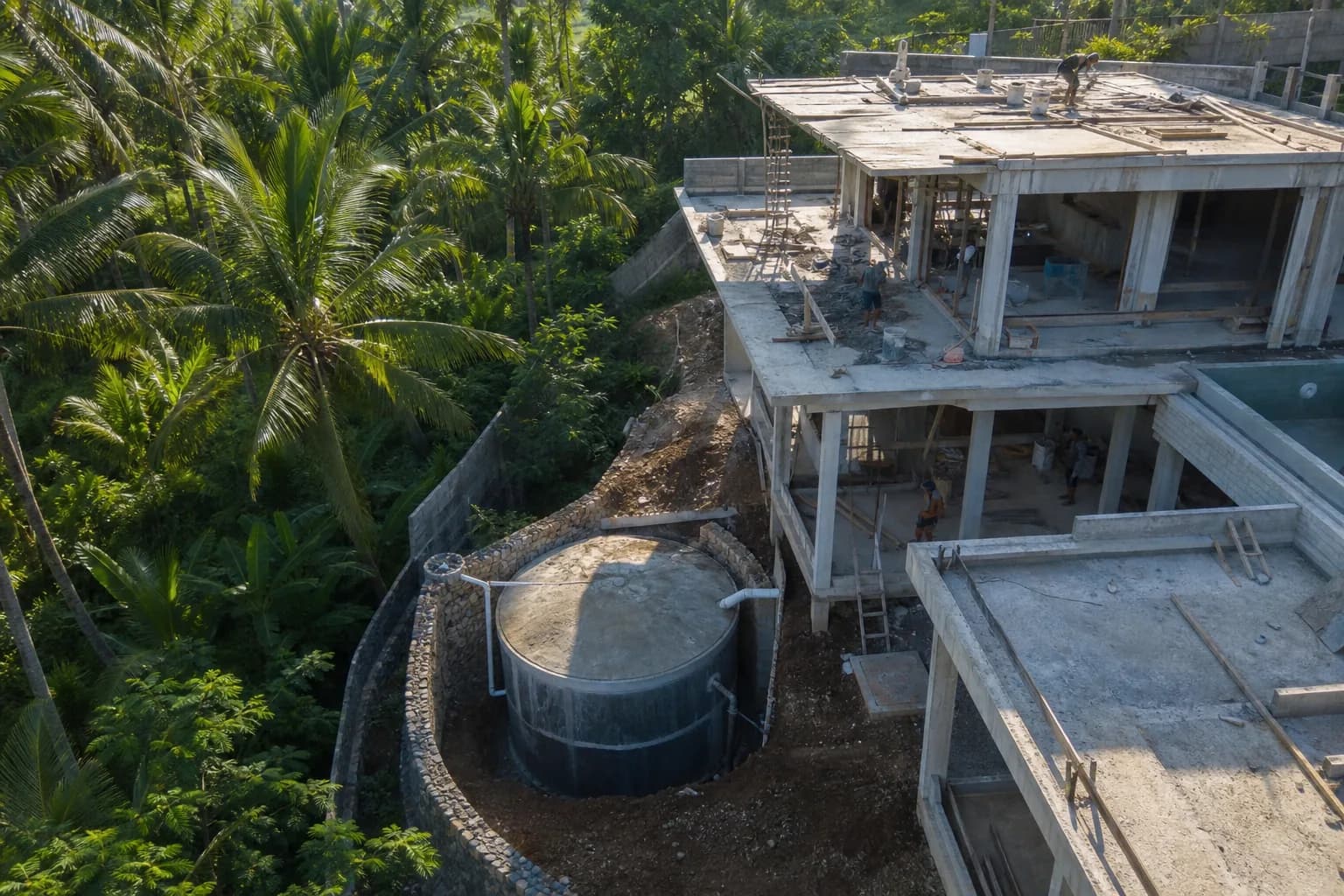
Gianyar Regency’s rapid villa development has created an unexpected compliance bottleneck: rainwater harvesting systems are increasingly required for new construction permits, yet most foreign buyers discover this requirement only after architectural plans are finalized. The technical challenge isn’t just installing a tank—it’s integrating a compliant system that satisfies Gianyar’s environmental regulations, structural load calculations for tropical soil conditions, and water quality standards for supplemental use. Unlike Badung or Tabanan, Gianyar’s permitting office now cross-references rainwater capacity with total roof area and occupancy projections, making undersized systems a common rejection point that delays IMB issuance by 6-12 weeks.
Technical Requirements for Gianyar Rainwater Harvesting Compliance
Gianyar’s environmental office (Dinas Lingkungan Hidup) enforces specific technical standards that differ from neighboring regencies. The core requirement mandates rainwater harvesting capacity equal to minimum 10% of annual roof catchment potential for residential villas, calculated using Gianyar’s average rainfall data of 2,100mm annually. For a typical 200m² villa roof, this translates to approximately 42,000 liters theoretical catchment, requiring minimum 4,200-liter storage capacity—though practical systems typically install 5,000-10,000 liters to account for dry season buffer.
The structural engineering component becomes critical in Gianyar’s volcanic soil conditions. Underground concrete tanks require foundation calculations accounting for seasonal water table fluctuations, particularly in areas near Petanu River watershed. Teville’s engineering team consistently encounters soil bearing capacity issues in Ubud-adjacent zones where expansive clay soils create differential settlement risks. Above-ground polyethylene tanks avoid foundation complexity but require structural support frames engineered for seismic loads—Bali sits in Zone 4 seismic classification, mandating specific anchoring protocols.
Water quality specifications add another compliance layer. Gianyar regulations require first-flush diversion systems (minimum 20 liters per 100m² roof area) to prevent initial rainfall contamination from entering storage tanks. Filtration standards mandate 5-micron sediment filters before storage and UV sterilization or chlorination systems if harvested water supplements potable supply. Most villa projects use rainwater exclusively for irrigation, toilet flushing, and vehicle washing—applications that still require basic filtration to prevent pump damage and distribution line clogging.
The permitting documentation package for Gianyar includes: detailed tank placement drawings showing setback compliance (minimum 1.5m from property boundaries), structural calculations stamped by Indonesian-licensed engineers (LPJK certification), hydraulic flow diagrams indicating overflow management, and water balance calculations demonstrating system adequacy for intended use. The environmental impact analysis (UKL-UPL) for villas over 300m² built area must specifically address rainwater harvesting integration as a water conservation measure.
Installation timing within the construction sequence matters significantly. Underground tanks must be installed before foundation backfill and landscaping, requiring coordination with excavation contractors. Above-ground systems need structural support integrated into architectural design—retrofitting support frames after construction completion typically costs 40-60% more than integrated installation. Teville’s construction process schedules rainwater system installation during the structural phase, immediately after foundation curing, to avoid sequencing conflicts that delay subsequent trades.
Hidden Risks Foreign Buyers Miss in Gianyar Rainwater Projects
The most expensive mistake involves undersizing tank capacity based on generic online calculators rather than Gianyar-specific rainfall patterns and dry season duration. Gianyar experiences 4-5 month dry seasons where rainwater systems provide zero input—buyers who calculate capacity based only on wet season rainfall discover their systems run dry by August, defeating the water conservation purpose that justified permit approval. Proper sizing requires modeling both wet season storage and dry season depletion rates based on actual usage patterns.
Soil contamination from improper overflow management creates liability issues rarely discussed during planning. Gianyar’s volcanic soils have high infiltration rates, but concentrated overflow discharge from 5,000+ liter tanks can cause localized erosion and neighbor property drainage complaints. The permitting office requires engineered overflow systems connecting to either soakaway pits (sized at 1.5x tank capacity) or existing drainage infrastructure—simple overflow pipes discharging to surface grade fail inspection.
Material specification errors prove costly in Bali’s tropical UV exposure and temperature cycling. Standard polyethylene tanks without UV stabilization degrade within 3-5 years, developing stress cracks that contaminate stored water with plastic particulates. Concrete tanks without proper waterproofing membranes allow groundwater intrusion during wet season, diluting stored rainwater and introducing bacterial contamination. Teville specifies only food-grade HDPE tanks with minimum 10-year UV warranties or reinforced concrete with crystalline waterproofing admixtures for Gianyar projects.
The maintenance access oversight becomes apparent only after landscaping completion. Tanks installed without adequate access for pump servicing, filter replacement, and sediment cleaning require expensive landscape removal for routine maintenance. Gianyar’s high dust levels during dry season cause rapid filter clogging—systems without easily accessible filter housings become maintenance nightmares that owners eventually abandon.
Step-by-Step Process for Gianyar Rainwater Harvesting Permit Approval
The compliance process begins during preliminary architectural design, not as an afterthought during permit application. Step one involves site-specific rainfall and usage calculations: measure total roof catchment area, apply Gianyar’s 2,100mm annual rainfall coefficient, calculate seasonal distribution (70% falls in 6-month wet season), and project daily usage for intended applications. This determines minimum tank capacity and informs architectural placement options.
Step two requires geotechnical assessment if underground tanks are planned. Soil boring to minimum 3-meter depth identifies water table levels, soil bearing capacity, and presence of expansive clays. For sites in Ubud, Tegallalang, or Tampaksiring areas, shallow bedrock often necessitates above-ground tank solutions. The geotechnical report becomes supporting documentation for structural calculations submitted with permit applications.
Step three involves detailed system design by licensed engineers. This includes: tank structural calculations (concrete wall thickness, reinforcement schedules, or support frame specifications for above-ground tanks), hydraulic sizing for pumps and distribution lines, first-flush diverter calculations, filtration system specifications, and overflow management design. All calculations require LPJK-certified engineer stamps—foreign engineering credentials are not recognized by Gianyar permitting offices.
Step four submits the integrated package to Gianyar’s environmental office concurrent with IMB (building permit) application. Required documents include: site plan showing tank location with setback dimensions, tank structural drawings, hydraulic schematic, water balance calculations, overflow management plan, and maintenance access provisions. Processing typically requires 3-4 weeks if documentation is complete; incomplete submissions restart the review clock.
Step five coordinates installation with construction sequencing. For underground tanks: excavate during foundation phase, install tank with proper bedding and backfill compaction, connect inlet piping from roof downspouts with first-flush diverters, install overflow to soakaway pit or drainage connection, backfill and compact in 300mm lifts. For above-ground tanks: construct support platform during structural phase, install tank with seismic anchoring, connect distribution pumps and filtration systems, integrate electrical controls with villa power systems.
Step six involves final inspection by environmental office before occupancy permit issuance. Inspectors verify: tank capacity matches approved plans, first-flush system is operational, filtration equipment is installed, overflow management functions properly, and maintenance access is adequate. Failed inspections require remediation before occupancy approval—a delay that can cost $150-300 daily in extended contractor overhead and delayed handover.
Realistic Installation Costs and Timeframes for Gianyar Projects
Material costs for compliant systems in Gianyar range significantly based on tank type and capacity. Underground reinforced concrete tanks (5,000-liter capacity) cost $1,800-2,400 including excavation, formwork, reinforcement, concrete, waterproofing, and backfill. Above-ground food-grade HDPE tanks (5,000-liter) cost $800-1,200 for the tank itself, plus $600-900 for structural support platforms and seismic anchoring systems. Larger 10,000-liter systems increase costs to $3,200-4,200 for concrete or $2,400-3,000 for above-ground installations.
Ancillary system components add $800-1,500 regardless of tank type: first-flush diverters ($120-180), sediment filtration systems ($200-350), distribution pumps with pressure tanks ($300-500), UV sterilization units if potable supplementation is planned ($180-280), and electrical controls with float switches ($150-250). Overflow management infrastructure adds $400-700 for properly sized soakaway pits or drainage connections meeting Gianyar specifications.
Engineering and permitting costs specific to Gianyar include: structural calculations by LPJK-certified engineers ($350-500), hydraulic system design ($200-300), and environmental office processing fees ($150-250). Projects requiring geotechnical assessment for underground tanks add $400-600 for soil boring and analysis. Total soft costs typically represent 15-20% of total system installation budget.
Installation timeframes depend on construction sequencing coordination. Underground systems require 5-7 working days from excavation through backfill completion, weather permitting. Above-ground installations complete in 3-4 days once support structures are ready. Permit processing adds 3-4 weeks to project timelines if submitted with complete documentation—incomplete submissions can extend this to 8-12 weeks through revision cycles. Teville’s cost estimation process includes rainwater harvesting as a standard line item for all Gianyar villa projects to avoid budget surprises during permitting.
Frequently Asked Questions: Gianyar Rainwater Harvesting Compliance
Does every villa construction project in Gianyar require rainwater harvesting systems?
Gianyar Regency currently requires rainwater harvesting for new residential construction over 150m² built area, though enforcement varies by district. Ubud and Tegallalang districts enforce strictly, while coastal Gianyar areas show more flexibility. The requirement appears in environmental compliance sections of IMB applications—projects without adequate rainwater provisions receive permit rejections requiring design revisions. Renovation projects adding less than 40% to existing built area typically receive exemptions, but new construction on vacant land consistently faces this requirement regardless of property size.
Can I use rainwater for drinking water in my Bali villa?
Technically yes with proper treatment, but practically inadvisable as primary potable source. Gianyar regulations permit rainwater for potable supplementation if systems include multi-stage filtration (sediment, carbon, and 1-micron filters), UV sterilization minimum 30mJ/cm² dosage, and regular water quality testing for coliform bacteria. However, Bali’s dry season duration makes year-round potable supply unreliable. Most villa projects use rainwater exclusively for non-potable applications (irrigation, toilet flushing, vehicle washing) and maintain PDAM municipal connections or drilled wells for drinking water, avoiding the complexity and liability of potable rainwater systems.
What happens if I install a rainwater system that’s too small for permit requirements?
Undersized systems discovered during permit review result in application rejection and required design revisions, delaying IMB issuance by 4-8 weeks. If undersizing is discovered during final inspection after construction completion, environmental officers can withhold occupancy permits until remediation—either installing additional capacity or providing engineering justification for reduced sizing based on actual usage patterns. Some builders attempt to satisfy permits with minimal systems then never connect them operationally, but this creates liability if water conservation claims in environmental documents prove false during future property transactions or neighbor complaints.
Are above-ground tanks acceptable or do Gianyar regulations require underground installation?
Gianyar regulations are capacity-focused rather than installation-method prescriptive—both above-ground and underground tanks are acceptable if properly engineered. Above-ground tanks offer cost advantages ($1,500-2,000 less than equivalent underground concrete systems) and easier maintenance access, but require architectural integration since they’re visible. Underground tanks preserve landscape aesthetics but need proper structural design for Gianyar’s soil conditions and water table management. The choice depends on site-specific factors: shallow bedrock or high water tables favor above-ground solutions, while expansive properties with flexible landscaping accommodate underground systems. Teville’s project portfolio at villa concepts shows both approaches integrated architecturally.
How does rainwater harvesting affect total villa construction budgets in Gianyar?
Compliant rainwater harvesting systems add approximately 1.5-2.5% to total villa construction budgets for typical 200-300m² projects. A properly specified 5,000-liter system with all re
 3127 m²9 month(s)from 177.000 USD
Mukunda
 3180 m²7 month(s)from 142.000 USD
Vasudeva

Want to calculate?
 2144 m²11 month(s)from 104.000 USD
Narayana
 164 m²7 month(s)from 79.000 USD
TALA TWO
 3124 m²6 month(s)from 123.000 USD
TALA 8
 3104 m²11 month(s)from 99.000 USD
TALA 100
 172 m²8 month(s)from 120.000 USD
Keshava
164 m²7 month(s)from 79.000 USDPrivate: Haridas Villas, Tegallalang
 4344 m²16 month(s)from 290.000 USD
Radha
 3173 m²6 month(s)from 125.000 USD
TALA FOUR
 1from 198.000 USD
Private: Haridas Villas
Start With Real Numbers, Not Guesses
Before buying land or finalizing a design, check the realistic build cost range for your project in Bali.
Our team reviews your inputs and gives a grounded estimate.
Available lands
 250 m²15 min$ 40025Bali, Munggu
 2200 m²3 min$ 183842Bali, Berawa
 3000 m²15 min$ 738916Bali, Cepaka
 1000 m²10 min$ 230911Bali, Kerobokan
 615 m²15 min$ 113608Bali, Tabanan
 1950 m²7 min$ 150092Bali, Tabanan
 750 m²15 min$ 187038Bali, Kerobokan
 1000 m²10 min$ 280788Bali, Pecatu
 2800 m²2 min$ 713793Bali, Kedungu
 325 m²15 min$ 44472Bali, Ungasan
 6000 m²30 min$ 55419Bali, Tabanan
 1600 m²32 min$ 266010Bali, Tabanan
 1158 m²12 min$ 291996Bali, Mengwi
 420 m²15 min$ 41897Bali, Tabanan
 585 m²8 min$ 165702Bali, Mengwi
Essential Bali build & buy guides
- Bali villa construction cost per m² in 2026
- How much will your villa cost? Calculator
- Building a villa in Bali: the complete guide
- Buying land in Bali: step-by-step for foreigners
- Bali villa investment: yields, risks, returns
- Leasehold vs freehold: what foreigners can own
- Construction defect liability & 10-year warranty
- Bali building codes and construction standards
Related guides
Bali Rental Income Tax and Compliance Costs: The 10% Rule and the Real Math
How Bali rental income is really taxed in 2026 — the 10% final tax, the 20% non-resident trap, PB1, licensing overhead — and a worked example showing what a villa owner actually keeps.
7 min read
True Closing Costs of a Bali Purchase: Notary, Taxes and Fees on Top of the Price
What you really pay on top of a Bali property price in 2026: notary fees, transfer and lease taxes, VAT on developer units — with realistic totals for each deal type and a worked example.
7 min read
Bali Property Taxes for Foreigners: BPHTB, PPh and PBB-P2 — Who Pays What and When
A clear 2026 breakdown of the three taxes every foreign buyer meets in Bali — BPHTB, PPh and PBB-P2 — with who pays what, on which value, and at which point in the deal.
9 min read