Denpasar Water Connection vs Well Drilling Costs in Bali
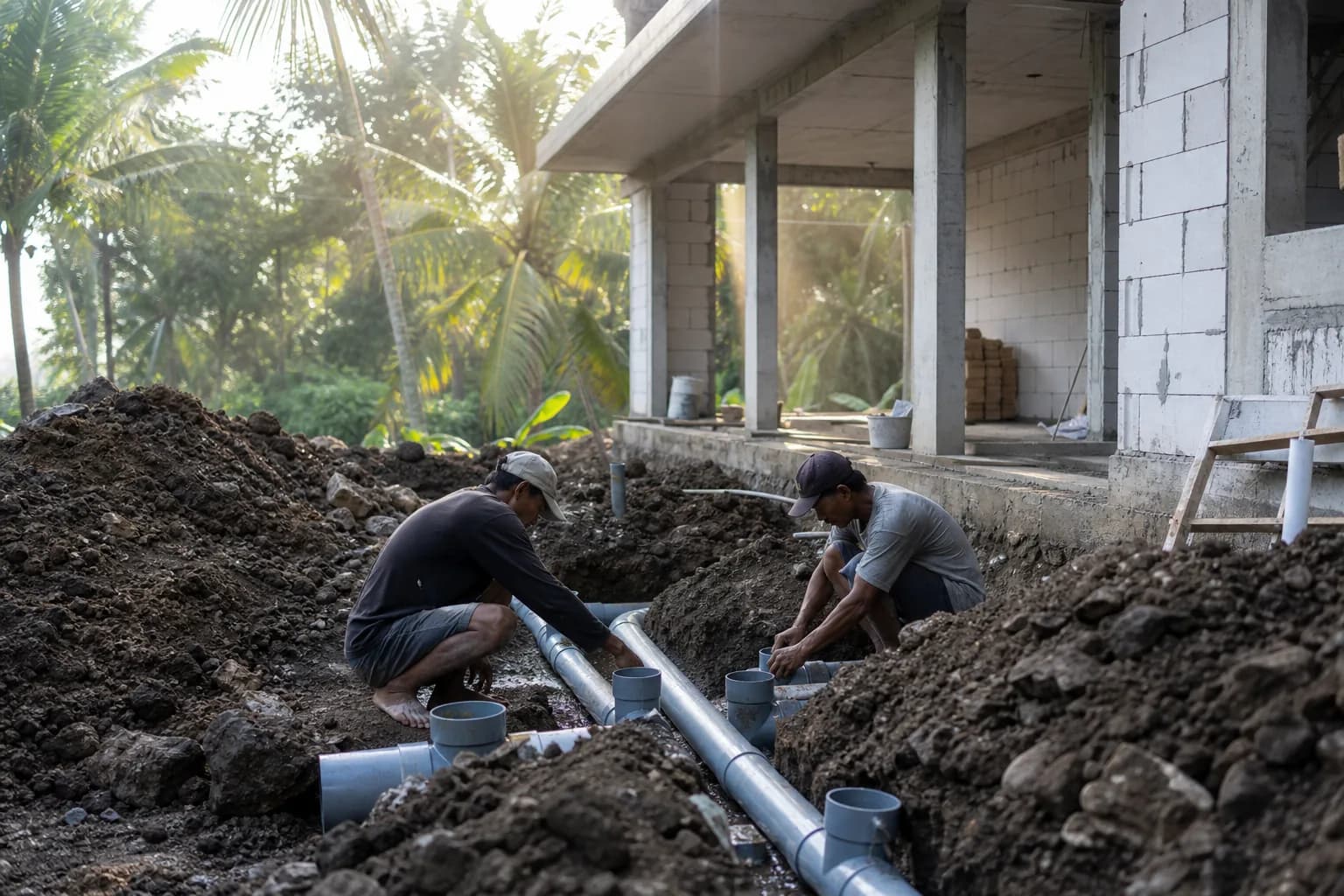
The Hidden Infrastructure Decision That Adds $3,000–$12,000 to Your Bali Villa Budget
When planning villa construction in Denpasar, most foreign buyers focus on land costs and building permits, but overlook a critical infrastructure decision that permanently affects both upfront investment and operational expenses: municipal water connection versus private well drilling. This choice isn’t merely about convenience—it’s a complex engineering and regulatory decision involving PDAM Denpasar tariff structures, groundwater extraction permits, geological drilling feasibility, and long-term water security in Bali’s increasingly stressed aquifer systems. The cost differential between these options ranges from $3,000 to over $12,000 depending on location, depth requirements, and regulatory compliance pathways, yet the decision carries implications far beyond initial capital expenditure. Understanding the technical realities, hidden regulatory costs, and engineering constraints of each water supply method is essential for accurate budget planning and avoiding costly mid-construction surprises in Denpasar’s evolving water infrastructure landscape.
Technical Engineering and Regulatory Framework for Water Supply Options
Denpasar’s water supply infrastructure operates under PDAM (Perusahaan Daerah Air Minum) Kota Denpasar, the municipal water utility that manages piped water distribution across the city. As of 2026, PDAM connection availability varies significantly by district—areas like Sanur, Renon, and central Denpasar generally have established pipe networks, while peripheral zones in South Denpasar and newly developed areas often lack infrastructure entirely. This geographic reality fundamentally determines whether municipal connection is even feasible for your construction site.
Municipal PDAM Connection: Technical Requirements and Cost Structure
PDAM Denpasar connection involves three distinct cost components that many buyers fail to anticipate. First, the sambungan baru (new connection fee) varies by pipe diameter and customer classification. Residential villa connections typically require 1/2-inch to 3/4-inch diameter pipes, with connection fees ranging from Rp 2,500,000 to Rp 5,000,000 ($160–$320 USD) for standard residential classification. However, if your villa operates commercially (rental/hospitality), you’ll be classified under tariff group III (business), which carries significantly higher connection fees—often Rp 8,000,000–Rp 15,000,000 ($510–$960 USD).
Second, infrastructure extension costs apply when the nearest PDAM main line exceeds standard connection distance (typically 10 meters from property boundary). Extension costs run approximately Rp 450,000–Rp 750,000 per linear meter ($29–$48 USD/meter) including pipe materials, excavation, and installation. For properties 50+ meters from existing mains, this alone can add $1,500–$2,400 to your water infrastructure budget. Third, meter installation and deposit requirements add another Rp 1,000,000–Rp 2,000,000 ($64–$128 USD) depending on meter capacity.
The critical technical limitation: PDAM water pressure in Denpasar averages 1.5–2.5 bar, insufficient for multi-story villas without booster pump systems. This necessitates additional investment in pressure tanks, booster pumps, and elevated storage tanks—typically adding $800–$1,500 to your plumbing infrastructure. Water quality from PDAM varies seasonally, with higher turbidity during rainy season requiring filtration systems for potable use, adding another $400–$800 for whole-house filtration.
Private Well Drilling: Geological and Regulatory Complexity
Private well drilling in Denpasar involves navigating both geological constraints and increasingly stringent groundwater extraction regulations. Bali’s aquifer depth varies dramatically—in coastal Sanur areas, brackish water intrusion means drilling must reach 40–80 meters to access freshwater layers, while inland Denpasar areas may find adequate water at 15–30 meters. This geological variability directly impacts drilling costs, which range from Rp 350,000 to Rp 650,000 per meter ($22–$42 USD/meter) depending on soil composition and drilling method.
The regulatory framework has tightened significantly since 2024. All new wells in Denpasar require Izin Pengambilan dan Pemanfaatan Air Tanah (groundwater extraction and utilization permit) from the Dinas ESDM (Energy and Mineral Resources Department). The permit process involves hydrogeological assessment, environmental impact consideration, and annual extraction volume limits. Permit costs range from Rp 3,000,000 to Rp 8,000,000 ($190–$510 USD) depending on well depth and projected daily extraction volume. Processing time typically extends 6–12 weeks, potentially delaying construction schedules.
Well construction itself involves multiple technical components beyond drilling. After reaching adequate depth and water yield (minimum 0.5–1.0 liters/second for residential villa), you’ll need PVC casing installation (Rp 150,000–Rp 250,000 per meter), gravel packing, sanitary seal, submersible pump installation (Rp 4,000,000–Rp 12,000,000 for quality pumps), pressure tank system, and electrical infrastructure. Total well completion costs typically run $4,500–$9,000 for depths of 30–60 meters with proper equipment.
Water quality testing is non-negotiable for private wells. Laboratory analysis for bacterial contamination, mineral content, salinity, and heavy metals costs Rp 1,500,000–Rp 3,000,000 ($95–$190 USD). Wells in coastal Denpasar frequently show elevated salinity requiring reverse osmosis systems ($1,200–$2,500) for potable water, while inland wells may have high iron content necessitating oxidation filtration ($600–$1,200).
Hidden Risks and Common Mistakes in Water Infrastructure Planning
The most costly mistake foreign villa developers make is treating water infrastructure as an afterthought rather than integrating it into initial site feasibility analysis. We’ve encountered projects where buyers purchased land in peripheral Denpasar assuming PDAM connection availability, only to discover the nearest main line was 200+ meters away—adding $6,000–$9,000 in unexpected infrastructure costs that eliminated budget contingency for other critical systems.
Another critical oversight: failing to verify PDAM service reliability before committing to municipal connection. Several Denpasar districts experience frequent supply interruptions (3–5 days monthly during dry season), making backup water storage essential. This reality transforms a “simple” PDAM connection into a hybrid system requiring 5,000–10,000 liter storage tanks ($800–$1,500) and potentially a backup well anyway—doubling your water infrastructure investment.
For well drilling, the most expensive mistake is proceeding without proper geological survey. Drilling to 40 meters only to encounter insufficient yield or brackish water means abandoning that investment and drilling deeper or relocating—we’ve seen cases where this added $3,000–$5,000 in wasted drilling costs. Professional hydrogeological assessment ($400–$700) before drilling is always cost-effective insurance.
Permit non-compliance represents severe long-term risk. Operating an unpermitted well in Denpasar can result in Rp 50,000,000+ fines ($3,200+ USD) and well closure orders. More critically, unpermitted wells create complications for IMB (building permit) final inspection and property resale, as buyers increasingly conduct infrastructure due diligence. The $190–$510 permit cost is trivial compared to these downstream risks.
Many developers also underestimate ongoing operational costs. PDAM water in Denpasar costs approximately Rp 7,500–Rp 15,000 per cubic meter ($0.48–$0.96 USD) depending on consumption tier and customer classification, while well water appears “free” but requires pump electricity (typically 900–1,500 watts), periodic maintenance, and eventual pump replacement every 5–8 years ($800–$1,200). Over 10 years, operational cost differences narrow considerably, making the decision more complex than simple upfront cost comparison.
Step-by-Step Decision Framework and Implementation Process
Phase 1: Site-Specific Feasibility Assessment (Week 1-2)
Begin by requesting official PDAM service availability confirmation for your specific land parcel. Contact PDAM Denpasar directly with land certificate details—they’ll provide written confirmation of nearest main line location, available pipe diameter, and estimated connection costs. This document is essential for accurate budgeting. Simultaneously, consult with local drilling contractors to obtain preliminary geological assessment based on nearby well data. Reputable contractors maintain databases of drilling results by district and can estimate likely depth requirements and yield expectations for your location.
For properties in areas with PDAM access, request service reliability data—frequency of supply interruptions, typical water pressure, and any planned infrastructure upgrades. This information rarely appears in official documentation but is critical for realistic system design. For well drilling consideration, obtain at least three drilling quotes specifying depth estimates, drilling method (rotary vs. percussion), casing specifications, and permit assistance services.
Phase 2: Regulatory Pathway Clarification (Week 2-3)
If proceeding with PDAM connection, submit formal application including land certificate copy, IMB (building permit), site plan showing connection point, and customer classification documentation. PDAM will conduct site survey (typically 1-2 weeks) and provide official quotation including all connection fees, extension costs if applicable, and timeline. Clarify whether your villa’s intended use (personal residence vs. rental operation) affects tariff classification—this significantly impacts both connection fees and ongoing water rates.
For well drilling, engage with Dinas ESDM to understand current permit requirements. As of 2026, the process requires: technical drilling plan from licensed contractor, hydrogeological assessment report, environmental impact statement for wells exceeding 50 meters depth, and proof of land ownership/authorization. Permit processing officially takes 30 working days but realistically extends 6-12 weeks. Factor this timeline into your construction schedule—well drilling typically occurs early in construction to provide water for concrete mixing and other building processes.
Phase 3: Integrated System Design (Week 3-4)
Work with your construction engineering team to design water infrastructure integrated with overall villa systems. For PDAM connections, this includes: entry point location coordinating with property boundary and internal plumbing layout, booster pump and pressure tank sizing based on fixture count and building height, backup storage tank capacity (minimum 3-5 days consumption), and filtration system specifications. At Teville, we integrate water infrastructure planning into our initial engineering phase, ensuring coordination with electrical systems, drainage design, and structural requirements—see our construction process documentation for how we approach integrated systems design.
For well systems, design must address: well location meeting 10+ meter setback from septic systems and property boundaries, pump house or protective structure, pressure tank and control system location, backup power provisions (wells require electricity, making them vulnerable to outages), and water treatment system integration based on laboratory test results. Hybrid systems combining well water for non-potable uses (irrigation, pools) with PDAM for potable consumption offer optimal reliability but require careful plumbing segregation and backflow prevention.
Phase 4: Implementation and Quality Verification (Week 5-12)
PDAM connection implementation typically takes 3-6 weeks after approval, including excavation, pipe laying, meter installation, and pressure testing. Ensure contractor provides proper trench depth (minimum 60cm), bedding material, and backfill compaction to prevent future pipe damage. Request pressure testing documentation and verify actual delivery pressure at property boundary before accepting connection.
Well drilling requires active site supervision. Reputable contractors provide daily drilling logs documenting depth, soil/rock layers encountered, and water strikes. Insist on yield testing (minimum 4-hour pumping test) before well completion to verify sustainable extraction rate. After drilling completion and pump installation, conduct comprehensive water quality testing before connecting to villa plumbing. Maintain all drilling records, permit documentation, and test results—these become essential property documentation affecting future resale value.
Realistic Cost Ranges and Timeline Expectations for Denpasar Projects
For PDAM municipal connection in areas with existing infrastructure (within 20 meters of main line), expect total costs of $800–$1,800 including connection fees, meter installation, basic pressure system, and standard filtration. Timeline: 4-8 weeks from application to active service. For properties requiring infrastructure extension (20-100 meters from main line), costs escalate to $2,500–$5,500 with timelines extending to 8-16 weeks depending on excavation complexity and PDAM workload.
For private well drilling, shallow wells (15-30 meters) in favorable inland Denpasar locations cost $4,000–$6,500 including drilling, casing, pump installation, basic treatment, and permits. Timeline: 6-10 weeks including permit processing and drilling. Deep wells (40-80 meters) required in coastal areas or locations with aquifer challenges cost $7,500–$12,000 with timelines extending to 10-16 weeks. These figures assume normal drilling conditions—encountering rock layers or requiring multiple drilling attempts can add 20-40% to costs.
Hybrid systems (PDAM connection plus backup well or vice versa) represent the most reliable but expensive option at $6,000–$10,000 total investment. However, for rental villas where water supply interruption directly impacts guest experience and revenue, this redundancy often proves cost-effective. Many of the villa projects in our portfolio utilize hybrid systems in areas with marginal PDAM reliability.
Ongoing operational costs differ significantly: PDAM-connected villas typically spend $30–$80 monthly on water bills (based on 15-25 cubic meters consumption), while

Want to calculate?
 3127 m²9 month(s)from 177.000 USD
Mukunda
 172 m²8 month(s)from 120.000 USD
Keshava
 2144 m²11 month(s)from 104.000 USD
Narayana
 3180 m²7 month(s)from 142.000 USD
Vasudeva
 3124 m²6 month(s)from 123.000 USD
TALA 8
 164 m²7 month(s)from 79.000 USD
TALA TWO
164 m²7 month(s)from 79.000 USDPrivate: Haridas Villas, Tegallalang
 1from 198.000 USD
Private: Haridas Villas
 3104 m²11 month(s)from 99.000 USD
TALA 100
 4344 m²16 month(s)from 290.000 USD
Radha
 3173 m²6 month(s)from 125.000 USD
TALA FOUR
Start With Real Numbers, Not Guesses
Before buying land or finalizing a design, check the realistic build cost range for your project in Bali.
Our team reviews your inputs and gives a grounded estimate.
Available lands
 700 m²7 min$ 400000Bali, Canggu
 660 m²10 min$ 175567Bali, Mengwi
 2400 m²7 min$ 496552Bali, Canggu
 300 m²55 min$ 32475Bali, Tegelalang
 800 m²5 min$ 295567Bali, Seseh
 1000 m²10 min$ 303571Bali, Tabanan
 585 m²8 min$ 165702Bali, Mengwi
 700 m²8 min$ 165517Bali, Umalas
 1660 m²10 min$ 343448Bali, Kerobokan
 600 m²12 min$ 101970Bali, Mengwi
 1000 m²8 min$ 134544Bali, Bukit
 700 m²15 min$ 90517Bali, Central Bali
 2800 m²15 min$ 310345Bali, Tabanan
 250 m²15 min$ 40025Bali, Munggu
 680 m²15 min$ 110751Bali, Pererenan
Essential Bali build & buy guides
- Bali villa construction cost per m² in 2026
- How much will your villa cost? Calculator
- Building a villa in Bali: the complete guide
- Buying land in Bali: step-by-step for foreigners
- Bali villa investment: yields, risks, returns
- Leasehold vs freehold: what foreigners can own
- Construction defect liability & 10-year warranty
- Bali building codes and construction standards
Related guides
Milestone Payment Schedules in Bali Construction: How Staged Payments Protect You
Milestone-based payment schedules are a Bali builder's best client protection: what a healthy 6-stage structure looks like, how to verify progress remotely, and which payment terms to refuse.
7 min read
Financing a Bali Villa: Why the Market Is Cash-Only for Foreigners — and the Realistic Alternatives
Why foreign buyers in Bali almost always pay cash, the narrow 2026 bank options for residents, and the realistic alternatives — from home-country equity to milestone-staged construction payments.
7 min read
Bali Rental Income Tax and Compliance Costs: The 10% Rule and the Real Math
How Bali rental income is really taxed in 2026 — the 10% final tax, the 20% non-resident trap, PB1, licensing overhead — and a worked example showing what a villa owner actually keeps.
7 min read