Bengkirai Subfloor Joist Spacing: Prevent Warp in Bali Humidity
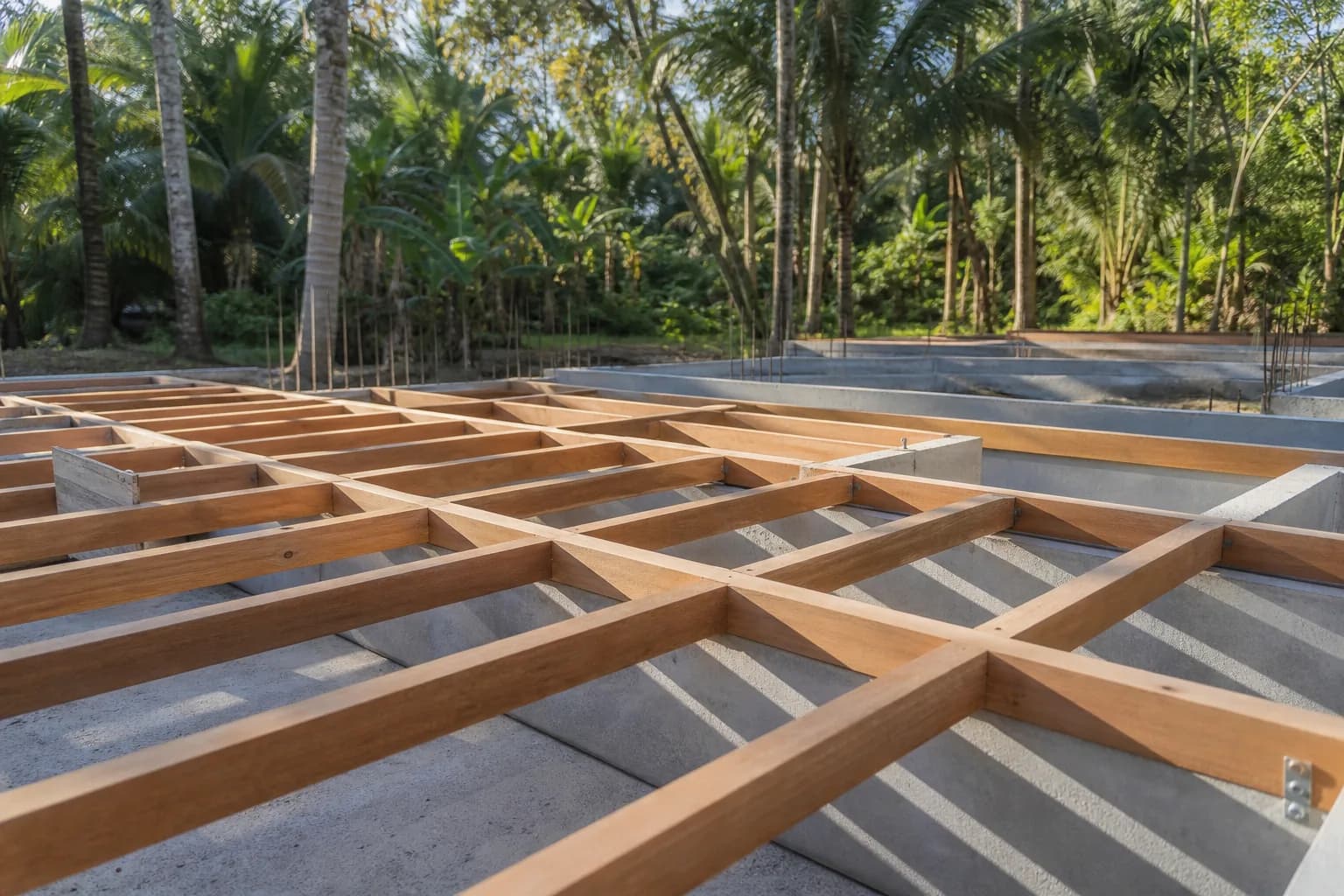
Why Bengkirai Joist Spacing Determines Your Bali Villa Floor’s Lifespan
When installing wood flooring in Bali’s tropical climate, the hidden subfloor structure determines whether your beautiful Bengkirai floors remain flat or develop waves within months. The critical factor isn’t the visible flooring—it’s the joist spacing beneath. In Bali’s 80-90% humidity environment, improperly spaced Bengkirai subfloor joists will warp, twist, and cup, telegraphing defects through your finished floor. This technical guide addresses the precise joist spacing requirements for Bengkirai subfloors in tropical conditions, preventing the costly floor failures we regularly see in Bali villa construction projects where builders ignore humidity-specific engineering.
Technical Deep Dive: Bengkirai Behavior in Tropical Humidity
Bengkirai (Shorea laevis) is a premium tropical hardwood with exceptional durability, but its dimensional stability depends entirely on proper structural support. With a density of 880-950 kg/m³ and moisture content fluctuating between 12-18% in Bali’s climate, Bengkirai joists experience continuous expansion and contraction cycles that standard temperate-climate spacing cannot accommodate.
The fundamental engineering principle: joist spacing must prevent deflection exceeding L/360 (span length divided by 360) under load. For Bengkirai subfloors supporting hardwood flooring, this translates to maximum spacing of 400mm on-center for 50mm thick joists, or 300mm on-center for 40mm joists. These specifications differ significantly from the 600mm spacing common in dry climates because tropical humidity reduces the wood’s effective load-bearing capacity by 15-20%.
Bali’s unique challenge involves not just high humidity but dramatic daily fluctuations. Morning humidity at 95% drops to 65% by afternoon, causing Bengkirai to absorb and release moisture continuously. Without proper joist spacing, this movement creates stress concentrations at support points, leading to permanent deformation. The wood’s tangential shrinkage of 7.8% and radial shrinkage of 4.2% means inadequate support allows differential movement that manifests as cupping and twisting.
Critical to understanding Bengkirai’s performance: the species has excellent natural durability (Class I-II) but moderate dimensional stability. When used as structural joists, the wood must be properly seasoned to 12-14% moisture content before installation—matching Bali’s equilibrium moisture content. Installing joists with higher moisture content guarantees warping as they dry in place, regardless of spacing.
The subfloor system functions as a structural sandwich: concrete foundation, moisture barrier, Bengkirai joists at specified spacing, plywood or solid wood subflooring, and finished flooring. Each layer’s performance depends on the one below. When joist spacing exceeds recommendations, the plywood subfloor deflects between supports, creating bounce that stresses flooring joints and adhesives. In our construction process, we’ve documented that every 50mm increase in joist spacing beyond optimal specifications doubles the probability of visible floor defects within two years.
Temperature also plays a role often overlooked in tropical construction. Bali’s consistent 26-32°C range means thermal expansion is predictable, but when combined with moisture movement, the cumulative effect requires engineering precision. Bengkirai’s coefficient of thermal expansion (0.0000045 per °C) seems negligible until calculated across a 10-meter floor span with simultaneous moisture expansion—resulting in 8-12mm total movement that must be accommodated through proper joist design and expansion gaps.
Installation Process: Engineered Joist Layout for Tropical Conditions
Step 1: Foundation Assessment and Moisture Barrier Installation
Begin with concrete slab flatness verification using a 3-meter straightedge—maximum deviation 3mm over 3 meters. Any high spots must be ground down; low areas filled with self-leveling compound. Install 0.2mm polyethylene moisture barrier with 300mm overlaps, sealed with moisture-resistant tape. This barrier is non-negotiable in Bali’s ground moisture conditions, preventing capillary rise that would saturate joists from below.
Step 2: Joist Material Selection and Acclimatization
Source Bengkirai joists kiln-dried to 12-14% moisture content, verified with a pin-type moisture meter at multiple points. Reject any timber exceeding 15% or showing existing warp greater than 3mm over 2 meters. Store joists on-site for minimum 7 days in the installation environment, stacked with spacers for air circulation. This acclimatization prevents immediate movement post-installation.
Step 3: Layout Marking and Spacing Calculation
For standard residential loads (2.0 kN/m²), mark joist centers at 400mm intervals for 50x100mm Bengkirai joists, or 300mm for 40x100mm sections. Perpendicular to the finished floor direction is standard, but diagonal layouts (45°) can be used for enhanced stability in large open spaces. Use chalk lines for accuracy—laser levels for elevation consistency across the entire floor plane.
Step 4: Joist Installation with Ventilation Provisions
Install joists on 10mm rubber pads or adjustable plastic pedestals, never in direct concrete contact. This creates essential ventilation space preventing moisture accumulation. Secure joists with concrete anchors every 800mm, using stainless steel fasteners to prevent corrosion. Maintain 10-15mm gaps between joist ends and walls for expansion. Cross-ventilation paths every 2 meters prevent dead air pockets where humidity concentrates.
Step 5: Leveling and Shimming
Using a laser level, verify all joist tops align within 2mm tolerance. Shim low joists with marine-grade plywood shims, never wood wedges that compress over time. Each shim point requires mechanical fastening—adhesive alone fails in tropical humidity. This precision ensures the plywood subfloor receives uniform support, eliminating deflection points.
Step 6: Subfloor Panel Installation
Install 18mm marine plywood or 19mm tongue-and-groove solid wood subflooring perpendicular to joists. Fasten every 150mm along joists with 50mm stainless steel screws, pre-drilling to prevent splitting. Leave 3mm expansion gaps between panels, 10mm at walls. Stagger panel joints, never aligning seams across adjacent rows. This creates a rigid diaphragm that distributes loads across multiple joists.
Materials & Specifications: What Works in Bali’s Climate
Joist Specifications: Bengkirai (Shorea laevis) dimensional lumber, kiln-dried to 12-14% MC. Standard sections: 50x100mm for 400mm spacing, 40x100mm for 300mm spacing, 60x120mm for 500mm spacing in commercial applications. Reject any timber with knots exceeding 30mm diameter or located within 100mm of joist ends. Grain should run parallel to length—cross-grain pieces will twist regardless of spacing.
Fasteners and Hardware: Exclusively stainless steel (304 grade minimum) or hot-dip galvanized fasteners. Standard steel corrodes within 18 months in Bali humidity, causing joist splitting and structural failure. Concrete anchors: 10mm diameter, 80mm embedment. Joist screws: 6mm diameter, 100mm length. Avoid pneumatic nails—they lack holding power in dense Bengkirai and create splitting risks.
Moisture Barriers: 0.2mm (200 micron) polyethylene sheeting minimum, or preferably 0.3mm cross-laminated polyethylene with integrated vapor retarder. Reflective foil barriers add thermal benefits but cost 40% more. Seam tape must be acrylic-based, not rubber-based which degrades in tropical heat.
Support Systems: Adjustable plastic pedestals (polypropylene) rated for 500kg load capacity, or 10mm EPDM rubber pads. Avoid wood blocking which absorbs moisture and compresses. For renovation projects over existing tile, pedestal systems allow height adjustment without demolition, critical for villa renovation work where floor level matching is required.
Subfloor Panels: Marine-grade plywood (18mm minimum) with phenolic resin bonding, or solid Bengkirai tongue-and-groove boards (19mm). Standard interior plywood delaminates within 3-5 years in Bali conditions. Oriented strand board (OSB) is completely unsuitable—it swells 25% in tropical humidity and never recovers.
Cost Breakdown: Investment in Proper Joist Spacing
Materials (per square meter): Bengkirai joists at 400mm spacing: Rp 185,000-220,000 depending on section size and grade. Moisture barrier system: Rp 25,000-35,000. Fasteners and anchors: Rp 30,000-40,000. Adjustable pedestals or rubber pads: Rp 45,000-65,000. Marine plywood subflooring (18mm): Rp 280,000-320,000. Total materials: Rp 565,000-680,000/m².
Labor Costs: Skilled carpentry team for joist installation: Rp 150,000-200,000/m² including layout, leveling, and fastening. Subfloor panel installation: Rp 75,000-100,000/m². Total labor: Rp 225,000-300,000/m². Combined material and labor: Rp 790,000-980,000/m² for complete subfloor system.
Cost Comparison: Reducing joist spacing from 400mm to 600mm saves approximately Rp 120,000/m² in materials but guarantees floor failure requiring complete replacement within 3-5 years. Replacement costs including demolition, disposal, and reinstallation: Rp 1,850,000-2,200,000/m²—more than double the initial proper installation cost. For a typical 150m² villa floor, cutting corners saves Rp 18 million initially but costs Rp 277-330 million in premature replacement.
Long-term Value: Properly spaced Bengkirai subfloors last 25-30+ years in Bali conditions with minimal maintenance. The incremental cost represents just 8-12% of total flooring system investment (including finished hardwood) but determines 80% of long-term performance. Get detailed project costing through our cost estimation service.
Common Mistakes: What Causes Bengkirai Subfloor Failure
Mistake 1: Applying Temperate-Climate Spacing Standards
Using 600mm joist spacing because “it’s code in Australia/US” ignores tropical humidity’s impact on wood strength. We’ve remediated dozens of floors where international builders applied home-country standards, resulting in bouncy floors and cracked tiles within 18 months. Bali requires Bali-specific engineering.
Mistake 2: Installing Wet Timber
Contractors often install Bengkirai joists at 18-22% moisture content, claiming “it will dry in place.” As joists dry to equilibrium (12-14%), they shrink, twist, and cup, destroying subfloor flatness. Always verify moisture content below 15% before installation—no exceptions. Wet timber installation is the single most common cause of warped subfloors in finishing works Bali projects.
Mistake 3: Inadequate Ventilation Under Joists
Installing joists directly on concrete or with insufficient air gaps creates moisture traps. Trapped humidity concentrates at joist bottoms, causing localized swelling and rot even in durable Bengkirai. Minimum 10mm air gap with cross-ventilation paths is mandatory—this isn’t optional detailing.
Mistake 4: Using Inferior Fasteners
Standard steel screws and nails corrode rapidly in Bali’s salt-laden coastal air, losing 60% holding strength within two years. Corroded fasteners allow joist movement and squeaking floors. Stainless steel costs 3x more but lasts 10x longer—the economics clearly favor quality fasteners.
Mistake 5: Ignoring Subfloor Panel Quality
Installing standard interior plywood over perfectly spaced joists wastes the structural investment. Interior plywood delaminates in humidity, creating soft spots and telegraphing through finished flooring. Marine-grade plywood or solid wood subflooring is non-negotiable in MEP systems Bali installations where long-term performance matters.
Frequently Asked Questions: Bengkirai Joist Spacing in Bali
Can I use 500mm joist spacing to reduce costs without major problems?
No. Testing across multiple villa renovation Bali projects shows 500mm spacing with 50mm joists creates noticeable floor deflection under normal foot traffic. While not immediately catastrophic, this deflection stresses flooring joints, causes tile cracking, and creates squeaks within 2-3 years. The 15% material savings becomes a 200% replacement cost. Stick with 400mm maximum for residential applications.
How does Bengkirai compare to other tropical hardwoods for joist applications?
Bengkirai offers the best balance of strength (bending strength 1,200 kg/cm²), durability (Class I-II), and local availability in Bali. Alternatives like Merbau have similar properties but cost 20-30% more. Teak is more dimensionally stable but 2-3x the price and often over-specified for subfloor applications. For hidden structural work, Bengkirai is the optimal choice in wood flooring Bali projects.
What moisture content should Bengkirai joists have at installation in Bali?
Target 12-14% moisture content, matching Bali’s equilibrium moisture content for indoor spaces. Never install above 15%. Joists delivered at 18-20% (common from local suppliers) must be stacked with spacers in the installation environment for 10-14 days before use. Verify with a calibrated pin-type moisture meter at multiple points—surface readings can be misleading.
Do I need different joist spacing for tile versus hardwood finished flooring?
Yes. Tile flooring requires more rigid support—use 300mm spacing regardless of joist size, with 20mm marine plywood subfloor minimum. Tile’s rigidity means any subfloor deflection causes grout cracking and tile debonding. Hardwood flooring has more flexibility, allowing 400mm spacing with 18mm subfloor. This is critical in Bali villa construction where mixed flooring types are common.
Can existing subfloors with incorrect spacing be retrofitted without complete replacement?
Sometimes. If joists are at 600mm spacing, sister joists can be added between existing ones, bringing spacing to 300mm. This requires removing subfloor panels, installing additional joists on the same foundation system, releveling everything, and reinstalling subfloor. Cost is 60-70% of new installation but avoids foundation work. Only viable
 4344 m²16 month(s)from 290.000 USD
Radha
 2144 m²11 month(s)from 104.000 USD
Narayana
 3104 m²11 month(s)from 99.000 USD
TALA 100
 164 m²7 month(s)from 79.000 USD
TALA TWO
 3124 m²6 month(s)from 123.000 USD
TALA 8
 1from 198.000 USD
Private: Haridas Villas

Want to calculate?
 3127 m²9 month(s)from 177.000 USD
Mukunda
 3173 m²6 month(s)from 125.000 USD
TALA FOUR
164 m²7 month(s)from 79.000 USDPrivate: Haridas Villas, Tegallalang
 3180 m²7 month(s)from 142.000 USD
Vasudeva
 172 m²8 month(s)from 120.000 USD
Keshava
Start With Real Numbers, Not Guesses
Before buying land or finalizing a design, check the realistic build cost range for your project in Bali.
Our team reviews your inputs and gives a grounded estimate.
Available lands
 680 m²15 min$ 110751Bali, Pererenan
 550 m²5 min$ 217629Bali, Tabanan
 6000 m²30 min$ 55419Bali, Tabanan
 6000 m²10 min$ 1330049Bali, Kutuh South Bali
 250 m²15 min$ 40025Bali, Munggu
 2000 m²15 min$ 523000Bali, Canggu
 2800 m²15 min$ 310345Bali, Tabanan
 2230 m²15 min$ 410573Bali, Padonan
 1000 m²10 min$ 384852Bali, Canggu
 2200 m²15 min$ 508005Bali, Canggu
 911 m²15 min$ 248217Bali, Pererenan
 750 m²15 min$ 187038Bali, Kerobokan
 1300 m²10 min$ 312192Bali, Kutuh South Bali
 204 m²5 min$ 40899Bali, Kedungu
 5028 m²10 min$ 361000Bali, Ubud
Essential Bali build & buy guides
- Bali villa construction cost per m² in 2026
- How much will your villa cost? Calculator
- Building a villa in Bali: the complete guide
- Buying land in Bali: step-by-step for foreigners
- Bali villa investment: yields, risks, returns
- Leasehold vs freehold: what foreigners can own
- Construction defect liability & 10-year warranty
- Bali building codes and construction standards
Related guides
Leasehold Depreciation in Bali: How Remaining Term Affects Resale Value — and What Offsets It
A Bali leasehold is a depreciating right on land plus an ageing building — but the loss of value is neither linear nor unmanageable. How remaining term drives resale price, where the danger lines sit, and the clauses and decisions that protect your exit.
7 min read
Annual Holding Costs of a Bali Villa: A Realistic Owner's Budget
The purchase price is only the entry ticket. Here is what a Bali villa actually costs to hold each year — staff, utilities, pool, maintenance, insurance, taxes and management — with realistic 2026 numbers and a sample budget.
7 min read
Transferring Money to Indonesia for a Property Purchase: Banking, Documentation and Safe Practice
Moving six figures across borders is the least glamorous part of buying in Bali, and the part most buyers under-prepare for. This guide covers the rupiah rule, notary escrow, transfer documentation, and the paper trail that protects a future exit.
8 min read