Bali Import Duty Impact on Steel Concrete Budgets
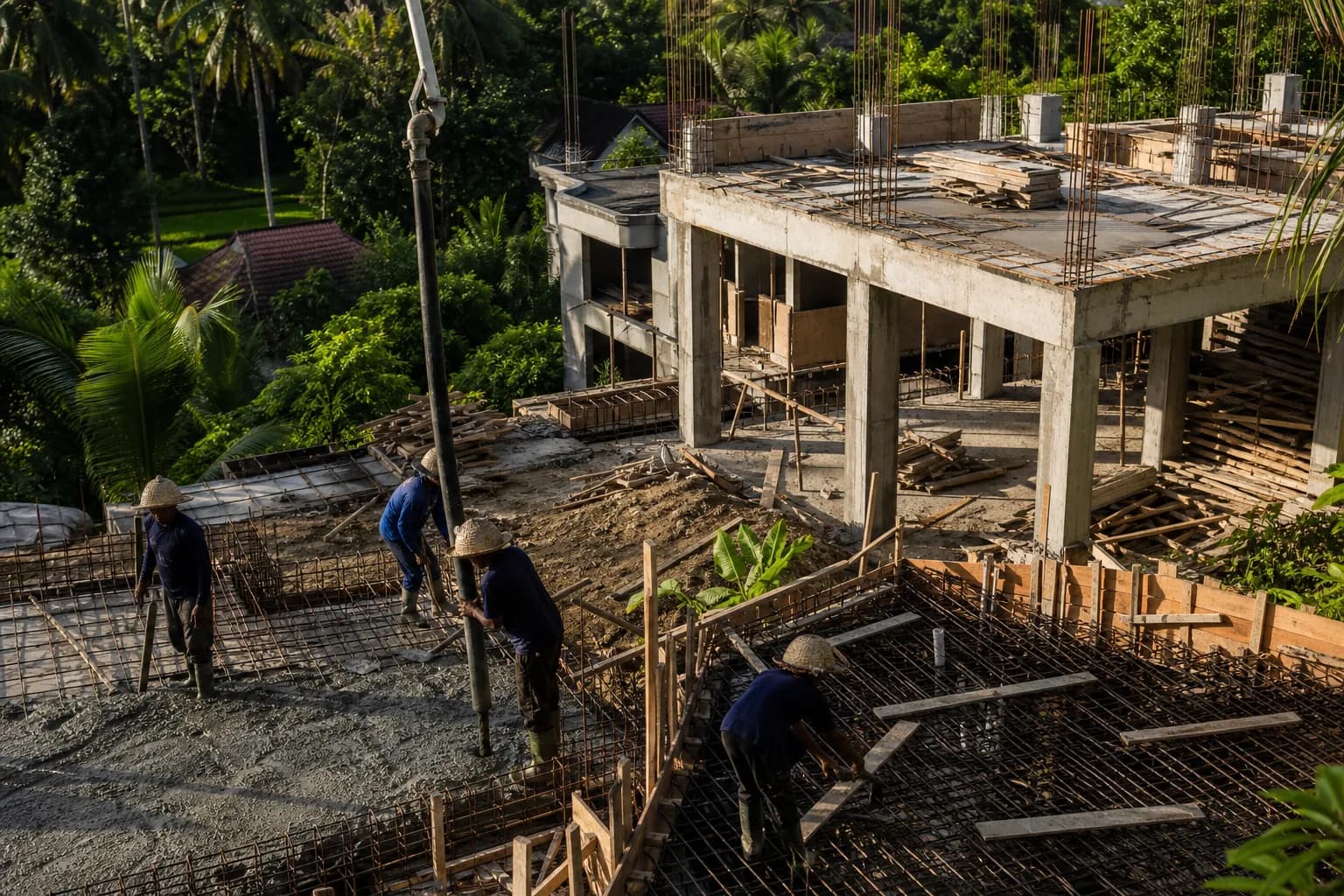
How Import Duty Fluctuations Are Reshaping Bali Villa Construction Material Budgets in 2026
Villa developers in Bali face an increasingly complex challenge: Indonesia’s evolving import tariff structure is directly impacting steel reinforcement and concrete additive costs, with customs revenue targets reaching $20 billion in 2026. For a typical 300m² villa project requiring 18-22 tons of steel rebar and specialized cement additives, import duty variations can shift material budgets by 12-18% compared to 2024 baselines. The critical issue isn’t just the headline tariff rates—it’s the cascading effect through supply chains, currency fluctuations against the rupiah, and the strategic decision between imported high-grade materials versus domestic alternatives that may not meet tropical engineering standards for corrosion resistance and structural longevity.
Technical Breakdown: Import Duty Mechanics for Construction Steel and Concrete Components
Indonesia’s import duty framework for construction materials operates through a tiered classification system under the Harmonized System (HS) codes, with steel products falling primarily under HS 72 and 73 categories. As of 2026, standard steel rebar (HS 7214) carries base import duties ranging from 0-10% depending on grade and origin, but the effective landed cost includes Value Added Tax (VAT) at 11%, income tax article 22 (PPh 22) at 2.5-7.5% for importers without API status, and potential anti-dumping duties on specific origin countries that can add another 8-25%.
For villa construction in Bali, the material impact breaks down into three critical categories:
Steel Reinforcement and Structural Components
High-tensile deformed bars (Grade 500 MPa) required for seismic-resistant foundations in Bali’s active tectonic zone often need importing from Japan, South Korea, or Taiwan when domestic production cannot guarantee consistent tensile strength certification. The 2026 customs revenue intensification means stricter verification of HS code classifications—misclassification of high-grade structural steel as standard rebar can result in retroactive duty assessments plus penalties of 100-400% of the duty shortfall. Import duties on corrosion-resistant epoxy-coated rebar, essential for Bali’s high-salinity coastal environment, face combined effective rates of 18-23% when all taxes are calculated on the CIF (Cost, Insurance, Freight) value.
The engineering consequence: developers must decide whether 18-23% premium on imported corrosion-resistant steel justifies the 15-20 year extended structural lifespan versus domestic alternatives that may require replacement or remediation within 8-12 years in tropical marine conditions. For a 300m² villa requiring 20 tons of rebar, this translates to $3,600-$4,600 in additional import-related costs for premium materials, but potentially $12,000-$18,000 in avoided future structural repairs.
Specialized Concrete Additives and Admixtures
High-performance concrete for Bali villa construction requires specific admixtures: superplasticizers for workability in high-temperature pours, corrosion inhibitors for rebar protection, and crystalline waterproofing compounds for below-grade structures. These chemical additives, predominantly imported from Germany, Switzerland, and Singapore, fall under HS codes 3824.40 and 3824.50, carrying base duties of 5-7.5% but facing the same VAT and PPh 22 multipliers.
The 2026 import duty environment creates a technical dilemma: domestic concrete additive manufacturers have expanded capacity, but independent laboratory testing reveals performance gaps in chloride penetration resistance—critical for structures within 3km of Bali’s coastline. Import duties add approximately $180-$240 per cubic meter to high-performance concrete costs (typical villa requires 180-220m³), but the alternative is concrete with 30-40% reduced service life in marine exposure conditions.
Currency Exchange and Duty Calculation Timing
Import duties are calculated on the CIF value converted to rupiah at the Bank Indonesia reference rate on the date of customs declaration. With the rupiah fluctuating between 15,200-16,800 per USD through 2025-2026, a 10% currency depreciation effectively increases import duty burden by the same percentage. For villa projects with 6-9 month construction timelines, material procurement timing relative to currency cycles can create budget variances of $4,000-$7,000 on steel and concrete components alone.
Teville’s engineering approach involves currency-hedged material procurement contracts with verified suppliers, locking CIF values and duty calculations at project commencement. This eliminates mid-construction budget surprises but requires sophisticated supply chain coordination—review our structured procurement methodology at our construction process documentation.
Hidden Risks: What Villa Developers Consistently Underestimate
The most dangerous assumption in Bali villa construction budgeting is treating import duties as a simple percentage add-on. Three critical risks emerge repeatedly:
Customs Classification Disputes and Retroactive Assessments
Indonesian customs authorities have intensified HS code verification audits in 2026. Steel products classified as “general construction steel” (lower duty) versus “high-grade structural steel” (higher duty) face subjective interpretation. We’ve documented cases where customs reclassified imported Grade 500 seismic-rated rebar from HS 7214.20 to 7228.30, triggering retroactive duty assessments of $2,800-$4,200 on typical villa steel orders, plus penalties and storage fees during dispute resolution that can halt construction for 3-6 weeks.
Domestic Content Requirements and Substitution Pressure
Indonesia’s industrial policy increasingly favors domestic material sourcing. While not yet mandatory for private villa construction, import approval delays for materials with “adequate domestic alternatives” have extended from 2-3 days to 12-18 days in 2026. For time-sensitive concrete pours requiring specific admixtures, this creates either schedule delays (costly in monsoon season planning) or forced substitution with domestic products that may not meet engineering specifications for tropical durability.
The False Economy of Duty-Exempt Schemes
Some developers attempt to import materials under temporary import schemes (KITE) or bonded zone arrangements to defer or reduce duties. The administrative burden, bank guarantee requirements (typically 110% of duty value), and strict re-export or domestic sale documentation make this impractical for villa-scale projects. Failed compliance results in full duty payment plus 50% penalties—we’ve seen this add $8,000-$12,000 to projects that attempted duty optimization without proper legal structure.
Strategic Procurement Process: Navigating Import Duty Impact on Material Budgets
Effective management of import duty impact requires a structured six-phase approach integrated into overall villa construction planning:
Phase 1: Material Specification and Origin Analysis (Weeks 1-2)
Begin with structural engineering specifications that identify which materials genuinely require import-grade quality versus those where domestic alternatives meet tropical performance standards. For Bali coastal villas, this typically means: imported corrosion-resistant rebar for primary structure, domestic steel for non-structural elements, imported crystalline waterproofing, domestic standard concrete. Document technical justification for each import decision—customs authorities increasingly request engineering rationale for import necessity.
Phase 2: Duty Calculation and Landed Cost Modeling (Week 3)
Calculate total landed costs including all duty components: base tariff + VAT (11%) + PPh 22 (2.5-7.5%) + potential anti-dumping duties + freight + insurance + customs clearance fees ($400-$800) + port handling ($200-$350). For a typical villa steel order of 20 tons from Japan with CIF value of $18,000, total landed cost reaches $23,400-$24,600 depending on importer tax status. Build 8-12% contingency for currency fluctuation and potential classification disputes.
Phase 3: Supplier Verification and Duty Optimization (Weeks 4-5)
Engage suppliers with API (Angka Pengenal Importir) status and proven customs clearance track records in Bali. Verify their HS code classification history—suppliers with frequent reclassification disputes signal risk. Evaluate Free Trade Agreement (FTA) benefits: steel from ASEAN countries may qualify for preferential tariffs under ATIGA, reducing duties by 3-7%. Concrete additives from Australia may benefit from IA-CEPA preferences. Proper Certificate of Origin documentation is critical—errors void FTA benefits and trigger full duty rates.
Phase 4: Procurement Timing and Currency Strategy (Week 6)
Coordinate material orders with rupiah strength periods when possible. A 5% stronger rupiah reduces duty burden by approximately $900-$1,200 on typical villa material imports. For projects with flexible timelines, strategic procurement timing can offset 40-60% of duty increases. Lock exchange rates through forward contracts when ordering 8-12 weeks ahead of delivery—most Indonesian banks offer 90-180 day forwards for commercial import transactions.
Phase 5: Customs Documentation and Clearance Management (Weeks 7-9)
Prepare complete documentation packages: commercial invoice, packing list, Bill of Lading, Certificate of Origin (for FTA claims), technical specifications, import permits (if required for specific materials), and engineering justification letters. Incomplete documentation is the primary cause of clearance delays—average delay costs $150-$280 per day in port storage fees plus construction schedule impact. Engage licensed customs brokers (PPJK) with Bali port experience; their fee of $600-$900 is minor compared to delay risk.
Phase 6: Delivery Coordination and Quality Verification (Week 10)
Coordinate delivery timing with construction schedule critical paths—imported steel should arrive 2-3 weeks before foundation pour to allow quality testing. Verify material certifications match customs declarations; discrepancies can trigger post-clearance audits. Conduct independent testing of imported materials: tensile strength for steel, chloride penetration resistance for concrete additives. Testing costs $400-$700 but validates that premium import duties delivered actual performance value.
Teville integrates this procurement process into our comprehensive project management framework, with dedicated supply chain coordination that treats import duty management as an engineering discipline, not an afterthought. Explore our systematic approach at our construction methodology page.
Realistic Budget Impact: Numbers for 2026 Bali Villa Construction
For a reference 300m² two-bedroom villa in Bali’s coastal zones (Canggu, Uluwatu, Sanur), import duty impact on steel and concrete materials breaks down as follows:
Steel Reinforcement (20 tons required):
- Domestic Grade 400 steel: $16,000-$18,000 (no import duties, 8-12 year coastal lifespan)
- Imported Grade 500 epoxy-coated: $24,000-$27,000 (18-23% effective duty rate, 15-20 year lifespan)
- Import duty component: $3,800-$4,600
- Long-term value consideration: $12,000-$18,000 avoided future remediation
Concrete and Additives (200m³ high-performance mix):
- Domestic standard concrete: $88-$96 per m³ = $17,600-$19,200 total
- Imported additive-enhanced concrete: $112-$128 per m³ = $22,400-$25,600 total
- Import duty component on additives: $2,400-$3,200
- Performance differential: 40% better chloride resistance, 30% reduced permeability
Total Import Duty Impact on Materials Budget: $6,200-$7,800 for premium imported materials, representing 2.8-3.4% of typical $220,000-$280,000 total villa construction cost. However, this 3% upfront investment prevents 5-8% of construction value in potential structural repairs over 15-year ownership period.
Timeline Considerations: Import procurement adds 8-12 weeks to material acquisition versus domestic sourcing’s 2-3 weeks. For monsoon-sensitive construction schedules (optimal building: April-October), this timing difference can determine whether foundation work completes before November rains, potentially saving $4,000-$6,000 in weather delay costs.
Request detailed material budget analysis specific to your villa design and location at our cost estimation service.
Frequently Asked Questions: Import Duty Impact on Bali Villa Material Costs
Can I avoid import duties by purchasing materials through a local supplier rather than importing directly?
Local suppliers who stock imported materials have already paid import duties and incorporate those costs (plus their margin) into retail pricing. You’re paying the duty indirectly, typically with a 15-25% markup over direct import landed costs. The advantage is simplified procurement and faster availability; the disadvantage is higher total cost and less control over material specifications and origin verification. For villa-scale projects, direct import through a qualified customs broker often provides better value and quality assurance, despite the administrative complexity. Teville’s supply chain includes pre-negotiated import channels that deliver direct-import pricing with local supplier convenience.
How do Free Trade Agreements affect steel and concrete material import duties for Bali construction?
Indonesia’s FTAs with ASEAN (ATIGA), Australia (IA-CEPA), Japan (IJEPA), and South Korea (IK-CEPA) offer preferential tariff rates on qualifying construction materials. Steel from ASEAN countries may enter duty-free or at reduced rates of 0-5% versus standard 10% MFN rates. However, benefits require proper Certificate of Origin (Form D for ASEAN, Form JIEPA for Japan) and compliance with Rules of Origin—materials must meet minimum local content thresholds (typically 40-45%) in the exporting country. Concrete additives from Australia can qualify for 5-7% duty reductions under IA-CEPA. The administrative burden of FTA compliance adds $300-$500 in documentation costs but saves $1,200-$2,400 in duties on typical villa material imports—net benefit of $700-$2,100.
What happens if customs authorities reclassify my imported steel to a hi 3127 m²9 month(s)from 177.000 USD
Mukunda
 3124 m²6 month(s)from 123.000 USD
TALA 8
 164 m²7 month(s)from 79.000 USD
TALA TWO
164 m²7 month(s)from 79.000 USDPrivate: Haridas Villas, Tegallalang
 3173 m²6 month(s)from 125.000 USD
TALA FOUR

Want to calculate?
 2144 m²11 month(s)from 104.000 USD
Narayana
 3180 m²7 month(s)from 142.000 USD
Vasudeva
 1from 198.000 USD
Private: Haridas Villas
 4344 m²16 month(s)from 290.000 USD
Radha
 3104 m²11 month(s)from 99.000 USD
TALA 100
 172 m²8 month(s)from 120.000 USD
Keshava
Start With Real Numbers, Not Guesses
Before buying land or finalizing a design, check the realistic build cost range for your project in Bali.
Our team reviews your inputs and gives a grounded estimate.
Available lands
 7000 m²36 min$ 284483Bali, Gianyar
 6000 m²30 min$ 55419Bali, Tabanan
 889 m²15 min$ 145612Bali, Cepaka
 700 m²15 min$ 109052Bali, Buduk
 700 m²15 min$ 162500Bali, Tabanan
 750 m²15 min$ 187038Bali, Kerobokan
 29000 m²6 min$ 3857143Bali, Tabanan
 1300 m²10 min$ 312192Bali, Kutuh South Bali
 1375 m²10 min$ 447044Bali, Canggu
 608 m²15 min$ 310377Bali, Seminyak
 2700 m²30 min$ 314224Bali, Sidemen
 2850 m²15 min$ 315887Bali, Tabanan
 325 m²15 min$ 44472Bali, Ungasan
 2000 m²15 min$ 110837Bali, Karangasem
 3000 m²15 min$ 1246921Bali, Tabanan
Essential Bali build & buy guides
- Bali villa construction cost per m² in 2026
- How much will your villa cost? Calculator
- Building a villa in Bali: the complete guide
- Buying land in Bali: step-by-step for foreigners
- Bali villa investment: yields, risks, returns
- Leasehold vs freehold: what foreigners can own
- Construction defect liability & 10-year warranty
- Bali building codes and construction standards
Related guides
Milestone Payment Schedules in Bali Construction: How Staged Payments Protect You
Milestone-based payment schedules are a Bali builder's best client protection: what a healthy 6-stage structure looks like, how to verify progress remotely, and which payment terms to refuse.
7 min read
Financing a Bali Villa: Why the Market Is Cash-Only for Foreigners — and the Realistic Alternatives
Why foreign buyers in Bali almost always pay cash, the narrow 2026 bank options for residents, and the realistic alternatives — from home-country equity to milestone-staged construction payments.
7 min read
Bali Rental Income Tax and Compliance Costs: The 10% Rule and the Real Math
How Bali rental income is really taxed in 2026 — the 10% final tax, the 20% non-resident trap, PB1, licensing overhead — and a worked example showing what a villa owner actually keeps.
7 min read