Andesite vs Porcelain Pool Deck Tiles: Heat Resistance in Bali
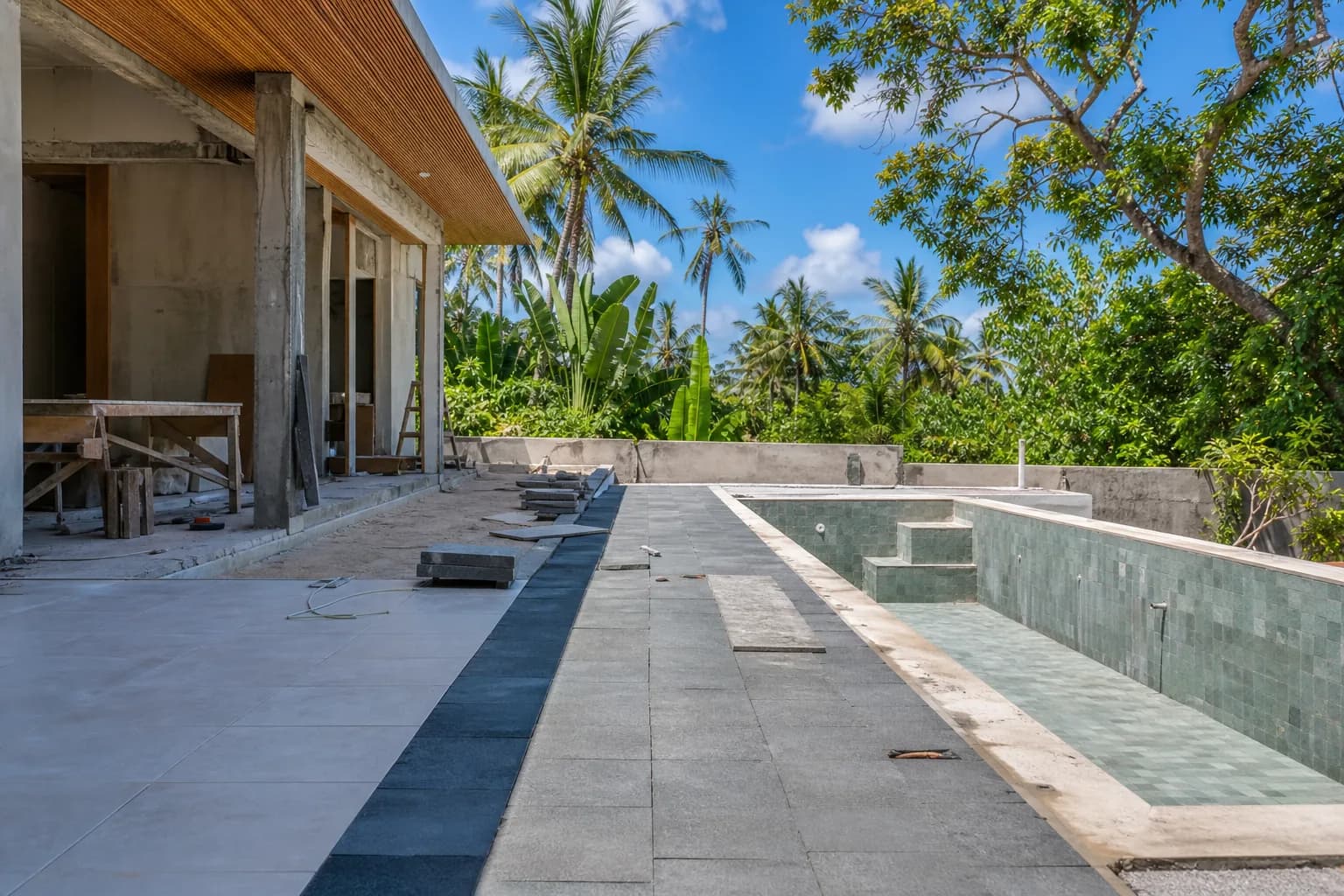
The Pool Deck Heat Problem: Why Your Tile Choice Matters in Bali’s Tropical Climate
When temperatures soar above 32°C in Bali’s dry season, pool deck surfaces can reach scorching temperatures of 50-60°C, making barefoot walking painful and potentially dangerous. This critical finishing challenge affects villa owners and hospitality projects across the island. The choice between andesite stone and porcelain tiles for pool deck installation isn’t just aesthetic—it’s a thermal comfort decision that impacts daily usability. At Teville, our villa construction projects consistently address this heat resistance challenge through strategic material selection and proper installation techniques that account for Bali’s intense UV exposure and high ambient temperatures throughout the year.
Technical Deep Dive: Heat Resistance Properties of Andesite vs Porcelain
Understanding the thermal behavior of pool deck materials requires examining their physical composition and heat transfer characteristics. Andesite stone, formed from volcanic activity abundant in Bali’s geological history, possesses a unique crystalline structure with natural air pockets that provide exceptional thermal insulation. This volcanic rock typically maintains surface temperatures 8-12°C cooler than porcelain under identical sun exposure conditions.
The thermal conductivity coefficient of andesite stone ranges from 1.5-2.0 W/mK, significantly lower than porcelain’s 2.5-3.5 W/mK. This means andesite absorbs heat more slowly and releases it faster during evening hours. The stone’s natural texture and lighter color variations (typically grey to light brown) also contribute to lower solar heat absorption compared to darker porcelain finishes.
Porcelain tiles, manufactured through high-temperature firing of refined clay, create a dense, non-porous surface with minimal air gaps. While this density provides excellent water resistance and durability—critical factors for pool environments—it also creates efficient heat conductivity. The glazed surface of many porcelain tiles can reach extreme temperatures when exposed to direct tropical sunlight for 4-6 hours, common during Bali’s peak season from May to September.
In our construction process, we conduct thermal testing on both materials under actual site conditions. Recent projects in Canggu and Uluwatu demonstrated that honed andesite stone maintained comfortable walking temperatures (below 42°C) even at 2 PM, while standard porcelain tiles exceeded 55°C under identical conditions. This 13-degree difference translates to practical usability—guests can walk comfortably on andesite without requiring pool shoes or constant water cooling.
The reflectivity index also differs substantially. Andesite’s natural matte finish reflects approximately 25-30% of solar radiation, while glossy porcelain can reflect up to 40% but absorbs the remaining 60% more efficiently due to its dense structure. This absorbed heat then radiates upward, creating an uncomfortable microclimate around the pool area. For villa renovation Bali projects, switching from porcelain to andesite often resolves guest complaints about hot pool decks without requiring shade structure additions.
Moisture interaction further affects thermal performance. Andesite’s slight porosity (3-5% absorption rate) allows minimal water penetration that actually aids cooling through evaporative processes. Porcelain’s near-zero porosity (less than 0.5%) prevents this natural cooling mechanism. During Bali’s humid season, this difference becomes less pronounced, but during dry months, andesite’s evaporative cooling provides measurable comfort advantages.
Installation Process: Proper Pool Deck Tile Installation for Heat Management
Correct tile installation Bali techniques significantly impact thermal performance beyond material selection alone. The substrate preparation, adhesive selection, and joint treatment all influence final heat resistance characteristics.
Substrate Preparation and Thermal Barrier Integration
Begin with a properly sloped concrete base (minimum 2% gradient away from pool) that’s been cured for at least 21 days in tropical conditions. For optimal heat management, we apply a 5mm thermal barrier coating—a specialized cement-based product with ceramic microspheres that reduces heat transfer from the substrate. This step, often omitted in standard installations, can reduce surface temperatures by an additional 3-4°C.
The concrete base should be thoroughly cleaned, free of laitance, and slightly roughened through mechanical scarification. In Bali’s climate, moisture content must be below 4% before proceeding—use a moisture meter to verify, as visual dryness can be deceiving in humid conditions.
Adhesive Selection and Application
For andesite stone installation, use a flexible, white-colored C2S1 adhesive specifically formulated for natural stone. White adhesive prevents dark shadowing through lighter stone and reflects rather than absorbs heat. Apply using a 10mm notched trowel, achieving 95% coverage to prevent hollow spots that create heat pockets.
Porcelain installation requires C2S2 adhesive with enhanced flexibility to accommodate thermal expansion. The dense porcelain body expands more uniformly than natural stone, requiring joints that can handle 3-4mm of movement across a 5-meter span during temperature fluctuations from morning cool (24°C) to afternoon peak (35°C+).
Joint Treatment and Expansion Management
Andesite installations should maintain 8-10mm joints filled with light-colored, flexible epoxy grout. Wider joints accommodate the stone’s natural dimensional variations and provide expansion space. For finishing works Bali projects, we recommend cream or light grey grout that reflects heat rather than absorbing it.
Porcelain requires 5-6mm joints with high-performance epoxy grout rated for pool environments. Install expansion joints every 4 meters in both directions, filled with polyurethane sealant that remains flexible across temperature ranges. These joints prevent the thermal stress cracking we frequently observe in improperly installed porcelain pool decks.
Edge Treatment and Pool Coping
The pool edge requires special attention for both materials. Andesite coping stones should be 50-60mm thick with bullnose or chamfered edges, mechanically anchored to the pool structure with stainless steel pins. Porcelain coping uses specialized trim pieces with rounded edges, adhered with flexible sealant that accommodates differential movement between the pool shell and deck.
Materials & Specifications: What Works in Bali’s Climate
Selecting appropriate materials for pool deck tile installation requires understanding both performance requirements and local availability in Bali’s construction market.
Andesite Stone Specifications
Source locally quarried andesite from Bali or Java suppliers, typically available in 30x30cm, 40x40cm, or 60x30cm formats. Specify honed or flamed finish—never polished, which becomes dangerously slippery when wet. Thickness should be minimum 20mm for pool deck applications, with 25-30mm preferred for high-traffic resort installations. Verify compressive strength exceeds 120 MPa and water absorption remains below 5%.
Porcelain Tile Specifications
If porcelain is selected despite heat considerations, specify 20mm thick outdoor-rated porcelain pavers in light colors (white, cream, light grey). Avoid dark colors entirely—our testing shows black porcelain can reach 65°C+ in direct sun. Choose textured or structured surfaces rated R11 or higher for slip resistance. Verify frost resistance rating (though unnecessary in Bali, it indicates quality manufacturing) and breaking strength above 1,300N.
Supporting Materials
Use only stainless steel (grade 316) or brass movement joints and drainage channels—galvanized steel corrodes rapidly in pool environments. Adhesives must be pool-grade with fungicide additives to prevent algae growth in joints. Sealers for andesite should be penetrating, breathable types that don’t create surface films; apply every 18-24 months for optimal performance and heat reflection maintenance.
Cost Breakdown: Investment Analysis for Pool Deck Materials
Understanding the complete cost picture helps inform material decisions for villa construction budgeting. Prices reflect 2026 Bali market conditions for professional installation.
Andesite Stone Pool Deck Costs
Material costs: IDR 350,000-550,000 per square meter for quality honed andesite, depending on finish and thickness. Installation labor: IDR 200,000-280,000 per square meter including substrate preparation, adhesive, and grouting. Additional costs include edge coping (IDR 150,000-200,000 per linear meter) and initial sealing (IDR 45,000 per square meter). Total installed cost: IDR 595,000-830,000 per square meter.
Porcelain Tile Pool Deck Costs
Material costs: IDR 450,000-750,000 per square meter for 20mm outdoor porcelain pavers (imported quality). Installation labor: IDR 180,000-250,000 per square meter—slightly lower than stone due to uniform sizing. Edge trim and coping: IDR 180,000-250,000 per linear meter. Total installed cost: IDR 630,000-1,000,000 per square meter.
Long-Term Cost Considerations
Andesite requires resealing every 18-24 months (IDR 45,000 per square meter) and occasional deep cleaning. Porcelain needs minimal maintenance but may require grout replacement every 5-7 years in pool environments (IDR 85,000 per square meter). Over a 10-year period, andesite’s maintenance costs approximately IDR 225,000 per square meter versus porcelain’s IDR 170,000 per square meter. However, andesite’s superior heat performance often justifies this difference for MEP systems Bali projects prioritizing guest comfort.
Common Mistakes: What Goes Wrong and Prevention Strategies
Our experience across dozens of completed villa projects reveals recurring installation errors that compromise thermal performance and longevity.
Inadequate Substrate Preparation
Installing tiles over improperly cured concrete or uneven surfaces creates hollow spots where heat accumulates. These voids can reach 10-15°C hotter than properly bonded areas. Prevention: Always verify concrete cure time, moisture content, and flatness (maximum 3mm deviation over 2 meters) before beginning tile work.
Wrong Adhesive Selection
Using standard interior adhesive or grey-colored products undermines heat resistance. Grey adhesive absorbs heat and transfers it through lighter-colored stone. Prevention: Specify white, flexible, pool-grade adhesive appropriate for the specific tile material and verify it’s rated for tropical outdoor use.
Insufficient Expansion Joints
Omitting or improperly spacing expansion joints causes thermal stress cracking, particularly in porcelain installations. Bali’s temperature swings create significant expansion—a 10-meter porcelain deck can expand 4-5mm between morning and afternoon. Prevention: Install expansion joints every 4 meters maximum, using compressible backer rod and flexible polyurethane sealant.
Improper Drainage Design
Flat or reverse-sloped pool decks allow water pooling, which accelerates material degradation and creates slip hazards. Standing water also increases surface temperature through solar heating. Prevention: Maintain minimum 2% slope away from pool, install drainage channels at low points, and verify slope with laser level during installation.
Neglecting Edge Detailing
Poorly executed pool coping allows water infiltration behind tiles, causing adhesive failure and creating dangerous loose tiles. Prevention: Use proper coping stones or trim pieces, seal all joints between coping and deck tiles, and ensure coping overhangs pool edge by 30-40mm to direct water into pool rather than behind tiles.
Frequently Asked Questions: Pool Deck Heat Resistance
How much cooler does andesite stone actually stay compared to porcelain in Bali’s climate?
Based on our thermal testing across multiple villa renovation Bali projects, andesite stone maintains surface temperatures 8-13°C cooler than porcelain tiles under identical conditions. During peak afternoon sun (1-3 PM), andesite typically reaches 40-42°C while porcelain exceeds 53-58°C. This difference is most pronounced with darker porcelain colors and during dry season months. The cooling effect makes andesite comfortable for barefoot walking, while porcelain often requires pool shoes or frequent water cooling.
Can I reduce porcelain tile heat by choosing lighter colors?
Yes, color selection significantly impacts porcelain heat absorption. White or cream porcelain stays approximately 6-8°C cooler than dark grey or black options. However, even light-colored porcelain still runs 5-7°C hotter than andesite stone due to its dense structure and higher thermal conductivity. If porcelain is preferred for aesthetic reasons, always specify the lightest available colors and consider textured finishes that create micro-shadows reducing heat absorption.
What maintenance does andesite require to maintain its cooling properties?
Andesite stone requires resealing every 18-24 months with penetrating, breathable sealer to maintain its heat-reflective properties and prevent staining. Regular cleaning with pH-neutral cleaners prevents buildup that can darken the stone and increase heat absorption. Pressure washing annually removes embedded dirt from the textured surface. This maintenance schedule, standard in our finishing works Bali projects, ensures the stone maintains optimal thermal performance throughout its lifespan of 20+ years.
Is the heat difference noticeable enough to justify andesite’s higher maintenance?
For pool deck applications in Bali’s tropical climate, absolutely. The 10-13°C temperature difference translates to practical daily usability—guests can comfortably walk barefoot on andesite throughout the day, while porcelain becomes unusable during peak sun hours without cooling measures. For hospitality projects or family villas where pool areas see frequent use, this comfort factor outweighs the minimal additional maintenance. The resealing cost (IDR 45,000 per square meter every two years) is negligible compared to the enhanced guest experience and property value.
Can I install cooling systems under tiles to reduce heat in porcelain decks?
While technically possible, installing coolin
 164 m²7 month(s)from 79.000 USD
TALA TWO
 3124 m²6 month(s)from 123.000 USD
TALA 8
164 m²7 month(s)from 79.000 USDPrivate: Haridas Villas, Tegallalang
 2144 m²11 month(s)from 104.000 USD
Narayana

Want to calculate?
 3173 m²6 month(s)from 125.000 USD
TALA FOUR
 172 m²8 month(s)from 120.000 USD
Keshava
 3104 m²11 month(s)from 99.000 USD
TALA 100
 4344 m²16 month(s)from 290.000 USD
Radha
 3127 m²9 month(s)from 177.000 USD
Mukunda
 1from 198.000 USD
Private: Haridas Villas
 3180 m²7 month(s)from 142.000 USD
Vasudeva
Start With Real Numbers, Not Guesses
Before buying land or finalizing a design, check the realistic build cost range for your project in Bali.
Our team reviews your inputs and gives a grounded estimate.
Available lands
 2000 m²15 min$ 261700Bali, Babakan
 600 m²10 min$ 206897Bali, Canggu
 1700 m²10 min$ 632257Bali, Kuta
 444 m²10 min$ 111000Bali, Tabanan
 4270 m²10 min$ 394397Bali, Ubud
 600 m²12 min$ 101970Bali, Mengwi
 1375 m²10 min$ 447044Bali, Canggu
 615 m²15 min$ 113608Bali, Tabanan
 700 m²20 min$ 90517Bali, Cepaka
 3254 m²5 min$ 631800Bali, All
 10000 m²19 min$ 232759Bali, Buleleng
 260 m²5 min$ 51872Bali, Kedungu
 1430 m²5 min$ 209862Bali, Klungkung
 500 m²2 min$ 175862Bali, Cemagi
 1350 m²5 min$ 283467Bali, Pecatu
Essential Bali build & buy guides
- Bali villa construction cost per m² in 2026
- How much will your villa cost? Calculator
- Building a villa in Bali: the complete guide
- Buying land in Bali: step-by-step for foreigners
- Bali villa investment: yields, risks, returns
- Leasehold vs freehold: what foreigners can own
- Construction defect liability & 10-year warranty
- Bali building codes and construction standards
Related guides
Leasehold Depreciation in Bali: How Remaining Term Affects Resale Value — and What Offsets It
A Bali leasehold is a depreciating right on land plus an ageing building — but the loss of value is neither linear nor unmanageable. How remaining term drives resale price, where the danger lines sit, and the clauses and decisions that protect your exit.
7 min read
Annual Holding Costs of a Bali Villa: A Realistic Owner's Budget
The purchase price is only the entry ticket. Here is what a Bali villa actually costs to hold each year — staff, utilities, pool, maintenance, insurance, taxes and management — with realistic 2026 numbers and a sample budget.
7 min read
Transferring Money to Indonesia for a Property Purchase: Banking, Documentation and Safe Practice
Moving six figures across borders is the least glamorous part of buying in Bali, and the part most buyers under-prepare for. This guide covers the rupiah rule, notary escrow, transfer documentation, and the paper trail that protects a future exit.
8 min read