Amed Volcanic Soil Piling Costs Depth Requirements Bali
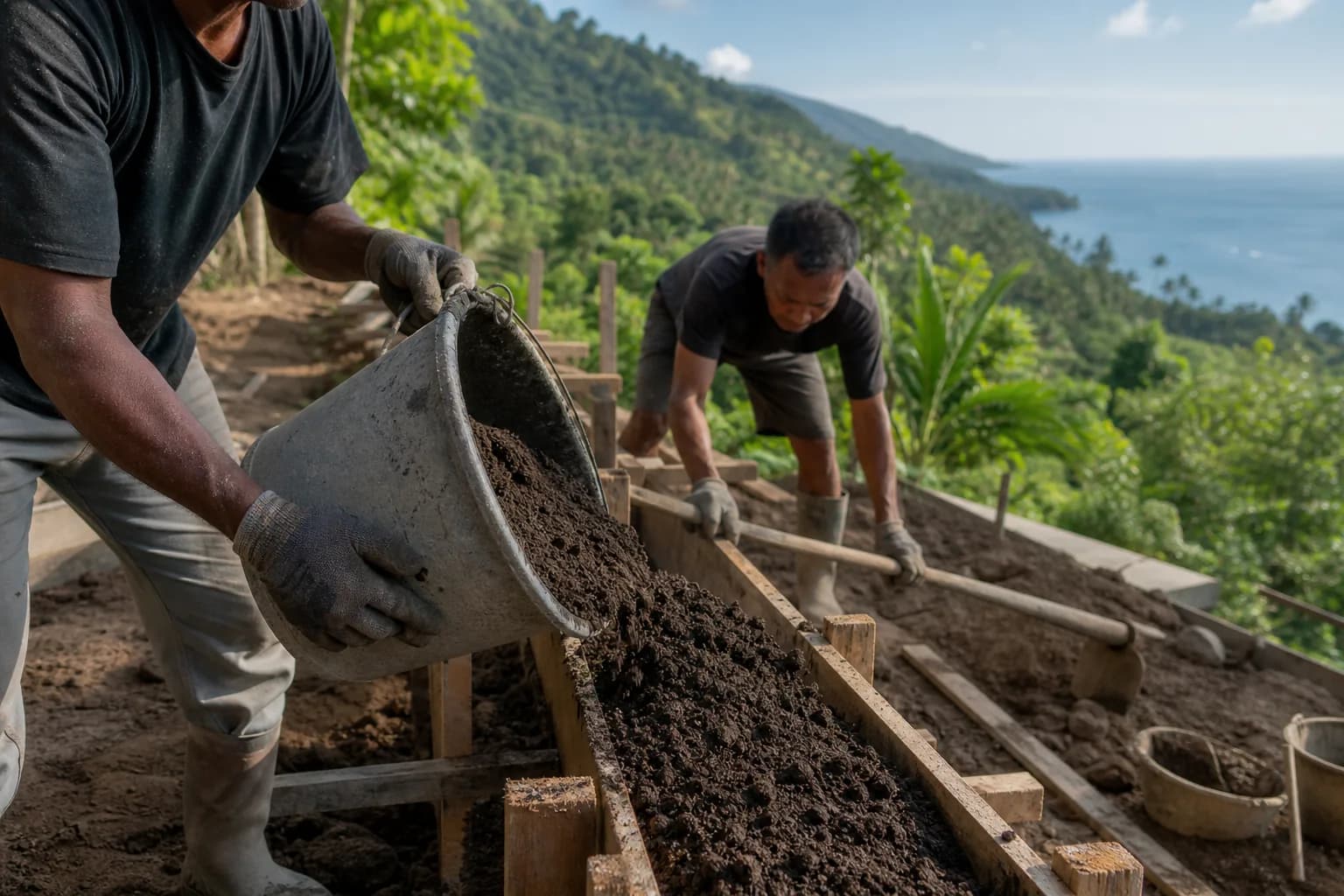
Why Amed’s Black Volcanic Soil Changes Everything About Foundation Piling Costs
Amed’s distinctive black volcanic soil—formed from centuries of Mount Agung eruptions—creates unique foundation engineering challenges that directly impact piling depth requirements and construction budgets. Unlike southern Bali’s limestone bedrock or Canggu’s sandy coastal substrates, Amed’s volcanic terrain exhibits variable load-bearing capacity, unpredictable moisture retention patterns, and stratified soil layers that can shift dramatically within a single plot. Builders who apply generic foundation specifications to Amed sites routinely face mid-construction surprises: piles that refuse to reach stable strata, unexpected groundwater interference at 4-6 meters depth, or volcanic rock layers that require specialized drilling equipment. Understanding Amed’s specific geological profile isn’t optional—it’s the difference between a $28,000 foundation budget and a $52,000 cost overrun when your standard piling strategy fails at depth.
The Engineering Reality of Amed Volcanic Soil Foundations
Amed’s volcanic soil composition fundamentally differs from other Bali construction zones. The region’s substrate typically consists of three distinct layers: a 1.5-3 meter topsoil layer of weathered volcanic ash with high organic content, a 3-7 meter intermediate zone of compacted volcanic sediment with variable density, and deeper volcanic rock formations that may appear at 8-12 meters or remain absent entirely depending on proximity to ancient lava flows.
Soil Bearing Capacity Variations
Standard geotechnical testing in Amed reveals bearing capacities ranging from 0.8 kg/cm² in upper volcanic ash layers to 3.5 kg/cm² in compacted sediment zones—a variance that makes surface-level visual assessment worthless. A two-story villa requiring 2.0 kg/cm² minimum bearing capacity cannot rely on shallow foundations in most Amed locations. This geological reality drives the necessity for deep foundation systems, specifically driven piles or bored piles that penetrate through unstable upper layers to reach competent strata.
The volcanic ash topsoil presents additional complications: high moisture absorption rates during Bali’s wet season (November-March) cause temporary bearing capacity reductions of 15-25%, while the dry season creates surface cracking and settlement. These seasonal fluctuations don’t affect properly installed deep piles, but they devastate shallow foundation systems that some builders still attempt to use for cost reduction.
Groundwater Interference Patterns
Amed’s volcanic terrain creates unpredictable groundwater behavior. Unlike coastal areas with consistent water tables, Amed sites may encounter perched water tables—isolated groundwater pockets trapped between impermeable volcanic layers—at depths of 4-6 meters. These perched tables complicate bored pile installation, requiring temporary casing systems and dewatering protocols that add $35-60 per linear meter to foundation costs. Sites within 500 meters of Amed’s coastline face additional challenges from saltwater intrusion into porous volcanic layers, necessitating corrosion-resistant pile materials and protective coatings.
Volcanic Rock Layer Complications
Approximately 40% of Amed construction sites encounter volcanic rock formations during piling operations—dense basalt layers from historical lava flows that standard pile driving equipment cannot penetrate. When rock layers appear at 6-8 meters depth, contractors must switch to rotary drilling methods with carbide-tipped augers, increasing equipment costs by $180-250 per pile and extending installation time from 45 minutes to 3-4 hours per pile. This geological lottery makes fixed-price foundation contracts risky without comprehensive soil investigation data.
Pile Type Selection for Volcanic Conditions
Amed’s volcanic soil characteristics favor specific pile technologies. Driven concrete piles (25cm x 25cm precast sections) work effectively in softer volcanic sediment layers, providing 15-20 ton capacity per pile at depths of 8-10 meters, with costs of $65-95 per linear meter including installation. Bored cast-in-place piles (30-40cm diameter) offer superior performance in mixed conditions with rock layers, delivering 25-35 ton capacity at similar depths but costing $110-160 per linear meter due to drilling complexity and concrete volume requirements.
Steel H-piles represent the premium solution for challenging Amed sites with multiple rock layers or extreme depth requirements, capable of reaching 12-15 meters with 40+ ton capacity per pile, but commanding $180-240 per linear meter. The selection isn’t about preference—it’s dictated by your specific site’s geological profile revealed through mandatory soil testing.
Hidden Risks That Destroy Amed Foundation Budgets
The most expensive mistake in Amed villa construction is treating foundation work as a standardized line item. Builders who quote “standard foundation packages” without site-specific geological data routinely underestimate actual requirements by 35-60%. This isn’t contractor incompetence—it’s the inherent unpredictability of volcanic terrain without proper investigation.
The Soil Testing Gap
Approximately 65% of small-scale Amed construction projects skip comprehensive geotechnical investigation, relying instead on visual assessment or “experience from nearby sites.” This gamble fails because volcanic soil conditions can vary dramatically across distances of 50-100 meters. A neighbor’s successful 8-meter pile depth provides zero guarantee for your adjacent plot if an underground volcanic rock layer dips or rises between properties. Proper soil boring to 12-15 meters depth costs $800-1,400 but prevents foundation redesigns that cost $15,000-30,000 mid-construction.
Seasonal Timing Failures
Foundation installation during Amed’s wet season (December-February peak rainfall) introduces complications that dry-season work avoids. Bored pile excavations fill with groundwater within 20-30 minutes, requiring continuous pumping and temporary casing that adds 25-40% to installation time and costs. Driven pile operations face reduced efficiency as equipment struggles in saturated surface conditions. Experienced contractors schedule Amed foundation work for April-October when volcanic soil moisture content stabilizes, but project timelines that ignore seasonal realities face inevitable delays and cost increases.
Inadequate Pile Depth Specifications
Generic structural calculations that specify pile depths without geological context create dangerous situations. A structural engineer in Jakarta who calculates 8-meter pile depth based on load requirements alone—without knowing that your Amed site’s competent bearing stratum doesn’t appear until 10.5 meters—produces a foundation design that will fail. This disconnect between structural engineering and geotechnical reality explains why Teville’s construction process mandates soil investigation before structural design begins, not after.
Corrosion Protection Oversights
Amed’s volcanic soil contains sulfates and chlorides from both volcanic minerals and coastal salt spray that accelerate concrete and steel corrosion. Standard concrete mixes without sulfate-resistant cement or adequate cover depth (minimum 75mm for piles) experience reinforcement corrosion within 5-8 years in Amed conditions. The $8-12 per cubic meter premium for sulfate-resistant concrete and proper admixtures represents essential protection, not optional enhancement, yet appears in fewer than 50% of small contractor specifications.
Step-by-Step Foundation Process for Amed Volcanic Sites
Phase 1: Comprehensive Soil Investigation (Week 1-2)
Begin with minimum three soil boring points across your plot, reaching 12-15 meters depth regardless of planned structure size. Amed’s volcanic stratification requires multiple test points because conditions vary laterally. Standard investigation includes Standard Penetration Tests (SPT) at 1.5-meter intervals, laboratory analysis of soil samples for bearing capacity and chemical composition, and groundwater level monitoring over 48-72 hours. Budget $1,200-2,000 for thorough investigation on typical villa plots (500-1000m²).
Request specific data: bearing capacity at each depth interval, groundwater table depth and fluctuation range, presence and depth of volcanic rock layers, soil pH and sulfate content for corrosion assessment, and recommended pile type and depth for your structural loads. This report becomes the foundation for all subsequent engineering decisions.
Phase 2: Foundation Engineering Design (Week 3-4)
Engage a structural engineer experienced with Bali volcanic soil conditions—not generic tropical construction—to design your pile foundation system using actual soil investigation data. The design should specify exact pile type, dimensions, depth to bearing stratum (not arbitrary depth), pile spacing and layout, pile cap dimensions and reinforcement, and connection details to superstructure.
For typical two-story Amed villas (200-300m² footprint), expect 24-40 piles depending on structural layout and soil conditions. Single-story structures may require 16-28 piles. The engineering should account for seismic loads (Bali Zone 4 requirements) and tropical wind loads, both of which increase pile depth and capacity requirements beyond simple gravity load calculations.
Phase 3: Pile Installation Execution (Week 5-7)
Mobilize specialized piling equipment appropriate to your site conditions. Driven pile operations require pile driving rigs with 3-5 ton hammers for Amed’s volcanic soil density. Bored pile work needs rotary drilling rigs with 12-15 meter depth capacity and carbide tooling for potential rock layers. Verify contractor equipment capabilities before mobilization—undersized equipment cannot achieve required depths in volcanic conditions.
Installation sequence: clear and level pile locations, install piles to design depth with continuous monitoring, perform pile integrity testing on minimum 10% of piles (sonic testing or load testing), document actual achieved depths and any geological anomalies encountered, and construct pile caps with proper reinforcement lap lengths and concrete cover. Quality control is critical—a single pile that fails to reach bearing stratum compromises the entire foundation system.
Phase 4: Verification and Documentation (Week 7-8)
Conduct pile load testing on representative piles to verify design capacity achievement. Static load testing (applying 150-200% of design load) provides definitive capacity confirmation but costs $800-1,200 per test pile. Dynamic load testing during driving offers more economical verification at $200-350 per pile. Amed’s variable soil conditions justify testing investment—discovering inadequate capacity before superstructure construction prevents catastrophic failures.
Document everything: as-built pile locations and depths, soil conditions encountered during installation, any design modifications made based on field conditions, pile integrity test results, and load test data. This documentation proves essential for future additions or modifications and demonstrates proper construction for property transactions.
Realistic Cost Ranges for Amed Volcanic Soil Foundations
Foundation costs in Amed’s volcanic terrain vary significantly based on geological conditions, but typical ranges for 2026 provide planning guidance. These figures assume proper soil investigation and engineering-driven design—not contractor guesswork.
Driven Concrete Pile Systems
For sites with favorable volcanic sediment conditions without extensive rock layers: $65-95 per linear meter installed, including pile materials, driving equipment, and labor. A typical two-story villa requiring 32 piles at 9-meter average depth totals $18,720-27,360 for piling alone. Add pile caps, grade beams, and reinforcement for complete foundation cost of $26,000-36,000.
Bored Cast-in-Place Pile Systems
For mixed volcanic conditions with moderate rock layers or groundwater complications: $110-160 per linear meter installed. Same villa specification (32 piles, 9-meter depth) totals $31,680-46,080 for piling, with complete foundation system reaching $42,000-58,000 including pile caps and grade beams.
Steel H-Pile Systems
For challenging sites with multiple rock layers or extreme depth requirements: $180-240 per linear meter installed. This premium solution for difficult Amed sites brings total foundation costs to $55,000-72,000 for typical villa applications, but provides certainty in unpredictable geological conditions.
Additional Cost Factors
Soil investigation: $1,200-2,000. Structural engineering: $2,500-4,000. Pile load testing: $1,600-3,600 (2-3 test piles). Seasonal wet-season premium: add 20-30% for December-February work. Difficult site access (steep Amed hillside locations): add 15-25% for equipment mobilization challenges. These aren’t optional extras—they’re essential components of proper volcanic soil foundation construction.
Total realistic budget for complete foundation system on typical Amed villa site: $32,000-65,000 depending on geological conditions, pile type required, and site-specific complications. Contractors quoting below $25,000 for Amed foundations are either underestimating volcanic soil challenges or planning to cut critical engineering steps.
Frequently Asked Questions: Amed Volcanic Soil Foundations
How deep do foundation piles need to go in Amed’s volcanic soil?
Pile depth in Amed depends entirely on site-specific geological conditions revealed through soil investigation, not generic standards. Typical depths range from 8-12 meters to reach competent bearing strata below unstable volcanic ash and sediment layers. Sites near ancient lava flows may encounter solid volcanic rock at 6-7 meters, allowing shorter piles, while locations with deep ash deposits may require 12-15 meters to reach adequate bearing capacity. The only way to determine actual required depth for your specific plot is comprehensive soil boring—visual assessment or assumptions based on nearby sites provide no reliable guidance in volcanic terrain where conditions change dramatically over short distances.
Can I use shallow foundations instead of piles to reduce costs in Amed?
Shallow foundations (strip footings or raft slabs) are structurally inadequate for most Amed construction sites due to volcanic soil’s low bearing capacity
 1from 198.000 USD
Private: Haridas Villas
 164 m²7 month(s)from 79.000 USD
TALA TWO
 172 m²8 month(s)from 120.000 USD
Keshava
 4344 m²16 month(s)from 290.000 USD
Radha
 2144 m²11 month(s)from 104.000 USD
Narayana
164 m²7 month(s)from 79.000 USDPrivate: Haridas Villas, Tegallalang
 3173 m²6 month(s)from 125.000 USD
TALA FOUR
 3124 m²6 month(s)from 123.000 USD
TALA 8
 3127 m²9 month(s)from 177.000 USD
Mukunda
 3104 m²11 month(s)from 99.000 USD
TALA 100

Want to calculate?
 3180 m²7 month(s)from 142.000 USD
Vasudeva
Start With Real Numbers, Not Guesses
Before buying land or finalizing a design, check the realistic build cost range for your project in Bali.
Our team reviews your inputs and gives a grounded estimate.
Available lands
 889 m²15 min$ 145612Bali, Cepaka
 3000 m²15 min$ 1246921Bali, Tabanan
 444 m²10 min$ 111000Bali, Tabanan
 6000 m²10 min$ 1330049Bali, Kutuh South Bali
 1375 m²10 min$ 447044Bali, Canggu
 250 m²15 min$ 40025Bali, Munggu
 1410 m²15 min$ 390702Bali, Tabanan
 1600 m²32 min$ 266010Bali, Tabanan
 1000 m²8 min$ 134544Bali, Bukit
 660 m²10 min$ 175567Bali, Mengwi
 7500 m²5 min$ 206281Bali, Kedungu
 2800 m²2 min$ 713793Bali, Kedungu
 2000 m²5 min$ 738916Bali, Ungasan
 29000 m²6 min$ 3857143Bali, Tabanan
 6000 m²30 min$ 55419Bali, Tabanan
Essential Bali build & buy guides
- Bali villa construction cost per m² in 2026
- How much will your villa cost? Calculator
- Building a villa in Bali: the complete guide
- Buying land in Bali: step-by-step for foreigners
- Bali villa investment: yields, risks, returns
- Leasehold vs freehold: what foreigners can own
- Construction defect liability & 10-year warranty
- Bali building codes and construction standards
Related guides
True Closing Costs of a Bali Purchase: Notary, Taxes and Fees on Top of the Price
What you really pay on top of a Bali property price in 2026: notary fees, transfer and lease taxes, VAT on developer units — with realistic totals for each deal type and a worked example.
7 min read
Bali Property Taxes for Foreigners: BPHTB, PPh and PBB-P2 — Who Pays What and When
A clear 2026 breakdown of the three taxes every foreign buyer meets in Bali — BPHTB, PPh and PBB-P2 — with who pays what, on which value, and at which point in the deal.
9 min read
Swimming Pool Construction Cost in Bali (2026): Real Prices by Size and Type
What a swimming pool really costs to build in Bali in 2026 — by size, structure and finish — plus running costs, common quote traps and where pools go wrong in the tropics.
3 min read