Voltage Stabilizer Requirements for Bali Villa Electrical Systems
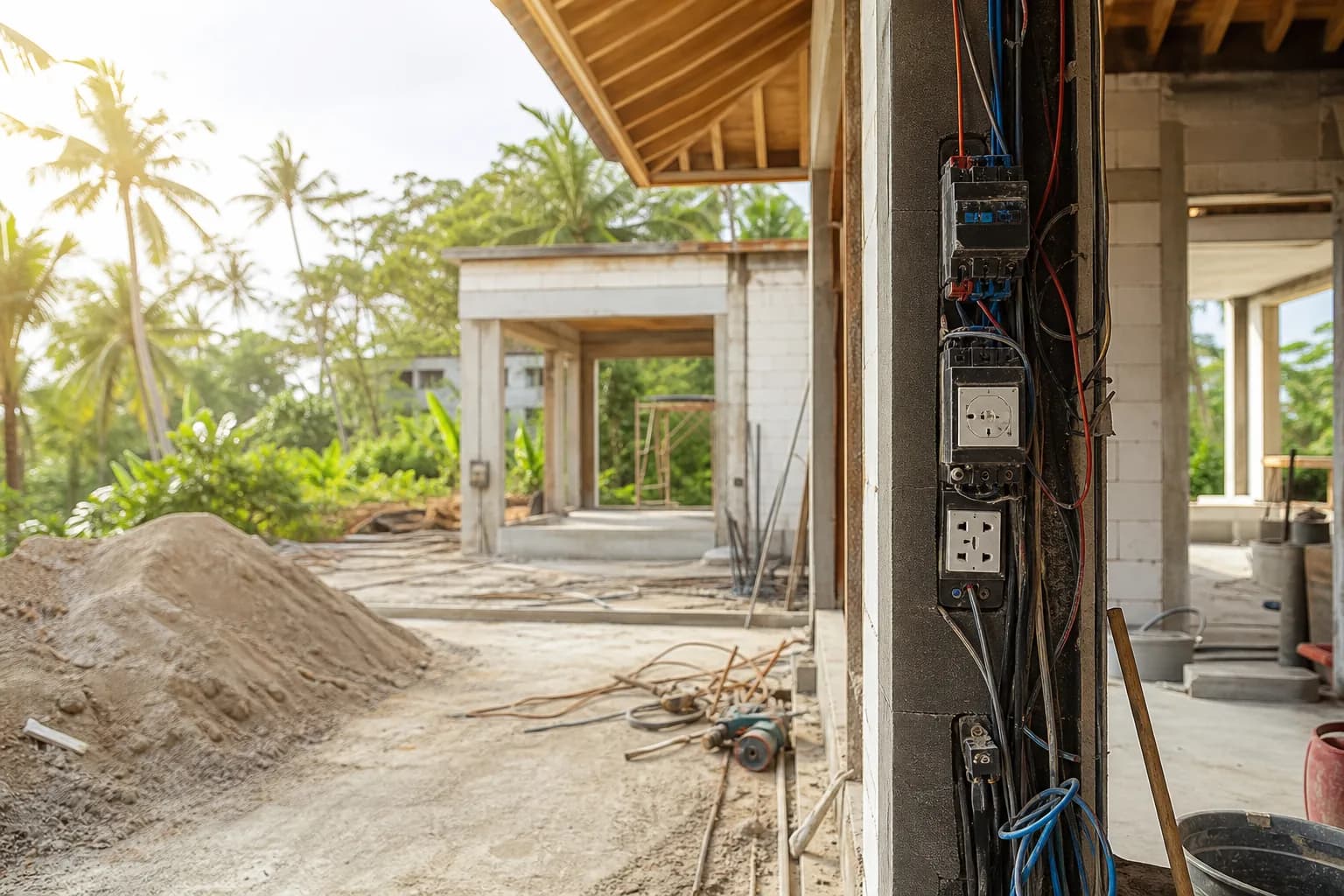
Why Voltage Stabilizers Are Non-Negotiable for Bali Villa Electrical Systems
Bali’s electrical grid presents unique challenges that can destroy expensive villa equipment within months of installation. Voltage fluctuations ranging from 160V to 250V occur regularly across the island, particularly in areas like Canggu, Uluwatu, and Ubud where villa development has outpaced infrastructure upgrades. Without proper voltage stabilization, your newly installed air conditioning units, kitchen appliances, entertainment systems, and smart home technology face premature failure. The question isn’t whether you need voltage stabilizers—it’s how to specify, install, and integrate them correctly into your villa’s electrical finishing works to protect your investment in quality interior systems and ensure long-term operational reliability.
Technical Requirements for Bali Villa Voltage Stabilization Systems
Voltage stabilizers for Bali villas require careful sizing based on total connected load, not just installed capacity. For a typical 3-4 bedroom villa with modern amenities, the baseline requirement starts at 10kVA, but professional installations should specify 15kVA units to accommodate simultaneous operation of multiple high-draw appliances. This sizing accounts for Bali’s frequent voltage drops below 180V, which force stabilizers to work harder and draw more current to maintain output voltage.
The technical specification must address three critical parameters: input voltage range, output voltage accuracy, and response time. Quality stabilizers for Bali applications should handle input voltages from 140V to 260V while maintaining output at 220V ±3%. Response time becomes crucial during rapid voltage changes—servo-motor stabilizers offer 20-40 millisecond response times, adequate for most villa applications, while static voltage regulators provide near-instantaneous correction for sensitive medical or laboratory equipment.
Installation location significantly impacts performance and longevity. Stabilizers generate heat during operation and require ventilation clearances of minimum 30cm on all sides. The installation room must maintain ambient temperatures below 40°C, challenging in Bali’s tropical climate. Professional installations incorporate dedicated ventilation systems or position stabilizers in semi-outdoor utility areas with louvered enclosures that protect from rain while allowing airflow. The mounting surface must support the unit’s weight—a 15kVA stabilizer typically weighs 80-120kg—requiring reinforced concrete pads or structural steel mounting frames.
Electrical integration involves more than simple input-output connections. The incoming supply requires a properly rated main circuit breaker, typically 63A for a 15kVA single-phase system. Grounding becomes critical—the stabilizer chassis must connect to a dedicated earth electrode with resistance below 5 ohms, often requiring supplementary grounding rods in Bali’s volcanic soil. Output distribution should incorporate surge protection devices rated for at least 40kA, as voltage stabilizers protect against fluctuations but not lightning-induced transients common during Bali’s monsoon season.
For larger villas or those with three-phase supplies, the decision between single large stabilizer versus multiple smaller units affects both performance and redundancy. A distributed approach using separate 10kVA stabilizers for different villa zones—one for air conditioning, another for general power, a third for kitchen equipment—provides better load management and prevents total power loss if one unit requires maintenance. This configuration aligns with Teville’s systematic construction approach, where electrical systems are designed with operational flexibility and maintenance accessibility as primary considerations.
Materials and Equipment Standards for Tropical Installation
Voltage stabilizer selection for Bali’s coastal and humid environments demands attention to materials and protection ratings beyond standard specifications. Units must carry minimum IP21 ingress protection, though IP23 is recommended for installations in semi-outdoor utility areas. The internal components—servo motors, transformers, and control circuits—should feature tropical-rated insulation systems designed for continuous operation at high humidity levels.
Servo-motor stabilizers dominate the Bali villa market due to their reliability and cost-effectiveness for residential applications. Quality brands include Matsunaga, Lexos, and Stabilizer Indonesia, with genuine units featuring copper-wound transformers rather than aluminum alternatives that degrade faster in tropical heat. The servo motor itself should be continuous-duty rated with sealed bearings to prevent moisture ingress. Carbon brushes, a wear component requiring replacement every 2-3 years, should be easily accessible without complete unit disassembly.
Electrical accessories must meet tropical installation standards. Input and output cabling should be NYY or N2XY type with XLPE insulation, sized conservatively—16mm² minimum for 15kVA single-phase installations despite calculations suggesting 10mm² sufficiency. This oversizing accounts for voltage drop in longer cable runs common in sprawling villa layouts and reduces heat generation. All terminations require copper compression lugs, never screw terminals alone, as thermal cycling in Bali’s climate loosens mechanical connections over time.
The mounting enclosure or housing requires specific attention in finishing works. Pre-fabricated metal enclosures should be hot-dip galvanized or powder-coated with marine-grade finishes. Custom-built housings using concrete block or brick construction must incorporate ventilation louvers positioned to prevent rain entry while maximizing airflow. Interior surfaces benefit from light-colored heat-reflective paint to reduce thermal buildup. The enclosure door should be lockable with provision for warning signage indicating high voltage equipment.
Step-by-Step Installation Process for Villa Voltage Stabilizers
The installation process begins during the villa’s electrical rough-in phase, not as an afterthought during finishing works. Proper integration requires coordination between structural, electrical, and finishing trades to ensure the stabilizer location doesn’t compromise villa aesthetics while maintaining technical requirements.
Phase 1: Location Preparation and Mounting (Days 1-2)
Identify the stabilizer location based on proximity to the main electrical panel (maximum 10 meters recommended) and accessibility for future maintenance. For ground-floor installations, excavate and pour a reinforced concrete pad 150mm thick, extending 100mm beyond the stabilizer footprint on all sides. The pad surface must be level within 2mm and positioned to allow water drainage away from the unit. For wall-mounted installations, install structural steel brackets anchored into concrete or masonry with chemical anchors rated for 4x the unit weight. Allow 48 hours for concrete curing before proceeding.
Phase 2: Electrical Infrastructure (Days 3-4)
Install dedicated conduit runs from the main distribution board to the stabilizer location and from the stabilizer to a new sub-distribution board serving protected circuits. Use minimum 32mm conduit for 15kVA installations to accommodate cable sizing and future modifications. Establish the grounding system by driving copper-bonded earth rods to achieve resistance below 5 ohms—typically requiring 2-3 rods in Bali’s volcanic soil, interconnected with 25mm² bare copper conductor. Test ground resistance with a calibrated earth tester and document results.
Phase 3: Stabilizer Installation and Connection (Day 5)
Position the stabilizer on the prepared mounting surface using appropriate lifting equipment—never attempt manual handling of units exceeding 50kg. Secure to mounting bolts or brackets and verify level installation. Connect input cables to the supply side, ensuring proper phase identification for three-phase systems. Install the main input circuit breaker rated 1.5x the stabilizer’s maximum input current. Connect output cables to the sub-distribution board, incorporating a surge protection device at the stabilizer output terminals. Bond the stabilizer chassis to the grounding system with 16mm² green-yellow cable using compression lugs at both ends.
Phase 4: Protection and Enclosure (Days 6-7)
For outdoor or semi-outdoor installations, construct or install the protective enclosure ensuring ventilation requirements are met. Install louvers at high and low positions to promote convective airflow. Apply weatherproof sealant around cable entry points while maintaining IP rating integrity. Install warning signage in English and Indonesian indicating high voltage equipment and restricted access. For integrated utility room installations, ensure the room’s ventilation system provides adequate air changes—minimum 10 air changes per hour for rooms housing electrical equipment.
Phase 5: Testing and Commissioning (Day 8)
Conduct comprehensive testing before energizing protected circuits. Verify input voltage at no-load, then progressively load the stabilizer while monitoring output voltage stability and temperature rise. Test the full input voltage range if possible using a variable transformer, confirming the stabilizer maintains output within ±3% across the specified input range. Document baseline readings including no-load voltage, full-load voltage, and temperature after 2 hours of operation. This documentation becomes essential for future troubleshooting and maintenance scheduling.
Cost Analysis and Installation Timeline for Bali Villas
Voltage stabilizer installation costs for Bali villas vary significantly based on capacity, brand selection, and installation complexity. A quality 15kVA servo-motor stabilizer from reputable manufacturers ranges from IDR 12,000,000 to IDR 18,000,000 for the unit alone. Installation costs including materials, labor, grounding system, and protective enclosure add IDR 8,000,000 to IDR 15,000,000, bringing total project costs to IDR 20,000,000 to IDR 33,000,000 (approximately USD 1,300 to USD 2,100 at 2026 exchange rates).
For comprehensive villa electrical protection, budget allocation should consider multiple stabilizers for different zones. A typical 4-bedroom villa might require one 15kVA unit for general power and lighting (IDR 25,000,000 installed), a separate 10kVA unit for air conditioning systems (IDR 18,000,000 installed), and a smaller 5kVA unit for sensitive equipment like home theater and network infrastructure (IDR 12,000,000 installed). This distributed approach totals IDR 55,000,000 but provides superior protection and operational flexibility.
Installation timeline depends on project phase integration. When incorporated during new construction as part of Teville’s villa projects, stabilizer installation occurs during the electrical finishing phase and requires 8-10 working days from site preparation through final commissioning. Retrofit installations in existing villas extend to 12-15 days due to coordination challenges with occupied spaces and potential modifications to existing electrical infrastructure. Weather delays during monsoon season can add 2-3 days to outdoor enclosure construction.
Ongoing operational costs include electricity consumption (stabilizers themselves draw 2-3% of rated capacity) and maintenance. Annual professional maintenance including cleaning, carbon brush inspection, and connection tightening costs IDR 1,500,000 to IDR 2,500,000 per unit. Carbon brush replacement every 2-3 years adds IDR 800,000 to IDR 1,200,000. These maintenance costs are minimal compared to the replacement cost of damaged air conditioning compressors (IDR 15,000,000+), refrigerators (IDR 8,000,000+), or entertainment systems (IDR 20,000,000+) that voltage fluctuations would destroy.
Frequently Asked Questions About Villa Voltage Stabilizers
Can I install a voltage stabilizer myself or do I need professional installation?
Professional installation is strongly recommended and often required by insurance policies. Voltage stabilizers involve high-current electrical connections, proper grounding systems, and load calculations that require licensed electricians familiar with Indonesian electrical codes (PUIL). Improper installation creates fire hazards, voids equipment warranties, and may violate local building permits. Professional installation also ensures proper documentation for future maintenance and provides warranty coverage for both equipment and installation workmanship.
Should I protect the entire villa or just sensitive equipment?
Whole-villa protection offers superior value despite higher initial costs. While it seems economical to protect only computers and entertainment systems, voltage fluctuations damage all electrical equipment including air conditioning compressors, water pumps, kitchen appliances, and lighting systems. The cumulative replacement cost of these items far exceeds the incremental cost of whole-house stabilization. Additionally, whole-house systems simplify electrical design and eliminate the need to identify and separate “sensitive” circuits during construction or renovation.
How do I know if my existing stabilizer is adequately sized?
Undersized stabilizers exhibit several warning signs: frequent thermal shutdowns during normal operation, inability to maintain stable output voltage under load, excessive noise from the servo motor, and shortened equipment lifespan. To verify sizing, sum the nameplate ratings of all simultaneously operated equipment and compare to the stabilizer’s continuous rating. If total load exceeds 80% of stabilizer capacity, upgrade to a larger unit. Professional load analysis during Teville’s cost estimation process prevents undersizing issues in new construction.
What’s the difference between voltage stabilizers and UPS systems?
Voltage stabilizers correct voltage fluctuations but don’t provide backup power during outages. UPS (Uninterruptible Power Supply) systems provide battery backup for brief outages but typically don’t handle the wide voltage ranges common in Bali. For comprehensive protection, villas need both: stabilizers for continuous voltage regulation and UPS systems for critical loads like security systems, network equipment, and gate automation. Some hybrid systems combine both functions b
 3104 m²11 month(s)from 99.000 USD
TALA 100
 3180 m²7 month(s)from 142.000 USD
Vasudeva
 3124 m²6 month(s)from 123.000 USD
TALA 8
 3173 m²6 month(s)from 125.000 USD
TALA FOUR
 164 m²7 month(s)from 79.000 USD
TALA TWO
 4344 m²16 month(s)from 290.000 USD
Radha
 3127 m²9 month(s)from 177.000 USD
Mukunda
 2144 m²11 month(s)from 104.000 USD
Narayana

Want to calculate?
 1from 198.000 USD
Private: Haridas Villas
 172 m²8 month(s)from 120.000 USD
Keshava
164 m²7 month(s)from 79.000 USDPrivate: Haridas Villas, Tegallalang
Start With Real Numbers, Not Guesses
Before finalizing your finishing works plan, check realistic cost ranges for your Bali villa project.
Available lands
 2000 m²5 min$ 738916Bali, Ungasan
 29000 m²6 min$ 3857143Bali, Tabanan
 500 m²10 min$ 107143Bali, Tabanan
 1720 m²2 min$ 241478Bali, Tabanan
 700 m²15 min$ 162500Bali, Tabanan
 8313 m²15 min$ 716670Bali, Buduk
 1000 m²10 min$ 184729Bali, Kutuh South Bali
 5028 m²10 min$ 361000Bali, Ubud
 3800 m²15 min$ 100616Bali, Pererenan
 6000 m²10 min$ 1330049Bali, Kutuh South Bali
 700 m²7 min$ 400000Bali, Canggu
 7500 m²5 min$ 206281Bali, Kedungu
 2000 m²15 min$ 110837Bali, Karangasem
 1200 m²2 min$ 155172Bali, Klungkung
 4270 m²10 min$ 394397Bali, Ubud
Essential Bali build & buy guides
- Bali villa construction cost per m² in 2026
- How much will your villa cost? Calculator
- Building a villa in Bali: the complete guide
- Buying land in Bali: step-by-step for foreigners
- Bali villa investment: yields, risks, returns
- Leasehold vs freehold: what foreigners can own
- Construction defect liability & 10-year warranty
- Bali building codes and construction standards
Related guides

Why a Cheap Bali Leasehold Is Cheap: Pricing Red Flags Every Buyer Should Decode
Suspiciously cheap Bali leaseholds are priced low for a reason: short remaining terms, forbidden zoning, missing road access, disputes or weak contracts. How to decode the discount before you pay for it.
8 min read
Fake Compliance and Licensing Agents in Bali: The 2026 Paperwork Scam and How to Verify Documents
Forged certificates, permit fixers and fake notaries: how Bali's paperwork scams work in 2026 and how to verify every property document at its government source.
7 min read
Buying a Bali Villa from Instagram: Phantom Listings, Render-Only Projects and How to Verify
Instagram is Bali's biggest property shop window and its least verified. How phantom listings, render-only projects and cloned developer accounts work — and the verification steps that expose them.
7 min read