Uluwatu Clifftop Erosion Surveys Geological Risk Assessment Cos
The Critical Question: What Does Clifftop Erosion Assessment Actually Cost in Uluwatu?
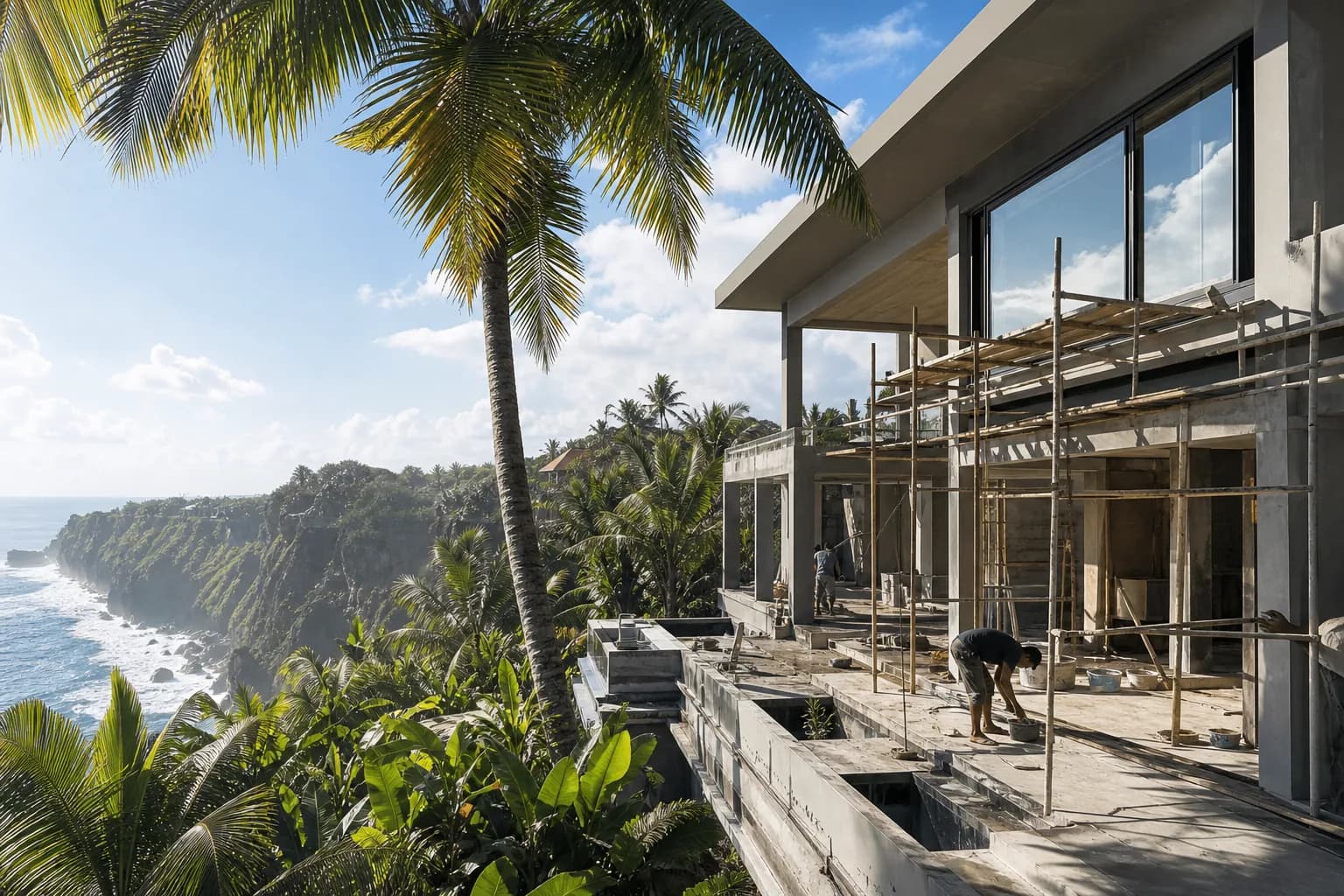
Uluwatu’s dramatic clifftop locations represent some of Bali’s most coveted construction sites—and its highest geological risk zones. When international buyers consider land purchases within 200 meters of the limestone cliff edges, they rarely account for mandatory erosion surveys and geological risk assessments that Indonesian building authorities now require. The question isn’t whether these assessments are necessary—it’s understanding their true scope, cost structure, and what happens when developers skip this critical engineering step. With the Indonesian government investing $5 million in seawall protection for Uluwatu’s eroding coastline, the message is clear: clifftop stability is no longer assumed, it’s engineered and verified through rigorous geological analysis.
Engineering Reality: What Clifftop Erosion Surveys Actually Measure
Uluwatu sits on porous Miocene limestone formations that erode at variable rates depending on wave action, groundwater flow, and structural loading. A comprehensive geological risk assessment for clifftop construction involves three distinct engineering disciplines, each with separate cost structures and technical requirements.
Geotechnical Site Investigation Components
The foundation of any clifftop assessment begins with subsurface exploration. Standard practice requires a minimum of three borehole samples extending 15-20 meters below proposed foundation depth, with additional boreholes positioned at cliff-edge proximity points. Each borehole extraction costs between $800-$1,200 USD depending on depth and limestone density. Laboratory analysis of core samples—testing for compressive strength, porosity, and chemical composition—adds $300-$500 per sample. For a typical villa plot within 100 meters of the cliff edge, expect 4-6 boreholes minimum, translating to $4,400-$8,200 for subsurface investigation alone.
What many buyers don’t realize: Indonesian building code PBI 1983 and its updates require increased borehole density for sites within defined erosion risk zones. Uluwatu’s designated high-risk areas mandate borehole spacing no greater than 25 meters apart, which can double investigation costs for larger plots.
Erosion Rate Monitoring and Historical Analysis
Determining annual erosion rates requires comparative analysis using historical satellite imagery, LiDAR scanning where available, and physical monitoring stations. Professional geological consultants in Bali charge $2,500-$4,500 for historical erosion analysis covering 10-15 years of coastal change data. This analysis identifies erosion patterns, seasonal acceleration factors, and projects future cliff-edge positions under various climate scenarios.
The critical output: a certified erosion setback distance that determines minimum safe construction distances from current cliff edges. This setback typically ranges from 30-80 meters depending on erosion velocity, but can exceed 100 meters in areas showing accelerated limestone dissolution. The government’s $5 million seawall initiative specifically targets zones where erosion rates exceed 0.8 meters annually—areas where construction was previously approved but now requires additional protective engineering.
Structural Load Impact Assessment
Beyond natural erosion, construction itself alters groundwater flow and adds structural loading that can accelerate cliff instability. A proper risk assessment models how proposed building mass, foundation type, and site drainage will affect underlying limestone integrity. This finite element analysis, conducted by licensed structural engineers, costs $3,200-$6,000 depending on building complexity and site topography.
For villa construction projects incorporating pools, the assessment must account for continuous water loading and potential seepage paths through porous limestone—factors that can triple local erosion rates if improperly managed. We’ve documented cases where pool construction within 60 meters of cliff edges created new groundwater channels that accelerated erosion by 40% within three years.
Regulatory Compliance and Certification Requirements
All geological assessments must be certified by Indonesian-licensed geotechnical engineers (LPJK certification required) and submitted to both district building authorities (DPMPTSP) and environmental agencies (BPLHD). The certification process itself costs $800-$1,500 and adds 3-4 weeks to permit timelines. Without proper certification, building permits for clifftop locations are automatically rejected—a reality that has surprised numerous foreign developers who commissioned assessments from non-licensed consultants.
Hidden Risks: What Standard Surveys Miss
The most dangerous assumption in Uluwatu clifftop development is that a single geological survey provides permanent clearance. Limestone erosion is not linear—it accelerates during monsoon seasons, responds to seismic activity, and changes dramatically when neighboring properties alter drainage patterns.
The Temporal Validity Problem
Geological risk assessments in erosion zones carry an effective validity period of 18-24 months maximum. Yet we regularly encounter buyers who purchased land with surveys conducted 3-5 years prior, assuming the data remains current. Indonesian building authorities now require survey updates if more than 24 months have elapsed between assessment and permit application—adding unexpected costs of $2,800-$4,200 for reassessment.
Cumulative Impact Blindness
Individual site assessments rarely account for cumulative loading effects when multiple villas are constructed in proximity. Three villas built within a 200-meter clifftop stretch create combined groundwater diversion and structural loading that no single assessment predicted. This is why Uluwatu’s Pecatu Indah Resort area now requires master drainage plans for any new construction—a regulation that emerged after cumulative development accelerated erosion beyond individual survey predictions.
Insurance and Liability Gaps
Even with completed geological assessments, securing construction insurance for clifftop sites costs 40-60% more than inland locations, and many international insurers exclude erosion-related structural failure entirely. The assessment identifies risk but doesn’t eliminate it—a distinction that affects long-term building value and resale potential in ways most buyers discover only after construction completion.
Step-by-Step Process: Commissioning a Legitimate Clifftop Assessment
Step 1: Verify Land Classification and Erosion Zone Designation (Week 1)
Before commissioning any survey, obtain official confirmation from Badung Regency’s spatial planning office (Dinas Tata Ruang) regarding the land’s erosion risk classification. Uluwatu clifftop areas are divided into three zones: red (high risk, construction restricted), yellow (moderate risk, enhanced assessment required), and green (standard assessment sufficient). This classification determines assessment scope and cost. Request the official “Surat Keterangan Rencana Kota” (SKRK) document—cost: $150-$250, processing time: 5-7 business days.
Step 2: Engage LPJK-Certified Geotechnical Consultant (Week 1-2)
Commission only Indonesian-licensed geotechnical firms holding valid LPJK certification in geological engineering. Request proof of professional indemnity insurance (minimum coverage: $500,000 USD) and examples of previous clifftop assessments accepted by Badung building authorities. Reputable firms provide detailed scope-of-work documents specifying borehole quantities, laboratory testing protocols, and deliverable formats. Budget: $8,500-$15,000 for comprehensive assessment depending on plot size and risk classification.
Step 3: Coordinate Site Access and Utility Mapping (Week 2-3)
Borehole drilling requires heavy equipment access and temporary utility shutdowns if existing infrastructure crosses the site. Coordinate with neighboring properties if shared access roads are involved—a commonly overlooked step that can delay surveys by weeks. Map all underground utilities (water lines, electrical conduits, septic systems) to avoid drilling conflicts. For verified land purchases, this utility mapping should be completed during due diligence.
Step 4: Monitor Field Investigation and Sample Collection (Week 3-5)
Physical borehole drilling typically requires 5-8 working days depending on limestone hardness and weather conditions. Insist on daily progress documentation with photographic evidence of core samples and drilling depths. Quality consultants provide real-time updates when unexpected geological features are encountered—such as subsurface voids or water channels that require additional investigation.
Step 5: Laboratory Analysis and Erosion Modeling (Week 6-8)
Core sample testing occurs at certified Indonesian laboratories (LPJK-accredited facilities required). Testing protocols should include unconfined compressive strength, porosity analysis, chemical composition, and water absorption rates. Simultaneously, erosion modeling uses historical data and current measurements to project future cliff-edge positions under various scenarios. Request both conservative (worst-case) and moderate erosion projections—the difference significantly impacts buildable area calculations.
Step 6: Structural Load Modeling and Foundation Recommendations (Week 8-10)
Using geological data, structural engineers model how proposed construction will interact with subsurface conditions. This phase produces specific foundation recommendations (pile depth, reinforcement requirements, drainage systems) and defines maximum allowable building loads. For tropical construction engineering, these specifications directly inform foundation design and cost estimation.
Step 7: Certification and Regulatory Submission (Week 10-12)
The final geological risk assessment report requires certification by the lead geotechnical engineer and submission to building authorities as part of the IMB (building permit) application. The report must include specific statements regarding construction feasibility, recommended setback distances, and required protective measures. Processing time for authority review: 3-4 weeks, with possible requests for additional data or clarification.
Realistic Cost Breakdown: What You’ll Actually Pay
Total geological risk assessment costs for Uluwatu clifftop sites vary significantly based on plot size, erosion risk classification, and building complexity. Here’s the realistic range breakdown for a standard 500-1000 sqm villa plot within 100 meters of cliff edges:
Basic Assessment Package (Yellow Zone, Standard Villa):
- Geotechnical investigation (4 boreholes): $4,400-$6,800
- Laboratory testing and analysis: $1,800-$2,400
- Erosion rate analysis: $2,500-$3,500
- Structural load modeling: $3,200-$4,500
- Certification and reporting: $800-$1,200
- Total: $12,700-$18,400 USD
Enhanced Assessment Package (Red Zone or Complex Design):
- Geotechnical investigation (6-8 boreholes): $7,200-$10,400
- Extended laboratory testing: $2,800-$3,800
- Advanced erosion modeling with climate scenarios: $4,500-$6,000
- Comprehensive structural analysis: $5,500-$7,500
- Environmental impact assessment integration: $2,200-$3,500
- Certification and regulatory coordination: $1,500-$2,000
- Total: $23,700-$33,200 USD
Timeline expectations: 10-14 weeks from initial engagement to certified report delivery. Expedited processing (available from some consultants) adds 25-35% to costs but reduces timeline to 7-9 weeks. These costs are separate from and additional to standard building permit fees, environmental assessments (AMDAL/UKL-UPL), and architectural design costs.
Critical consideration: These assessments represent 2-4% of typical villa construction costs in Uluwatu but can prevent catastrophic structural failures that would cost 10-20 times more to remediate. We’ve documented cases where skipped geological assessments led to foundation failures requiring $180,000+ in emergency stabilization work.
Frequently Asked Questions: Clifftop Erosion Assessment Specifics
Can I use a geological assessment from a neighboring property to avoid costs?
No. Indonesian building regulations require site-specific geological assessments for each individual plot, even when properties are adjacent. Subsurface limestone conditions vary dramatically over distances as short as 20-30 meters due to natural fracture patterns and historical water flow channels. Building authorities will reject permit applications that reference assessments conducted on different land certificates (different SHM/HGB numbers). Some cost savings are possible when multiple adjacent plots share a single owner and are assessed simultaneously—typically reducing per-plot costs by 15-20%—but each plot still requires dedicated borehole data and individual certification.
What happens if the assessment determines my land is too risky for construction?
Geological assessments classify risk levels but rarely declare land completely unbuildable. Instead, they define required protective measures and construction limitations. High-risk findings typically mandate: increased foundation depth (adding $15,000-$35,000 to construction costs), mandatory pile foundations instead of standard footings, reduced building footprints to minimize loading, enhanced drainage systems, and increased setback distances from cliff edges. In extreme cases—usually involving active erosion exceeding 1.2 meters annually—assessments may recommend construction delays until protective infrastructure (like the government’s seawall project) is completed. This doesn’t eliminate building potential but affects project timelines and budgets. For villa design concepts, we adjust architectural plans to work within geological constraints rather than abandoning projects.
How do erosion assessments affect property insurance and resale value?
Documented geological assessments with favorable findings actually enhance property value and insurability by providing certified evidence of construction sa
 164 m²7 month(s)from 79.000 USD
Private: Haridas Villas, Tegallalang
 3124 m²6 month(s)from 123.000 USD
TALA 8
 1from 198.000 USD
Private: Haridas Villas
 3173 m²6 month(s)from 125.000 USD
TALA FOUR
 4344 m²16 month(s)from 290.000 USD
Radha
 2144 m²11 month(s)from 104.000 USD
Narayana
 3180 m²7 month(s)from 142.000 USD
Vasudeva

Want to calculate?
 3104 m²11 month(s)from 99.000 USD
TALA 100
 3127 m²9 month(s)from 177.000 USD
Mukunda
 172 m²8 month(s)from 120.000 USD
Keshava
164 m²7 month(s)from 79.000 USDTALA TWO
Start With Real Numbers, Not Guesses
Before buying land or finalizing a design, check the realistic build cost range for your project in Bali.
Our team reviews your inputs and gives a grounded estimate.
Available lands
 250 m²15 min$ 40025Bali, Munggu
 1410 m²15 min$ 390702Bali, Tabanan
 2200 m²3 min$ 183842Bali, Berawa
 2400 m²7 min$ 496552Bali, Canggu
 700 m²20 min$ 90517Bali, Cepaka
 1533 m²5 min$ 165666Bali, Cepaka
 1600 m²32 min$ 266010Bali, Tabanan
 2115 m²5 min$ 1139547Bali, Pererenan
 1300 m²10 min$ 348214Bali, Tabanan
 800 m²10 min$ 307882Bali, Tibubeneng
 260 m²5 min$ 51872Bali, Kedungu
 1200 m²2 min$ 155172Bali, Klungkung
 10000 m²19 min$ 232759Bali, Buleleng
 2000 m²5 min$ 1440887Bali, Pecatu
 1350 m²5 min$ 283467Bali, Pecatu
Essential Bali build & buy guides
- Bali villa construction cost per m² in 2026
- How much will your villa cost? Calculator
- Building a villa in Bali: the complete guide
- Buying land in Bali: step-by-step for foreigners
- Bali villa investment: yields, risks, returns
- Leasehold vs freehold: what foreigners can own
- Construction defect liability & 10-year warranty
- Bali building codes and construction standards
Related guides

Why a Cheap Bali Leasehold Is Cheap: Pricing Red Flags Every Buyer Should Decode
Suspiciously cheap Bali leaseholds are priced low for a reason: short remaining terms, forbidden zoning, missing road access, disputes or weak contracts. How to decode the discount before you pay for it.
8 min read
Fake Compliance and Licensing Agents in Bali: The 2026 Paperwork Scam and How to Verify Documents
Forged certificates, permit fixers and fake notaries: how Bali's paperwork scams work in 2026 and how to verify every property document at its government source.
7 min read
Buying a Bali Villa from Instagram: Phantom Listings, Render-Only Projects and How to Verify
Instagram is Bali's biggest property shop window and its least verified. How phantom listings, render-only projects and cloned developer accounts work — and the verification steps that expose them.
7 min read