Title Insurance Gaps Land Verification in Bali Construction
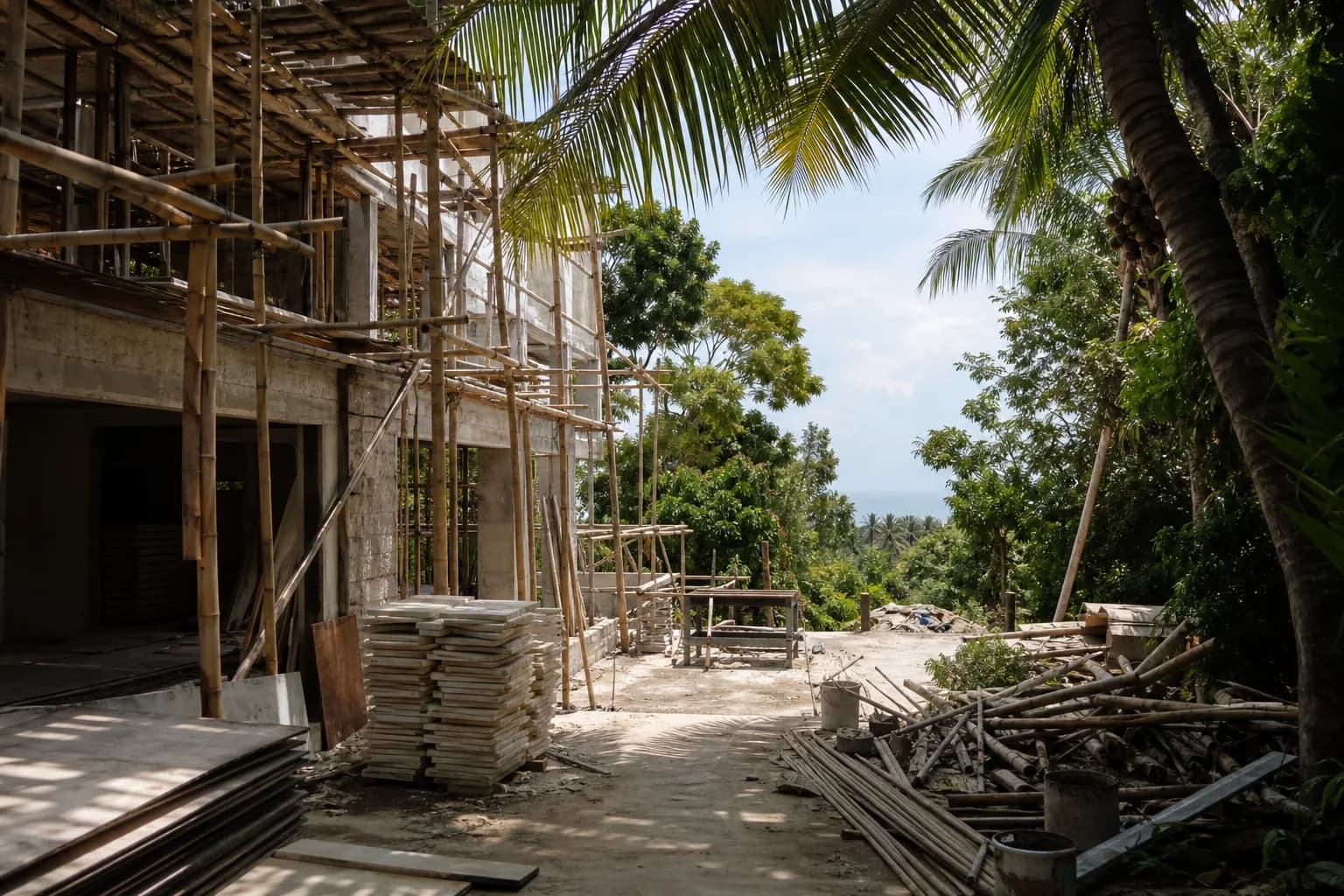
The Hidden Vulnerability: When Land Certificates Don’t Guarantee Construction Rights
A verified land certificate in Bali doesn’t automatically mean you can build. This gap between documented ownership and actual construction rights creates a critical vulnerability that most foreign buyers discover only after breaking ground—when neighboring landowners produce conflicting claims, when customary (adat) communities assert traditional rights, or when zoning restrictions suddenly appear that weren’t disclosed during purchase. The absence of comprehensive title insurance in Indonesia means that land certificate verification must go far beyond checking authenticity at the National Land Agency (BPN). For construction projects, you’re not just verifying ownership—you’re validating the complete chain of rights that allow physical development, including subsurface rights, access easements, water rights, and freedom from encumbrances that could halt construction mid-project.
Technical Architecture of Land Certificate Verification for Construction Projects
Land certificate verification for Bali villa construction requires a multi-layered technical approach that addresses gaps Western-style title insurance would typically cover. The Indonesian land registration system operates on a “negative publication” principle, meaning the certificate creates a presumption of ownership but doesn’t guarantee absolute protection against third-party claims—a fundamental difference from “positive” systems in countries with mature title insurance markets.
Certificate Hierarchy and Construction Implications
The type of land certificate directly impacts construction feasibility. Hak Milik (freehold) certificates provide the strongest rights but are restricted to Indonesian citizens. For foreign-backed construction through PT PMA structures, Hak Pakai (right to use) certificates offer 30-year terms with extensions, but verification must confirm the certificate explicitly permits commercial construction, not just residential use. HGB (Hak Guna Bangunan) certificates grant building rights for 30 years but require verification that the underlying land ownership is clear—many HGB certificates are issued over land with unresolved customary claims.
The critical gap: land certificates show ownership status but don’t document construction-specific encumbrances. A certificate may be authentic and current, yet the land could be subject to traditional irrigation rights (subak system), sacred site restrictions (pura or temple proximity), or informal agreements with neighboring communities that effectively prevent development. These restrictions rarely appear in official BPN records but carry legal weight under Indonesian customary law.
Subsurface and Boundary Verification Engineering
Construction projects require verification beyond surface boundaries. The land certificate provides coordinates and area measurements, but field verification using differential GPS surveying often reveals discrepancies of 2-5 meters—enough to place your foundation on disputed land or violate setback requirements. Subsurface rights verification is equally critical: many Bali land parcels have informal agreements allowing neighbors to access groundwater or maintain drainage channels beneath the property, creating construction obstacles and potential liability.
Topographic surveys must be cross-referenced with certificate boundaries to identify encroachments. In dense Bali neighborhoods, physical boundaries often don’t match certificate descriptions due to decades of informal adjustments. A tropical construction engineering approach requires commissioning a licensed surveyor (not just the seller’s surveyor) to produce an independent boundary verification report that can be legally defended if disputes arise during construction.
Encumbrance Search Beyond BPN Records
The BPN certificate check reveals registered mortgages and liens, but construction-relevant encumbrances often exist outside this system. Village-level (banjar) records may document community agreements, traditional access paths, or ceremonial use rights that restrict development. These customary encumbrances aren’t “title defects” in the Western sense—they’re legitimate traditional rights that coexist with modern land certificates but can halt construction when violated.
Professional verification requires checking three separate record systems: BPN national records, district land office archives, and village customary records (maintained by the banjar). Each system may contain different information about the same parcel. For building permits Bali applications, discrepancies between these systems must be resolved before construction begins, as permit authorities increasingly cross-reference all three sources.
Hidden Risks That Derail Construction After Certificate Verification
The most expensive mistakes occur when buyers verify the land certificate but fail to verify construction-specific rights. A common scenario: the certificate is authentic, ownership is clear, but the land falls within a newly designated green belt zone where construction permits are no longer issued. Zoning designations in Bali change frequently, and the land certificate doesn’t automatically update to reflect new restrictions.
Another critical gap: split ownership of improvements versus land. Some land certificates show clear ownership, but existing structures on the property are owned separately under informal agreements. When you demolish for new construction, you may face claims from parties who owned the previous buildings—claims that don’t appear in the land certificate but are recognized under Indonesian law.
Water rights present a hidden construction risk. Many Bali properties depend on shared water sources or traditional irrigation channels (subak). The land certificate doesn’t document these dependencies, but construction that disrupts water flow can trigger legal action from affected neighbors or subak organizations. For villa construction requiring significant water supply, verification must include hydrological surveys and written agreements with water source owners.
Adat (customary) land claims represent the largest title insurance gap. Even with a valid BPN certificate, customary communities may assert traditional rights to land, especially in areas undergoing rapid development. These claims can emerge years after purchase, triggered by construction activity that disturbs sacred sites or violates traditional boundaries. Unlike Western title insurance, there’s no policy to cover losses from adat claims—buyers absorb the full risk.
Step-by-Step Construction-Focused Certificate Verification Process
Phase 1: Multi-Source Certificate Authentication (Weeks 1-2)
Begin with BPN certificate verification, but don’t stop there. Obtain a certified copy of the certificate directly from the BPN office serving the land’s district—never rely solely on copies provided by sellers. Cross-reference the certificate number, land area, and boundaries against BPN digital records. Request a Certificate of Land Status (Surat Keterangan Pendaftaran Tanah) that shows the complete ownership history and any registered encumbrances.
Simultaneously, commission an independent licensed surveyor to conduct field boundary verification using GPS coordinates from the certificate. The surveyor’s report should identify any physical encroachments, boundary disputes, or discrepancies between certificate descriptions and actual site conditions. This engineering-level verification is essential for villa construction cost Bali estimation, as boundary issues can reduce buildable area or require expensive boundary wall adjustments.
Phase 2: Customary Rights and Community Verification (Weeks 2-3)
Engage a local legal consultant to review village (banjar) records and interview community leaders about customary rights affecting the land. This step is often skipped but critical for construction projects. Request written confirmation from the banjar that no traditional ceremonies, access paths, or sacred sites affect the property. Document any subak (irrigation cooperative) memberships or water rights associated with the land.
For properties near temples, obtain a letter from the temple authority confirming the land is outside sacred boundaries and construction won’t violate religious restrictions. These letters aren’t legally required but provide practical protection against community opposition during construction.
Phase 3: Zoning and Construction Rights Verification (Weeks 3-4)
Verify current zoning designation through the district spatial planning office (Dinas Tata Ruang). Request written confirmation of permitted building density, height limits, and setback requirements. Cross-reference this information with the land certificate to ensure the parcel size and configuration can accommodate your construction plans within zoning constraints.
Check environmental restrictions through the Environmental Agency (Dinas Lingkungan Hidup). Some areas require environmental impact assessments (AMDAL or UKL-UPL) before construction permits are issued. Verify whether the land falls within protected zones, coastal setback areas, or green belt designations that would prevent development.
Phase 4: Infrastructure and Access Rights Documentation (Weeks 4-5)
Verify legal access to the property through public roads or documented easements. Many Bali properties access main roads through private lanes (gang) that cross neighboring land. Obtain written easement agreements from all affected landowners, specifying rights for construction vehicle access and future maintenance. Without documented access rights, you may be unable to bring construction equipment to the site.
Verify utility connection rights and availability. Check with PLN (electricity), PDAM (water), and telecommunications providers to confirm service availability and connection requirements. Some areas require community agreements or infrastructure contributions before utilities can be connected—costs that don’t appear in the land certificate but significantly impact construction budgets.
Phase 5: Legal Opinion and Risk Assessment (Week 5-6)
Commission a comprehensive legal opinion from a construction-specialized law firm that synthesizes all verification findings. The opinion should explicitly address construction feasibility, identify remaining risks, and recommend risk mitigation strategies. This document serves as your substitute for title insurance, providing a professional assessment of title quality and construction rights.
For projects managed through Teville’s construction process, this verification phase is integrated into pre-construction planning, ensuring all title and rights issues are resolved before engineering work begins.
Realistic Costs and Timeframes for Comprehensive Verification
Professional land certificate verification for construction projects typically costs USD $2,500-$5,000, depending on property complexity and location. This includes BPN certificate checks ($300-500), independent surveyor boundary verification ($800-1,200), legal consultant fees for customary rights research ($600-1,000), zoning verification ($400-600), and comprehensive legal opinion ($400-1,700).
The verification process requires 5-8 weeks when conducted properly. Rushed verification is the primary cause of construction delays and disputes. Budget an additional $1,000-2,000 for resolving minor issues discovered during verification, such as boundary adjustments, easement documentation, or banjar agreement formalization.
For land purchase Bali transactions, factor verification costs into your total acquisition budget. Properties priced significantly below market often have title or rights issues that will emerge during thorough verification. The cost of comprehensive verification is typically 1-2% of land value but can prevent losses of 100% of your investment if serious defects are discovered before purchase.
Timeline for resolving discovered issues varies widely. Minor boundary discrepancies may be resolved in 2-3 weeks through surveyor mediation. Customary rights issues may require 2-3 months of community negotiation. Serious title defects or competing claims can take 6-12 months to resolve through legal processes. Build these contingencies into your construction timeline—starting construction with unresolved title issues typically results in work stoppages and legal complications that cost far more than proper upfront verification.
Frequently Asked Questions: Title Insurance Gaps in Bali Construction
Why doesn’t Indonesia offer title insurance like Western countries, and how does this affect construction projects?
Indonesia’s land registration system operates on a “negative publication” principle, where land certificates create a rebuttable presumption of ownership rather than absolute guarantee. This differs from “positive” systems in countries like the US or Australia where title insurance is standard. The absence of title insurance means construction buyers bear full risk of undiscovered claims, customary rights disputes, or certificate defects. For construction projects, this gap is particularly significant because building activities often trigger dormant claims or reveal rights conflicts that weren’t apparent during initial purchase. Mitigation requires comprehensive due diligence that goes beyond certificate verification to include customary rights research, community consultation, and engineering-level boundary verification—essentially self-insuring through thorough investigation rather than purchasing insurance coverage.
Can adat (customary) land claims override a valid BPN land certificate, and how do I protect my construction project?
Yes, customary land claims can coexist with modern land certificates and may be enforced through Indonesian courts, particularly when construction activities affect traditional rights or sacred sites. The Constitutional Court has affirmed that customary communities retain rights to traditional lands even when modern certificates have been issued, creating a dual system where both rights are legally valid. Protection requires proactive engagement with local customary authorities (banjar, traditional councils) before construction begins. Obtain written acknowledgment from customary leaders that your project doesn’t conflict with traditional rights, and consider incorporating traditional ceremonies or
 3180 m²7 month(s)from 142.000 USD
Vasudeva

Want to calculate?
 3173 m²6 month(s)from 125.000 USD
TALA FOUR
 3124 m²6 month(s)from 123.000 USD
TALA 8
 2144 m²11 month(s)from 104.000 USD
Narayana
 1from 198.000 USD
Private: Haridas Villas
 164 m²7 month(s)from 79.000 USD
TALA TWO
 3104 m²11 month(s)from 99.000 USD
TALA 100
 172 m²8 month(s)from 120.000 USD
Keshava
164 m²7 month(s)from 79.000 USDPrivate: Haridas Villas, Tegallalang
 3127 m²9 month(s)from 177.000 USD
Mukunda
 4344 m²16 month(s)from 290.000 USD
Radha
Start With Real Numbers, Not Guesses
Before buying land or finalizing a design, check the realistic build cost range for your project in Bali.
Our team reviews your inputs and gives a grounded estimate.
Available lands
 3100 m²15 min$ 257697Bali, Tegallalang
 8313 m²15 min$ 716670Bali, Buduk
 700 m²7 min$ 400000Bali, Canggu
 2200 m²3 min$ 183842Bali, Berawa
 750 m²15 min$ 187038Bali, Kerobokan
 500 m²15 min$ 124692Bali, Kaba Kaba
 1000 m²10 min$ 280788Bali, Pecatu
 2000 m²10 min$ 243842Bali, Mengwi
 2130 m²10 min$ 495776Bali, Pecatu
 500 m²2 min$ 175862Bali, Cemagi
 1700 m²10 min$ 392549Bali, Nusadua
 550 m²5 min$ 217629Bali, Tabanan
 800 m²5 min$ 295567Bali, Seseh
 3254 m²5 min$ 631800Bali, All
 200 m²5 min$ 59113Bali, Bukit
Essential Bali build & buy guides
- Bali villa construction cost per m² in 2026
- How much will your villa cost? Calculator
- Building a villa in Bali: the complete guide
- Buying land in Bali: step-by-step for foreigners
- Bali villa investment: yields, risks, returns
- Leasehold vs freehold: what foreigners can own
- Construction defect liability & 10-year warranty
- Bali building codes and construction standards
Related guides

Why a Cheap Bali Leasehold Is Cheap: Pricing Red Flags Every Buyer Should Decode
Suspiciously cheap Bali leaseholds are priced low for a reason: short remaining terms, forbidden zoning, missing road access, disputes or weak contracts. How to decode the discount before you pay for it.
8 min read
Fake Compliance and Licensing Agents in Bali: The 2026 Paperwork Scam and How to Verify Documents
Forged certificates, permit fixers and fake notaries: how Bali's paperwork scams work in 2026 and how to verify every property document at its government source.
7 min read
Buying a Bali Villa from Instagram: Phantom Listings, Render-Only Projects and How to Verify
Instagram is Bali's biggest property shop window and its least verified. How phantom listings, render-only projects and cloned developer accounts work — and the verification steps that expose them.
7 min read