Seminyak Flood Zone Construction: Bali Insurance Risk
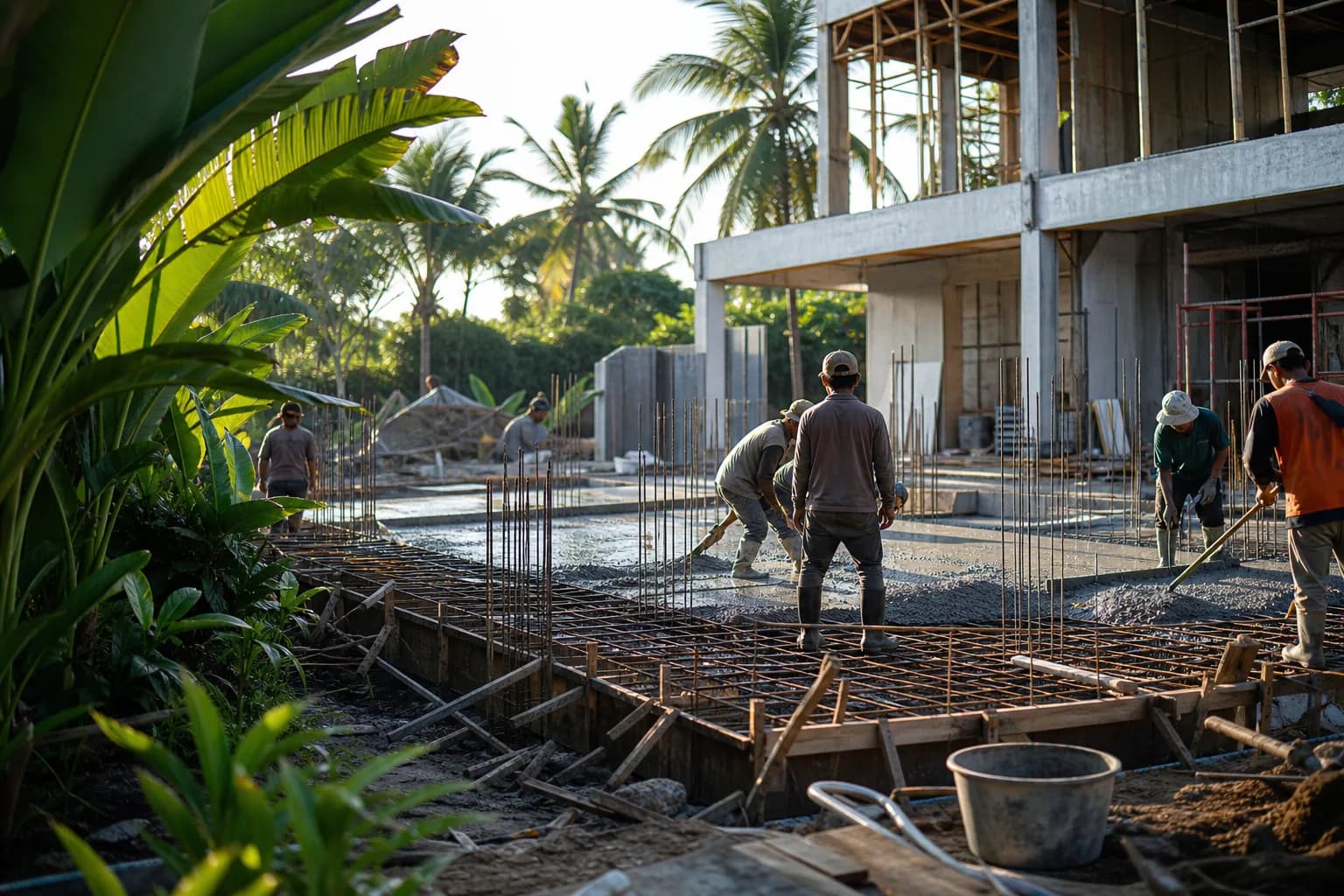
The Critical Insurance Gap in Seminyak’s Flood-Prone Construction Zones
Seminyak’s coastal proximity and low-lying topography create a complex insurance challenge that most villa developers discover too late. During Bali’s 2024 monsoon season, several construction sites in the Petitenget and Kerobokan Kelod areas experienced flooding that exceeded 80cm depth, triggering insurance claim disputes worth over USD $400,000. The core problem: standard Construction All Risk (CAR) policies often exclude flood damage in designated high-risk zones, while Property All Risk insurance won’t activate until construction completion and occupancy certification. This coverage gap leaves developers financially exposed during the most vulnerable 12-18 month construction period, particularly in Seminyak’s identified flood zones along Jalan Petitenget, Jalan Drupadi, and areas within 500 meters of the Tukad Mati river system.
Engineering and Legal Framework for Flood Zone Construction Insurance
Indonesia’s Financial Services Authority (OJK) mandates specific insurance protocols for construction in designated flood zones, but Bali’s implementation involves multiple regulatory layers. The Badung Regency spatial planning document (RTRW Badung 2013-2033) identifies three flood risk categories in Seminyak: high-risk (annual flooding probability >25%), moderate-risk (10-25%), and low-risk (<10%). Each category triggers different insurance requirements and construction standards.
Construction All Risk Insurance Requirements
For Seminyak flood zones, standard CAR policies must be enhanced with specific flood endorsements. The baseline CAR coverage typically includes material damage, third-party liability (minimum IDR 500 million), and contractor equipment protection. However, flood zone construction requires additional clauses: subsurface water intrusion coverage, foundation stabilization costs post-flooding, and temporary works protection during monsoon season (November-March). Premium rates for flood-enhanced CAR policies in Seminyak range from 0.8% to 2.5% of total construction value, compared to 0.4-0.8% for non-flood zones.
The critical technical specification: insurers require hydrological surveys conducted by certified Indonesian geotechnical firms before policy issuance. These surveys must document historical flood levels, soil permeability rates, and groundwater table fluctuations. At Teville, we commission these surveys during the pre-construction engineering phase, integrating findings directly into foundation design and insurance documentation.
Property All Risk Transition Strategy
The insurance transition from construction phase to operational phase creates a 30-60 day vulnerability window. Property All Risk policies for completed villas in Seminyak flood zones require: elevated electrical systems (minimum 1.2m above historical flood levels), flood-resistant building materials certification, and documented drainage system capacity. Premium calculations factor in building elevation above mean sea level, distance from primary drainage channels, and structural flood mitigation features.
Indonesian insurance law (Law No. 40/2014) requires full disclosure of flood history for the specific plot. Failure to disclose previous flooding events—even during land-only ownership—can void claims. This makes title research critical: we verify 10-year flood records through Badung BPBD (Regional Disaster Management Agency) archives and cross-reference with neighborhood association (banjar) documentation.
Regulatory Compliance and Building Code Integration
Bali Governor Regulation No. 5/2020 on disaster-resilient construction mandates specific engineering standards for flood zones. These include: reinforced concrete foundations extending minimum 2.5m depth, waterproof membrane systems rated for 72-hour submersion, and elevated first-floor levels. Insurance underwriters verify compliance through staged inspections at foundation completion, structural frame completion, and final handover. Non-compliance doesn’t just risk permit issues—it automatically triggers insurance exclusions for flood-related damage.
Hidden Risks and Common Insurance Mistakes in Seminyak Construction
The most expensive mistake: assuming your contractor’s insurance covers flood damage to your project. Standard contractor liability policies protect against construction defects and worker accidents, but explicitly exclude natural disaster damage. This means if flooding damages your 60% complete villa, you’re liable for reconstruction costs unless you’ve secured owner-controlled CAR insurance with flood endorsements.
Second critical oversight: underinsuring based on current construction value rather than replacement cost. A villa 70% complete when flooding occurs requires full demolition and reconstruction in many cases due to concrete contamination and rebar corrosion. Insurance policies based on “work completed to date” leave you covering 30-40% of total reconstruction costs. Proper flood zone CAR policies should cover 100% replacement value from day one of construction.
Third hidden risk: the subrogation clause trap. If flooding results from inadequate municipal drainage maintenance, your insurer may pursue subrogation claims against local government entities. This process can take 18-36 months in Indonesian courts, during which your claim remains partially unpaid. Experienced developers negotiate subrogation waiver clauses or advance payment terms, accepting slightly higher premiums (typically 0.15-0.3% additional) for immediate claim settlement.
Material storage insurance gaps create another vulnerability. Construction materials stored on-site—timber, gypsum, electrical components—often aren’t covered under basic CAR policies during non-working hours. Seminyak’s flash flooding typically occurs during evening storms when sites are unmanned. Comprehensive coverage requires specific “materials on-site” endorsements with 24-hour protection, adding approximately 0.2% to total premium costs but preventing losses that average IDR 150-300 million per flooding event.
Step-by-Step Insurance and Risk Mitigation Process
Phase 1: Pre-Construction Risk Assessment (Weeks 1-3)
Begin with certified hydrological survey through firms like PT Geotech Indonesia or PT Geotechnical Engineering. Survey deliverables must include: 20-year flood history analysis, soil permeability testing at 3m, 6m, and 9m depths, groundwater table monitoring across wet and dry seasons, and drainage capacity modeling. Cost range: IDR 35-65 million depending on plot size. This documentation becomes the foundation for both insurance applications and engineering design.
Simultaneously, obtain official flood zone classification from Badung BPBD. Request the “Peta Rawan Bencana” (Disaster Risk Map) specific to your plot coordinates. This document determines your insurance category and triggers specific building code requirements. Processing time: 7-14 business days through formal written request.
Phase 2: Insurance Policy Structuring (Weeks 4-6)
Engage insurance brokers specializing in construction risk—firms like Aon Indonesia or Marsh Indonesia have dedicated Bali construction teams. Provide complete documentation: hydrological survey, architectural plans, structural engineering calculations, and construction timeline. Request comparative quotes for CAR policies with flood endorsements from minimum three underwriters (typically Asuransi Sinar Mas, Asuransi ACA, or Zurich Insurance Indonesia).
Critical policy specifications to negotiate: aggregate deductible limits (target maximum IDR 50 million per claim), monsoon season coverage confirmation (some policies reduce coverage November-March), temporary works protection, and stored materials coverage. Verify that policy includes “sue and labor” clauses covering emergency flood response costs like pumping, temporary barriers, and material relocation.
Phase 3: Engineering Integration (Weeks 7-10)
Work with your construction partner to integrate insurance requirements into engineering specifications. At Teville’s engineering phase, we incorporate: foundation depth exceeding insurance minimums by 0.5m safety margin, waterproofing systems with third-party certification, elevated electrical and mechanical systems, and perimeter drainage with capacity 150% of calculated peak flow rates. These over-engineered solutions reduce insurance premiums by 15-25% while providing superior flood protection.
Install monitoring systems required by insurers: groundwater level sensors, rainfall gauges, and site drainage flow meters. Modern IoT systems (cost: IDR 25-40 million installed) provide real-time data that insurers use for claim verification and can trigger automatic emergency protocols.
Phase 4: Construction Phase Management (Months 3-18)
Implement staged insurance inspections aligned with construction milestones: foundation completion, structural frame completion, roof completion, and final handover. Each inspection generates certification required for continued coverage. Schedule inspections 2-3 weeks before milestone completion to allow time for any remedial work.
Maintain detailed photographic documentation of all flood mitigation features during construction. Time-stamped photos of waterproofing application, drainage installation, and elevated systems become critical evidence for claim processing. Store documentation in cloud systems with insurer access.
Phase 5: Transition to Property Insurance (Month 18-19)
Begin Property All Risk policy applications 60 days before construction completion. Provide insurers with: final engineering certifications, flood mitigation system test results, occupancy permit (IMB), and utility connection confirmations. Negotiate overlap period where both CAR and Property policies remain active for 30 days, eliminating coverage gaps during handover.
Realistic Cost Ranges and Timeline Expectations
Insurance costs for Seminyak flood zone construction vary significantly based on risk classification and villa value. For a typical 300m² villa with USD $400,000 construction value in moderate flood risk zones:
- Enhanced CAR Insurance Premium: USD $6,000-10,000 (1.5-2.5% of construction value) for 18-month construction period
- Hydrological Survey: USD $2,200-4,000 one-time cost
- Additional Engineering (flood mitigation): USD $8,000-15,000 added to base construction cost
- Monitoring Systems: USD $1,500-2,500 installed
- Property All Risk (first year): USD $3,500-6,000 (0.9-1.5% of property value)
High-risk flood zones see premiums increase 40-60% above these ranges, while low-risk zones may achieve 20-30% reductions. Deductibles typically range from IDR 25-75 million per claim, with aggregate annual limits of IDR 150-300 million.
Timeline considerations: insurance policy approval in flood zones requires 3-4 weeks versus 1-2 weeks for standard zones. Claim processing for flood damage averages 45-90 days for straightforward cases, extending to 6-12 months when disputes arise over causation or coverage interpretation. This makes cash flow planning critical—maintain construction contingency funds of 15-20% to bridge insurance payment delays.
Premium payment structures offer flexibility: annual lump sum (typically 5% discount), quarterly payments, or monthly installments (3-5% premium increase). For construction projects, quarterly payments aligned with construction milestones provide optimal cash flow management.
Frequently Asked Questions: Seminyak Flood Zone Construction Insurance
Does standard villa construction insurance cover flooding in Seminyak’s coastal areas?
No. Standard Construction All Risk policies explicitly exclude or severely limit flood damage coverage in designated flood zones. You must specifically request and pay additional premiums for flood endorsements. These endorsements typically add 0.4-1.7% to your base premium but are non-negotiable for Seminyak areas within 500m of drainage channels or below 5m elevation. Verify your policy includes “subsurface water intrusion” and “surface water flooding” clauses—some policies cover only one type. Request written confirmation that coverage remains active during monsoon season, as some insurers reduce or suspend flood coverage November-March.
What happens if flooding damages my villa during construction and I don’t have proper insurance?
You bear 100% of reconstruction costs, which typically exceed original construction costs by 30-50% due to demolition requirements, material contamination, and schedule delays. Flood-damaged concrete must often be completely removed due to contamination and structural integrity concerns—partial repairs rarely meet building code requirements. Additionally, you remain liable for contractor payments per your construction agreement, even if work stops due to flooding. Without business interruption coverage (another optional endorsement), you’ll also absorb holding costs, loan interest, and opportunity costs during 4-8 month reconstruction periods. This scenario has bankrupted several Seminyak villa projects in recent years.
How do insurers verify flood risk for my specific plot before issuing policies?
Insurers require certified hydrological surveys from Indonesian-licensed geotechnical firms, cross-referenced with government flood maps from Badung BPBD. They analyze: historical flood records for your specific coordinates (minimum 10-year history), elevation relative to nearest drainage channels, soil permeability and groundwater table data, and proximity to identified flood pathways. Many insurers now use satellite imagery analysis and LiDAR elevation data to verify plot characteristics. Discrepancies between your submitted data and insurer verification can result in policy denial or significantly increased premiums. This is why Teville’s land verification process includes preliminary flood risk assessment before clients commit to purchase.
Can I reduce insurance premiums through specific construction techniques or materials?
Yes, significantly. Engineered flood mitigation features can reduce premiums by 15-30%. Key premium-reducing strategies include: elevating first floor minimum 1.5m above historical flood levels (versus 1.2m code minimum), installing certified waterproofing systems with 20-year warranties, implementing perimeter drainage with capacity exceeding code requi
 3104 m²11 month(s)from 99.000 USD
TALA 100
 1from 198.000 USD
Private: Haridas Villas

Want to calculate?
 3180 m²7 month(s)from 142.000 USD
Vasudeva
 2144 m²11 month(s)from 104.000 USD
Narayana
 164 m²7 month(s)from 79.000 USD
Private: Haridas Villas, Tegallalang
 3173 m²6 month(s)from 125.000 USD
TALA FOUR
 4344 m²16 month(s)from 290.000 USD
Radha
 3127 m²9 month(s)from 177.000 USD
Mukunda
164 m²7 month(s)from 79.000 USDTALA TWO
 3124 m²6 month(s)from 123.000 USD
TALA 8
 172 m²8 month(s)from 120.000 USD
Keshava
Start With Real Numbers, Not Guesses
Before buying land or finalizing a design, check the realistic build cost range for your project in Bali.
Our team reviews your inputs and gives a grounded estimate.
Available lands
 500 m²15 min$ 124692Bali, Kaba Kaba
 5028 m²10 min$ 361000Bali, Ubud
 3100 m²20 min$ 272968Bali, Tabanan
 204 m²5 min$ 40899Bali, Kedungu
 2000 m²15 min$ 261700Bali, Babakan
 1300 m²10 min$ 348214Bali, Tabanan
 5815 m²5 min$ 815740Bali, Tabanan
 2680 m²10 min$ 1732759Bali, Pererenan
 2400 m²7 min$ 496552Bali, Canggu
 500 m²2 min$ 175862Bali, Cemagi
 29000 m²6 min$ 3857143Bali, Tabanan
 680 m²15 min$ 110751Bali, Pererenan
 1410 m²15 min$ 390702Bali, Tabanan
 550 m²5 min$ 217629Bali, Tabanan
 300 m²55 min$ 32475Bali, Tegelalang
Essential Bali build & buy guides
- Bali villa construction cost per m² in 2026
- How much will your villa cost? Calculator
- Building a villa in Bali: the complete guide
- Buying land in Bali: step-by-step for foreigners
- Bali villa investment: yields, risks, returns
- Leasehold vs freehold: what foreigners can own
- Construction defect liability & 10-year warranty
- Bali building codes and construction standards
Related guides

Why a Cheap Bali Leasehold Is Cheap: Pricing Red Flags Every Buyer Should Decode
Suspiciously cheap Bali leaseholds are priced low for a reason: short remaining terms, forbidden zoning, missing road access, disputes or weak contracts. How to decode the discount before you pay for it.
8 min read
Fake Compliance and Licensing Agents in Bali: The 2026 Paperwork Scam and How to Verify Documents
Forged certificates, permit fixers and fake notaries: how Bali's paperwork scams work in 2026 and how to verify every property document at its government source.
7 min read
Buying a Bali Villa from Instagram: Phantom Listings, Render-Only Projects and How to Verify
Instagram is Bali's biggest property shop window and its least verified. How phantom listings, render-only projects and cloned developer accounts work — and the verification steps that expose them.
7 min read