Sanur Coastal Setback Violations: Legal Penalties Demolition Co
The $200,000 Demolition Notice: Why Sanur’s Coastal Properties Face Legal Action
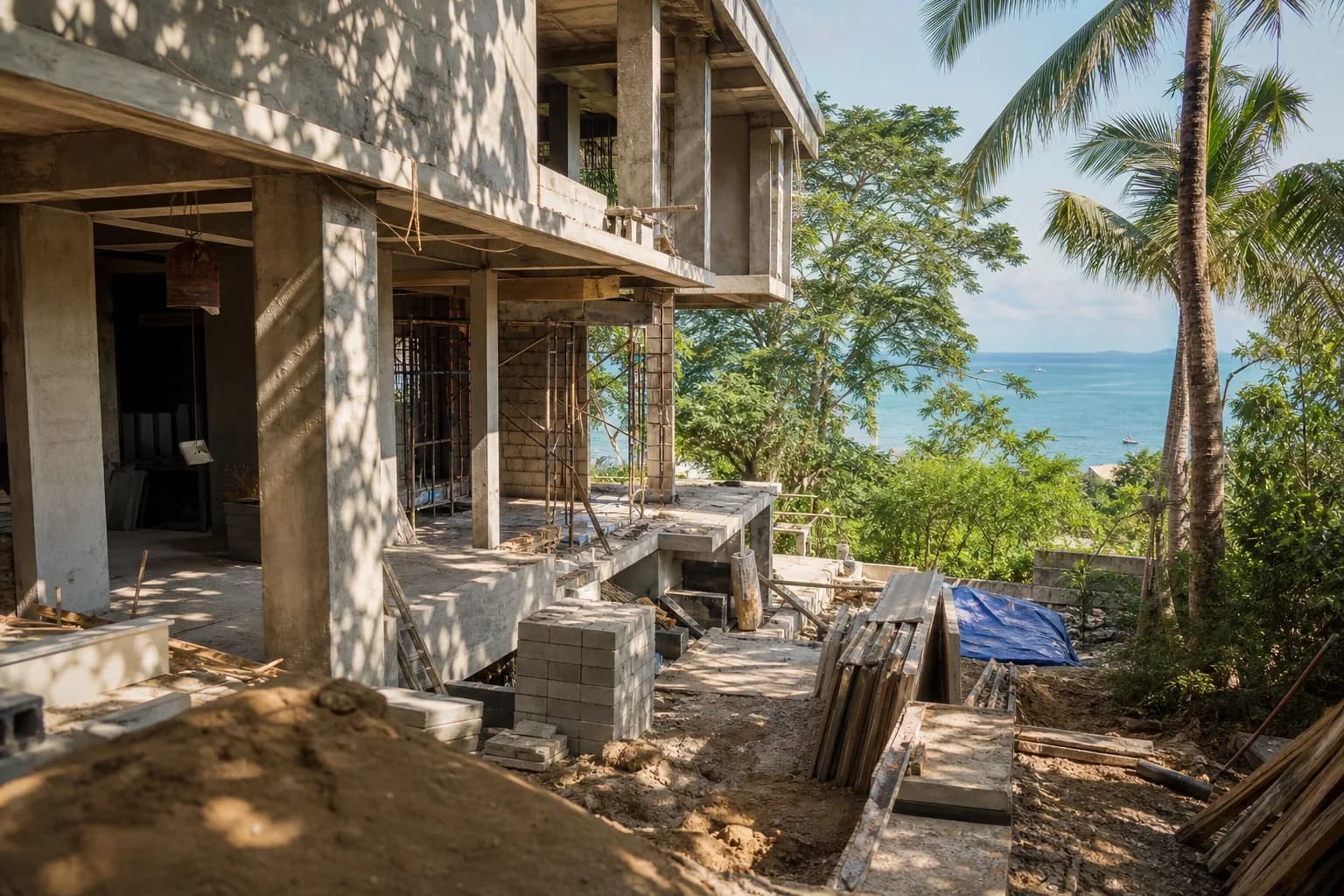
A beachfront villa owner in Sanur received a demolition order in late 2025 for a property built just 18 meters from the high-tide line—well within Bali’s mandatory 100-meter coastal setback zone. The structure, completed two years prior with what appeared to be valid permits, now faces forced removal at the owner’s expense, with penalties exceeding $45,000 and demolition costs projected at $180,000-$220,000. This case exemplifies the enforcement wave targeting Sanur’s coastal violations, where historical leniency has given way to strict regulatory action following the high-profile Bingin Beach demolitions of July 2025 that removed over 40 illegal structures.
Technical Framework: Sanur’s Coastal Setback Regulations and Enforcement Mechanisms
Sanur’s coastal development operates under Presidential Regulation No. 51/2016 concerning coastal border management, which establishes a minimum 100-meter setback from the highest tide line for all permanent structures. This regulation applies uniformly across Bali’s coastline, but Sanur presents unique enforcement challenges due to decades of pre-regulation development and complex land ownership patterns involving customary (adat) land, government-controlled beach zones, and private parcels with unclear boundaries.
The technical measurement process begins at the “pasang tertinggi” (highest tide mark), determined through tidal surveys conducted by the Ministry of Marine Affairs and Fisheries. In Sanur, this baseline shifts seasonally by 2-4 meters due to monsoon patterns and coastal erosion rates averaging 0.8-1.2 meters annually along certain stretches. Properties that appeared compliant during dry-season measurements may fall into violation during wet-season high tides, creating legal ambiguity that enforcement agencies now resolve in favor of the strictest interpretation.
The legal framework distinguishes between structures built before and after 2016. Pre-existing buildings receive conditional tolerance if they demonstrate: (1) valid IMB (building permit) issued before the regulation, (2) proof of continuous occupancy, (3) structural compliance with current safety standards, and (4) no expansion or major renovation post-2016. However, Sanur’s enforcement teams increasingly challenge “pre-existing” claims, requiring original construction documentation that many older properties cannot produce due to informal building practices common before 2010.
Violation categories carry escalating penalties. Category A violations (structures 0-50 meters from high tide) face immediate demolition orders with 30-day compliance windows. Category B violations (50-100 meters) receive modification orders requiring structural removal of encroaching elements within 90 days. Category C violations (100-150 meters with environmental impact) trigger environmental restoration requirements and fines but may avoid demolition if remediation plans are approved.
The engineering challenge in Sanur involves coastal erosion acceleration. Properties that maintained 110-meter setbacks in 2016 now measure 95-98 meters due to shoreline retreat, technically placing them in violation through no action of the owner. The regulatory response treats this as owner risk—coastal property buyers assume erosion liability, and setback compliance must account for projected 10-year erosion rates, adding 8-12 meters to the minimum 100-meter requirement for new construction.
Enforcement mechanisms include satellite imagery analysis, drone surveys, and ground verification by joint teams from the Ministry of Environment, provincial Spatial Planning Agency (Dinas Tata Ruang), and district-level building control officers. Sanur’s 2024-2025 survey identified 127 potential violations, with 34 properties receiving formal investigation notices as of early 2026. The process involves: initial site inspection, boundary survey by licensed geodetic engineers, legal review of permits and land titles, violation classification, and issuance of administrative sanctions or demolition orders.
Hidden Risks: What Property Buyers and Developers Miss in Sanur’s Coastal Zone
The most dangerous assumption involves permit validity. Many Sanur coastal properties hold IMB documents that appear legitimate but were issued by local officials without proper coastal zone clearance from provincial authorities. These “incomplete permits” provided false security for years until centralized enforcement databases cross-referenced building permits against coastal setback maps. Properties with IMB but lacking “Surat Keterangan Rencana Kota” (SKRK) spatial planning certificates now face retroactive violation status.
Leasehold agreements on coastal land create compounded risk. Foreign buyers holding 25-30 year leases on properties later deemed in violation face total investment loss—the demolition order applies to the structure regardless of lease terms, and lease payments made to Indonesian nominees provide no legal protection. Several Sanur cases involve lessees who paid $300,000-$500,000 for beachfront villa leases, only to receive demolition notices with no compensation mechanism and no recourse against the land owner who facilitated the illegal construction.
The “grandfather clause” myth persists despite clear regulatory language. Property sellers and some local agents claim pre-2016 structures are protected indefinitely, but the regulation explicitly states that pre-existing buildings lose protection upon: ownership transfer, structural modification exceeding 30% of original footprint, change of use (residential to commercial), or failure to maintain structural safety standards. A villa purchased in 2023 that was built in 2012 does not inherit grandfather protection—the new owner assumes current compliance obligations.
Environmental impact assessments (AMDAL) for coastal properties often overlook cumulative effects. A single villa 95 meters from the shoreline may receive individual approval, but when combined with neighboring developments, the collective impact triggers violation status for the entire cluster. Sanur’s Sindhu Beach area faces this scenario, where 11 individually-permitted villas now collectively violate coastal carrying capacity limits, subjecting all properties to modification orders despite individual permit validity.
Step-by-Step Compliance Verification Process for Sanur Coastal Properties
Phase 1: Boundary and Setback Verification (2-3 weeks)
Engage a licensed geodetic surveyor (surveyor berlisensi) registered with the Indonesian Geospatial Information Agency to conduct a coastal boundary survey. This requires: tidal observation over minimum 15-day period capturing spring and neap tides, establishment of the highest tide benchmark using tidal prediction models, GPS coordinate mapping of property boundaries, and calculation of perpendicular distance from highest tide line to all existing and proposed structures. The survey report must include certification that measurements account for projected 10-year erosion rates based on historical coastal change data.
Phase 2: Permit and Title Cross-Verification (3-4 weeks)
Obtain certified copies of all property documents: land title (SHM, HGB, or lease agreement), IMB building permit, SKRK spatial planning certificate, and environmental clearance (UKL-UPL or AMDAL). Submit these to the Denpasar Spatial Planning Agency for coastal zone compliance verification. Request written confirmation that the IMB was issued with proper coastal setback approval—this requires checking against the 2016-era coastal border maps (peta sempadan pantai) that many local building departments failed to reference during permit issuance.
Phase 3: Structural Compliance Assessment (1-2 weeks)
Commission a structural engineer to evaluate whether existing buildings meet current Indonesian Building Code (SNI) standards for coastal construction, including: foundation depth adequate for coastal soil conditions (minimum 2.5 meters in Sanur’s sandy substrates), corrosion-resistant reinforcement (epoxy-coated rebar or stainless steel), elevated floor levels minimum 1.2 meters above highest tide to prevent flooding, and wind load calculations for coastal exposure (minimum 120 km/h design wind speed). Non-compliant structures lose any grandfather protection even if pre-2016.
Phase 4: Violation Remediation or Legal Challenge (6-12 months)
If violations are identified, three pathways exist: (1) Voluntary modification—remove encroaching structures, restore setback compliance, and apply for amended permits (cost: $35,000-$80,000 for typical villa modifications); (2) Administrative appeal—challenge the violation determination through the provincial spatial planning appeals process, requiring legal representation and technical counter-surveys (cost: $15,000-$30,000, success rate approximately 12%); (3) Negotiated compliance—propose alternative mitigation measures such as beach restoration, public access easements, or environmental offset programs (acceptance rate varies, requires political navigation).
Phase 5: Ongoing Monitoring and Documentation (continuous)
Establish annual coastal erosion monitoring using fixed benchmark points and photographic documentation. Maintain comprehensive compliance files including all permits, survey reports, structural certifications, and correspondence with regulatory agencies. Sanur properties should budget $2,500-$4,000 annually for compliance monitoring, as setback status can change due to erosion even without any construction activity.
Financial Reality: Demolition Costs and Legal Penalties in Sanur
Forced demolition of a typical 250-square-meter two-story villa in Sanur’s coastal zone costs $180,000-$220,000, broken down as: structural demolition and material removal ($85,000-$105,000), hazardous material handling for asbestos or treated wood ($12,000-$18,000), site restoration to natural grade ($25,000-$35,000), debris transportation and disposal ($28,000-$38,000), and environmental remediation including soil testing and groundwater monitoring ($30,000-$45,000). These costs are borne entirely by the property owner, with no government compensation.
Administrative penalties for coastal setback violations range from Rp 500 million to Rp 2 billion ($31,000-$125,000 USD) depending on violation severity and structure size. Category A violations (0-50 meters from high tide) carry maximum penalties, while Category B violations (50-100 meters) typically incur Rp 750 million-Rp 1.2 billion ($47,000-$75,000). These fines are separate from demolition costs and must be paid before any appeal process can proceed.
Legal defense costs for challenging demolition orders average $25,000-$45,000 for administrative appeals through provincial agencies, and $60,000-$120,000 for judicial review through the State Administrative Court (PTUN). Success rates remain low—approximately 8-15% of coastal violation appeals result in order reversal or significant modification. The legal process typically spans 14-24 months, during which the property cannot be sold, renovated, or used for commercial purposes.
Remediation costs for properties that can avoid demolition through structural modification range from $35,000 for minor setback adjustments (removing decks, pools, or outbuildings) to $150,000 for major reconstruction (relocating entire building sections, foundation modifications, or vertical expansion to reduce footprint). These projects require new permits, engineering certifications, and typically 6-9 months of construction disruption.
Frequently Asked Questions: Sanur Coastal Violations
Can I purchase insurance to protect against demolition orders for coastal properties in Sanur?
No standard insurance product covers regulatory demolition risk in Indonesia. Title insurance available through some international providers explicitly excludes losses from government enforcement actions related to zoning or environmental violations. Some buyers attempt to negotiate seller indemnification clauses in purchase agreements, but these provide limited protection—if the seller is a nominee or offshore entity, enforcement of indemnification becomes practically impossible. The only effective protection is pre-purchase verification that the property maintains compliant setback distances with margin for projected erosion.
How do I verify if a Sanur coastal property has legitimate grandfather protection?
Request the seller to provide: (1) original IMB building permit dated before January 2016 with visible approval stamps from the provincial Spatial Planning Agency, (2) PBB (property tax) payment records showing continuous assessment from construction date to present, (3) utility connection records (PLN electricity, PDAM water) documenting occupancy timeline, and (4) written confirmation from the Denpasar Spatial Planning Agency that the property is registered in their pre-existing coastal structure database. Engage a legal consultant to verify these documents against government databases—many “original” permits are sophisticated forgeries. Even with valid grandfather status, protection terminates upon ownership transfer in most interpretations of the regulation.
What happens to property value after receiving a coastal violation notice in Sanur?
Market value typically drops 60-85% immediately upon issuance of a formal violation notice, as the property becomes effectively unsaleable through normal channels. Banks will not provide financing for properties under demolition orders, and title insurance becomes unavailable. Some distressed property buyers acquire violation properties at 10-20% of pre-notice value, gambling on successful legal appeals or regulatory changes, but this represents extreme speculation. Properties that successfully remediate violations through structural modification recover approximately 70-80% of original value, but the remediation costs and market stigma create permanent value impairment of 20-30%.
Can I convert a residential coastal villa to commercial use to gain different regulatory treatment?
No—commercial use intensifies regulatory scrutiny and typically disqualifies any grandfather protection. Coastal setback regulations apply more strictly to commercial structures, which face additional requirements including: environmental impact assessments (AMDAL) for any commercial activity within 200 meters of the shoreline, commercial building permits (IMB komersial) requiring higher structural standards, business licensing (NIB) that triggers tax and labor inspections, and public liability insurance minimums. Several Sanur
 172 m²8 month(s)from 120.000 USD
Keshava
 3127 m²9 month(s)from 177.000 USD
Mukunda
 3180 m²7 month(s)from 142.000 USD
Vasudeva
 164 m²7 month(s)from 79.000 USD
Private: Haridas Villas, Tegallalang
 2144 m²11 month(s)from 104.000 USD
Narayana

Want to calculate?
 3104 m²11 month(s)from 99.000 USD
TALA 100
164 m²7 month(s)from 79.000 USDTALA TWO
 3124 m²6 month(s)from 123.000 USD
TALA 8
 1from 198.000 USD
Private: Haridas Villas
 3173 m²6 month(s)from 125.000 USD
TALA FOUR
 4344 m²16 month(s)from 290.000 USD
Radha
Start With Real Numbers, Not Guesses
Before buying land or finalizing a design, check the realistic build cost range for your project in Bali.
Our team reviews your inputs and gives a grounded estimate.
Available lands
 1362 m²15 min$ 335468Bali, Tumbak
 700 m²7 min$ 400000Bali, Canggu
 400 m²15 min$ 67192Bali, Tabanan
 2800 m²2 min$ 713793Bali, Kedungu
 29000 m²6 min$ 3857143Bali, Tabanan
 1100 m²8 min$ 280419Bali, Ungasan
 600 m²10 min$ 206897Bali, Canggu
 5028 m²10 min$ 361000Bali, Ubud
 1000 m²10 min$ 123154Bali, Jimbaran
 6000 m²10 min$ 1330049Bali, Kutuh South Bali
 250 m²15 min$ 40025Bali, Munggu
 420 m²15 min$ 41897Bali, Tabanan
 615 m²15 min$ 113608Bali, Tabanan
 2000 m²10 min$ 243842Bali, Mengwi
 2000 m²15 min$ 523000Bali, Canggu
Essential Bali build & buy guides
- Bali villa construction cost per m² in 2026
- How much will your villa cost? Calculator
- Building a villa in Bali: the complete guide
- Buying land in Bali: step-by-step for foreigners
- Bali villa investment: yields, risks, returns
- Leasehold vs freehold: what foreigners can own
- Construction defect liability & 10-year warranty
- Bali building codes and construction standards
Related guides

Why a Cheap Bali Leasehold Is Cheap: Pricing Red Flags Every Buyer Should Decode
Suspiciously cheap Bali leaseholds are priced low for a reason: short remaining terms, forbidden zoning, missing road access, disputes or weak contracts. How to decode the discount before you pay for it.
8 min read
Fake Compliance and Licensing Agents in Bali: The 2026 Paperwork Scam and How to Verify Documents
Forged certificates, permit fixers and fake notaries: how Bali's paperwork scams work in 2026 and how to verify every property document at its government source.
7 min read
Buying a Bali Villa from Instagram: Phantom Listings, Render-Only Projects and How to Verify
Instagram is Bali's biggest property shop window and its least verified. How phantom listings, render-only projects and cloned developer accounts work — and the verification steps that expose them.
7 min read