Retainage Withholding Defect Rights in Bali Construction
The Critical Gap in Bali Construction Contracts: When Your Retainage Clause Fails to Protect Against Defects
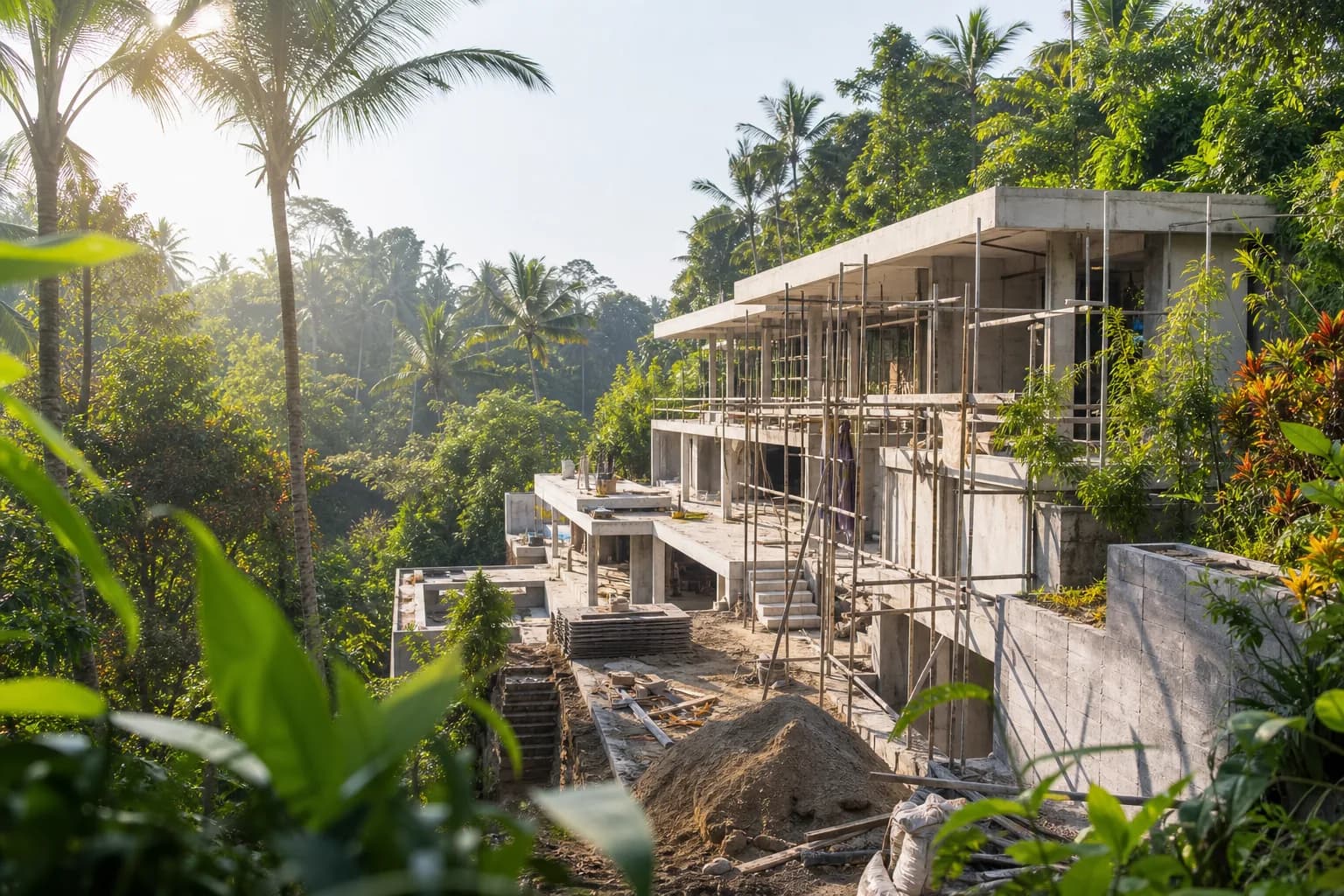
A foreign investor recently discovered that their IDR 8.5 billion villa construction in Canggu had significant structural defects—foundation settlement, waterproofing failures, and non-compliant electrical installations. Despite a contract stipulating 10% retainage withholding, the contractor had already received final payment through a poorly drafted release clause. The owner now faces IDR 450 million in remediation costs with no financial leverage. This scenario repeats across Bali because most construction contracts lack properly structured retainage withholding clauses tied to verifiable defect remediation rights. The question isn’t whether to include retainage provisions—it’s how to structure them so they actually function as enforceable protection mechanisms in Bali’s unique legal and construction environment, where informal practices often override contractual intent.
Engineering the Financial Safety Net: Technical Architecture of Retainage Withholding Systems
Retainage withholding clauses in Bali villa construction contracts function as performance-based financial instruments that secure the owner’s defect remediation rights through structured payment deferral. Unlike simple holdback provisions, properly engineered retainage systems create legally enforceable mechanisms that align contractor incentives with quality outcomes throughout the defect liability period.
Structural Components of Effective Retainage Clauses
The technical foundation requires three integrated elements: percentage-based withholding schedules, milestone-triggered release conditions, and defect-linked retention extensions. Standard practice in Indonesian construction contracts establishes 5-10% retainage on progress payments, but Bali’s tropical construction challenges—accelerated material degradation, monsoon-related defects, and complex waterproofing requirements—justify higher thresholds of 10-15% for critical building systems.
The withholding calculation methodology must specify whether retainage applies to gross contract value or net payments after variations. For a IDR 6 billion villa construction project, a 10% gross retainage creates a IDR 600 million defect remediation fund, while net calculation on a project with 15% variations reduces this to IDR 510 million—a significant difference when addressing structural failures.
Defect Classification and Remediation Triggers
Technical efficacy depends on precise defect categorization systems that trigger specific remediation rights. Critical defects—structural integrity failures, waterproofing breaches, electrical safety violations—must mandate immediate contractor response with retainage release contingent on certified repairs. Major defects affecting functionality require remediation within 14-30 days, while minor cosmetic issues allow 60-90 day correction periods.
The clause must define inspection protocols using measurable engineering standards. For tropical construction engineering in Bali, this includes concrete strength testing (minimum K-300 for structural elements), waterproofing membrane integrity verification (hydrostatic testing at 2 bar pressure for 24 hours), and electrical installation compliance with SNI 0225:2011 standards. Vague language like “satisfactory completion” creates enforcement gaps; specific technical benchmarks enable objective defect determination.
Temporal Architecture: Defect Liability Periods
The retainage withholding timeline must align with Bali’s climate-accelerated defect manifestation patterns. Standard 12-month defect liability periods prove insufficient for tropical construction where waterproofing failures, foundation settlement, and material degradation often emerge 18-24 months post-completion. Progressive release structures—50% retainage at practical completion, 30% at 12 months, 20% at 24 months—provide extended protection while maintaining contractor cash flow.
For projects incorporating building permits Bali requirements and IMB compliance verification, retainage release should be contingent on final permit issuance and occupancy certificate approval, not merely practical completion. This prevents scenarios where contractors receive payment before regulatory compliance is confirmed, leaving owners liable for permit-related modifications.
Legal Enforceability Under Indonesian Contract Law
The clause’s technical structure must withstand Indonesian Civil Code (KUHPerdata) scrutiny and align with Minister of Public Works and Housing Regulation No. 11/2021 regarding construction dispute resolution. Retainage provisions constitute conditional payment obligations under Article 1253 KUHPerdata, requiring explicit specification of conditions precedent for release. Ambiguous conditions render clauses unenforceable, allowing contractors to demand immediate payment through Indonesian courts.
Integration with Dispute Adjudication Board (DAB) mechanisms provides technical dispute resolution pathways when defect remediation disagreements arise. The clause should specify that retainage withholding continues during DAB proceedings, preventing contractors from forcing payment release through litigation delays while defects remain unresolved.
Hidden Contractual Vulnerabilities: What Foreign Buyers Consistently Overlook
The most dangerous oversight in Bali construction contracts involves retainage release triggers that bypass defect verification. Many contracts specify automatic release upon “substantial completion” or “practical completion” without defining these terms through measurable engineering criteria. Contractors exploit this ambiguity by claiming completion when 95% of work is finished, leaving critical waterproofing, electrical, or structural elements incomplete while triggering retainage release.
Foreign buyers frequently fail to recognize that Indonesian construction contracts often incorporate FIDIC-based templates modified for local practice, but these modifications typically weaken owner protections. Standard FIDIC retainage provisions include independent engineer certification requirements before release; local adaptations often eliminate this third-party verification, allowing contractor self-certification that renders the retainage clause meaningless.
The interaction between retainage clauses and Indonesian tax withholding (PPh Pasal 4 ayat 2) creates hidden vulnerabilities. Contractors sometimes argue that tax withholding obligations constitute the “retainage” amount, conflating separate legal requirements. This allows them to demand full contract payment while claiming tax withholding satisfies retention obligations—a fundamental mischaracterization that eliminates defect remediation protection.
Currency denomination presents another critical risk in land purchase Bali and construction scenarios. Contracts denominated in USD but with retainage calculated in IDR create exchange rate exposure that can erode the retention fund’s value by 15-25% over a 24-month defect liability period. A USD 400,000 project with 10% retainage (USD 40,000) calculated at IDR 15,000/USD creates a IDR 600 million fund; if released at IDR 18,000/USD, the effective retention drops to USD 33,333—a 17% reduction in defect remediation capacity.
Most critically, buyers overlook the enforcement mechanism gap. A retainage clause without specified remedies for contractor non-compliance becomes an unenforceable suggestion. If the contractor refuses to remediate defects, the clause must explicitly authorize the owner to: (1) engage third-party contractors for repairs using retainage funds, (2) offset remediation costs against retainage before release, and (3) extend the defect liability period until all defects are certified as corrected. Without these explicit remedies, owners must pursue separate breach of contract litigation—a 12-24 month process that negates the retainage clause’s protective function.
Implementation Protocol: Structuring Enforceable Retainage Protection
Step 1: Establish Percentage-Based Withholding Schedule
Begin by determining appropriate retainage percentages based on project complexity and risk profile. For standard villa construction projects in Bali, implement 10% retainage on all progress payments through practical completion. For projects involving complex engineering—hillside construction, extensive waterproofing, custom structural systems—increase to 15%. Calculate retainage on gross payment amounts before tax withholding to prevent conflation of separate obligations.
Structure the withholding schedule to apply uniformly across all payment milestones: foundation completion, structural frame, roof installation, MEP rough-in, finishing works. This creates consistent financial leverage throughout construction phases rather than concentrating retention at final payment when most work is complete and contractor motivation to address defects diminishes.
Step 2: Define Technical Completion and Defect Verification Standards
Draft explicit technical specifications that define “completion” for retainage release purposes. Reference Indonesian National Standards (SNI) for concrete (SNI 2847:2019), electrical installations (SNI 0225:2011), and plumbing systems (SNI 03-7065-2005). For tropical construction engineering elements, specify waterproofing testing protocols, timber moisture content limits (below 15% for structural elements), and HVAC system performance verification.
Require independent engineer certification before any retainage release. The certification protocol should mandate physical inspection, testing verification, and written confirmation that all work complies with contract specifications and applicable building permits Bali requirements. This third-party verification prevents contractor self-certification abuse and creates objective defect determination standards.
Step 3: Structure Progressive Release with Extended Liability
Implement a three-stage release schedule: 40% of total retainage at practical completion (after independent engineer certification and IMB issuance), 40% at 12-month defect inspection (after verification that no defects have manifested), and 20% at 24-month final inspection. This extended timeline accounts for Bali’s climate-related defect manifestation patterns while maintaining contractor engagement throughout the liability period.
Include automatic extension provisions: if defects are identified at any inspection milestone, retainage release is suspended until remediation is completed and re-certified. For critical defects affecting structural integrity or waterproofing, extend the defect liability period by an additional 12 months from remediation completion, ensuring adequate time to verify repair effectiveness.
Step 4: Integrate Enforcement and Remediation Rights
Explicitly authorize owner remediation rights within the clause: if the contractor fails to remediate identified defects within specified timeframes (7 days for critical defects, 30 days for major defects, 60 days for minor defects), the owner may engage third-party contractors to perform repairs and offset all costs against retainage funds. Include provisions for owner recovery of costs exceeding retainage amounts through separate legal action.
Specify that retainage withholding continues during any dispute resolution proceedings, whether through Dispute Adjudication Boards, arbitration, or litigation. This prevents contractors from forcing premature release through procedural delays while defect disputes remain unresolved.
Step 5: Document Currency, Calculation, and Account Management
Denominate retainage in the same currency as the primary contract to eliminate exchange rate erosion. For contracts using mixed currency structures, specify that retainage calculations use the exchange rate at the time of each progress payment, not the rate at release—this prevents contractors from benefiting from currency fluctuations during the liability period.
Consider requiring retainage funds to be held in an escrow account or bank guarantee rather than simply withheld from payments. This creates a segregated fund that cannot be claimed by contractor creditors if financial difficulties arise, ensuring defect remediation resources remain available throughout the liability period. For projects exceeding IDR 5 billion, bank guarantee structures provide superior protection despite the 1-2% annual cost.
Financial Architecture: Retainage Structures and Cost Implications
For a typical IDR 6 billion villa construction cost Bali project, a 10% retainage structure withholds IDR 600 million across the construction timeline. With eight progress payment milestones, each payment withholds approximately IDR 75 million, creating cumulative retention that reaches full value at practical completion. This represents 60-90 days of contractor operating capital, creating meaningful financial incentive for quality performance and defect remediation.
Bank guarantee alternatives cost contractors 1-2% annually of the guarantee value. For IDR 600 million retainage over a 24-month defect liability period, this represents IDR 12-24 million in guarantee fees—costs contractors typically seek to pass through to project pricing. However, bank guarantees provide superior owner protection, as they remain valid regardless of contractor financial status and can be called immediately upon defect certification without requiring contractor cooperation.
The cost of inadequate retainage protection becomes evident in defect remediation scenarios. Waterproofing failures in Bali villas typically cost IDR 150-300 million to remediate (membrane replacement, tile removal/reinstallation, structural drying). Foundation settlement repairs range from IDR 200-500 million depending on severity. Electrical system non-compliance corrections cost IDR 80-150 million. Without adequate retainage, owners bear these costs directly while pursuing lengthy breach of contract litigation.
Timeline considerations significantly impact retainage effectiveness. Standard 12-month defect liability periods prove insufficient for tropical construction; extending to 24 months increases the period during which retainage provides leverage but also extends contractor capital commitment. Progressive release structures balance these interests: releasing 40% at 12 months returns IDR 240 millio
 164 m²7 month(s)from 79.000 USD
Private: Haridas Villas, Tegallalang

Want to calculate?
 2144 m²11 month(s)from 104.000 USD
Narayana
164 m²7 month(s)from 79.000 USDTALA TWO
 3180 m²7 month(s)from 142.000 USD
Vasudeva
 1from 198.000 USD
Private: Haridas Villas
 3104 m²11 month(s)from 99.000 USD
TALA 100
 172 m²8 month(s)from 120.000 USD
Keshava
 4344 m²16 month(s)from 290.000 USD
Radha
 3173 m²6 month(s)from 125.000 USD
TALA FOUR
 3124 m²6 month(s)from 123.000 USD
TALA 8
 3127 m²9 month(s)from 177.000 USD
Mukunda
Start With Real Numbers, Not Guesses
Before buying land or finalizing a design, check the realistic build cost range for your project in Bali.
Our team reviews your inputs and gives a grounded estimate.
Available lands
 2800 m²15 min$ 310345Bali, Tabanan
 700 m²7 min$ 400000Bali, Canggu
 3000 m²15 min$ 738916Bali, Cepaka
 700 m²15 min$ 90517Bali, Central Bali
 420 m²15 min$ 41897Bali, Tabanan
 2000 m²15 min$ 523000Bali, Canggu
 1950 m²7 min$ 150092Bali, Tabanan
 928 m²15 min$ 910123Bali, Pererenan
 220 m²2 min$ 66565Bali, Cemagi
 2200 m²15 min$ 508005Bali, Canggu
 585 m²8 min$ 165702Bali, Mengwi
 2850 m²15 min$ 315887Bali, Tabanan
 1660 m²10 min$ 343448Bali, Kerobokan
 700 m²20 min$ 90517Bali, Cepaka
 1000 m²8 min$ 134544Bali, Bukit
Essential Bali build & buy guides
- Bali villa construction cost per m² in 2026
- How much will your villa cost? Calculator
- Building a villa in Bali: the complete guide
- Buying land in Bali: step-by-step for foreigners
- Bali villa investment: yields, risks, returns
- Leasehold vs freehold: what foreigners can own
- Construction defect liability & 10-year warranty
- Bali building codes and construction standards
Related guides

Why a Cheap Bali Leasehold Is Cheap: Pricing Red Flags Every Buyer Should Decode
Suspiciously cheap Bali leaseholds are priced low for a reason: short remaining terms, forbidden zoning, missing road access, disputes or weak contracts. How to decode the discount before you pay for it.
8 min read
Fake Compliance and Licensing Agents in Bali: The 2026 Paperwork Scam and How to Verify Documents
Forged certificates, permit fixers and fake notaries: how Bali's paperwork scams work in 2026 and how to verify every property document at its government source.
7 min read
Buying a Bali Villa from Instagram: Phantom Listings, Render-Only Projects and How to Verify
Instagram is Bali's biggest property shop window and its least verified. How phantom listings, render-only projects and cloned developer accounts work — and the verification steps that expose them.
7 min read