Payment Guarantee Bonds vs Bank Guarantees in Bali
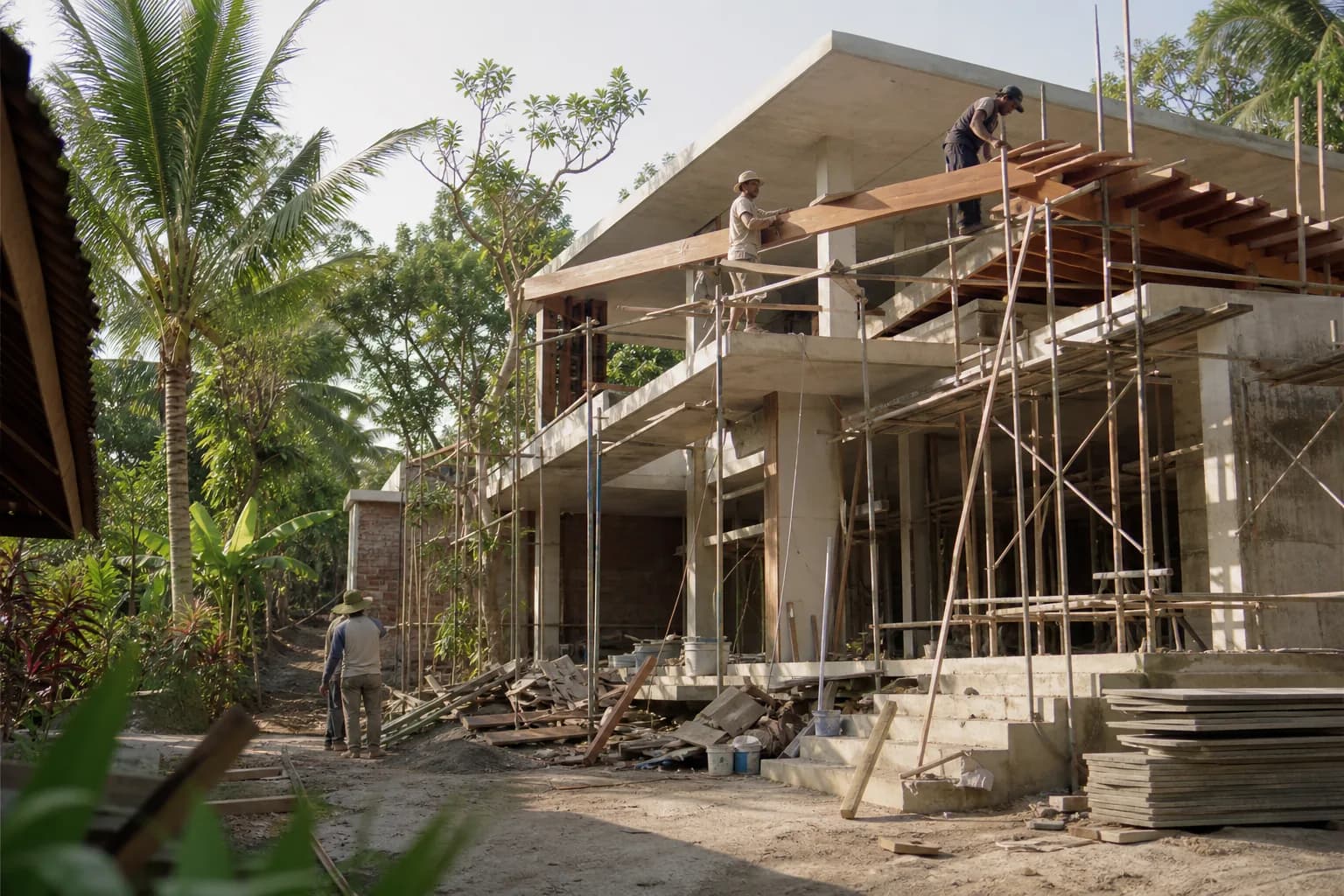
Payment Guarantee Bonds vs Bank Guarantees: Bali Contractor Default Protection
When a foreign investor commits USD $400,000 to villa construction in Bali only to discover their contractor has vanished with advance payments while subcontractors place liens on the half-finished structure, the absence of proper financial security instruments becomes devastatingly clear. In Bali’s construction sector, where contractor default rates have increased 23% since 2022 according to local construction dispute data, understanding the critical distinction between Payment Guarantee Bonds and Bank Guarantees isn’t academic—it’s the difference between recovering your investment and losing everything to legal battles with unpaid suppliers who now have legal claims against your property title.
Technical Architecture of Financial Security Instruments in Indonesian Construction Law
Payment Guarantee Bonds and Bank Guarantees operate under fundamentally different legal frameworks within Indonesia’s construction regulatory environment, each triggering distinct mechanisms when contractor default occurs during villa construction projects in Bali.
Payment Guarantee Bond Structure
A Payment Guarantee Bond in Indonesian construction contexts functions as a tripartite surety arrangement involving the principal (contractor), the obligee (property owner), and the surety (typically an insurance company licensed by OJK—Otoritas Jasa Keuangan). Under this structure, the surety guarantees payment to subcontractors and material suppliers if the principal contractor defaults on these obligations. The bond is conditional, activating only upon documented proof of default and unpaid legitimate claims.
The technical activation process requires the claimant (subcontractor or supplier) to provide: (1) executed subcontract agreements with the defaulting contractor, (2) delivery receipts or work completion certificates, (3) unpaid invoices beyond agreed payment terms, and (4) formal notice of claim to both contractor and surety. The surety then conducts investigation—typically 14-21 business days—before determining claim validity. This conditional nature means frivolous claims face scrutiny, but legitimate unpaid parties receive protection without the property owner bearing direct liability beyond the bond premium.
For Bali construction projects, Payment Guarantee Bonds typically cover 10-15% of total contract value, specifically protecting against subcontractor payment defaults. When a contractor fails to pay the steel supplier who delivered 40 tons of reinforcement bar, or the formwork subcontractor who completed foundation work, the bond ensures these parties receive payment without placing liens on the owner’s property or halting construction.
Bank Guarantee Mechanisms
Bank Guarantees issued by Indonesian banks operate as unconditional payment commitments under UU No. 10/1998 concerning Banking. When a bank issues a guarantee, it creates an independent obligation separate from the underlying construction contract. The bank commits to pay the beneficiary (property owner) upon presentation of compliant demand documents, regardless of whether actual default has occurred or disputes exist between owner and contractor.
This unconditional characteristic—while providing stronger security to the beneficiary—creates different risk dynamics. A bank guarantee for advance payment protection might be called immediately if the owner claims non-performance, even if the contractor disputes this claim. The bank pays first, then the contractor must pursue recovery through separate legal proceedings if the call was unjustified.
Indonesian banks typically structure construction guarantees in three categories: (1) Bid Bonds (jaminan penawaran), (2) Performance Bonds (jaminan pelaksanaan), and (3) Advance Payment Bonds (jaminan uang muka). Each serves distinct purposes, but none specifically protect subcontractors and suppliers—they protect the property owner against contractor non-performance.
Critical Legal Distinctions Under Indonesian Law
The fundamental difference emerges in Pasal 1820-1850 of the Indonesian Civil Code governing suretyship (borgtocht) versus independent bank guarantees. Payment Guarantee Bonds fall under suretyship principles—accessory obligations dependent on the underlying debt’s validity. Bank Guarantees are independent undertakings where the bank’s obligation exists separately from the construction contract’s performance.
For tropical construction engineering projects in Bali, this distinction determines recovery speed and legal complexity when defaults occur. Bank guarantees enable faster fund access (typically 5-7 business days after compliant demand), while Payment Guarantee Bonds require default investigation (14-30 days) but provide more targeted protection against the specific risk of subcontractor non-payment cascading into construction liens.
Hidden Risks Buyers Overlook in Bali Contractor Default Scenarios
Foreign property owners consistently underestimate three critical vulnerabilities when structuring financial security for Bali villa construction without proper understanding of these instruments’ operational differences.
The Subcontractor Lien Cascade
Indonesian construction law grants subcontractors and material suppliers preferential creditor status under certain conditions. When a contractor receives advance payment but fails to pay subcontractors, those unpaid parties can pursue legal claims that attach to the property itself—not just the contractor. A bank guarantee protecting your advance payment to the contractor provides zero protection against this scenario. You might recover funds from the contractor’s bank guarantee, but still face IDR 800 million in subcontractor claims with legal standing to block your IMB (building permit) renewal or property transfer.
Payment Guarantee Bonds specifically address this gap by ensuring subcontractors receive payment even when the general contractor defaults, preventing the lien cascade before it starts. Yet fewer than 12% of foreign-owned villa construction projects in Bali implement these bonds, focusing instead solely on bank guarantees that protect owner-contractor payment flows while leaving subcontractor payment risks entirely unaddressed.
Unconditional Guarantee Abuse Potential
Bank guarantees’ unconditional nature creates exploitation risk in construction disputes. If relationship deterioration occurs mid-project—perhaps over design changes or timeline disagreements—an unscrupulous owner could call the bank guarantee claiming default even when the contractor has performed adequately. The bank pays immediately, and the contractor must pursue lengthy legal recovery. Conversely, this same unconditional feature protects owners from contractors who dispute every claim to delay payment obligations.
This dynamic rarely appears in pre-construction discussions, yet it fundamentally shapes project risk allocation. For land purchase and construction projects in Bali, understanding whether your security structure incentivizes or discourages good-faith dispute resolution becomes critical when inevitable construction challenges arise.
Currency and Cross-Border Enforcement Gaps
Most Indonesian bank guarantees are issued in IDR and governed by Indonesian law with jurisdiction in Indonesian courts. When a Singapore-based owner needs to call a guarantee issued by a Denpasar bank branch, currency conversion timing and cross-border fund transfer regulations under Bank Indonesia rules can delay actual fund receipt by 3-4 weeks beyond the guarantee’s technical payment obligation. Payment Guarantee Bonds from international surety providers may offer multi-currency settlement and alternative dispute resolution mechanisms, but at 40-60% higher premium costs.
Step-by-Step Implementation Process for Dual-Layer Protection
Implementing comprehensive contractor default protection for Bali villa construction requires layered security addressing both owner-contractor and contractor-subcontractor payment chains.
Step 1: Risk Assessment and Security Structure Design (Weeks 1-2)
Before requesting any financial instruments, conduct structured risk assessment identifying specific default scenarios and their financial impacts. For a USD $350,000 villa construction project, map payment flows: owner advance payment (typically 30%), progress payments (50% across milestones), and retention (20% at completion). Then map contractor-to-subcontractor flows: foundation subcontractor (12% of contract value), structural frame (18%), MEP installation (15%), finishing trades (22%).
This mapping reveals that while a 30% advance payment bank guarantee protects your USD $105,000 advance, it provides zero protection if the contractor receives your progress payments but fails to pay the structural steel subcontractor, whose unpaid IDR 600 million claim could halt your project for 6-9 months in legal proceedings.
Design security structure accordingly: (1) Advance Payment Bank Guarantee covering 30% of contract value, (2) Performance Bank Guarantee covering 10% of contract value for completion obligations, and (3) Payment Guarantee Bond covering 15% of contract value specifically for subcontractor/supplier payment defaults.
Step 2: Surety and Bank Selection (Weeks 2-3)
For bank guarantees, select Indonesian banks with strong credit ratings (minimum A- from Fitch or equivalent) and established construction guarantee departments. Bank Mandiri, BCA, and BNI maintain specialized construction finance units familiar with villa construction security instruments. Request guarantee drafts in advance, ensuring they specify: unconditional payment obligation, compliant demand document requirements, expiry date extending 90 days beyond projected completion, and automatic extension clauses if construction extends.
For Payment Guarantee Bonds, identify surety providers licensed by OJK with construction bond experience. International providers like Zurich or AIG operating through Indonesian subsidiaries offer stronger financial backing but charge 2.5-4% annual premiums. Domestic providers like Askrindo or Jamkrindo charge 1.5-2.5% but may have slower claims processing. Verify the surety’s claims payment history—request references from contractors who’ve had claims processed.
Step 3: Documentation and Issuance (Weeks 3-5)
Bank guarantee issuance requires the contractor to provide counter-guarantee (typically cash collateral of 100-120% of guarantee value or credit facility allocation). This requirement itself serves as contractor financial health screening—contractors unable to secure bank guarantees may lack financial stability for your project.
Payment Guarantee Bond issuance requires more extensive underwriting: contractor financial statements (3 years), project portfolio, current project commitments, and subcontractor payment history. The surety assesses contractor default probability before issuing bonds. This underwriting provides valuable third-party due diligence on your contractor’s financial viability.
Ensure all instruments reference the specific construction contract by date and parties, specify the project address with land certificate number, and define trigger events precisely. Vague language like “upon default” should be replaced with specific conditions: “upon contractor’s failure to pay subcontractor invoices within 45 days of invoice date, as evidenced by…”
Step 4: Integration with Construction Contract (Week 5)
The construction contract must explicitly require these security instruments as conditions precedent to contract effectiveness. Include provisions that: (1) no payments are due until all required guarantees and bonds are in place, (2) guarantees and bonds must remain valid through final completion plus 90 days, (3) contractor must renew or extend instruments if construction extends beyond original timeline, and (4) failure to maintain required security constitutes material breach enabling contract termination.
For villa construction cost estimation and contracting, factor security instrument costs into the overall project budget. These aren’t contractor profit items—they’re project costs that protect all parties and should be transparently allocated.
Step 5: Active Monitoring and Claim Preparation (Throughout Construction)
Maintain organized records of all payment transactions, subcontractor agreements (request copies from your contractor monthly), and delivery receipts. If contractor payment delays to subcontractors emerge, document everything immediately. Under Payment Guarantee Bonds, you may need to file claims on behalf of unpaid subcontractors to prevent liens, which requires complete documentation of their legitimate claims.
Monitor bank guarantee expiry dates closely. If construction extends, initiate guarantee extension requests 45 days before expiry—banks require contractor cooperation for extensions, which becomes difficult if relationships have deteriorated.
Realistic Cost Structures and Timeline Implications
For a representative USD $400,000 villa construction project in Bali (approximately IDR 6.2 billion at current rates), comprehensive financial security implementation involves specific cost allocations and timeline considerations.
Bank Guarantee Costs
Advance Payment Bank Guarantee (30% of contract value = USD $120,000): Annual fee of 1.5-2.5% of guarantee value = USD $1,800-3,000 annually. For an 18-month construction timeline, total cost reaches USD $2,700-4,500. The contractor typically pays this cost but passes it through in contract pricing.
Performance Bank Guarantee (10% of contract value = USD $40,000): Annual fee of 2-3% = USD $800-1,200 annually, or USD $1,200-1,800 for 18 months.
Payment Guarantee Bond Costs
Payment Guarantee Bond (15% of contract value = USD $60,000 coverage): Annual premium of 2-4% of bond value = USD $1,200-2,400 annually, or USD $1,800-3,600 for 18 months. Higher premiums apply for contractors with limited track records or financial concerns.
Total Security Cost Investment
Combined security instruments for this project total USD $5,700-9,900 over 18 months—approximately 1.4-2.5% of total project value. This investment protects against default scenarios that could result in 100% capital loss plus legal costs of USD $30,000-80,000 in Indonesian construction dispute proceedings.
Timeline Considerations
Securit
 172 m²8 month(s)from 120.000 USD
Keshava
 3104 m²11 month(s)from 99.000 USD
TALA 100
 3124 m²6 month(s)from 123.000 USD
TALA 8
 1from 198.000 USD
Private: Haridas Villas
 164 m²7 month(s)from 79.000 USD
TALA TWO
 3127 m²9 month(s)from 177.000 USD
Mukunda
164 m²7 month(s)from 79.000 USDPrivate: Haridas Villas, Tegallalang
 3180 m²7 month(s)from 142.000 USD
Vasudeva
 2144 m²11 month(s)from 104.000 USD
Narayana

Want to calculate?
 3173 m²6 month(s)from 125.000 USD
TALA FOUR
 4344 m²16 month(s)from 290.000 USD
Radha
Start With Real Numbers, Not Guesses
Before buying land or finalizing a design, check the realistic build cost range for your project in Bali.
Our team reviews your inputs and gives a grounded estimate.
Available lands
 500 m²15 min$ 124692Bali, Kaba Kaba
 3800 m²15 min$ 100616Bali, Pererenan
 7900 m²25 min$ 413485Bali, Tabanan
 1000 m²5 min$ 350431Bali, Drupadi
 6000 m²30 min$ 55419Bali, Tabanan
 700 m²20 min$ 90517Bali, Cepaka
 1158 m²12 min$ 291996Bali, Mengwi
 220 m²2 min$ 66565Bali, Cemagi
 1000 m²10 min$ 384852Bali, Canggu
 6000 m²10 min$ 1330049Bali, Kutuh South Bali
 2000 m²5 min$ 738916Bali, Ungasan
 29000 m²6 min$ 3857143Bali, Tabanan
 2800 m²15 min$ 310345Bali, Tabanan
 1100 m²8 min$ 280419Bali, Ungasan
 515 m²7 min$ 570813Bali, Canggu
Essential Bali build & buy guides
- Bali villa construction cost per m² in 2026
- How much will your villa cost? Calculator
- Building a villa in Bali: the complete guide
- Buying land in Bali: step-by-step for foreigners
- Bali villa investment: yields, risks, returns
- Leasehold vs freehold: what foreigners can own
- Construction defect liability & 10-year warranty
- Bali building codes and construction standards
Related guides

Why a Cheap Bali Leasehold Is Cheap: Pricing Red Flags Every Buyer Should Decode
Suspiciously cheap Bali leaseholds are priced low for a reason: short remaining terms, forbidden zoning, missing road access, disputes or weak contracts. How to decode the discount before you pay for it.
8 min read
Fake Compliance and Licensing Agents in Bali: The 2026 Paperwork Scam and How to Verify Documents
Forged certificates, permit fixers and fake notaries: how Bali's paperwork scams work in 2026 and how to verify every property document at its government source.
7 min read
Buying a Bali Villa from Instagram: Phantom Listings, Render-Only Projects and How to Verify
Instagram is Bali's biggest property shop window and its least verified. How phantom listings, render-only projects and cloned developer accounts work — and the verification steps that expose them.
7 min read