Hidden Liability Gaps in Bali Contractor Insurance
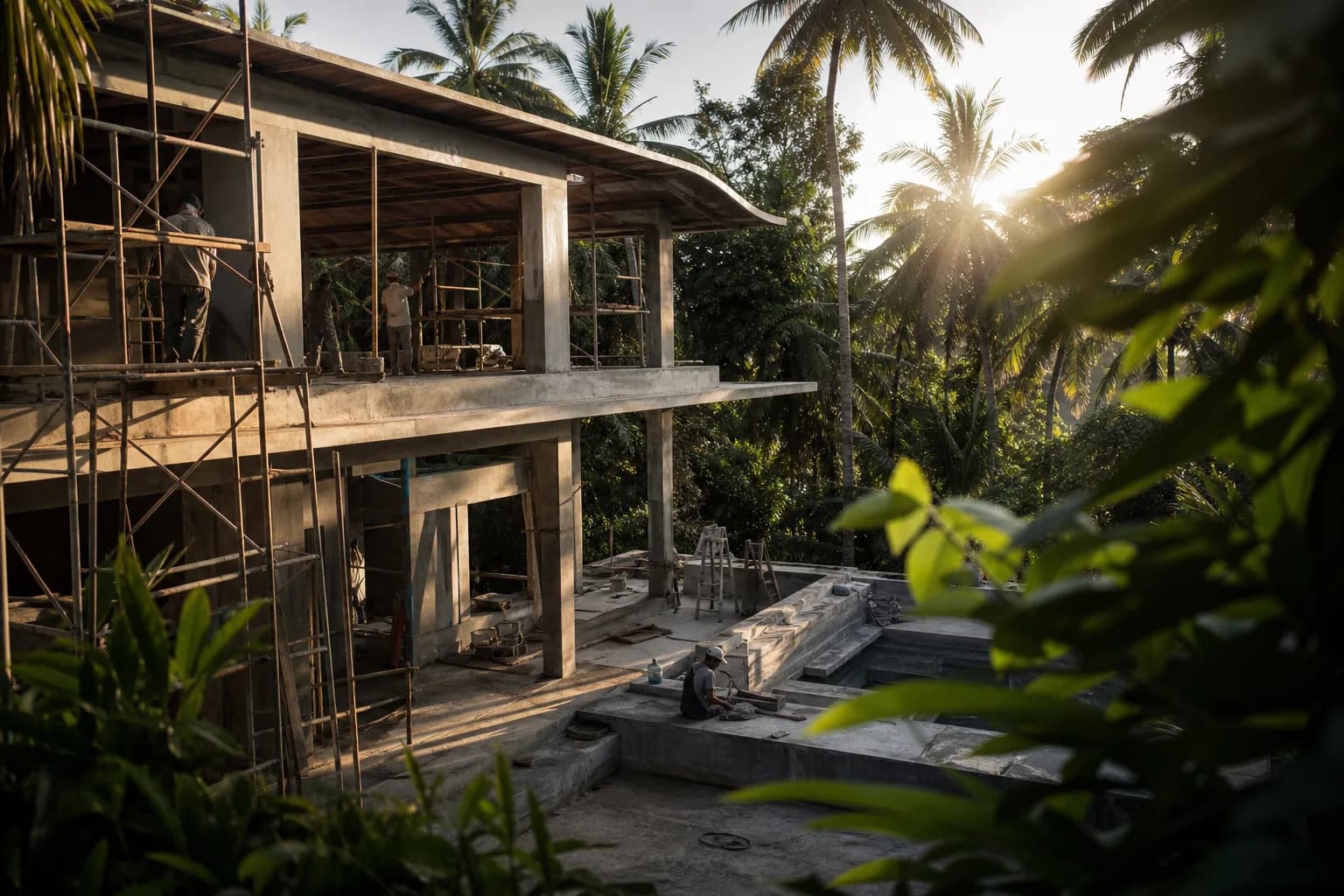
The Critical Problem: When Your Bali Contractor’s Insurance Certificate Hides Catastrophic Coverage Gaps
A foreign property owner in Canggu discovered their contractor’s “comprehensive” insurance policy excluded completed operations liability—three months after handover, when structural water damage from improper waterproofing triggered a $47,000 repair claim that the insurer denied. The certificate of insurance (COI) appeared legitimate, listing general liability coverage at IDR 5 billion, but buried exclusions and endorsement gaps rendered it nearly worthless for post-construction defects. This scenario repeats across Bali’s construction sector, where insurance verification processes rarely catch the liability gaps that matter most: tropical-specific perils, subcontractor default coverage, professional indemnity for design-build contracts, and the critical distinction between occurrence-based and claims-made policies in Indonesia’s evolving insurance regulatory environment.
Technical Architecture of Contractor Insurance Verification in Bali’s Construction Context
Bali contractor insurance verification requires understanding three distinct liability layers that Indonesian construction law and international best practices demand: general liability (pertanggungan umum), professional indemnity (pertanggungan profesional), and construction all-risk (CAR) policies. The hidden gaps emerge at the intersection of these coverage types and Bali’s specific risk environment.
Primary Coverage Architecture and Exclusion Patterns
Standard Indonesian general liability policies typically provide third-party bodily injury and property damage coverage, with limits ranging from IDR 2-10 billion ($125,000-$625,000 USD) for mid-tier contractors. However, the critical gap lies in completed operations coverage—the extension that covers defects discovered after project handover. Most basic policies terminate liability at practical completion, leaving a 2-10 year exposure window uncovered precisely when latent defects in tropical waterproofing, foundation settlement, or structural connections manifest.
The 2026 contractual shifts in construction insurance emphasize additional insured endorsements and primary and non-contributory clauses. In Bali’s context, this means property owners should verify that their interest is named as an additional insured on the contractor’s policy, with their coverage applying primary to any owner-held builder’s risk policy. Without this endorsement hierarchy, insurance disputes default to contribution battles between multiple policies, delaying claims resolution by 8-18 months in Indonesian courts.
Tropical-Specific Peril Exclusions
Bali’s insurance market presents unique exclusion patterns for tropical construction risks. Standard policies often exclude or severely limit coverage for: mold and fungus damage (critical given 80%+ humidity), earth movement and subsidence (relevant for volcanic soil conditions), flood damage below certain elevations (increasingly important with monsoon intensification), and corrosion-related failures (affecting steel reinforcement in coastal zones within 3km of shoreline).
The verification gap occurs because certificates of insurance rarely detail these exclusions. A COI might list “General Liability – IDR 5,000,000,000” without disclosing that water intrusion claims require separate endorsements, or that the policy excludes liability for design defects in design-build contracts—the dominant delivery method for Bali villa construction. Professional indemnity coverage, which addresses design errors, typically requires separate policies with premiums 40-60% higher than basic liability coverage, yet fewer than 30% of Bali contractors maintain this protection.
Subcontractor Default and Downstream Liability Chains
Bali construction projects typically involve 12-25 specialized subcontractors (foundation specialists, steel fabricators, waterproofing applicators, pool engineers, MEP contractors). The liability verification gap widens when general contractors fail to maintain contingent liability coverage for subcontractor defaults or when subcontractor insurance certificates aren’t independently verified.
Indonesian construction law (LPJK regulations) requires contractors to maintain insurance, but enforcement mechanisms remain weak. A general contractor might present valid insurance while their critical-path subcontractors—particularly waterproofing and structural specialists—carry inadequate or expired coverage. When a subcontractor’s work fails and that entity has dissolved (common with small Bali-based specialty contractors), the liability chain breaks unless the general contractor’s policy includes contingent bodily injury and property damage coverage for subcontractor gaps.
Hidden Risks Property Owners Miss During Insurance Verification
The most dangerous verification gap involves occurrence versus claims-made policy structures. Occurrence-based policies cover incidents that occur during the policy period regardless of when claims are filed—ideal for construction defects that manifest years later. Claims-made policies only respond if both the incident and the claim filing occur during the active policy period. If a contractor completes your villa in 2026 under a claims-made policy, then doesn’t renew that policy in 2027, you have zero coverage for defects discovered in 2028, even if the defect originated from 2026 construction work.
Indonesian insurance regulations don’t mandate occurrence-based coverage for construction, and claims-made policies cost 25-35% less, creating financial incentive for contractors to choose inadequate structures. Verification requires examining the policy declarations page, not just the certificate—yet fewer than 15% of property owners request this documentation.
The second critical gap involves aggregate versus per-occurrence limits. A policy listing IDR 5 billion coverage might have a per-occurrence limit of IDR 5 billion but an aggregate annual limit of IDR 8 billion. If your contractor faces multiple claims across different projects in the same policy year, the aggregate limit depletes, potentially leaving your claim partially uncovered. This scenario intensified in 2024-2025 as Bali’s construction boom increased claim frequency across contractor portfolios.
Geographic limitations present another hidden risk. Some Indonesian policies restrict coverage to specific kabupaten (regencies) or exclude coverage for work performed in “high-risk coastal zones”—definitions that might encompass premium villa locations in Uluwatu, Canggu, or Seminyak. The certificate won’t flag these geographic exclusions; only the full policy schedule reveals them.
Step-by-Step Insurance Verification Process for Bali Construction Contracts
Step 1: Request Complete Documentation Package (Week 1 of Contractor Selection)
Demand the following from prospective contractors: (1) Current certificate of insurance with issue date within 30 days, (2) Full policy declarations page showing coverage structure, limits, deductibles, and exclusions, (3) Additional insured endorsement draft showing your name/entity, (4) Loss runs for the past 36 months showing claim history, (5) Direct contact information for the insurance broker and underwriter. Legitimate contractors with proper coverage provide this within 3-5 business days. Delays or incomplete responses signal potential gaps.
Step 2: Independent Verification with Insurance Provider (Week 2)
Contact the listed insurance company directly using contact information you source independently (not from the contractor’s documents) to verify: (1) Policy active status and premium payment currency, (2) Coverage limits and whether they’re per-occurrence or aggregate, (3) Specific exclusions relevant to your project scope, (4) Whether the policy is occurrence-based or claims-made, (5) Confirmation that additional insured endorsements can be issued. Indonesian insurance companies typically respond to verification requests within 5-7 business days when contacted in Bahasa Indonesia with proper authorization from the contractor.
Step 3: Gap Analysis Against Project-Specific Risks (Week 2-3)
Map the verified coverage against your project’s risk profile: For coastal properties (within 3km of ocean), confirm coverage includes corrosion-related failures and salt-air exposure damage. For hillside sites, verify earth movement and retaining wall failure coverage. For projects with pools, confirm separate pool engineering liability coverage (often excluded from general policies). For design-build contracts, verify professional indemnity coverage exists separately with limits matching general liability. Document all identified gaps in writing.
Step 4: Negotiate Coverage Enhancements and Contract Language (Week 3-4)
For identified gaps, negotiate either: (1) Contractor purchases additional endorsements (cost typically 8-15% of base premium per endorsement), (2) Owner purchases separate owner-controlled insurance program (OCIP) covering specific gaps, or (3) Contract includes specific indemnification language and financial guarantees (bank guarantees or retention holdbacks) addressing uncovered risks. Ensure construction contract explicitly states: “Contractor shall maintain occurrence-based general liability coverage with completed operations extension for minimum 10 years post-completion, with Owner named as additional insured on primary and non-contributory basis.”
Step 5: Ongoing Verification and Renewal Monitoring (Throughout Construction + 10 Years Post-Completion)
Establish quarterly verification checkpoints during construction to confirm: (1) Premium payments remain current (request payment receipts), (2) Coverage hasn’t been reduced or cancelled, (3) No material changes to exclusions or endorsements, (4) Subcontractor certificates remain valid for active trades. Post-completion, require contractor to provide annual proof of continued coverage for the completed operations period, with contract language triggering financial penalties (typically 2-5% of contract value) for coverage lapses.
Realistic Cost and Timeline Implications for Proper Insurance Verification
Comprehensive insurance verification adds 3-4 weeks to contractor selection timelines but prevents exposure to uninsured losses averaging $35,000-$180,000 for typical Bali villa projects when defects occur. Professional insurance verification services in Bali (offered by risk management consultants and specialized legal firms) cost IDR 15-35 million ($950-$2,200 USD) for complete due diligence on contractor insurance packages.
For contractors to upgrade from basic to comprehensive coverage meeting international standards, expect premium increases of 40-85% above baseline costs. A contractor building a $400,000 USD villa might pay IDR 45-65 million ($2,800-$4,100 USD) annually for basic general liability, versus IDR 85-140 million ($5,300-$8,750 USD) for occurrence-based coverage with completed operations extension, professional indemnity, and proper endorsements. These costs typically add 0.8-1.4% to total project costs but provide coverage for 10+ years post-completion.
The timeline for securing proper additional insured endorsements averages 12-18 business days in Indonesia’s insurance market, requiring coordination between contractor, broker, and underwriter. Budget 3-4 weeks between contract signing and construction commencement to finalize insurance documentation properly. Projects that skip this verification phase save 3 weeks upfront but face average claim resolution timelines of 14-26 months when uninsured defects emerge, with legal costs alone reaching IDR 80-200 million ($5,000-$12,500 USD) for dispute resolution.
Frequently Asked Questions: Bali Contractor Insurance Verification
What’s the difference between a Certificate of Insurance and actual proof of adequate coverage for Bali construction?
A Certificate of Insurance (COI) is a summary document that confirms a policy exists and lists basic coverage types and limits, but it doesn’t disclose exclusions, endorsements, deductibles, or policy structure (occurrence vs. claims-made). In Bali’s construction context, COIs often show “General Liability – IDR 5 billion” without revealing that the policy excludes completed operations, has a claims-made structure that expires at project completion, or contains tropical-specific exclusions for mold, corrosion, or water intrusion. Adequate proof requires the full policy declarations page, schedule of exclusions, and specific endorsement documents. Request these directly from contractors and verify authenticity with the insurance company independently—legitimate policies can be confirmed within 5-7 business days through direct insurer contact.
How do I verify that my contractor’s insurance will actually cover defects discovered 2-5 years after villa completion?
Verify three specific elements: (1) The policy must be occurrence-based (not claims-made), which covers incidents during the policy period regardless of when claims are filed, (2) The policy must include a completed operations extension or products-completed operations hazard coverage—this specific endorsement extends liability beyond project handover, (3) Confirm the contractor commits contractually to maintaining this coverage (or purchasing an extended reporting period/tail coverage) for a specified period post-completion, typically 5-10 years. Request the policy declarations page and search for language like “claims-made” (inadequate) versus “occurrence form” (adequate), and verify a separate premium line item for “completed operations” coverage. If the contractor can’t provide this documentation, the policy likely terminates at practical completion, leaving you exposed to the highest-risk period when latent defects manifest.
What insurance gaps are most dangerous for tropical villa construction that standard policies don’t cover?
The four most critical gaps for Bali villa construction are: (1) Water intrusion and mold exclusions—standard policies often exclude gradual water damage and fungus/mold, yet these represent 40-55% of post-completion claims in tropical climates; proper coverage requires specific endorsements for “water damage legal liability” and removal of mold exclusions, (2) 172 m²8 month(s)from 120.000 USD
Keshava
 3124 m²6 month(s)from 123.000 USD
TALA 8
 164 m²7 month(s)from 79.000 USD
Private: Haridas Villas, Tegallalang
 3104 m²11 month(s)from 99.000 USD
TALA 100
 1from 198.000 USD
Private: Haridas Villas
164 m²7 month(s)from 79.000 USDTALA TWO
 3180 m²7 month(s)from 142.000 USD
Vasudeva
 3173 m²6 month(s)from 125.000 USD
TALA FOUR
 3127 m²9 month(s)from 177.000 USD
Mukunda

Want to calculate?
 2144 m²11 month(s)from 104.000 USD
Narayana
 4344 m²16 month(s)from 290.000 USD
Radha
Start With Real Numbers, Not Guesses
Before buying land or finalizing a design, check the realistic build cost range for your project in Bali.
Our team reviews your inputs and gives a grounded estimate.
Available lands
 911 m²15 min$ 248217Bali, Pererenan
 2850 m²15 min$ 315887Bali, Tabanan
 1000 m²8 min$ 134544Bali, Bukit
 10000 m²19 min$ 232759Bali, Buleleng
 2000 m²15 min$ 110837Bali, Karangasem
 1700 m²10 min$ 632257Bali, Kuta
 1600 m²32 min$ 266010Bali, Tabanan
 1350 m²5 min$ 283467Bali, Pecatu
 1720 m²2 min$ 241478Bali, Tabanan
 1000 m²10 min$ 303571Bali, Tabanan
 700 m²15 min$ 162500Bali, Tabanan
 2000 m²15 min$ 261700Bali, Babakan
 1362 m²15 min$ 335468Bali, Tumbak
 200 m²11 min$ 89286Bali, Tabanan
 4270 m²10 min$ 394397Bali, Ubud
Essential Bali build & buy guides
- Bali villa construction cost per m² in 2026
- How much will your villa cost? Calculator
- Building a villa in Bali: the complete guide
- Buying land in Bali: step-by-step for foreigners
- Bali villa investment: yields, risks, returns
- Leasehold vs freehold: what foreigners can own
- Construction defect liability & 10-year warranty
- Bali building codes and construction standards
Related guides

Why a Cheap Bali Leasehold Is Cheap: Pricing Red Flags Every Buyer Should Decode
Suspiciously cheap Bali leaseholds are priced low for a reason: short remaining terms, forbidden zoning, missing road access, disputes or weak contracts. How to decode the discount before you pay for it.
8 min read
Fake Compliance and Licensing Agents in Bali: The 2026 Paperwork Scam and How to Verify Documents
Forged certificates, permit fixers and fake notaries: how Bali's paperwork scams work in 2026 and how to verify every property document at its government source.
7 min read
Buying a Bali Villa from Instagram: Phantom Listings, Render-Only Projects and How to Verify
Instagram is Bali's biggest property shop window and its least verified. How phantom listings, render-only projects and cloned developer accounts work — and the verification steps that expose them.
7 min read