Gianyar Termite Treatment Costs Bali | Pre-Construction
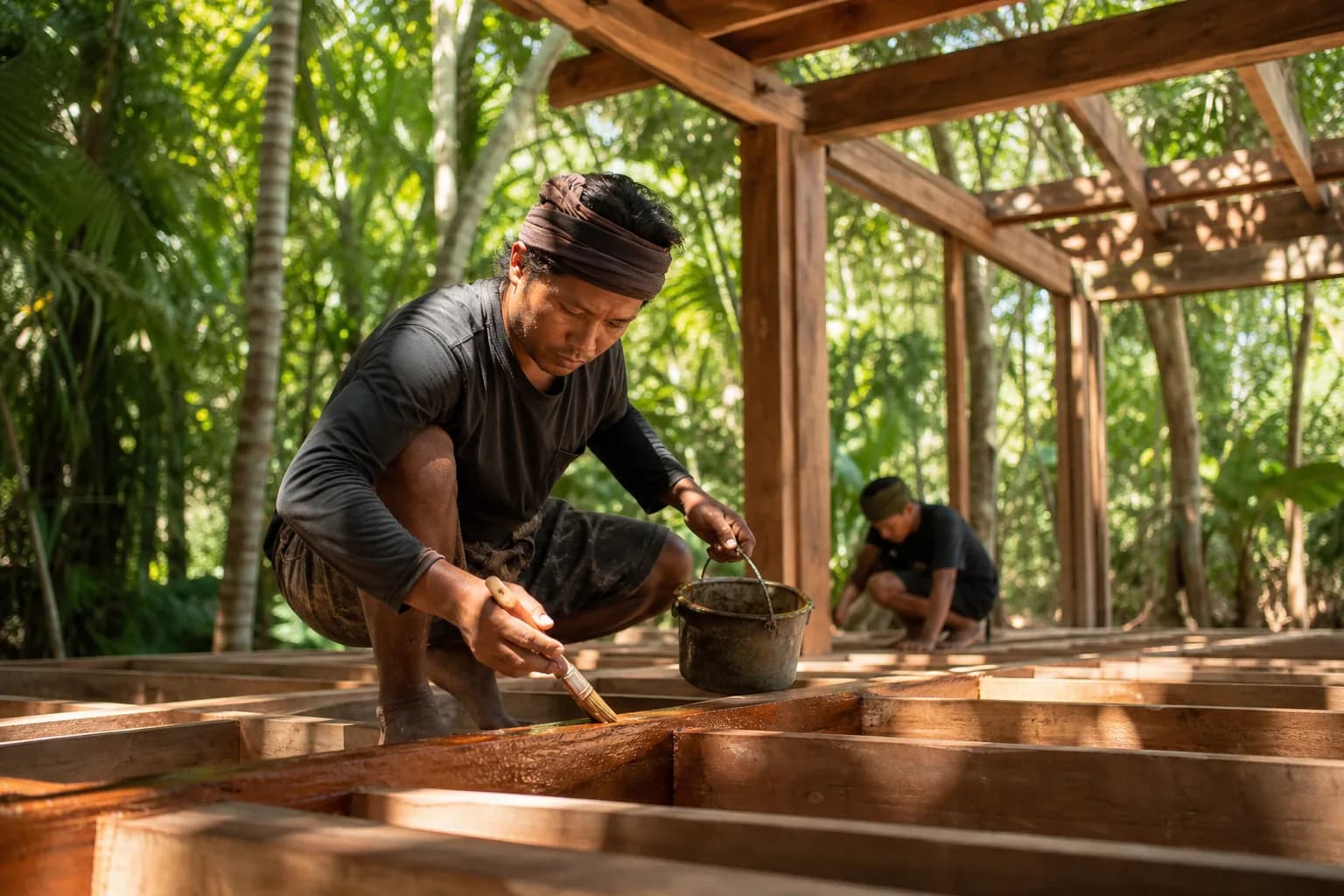
{
“article”: “
Why Gianyar’s Soil Composition Creates Elevated Termite Risk Before Foundation Work
\n\n
Gianyar regency presents a specific termite infestation challenge that many foreign buyers and even local contractors underestimate during the pre-construction phase. The region’s volcanic soil composition, combined with high organic matter content from rice paddy conversion and elevated groundwater tables in areas like Ubud, Tegallalang, and Sukawati, creates optimal conditions for subterranean termite colonies—particularly Coptotermes curvignathus, the most destructive species in Bali. Unlike post-construction treatments that address visible infestations, pre-construction soil treatment in Gianyar requires understanding the specific geological and hydrological conditions of your exact plot before foundation excavation begins, as the cost differential between preventative treatment and structural remediation can exceed 400% over a building’s first decade.
\n\n
Technical Deep Dive: Gianyar Soil Conditions and Termiticide Application Engineering
\n\n
Gianyar’s termite risk profile differs significantly from coastal Bali regions due to three geological factors. First, the regency’s volcanic andosol soils retain moisture at 25-40% higher rates than the sandy loam found in Canggu or Seminyak, creating year-round humidity conditions that sustain termite colonies even during dry season. Second, the prevalence of converted rice paddy land—especially in Ubud and Tegallalang sub-districts—means organic matter decomposition in soil layers 60-120cm below grade provides continuous food sources for subterranean termites before your foundation even exists. Third, groundwater tables in valley locations frequently sit 2-4 meters below surface grade, requiring deeper termiticide barrier penetration than standard coastal applications.
\n\n
Pre-construction soil treatment in Gianyar involves creating a continuous chemical barrier through the soil profile where your foundation, ground beams, and floor slab will be constructed. The engineering process requires applying liquid termiticides—typically fipronil-based or imidacloprid formulations registered with Indonesia’s Ministry of Agriculture—at concentrations of 0.05-0.1% active ingredient, delivered at 5 liters per linear meter for perimeter trenching and 4 liters per square meter for horizontal barriers beneath slab areas. For a standard 200m² villa footprint in Gianyar, this translates to approximately 1,200-1,500 liters of diluted termiticide solution applied to excavated foundation trenches, backfill zones, and sub-slab preparation areas.
\n\n
The critical engineering consideration specific to Gianyar is soil porosity and treatment penetration depth. Volcanic soils with high clay content require pressure injection equipment capable of 40-60 PSI to achieve adequate lateral dispersion, as gravity-fed applications often create incomplete barriers with gaps that termites exploit within 18-24 months. Treatment must extend 30cm beyond foundation perimeters and penetrate to depths matching your foundation base—typically 80-120cm for single-story construction, 120-180cm for two-story villas with deeper footings required by Gianyar’s building codes for sloped terrain.
\n\n
Timing is equally critical. Soil treatment must occur after excavation and formwork installation but before concrete pouring, as the chemical barrier needs direct contact with undisturbed soil. In Gianyar’s wet season (November-March), scheduling becomes complex—excessive rainfall within 48 hours of application can dilute termiticide concentrations below effective thresholds, requiring re-treatment. Professional contractors working in Gianyar typically schedule soil treatment during dry season months (April-October) or implement temporary drainage systems to control moisture during wet season construction.
\n\n
The treatment’s longevity in Gianyar conditions ranges from 5-8 years for standard applications, shorter than the 10-year duration often cited for drier climates. High soil moisture accelerates chemical breakdown, and microbial activity in organic-rich soils metabolizes termiticides faster than in inert sandy soils. This means Gianyar properties require more frequent monitoring and potential re-treatment compared to coastal locations, a lifecycle cost consideration rarely disclosed during land purchase negotiations.
\n\n
Hidden Risks Buyers Miss in Gianyar Pre-Construction Termite Planning
\n\n
The most significant oversight occurs during land due diligence. Buyers focus on legal title verification and zoning compliance but rarely commission soil composition analysis or termite activity surveys before purchase. In Gianyar, land previously used for rice cultivation or coconut plantations contains buried organic matter—old root systems, decomposed plant material, wooden irrigation structures—that attracts termite colonies before construction begins. A 2024 survey of Ubud-area construction sites found active termite presence in 67% of former agricultural plots, compared to 31% in previously developed land.
\n\n
Second, many contractors treat soil treatment as a checkbox item rather than an engineered system. Budget proposals often list \”termite treatment\” as a single line item without specifying chemical type, concentration, application method, or coverage area. In Gianyar’s variable terrain, a flat-rate treatment approach fails to account for sloped sites requiring terracing, where each terrace level needs independent barrier treatment, or properties with existing mature trees whose root systems create channels that bypass standard perimeter treatments.
\n\n
Third, the integration between soil treatment and foundation waterproofing is frequently mismanaged. Gianyar’s high groundwater tables require foundation waterproofing membranes, but if termiticide application occurs after membrane installation, the chemical barrier sits outside the waterproof envelope, creating a gap where moisture accumulation attracts termites to the exact zone the treatment should protect. Proper sequencing—termiticide application, then waterproofing membrane installation overlapping the treated zone—requires coordination that generic contractors often miss.
\n\n
Finally, buyers underestimate the importance of treatment documentation. Without detailed records showing chemical product specifications, application rates, coverage maps, and date of treatment, future property sales or refinancing become complicated, as banks and buyers increasingly require proof of termite prevention measures. In Gianyar’s competitive villa rental market, properties without documented pre-construction treatment face higher insurance premiums and lower valuations.
\n\n
Step-by-Step Process for Gianyar Pre-Construction Soil Treatment
\n\n
Step 1: Pre-Purchase Soil Assessment (2-3 weeks before land acquisition)
Commission a soil composition analysis and termite activity survey specific to your target plot. In Gianyar, request testing for organic matter content, soil pH (termites prefer 5.5-7.0 range common in volcanic soils), and moisture retention characteristics. If purchasing through Teville’s verified land portfolio, these assessments are included in the technical due diligence package, providing baseline data that informs treatment specifications.
\n\n
Step 2: Treatment Specification During Design Phase
Work with your structural engineer to integrate termite treatment into foundation drawings. For Gianyar sites, specify treatment zones extending 30cm beyond all foundation perimeters, beneath the entire ground floor slab area, and around all ground-penetrating utilities (plumbing, electrical conduits). On sloped sites common in Ubud and Tegallalang, each retaining wall and terrace level requires independent treatment specification. Teville’s engineering-driven construction process includes termite treatment in structural drawings, ensuring contractors cannot value-engineer this critical step out of the build.
\n\n
Step 3: Chemical Product Selection and Procurement
Specify termiticide products registered with Indonesia’s Ministry of Agriculture for pre-construction use. In Gianyar, fipronil-based products (Termidor SC, Regent) or imidacloprid formulations (Premise, Prothor) are standard, with fipronil showing better longevity in high-moisture volcanic soils. Verify the contractor procures genuine product with intact seals and batch numbers—counterfeit termiticides are a documented problem in Bali’s construction supply chain. Request supplier invoices and product data sheets as part of your construction documentation.
\n\n
Step 4: Site Preparation and Application Timing
Schedule treatment after foundation excavation, formwork installation, and any required ground beam reinforcement placement, but before concrete pouring. In Gianyar, monitor weather forecasts to ensure 48-72 hours of dry conditions post-application. For wet season construction, install temporary drainage sumps to remove standing water from excavations before treatment. Application should occur in early morning (6-9 AM) when soil temperatures are cooler, improving chemical absorption and reducing evaporation losses in Gianyar’s tropical heat.
\n\n
Step 5: Application Execution and Quality Control
Professional application requires pressure injection equipment, not manual spraying. For a 200m² villa in Gianyar, expect 6-8 hours of application time with a three-person crew. Critical quality checkpoints include: verifying dilution ratios match specifications (typically 20-40 liters of concentrate to 1,000 liters of water), confirming application rates (5L/linear meter for trenches, 4L/m² for horizontal barriers), and photographic documentation of treatment coverage before concrete placement. Teville’s site supervision protocols include independent verification of termiticide batch numbers and application coverage mapping.
\n\n
Step 6: Documentation and Warranty Registration
Compile a treatment dossier including: chemical product specifications and safety data sheets, supplier invoices proving genuine product procurement, site application maps showing treated areas, photographic evidence of application process, and contractor certification. Many termiticide manufacturers offer extended warranties (5-10 years) if application meets their specifications and is registered within 30 days of treatment. This documentation becomes part of your property’s permanent record, essential for future sales or insurance claims.
\n\n
Realistic Cost Ranges for Gianyar Pre-Construction Soil Treatment
\n\n
Pre-construction soil treatment costs in Gianyar vary based on villa footprint, site conditions, and chemical product selection. For a standard 200m² single-story villa on relatively flat terrain, expect total costs of IDR 15,000,000-25,000,000 (approximately USD 950-1,580 at 2026 exchange rates). This includes chemical product procurement (IDR 8,000,000-12,000,000 for 30-40 liters of concentrate), labor and equipment (IDR 5,000,000-8,000,000 for professional application crew with pressure injection equipment), and site preparation including temporary drainage if needed (IDR 2,000,000-5,000,000).
\n\n
For larger two-story villas (300-400m² footprint) or sloped Ubud/Tegallalang sites requiring terracing, costs increase to IDR 30,000,000-45,000,000 (USD 1,900-2,850) due to deeper foundation depths, multiple terrace levels requiring independent treatment, and increased chemical volumes. Properties with complex geometries, multiple pavilions, or extensive ground-floor areas can reach IDR 50,000,000-70,000,000 (USD 3,160-4,420).
\n\n
These costs represent 0.8-1.5% of total construction budgets for mid-range villas (IDR 2-3 billion total build cost), but prevent remediation expenses that typically cost 4-6 times more. Post-construction termite damage repair in Gianyar commonly runs IDR 80,000,000-150,000,000 for structural timber replacement, concrete remediation, and re-treatment of active infestations. When evaluating construction cost estimates, verify that soil treatment is specified as a separate line item with chemical product details, not buried in generic \”site preparation\” costs where it can be quietly eliminated.
\n\n
Treatment longevity in Gianyar’s conditions means planning for re-treatment every 6-8 years, at approximately 60% of initial costs (IDR 9,000,000-15,000,000 for 200m² villas) since excavation and formwork aren’t required. Factor this into long-term property maintenance budgets, especially for leasehold properties where the 25-30 year lease term will require 3-4 treatment cycles.
\n\n
Frequently Asked Questions: Gianyar Termite Treatment Specifics
\n\n
Does Gianyar’s volcanic soil require different termite treatment than coastal Bali areas?
\n
Yes, significantly. Gianyar’s volcanic andosol soils retain 25-40% more moisture than coastal sandy soils, requiring higher termiticide concentrations and pressure injection application rather than gravity-fed methods. The high organic matter content in former rice paddy land—common in Ubud, Tegallalang, and Sukawati—also means termite colonies establish faster and deeper (80-120cm below grade versus 40-60cm in coastal areas). Treatment specifications that work in Canggu or Seminyak often prove inadequate in Gianyar’s conditions, leading to breakthrough infestations within 2-3 years. Professional contractors familiar with Gianyar’s geology adjust chemical concentrations upward by 15-20% and extend treatment depth to match the deeper foundation requirements of the regency’s sloped terrain building codes.
\n\n
Can I skip pre-construction treatment and just treat after the villa is built?
\n
Technically possible but economically and structurally inadvisable in Gianyar. Post-construction treatment requires drilling through completed floor slabs at 30cm intervals to inject termiticide into the soil beneath—a process that costs 3-4 times more than pre-construction application, creates dozens of penetration points that compromise waterproofing (critical in Gianyar’s high-rainfall areas), and cannot effectively treat soil beneath ground beams and foundation footings where termites often establish colonies. More critically, if termites infest structural timber or attack concrete during construction before post-treatment occurs, you face remediation costs of IDR 80,000,000-150,000,000 versus the IDR 15,000,000-25,000,000 cost of proper pre-construction treatment. In Gianyar’s high-risk environment, post-construction-only approaches are considered c

Want to calculate?
 172 m²8 month(s)from 120.000 USD
Keshava
 3124 m²6 month(s)from 123.000 USD
TALA 8
 3173 m²6 month(s)from 125.000 USD
TALA FOUR
 164 m²7 month(s)from 79.000 USD
Private: Haridas Villas, Tegallalang
 2144 m²11 month(s)from 104.000 USD
Narayana
164 m²7 month(s)from 79.000 USDTALA TWO
 3104 m²11 month(s)from 99.000 USD
TALA 100
 4344 m²16 month(s)from 290.000 USD
Radha
 1from 198.000 USD
Private: Haridas Villas
 3127 m²9 month(s)from 177.000 USD
Mukunda
 3180 m²7 month(s)from 142.000 USD
Vasudeva
Start With Real Numbers, Not Guesses
Before buying land or finalizing a design, check the realistic build cost range for your project in Bali.
Our team reviews your inputs and gives a grounded estimate.
Available lands
 2230 m²15 min$ 410573Bali, Padonan
 3900 m²10 min$ 432266Bali, Tabanan
 600 m²10 min$ 206897Bali, Canggu
 3800 m²15 min$ 100616Bali, Pererenan
 5028 m²10 min$ 361000Bali, Ubud
 2800 m²15 min$ 310345Bali, Tabanan
 420 m²15 min$ 41897Bali, Tabanan
 1720 m²2 min$ 241478Bali, Tabanan
 1375 m²10 min$ 447044Bali, Canggu
 2000 m²15 min$ 261700Bali, Babakan
 3700 m²15 min$ 738177Bali, Tabanan
 325 m²15 min$ 44472Bali, Ungasan
 660 m²10 min$ 175567Bali, Mengwi
 911 m²15 min$ 248217Bali, Pererenan
 550 m²15 min$ 164594Bali, Mengwi
Essential Bali build & buy guides
- Bali villa construction cost per m² in 2026
- How much will your villa cost? Calculator
- Building a villa in Bali: the complete guide
- Buying land in Bali: step-by-step for foreigners
- Bali villa investment: yields, risks, returns
- Leasehold vs freehold: what foreigners can own
- Construction defect liability & 10-year warranty
- Bali building codes and construction standards
Related guides

Why a Cheap Bali Leasehold Is Cheap: Pricing Red Flags Every Buyer Should Decode
Suspiciously cheap Bali leaseholds are priced low for a reason: short remaining terms, forbidden zoning, missing road access, disputes or weak contracts. How to decode the discount before you pay for it.
8 min read
Fake Compliance and Licensing Agents in Bali: The 2026 Paperwork Scam and How to Verify Documents
Forged certificates, permit fixers and fake notaries: how Bali's paperwork scams work in 2026 and how to verify every property document at its government source.
7 min read
Buying a Bali Villa from Instagram: Phantom Listings, Render-Only Projects and How to Verify
Instagram is Bali's biggest property shop window and its least verified. How phantom listings, render-only projects and cloned developer accounts work — and the verification steps that expose them.
7 min read