Escrow Account Structures for Bali Villa Construction Milestones
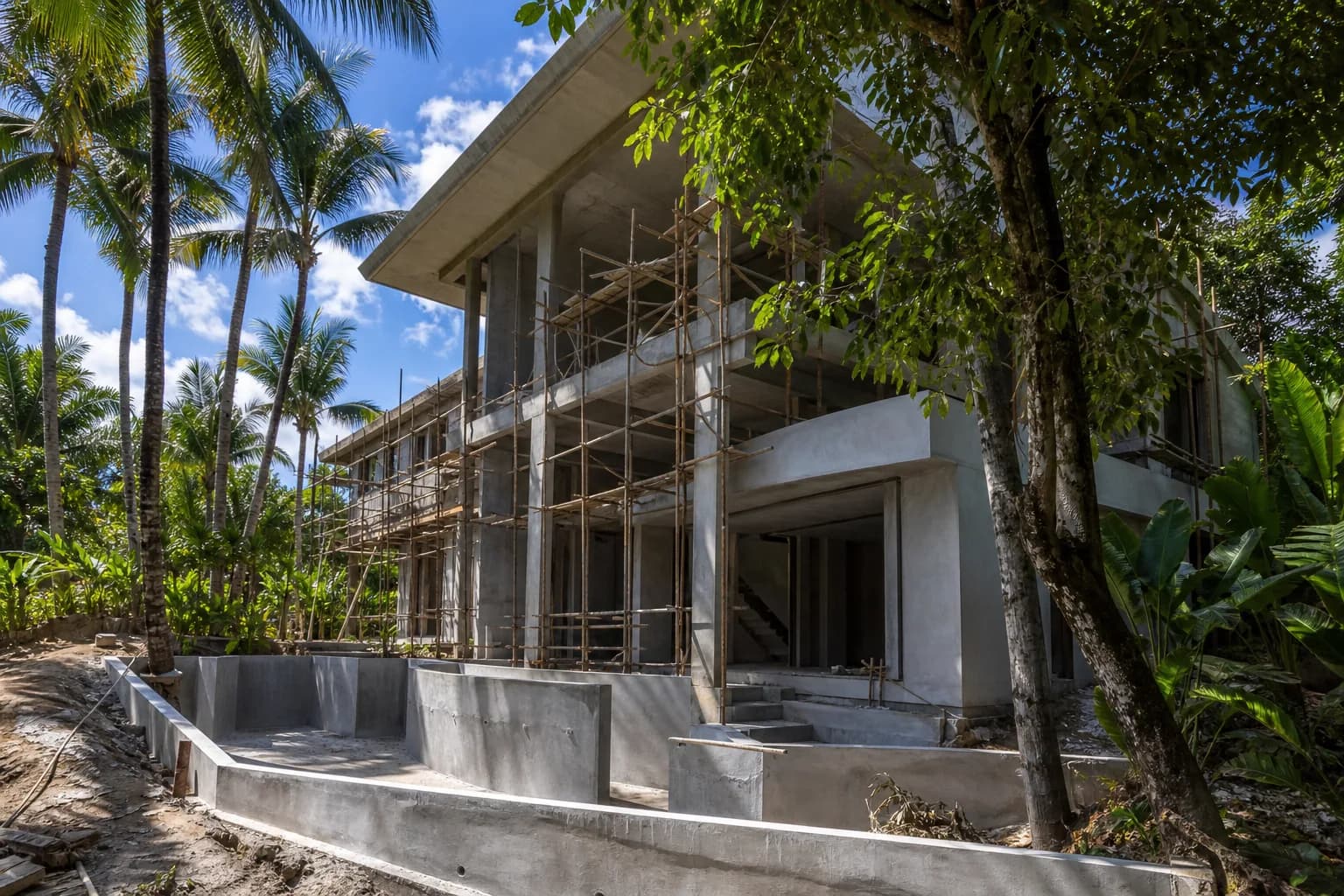
The Critical Flaw in Bali Villa Construction Payment Structures
When a foreign buyer commits $400,000 to build a villa in Bali, the most dangerous moment isn’t foundation failure or permit delays—it’s the payment structure itself. Without properly structured escrow accounts tied to verified construction milestones, clients face catastrophic exposure: contractors disappearing after 60% payment with only 30% work completed, funds diverted to other projects during material procurement phases, or disputes over “substantial completion” when structural defects remain hidden. The fundamental problem isn’t trust—it’s the absence of independent verification mechanisms between payment release and actual construction progress, compounded by Indonesia’s legal framework where foreign buyers have limited recourse once funds transfer to local contractor accounts.
Engineering-Grade Escrow Architecture for Construction Milestones
Escrow account structures for Bali villa construction require three-party verification systems that separate payment authorization from construction execution. The technical framework involves a licensed Indonesian notary (Notaris) establishing a dedicated escrow account (rekening escrow) under Indonesian Financial Services Authority (OJK) regulations, with funds released only upon independent quantity surveyor verification of completed milestones.
Legal Foundation and Account Structure
Indonesian escrow arrangements for construction operate under Civil Code Article 1792 (construction agreements) and OJK Regulation 15/2020 governing third-party fund management. The account structure requires: (1) a tripartite escrow agreement between buyer, contractor, and notary, (2) milestone definition documents with measurable completion criteria, (3) independent surveyor appointment clauses, and (4) dispute resolution protocols referencing Indonesian Construction Services Development Board (LPJK) standards.
The notary establishes the escrow account at a licensed Indonesian bank—typically Bank Mandiri, BCA, or BNI for international transaction capability—with specific mandate letters (surat kuasa) limiting withdrawal conditions. Critical: the account must be denominated in Indonesian Rupiah (IDR) per Bank Indonesia regulations, requiring currency conversion protocols and exchange rate protection mechanisms for foreign currency deposits.
Milestone Definition and Verification Protocols
Construction milestones must align with Indonesian National Standard (SNI) construction phases and include quantifiable completion metrics. Standard milestone structure: (1) Site preparation and foundation—15% release upon soil compaction testing and foundation concrete strength verification at 28-day cure, (2) Structural frame completion—25% release upon column/beam dimensional tolerance verification and rebar inspection compliance with SNI 2847, (3) Roof structure and weatherproofing—20% release upon roof load testing and waterproofing membrane certification, (4) MEP rough-in installation—15% release upon pressure testing (plumbing), insulation resistance testing (electrical), and refrigerant line testing (HVAC), (5) Finishes and fixtures—15% release upon material specification compliance and installation quality verification, (6) Final completion and defect rectification—10% retention released 90 days post-occupancy upon defect-free inspection.
Each milestone requires independent quantity surveyor (QS) certification using LPJK-approved measurement standards. The QS produces a Berita Acara Kemajuan Pekerjaan (Work Progress Report) with photographic documentation, material testing certificates, and dimensional verification against approved construction drawings. This document becomes the legal trigger for notary fund release—not contractor invoices or buyer site visits.
Technical Verification Standards
Verification protocols must reference specific Indonesian construction standards: SNI 2847 for concrete structures (minimum 25 MPa compressive strength for residential foundations), SNI 03-1726 for seismic design (Bali classified as Zone 4, requiring ductile detailing), SNI 03-6572 for steel structure design, and SNI 03-6481 for fire safety systems. The QS verification checklist includes: concrete cylinder break tests with certified lab results, rebar placement photography with date stamps, structural dimension measurements with ±5mm tolerance verification, waterproofing membrane thickness testing (minimum 2mm for tropical exposure), and electrical installation resistance testing (minimum 1 megaohm insulation resistance).
For tropical engineering compliance, milestone verification includes: timber moisture content testing (maximum 18% for structural timber per SNI 7973), anti-termite treatment certification with chemical specification, foundation drainage system flow testing (minimum 50mm/hour infiltration rate), and roof ventilation airflow measurement (minimum 10 air changes per hour for attic spaces).
Hidden Structural Risks in Escrow Implementation
The most critical failure point in Bali villa escrow structures isn’t fraud—it’s milestone definition ambiguity. Contracts specifying “foundation completion” without concrete strength testing requirements allow 15% payment release when concrete is poured but before 28-day cure verification, creating structural risk if mix design is substandard. Similarly, “roof completion” milestones without waterproofing certification enable payment for installed roofing that fails during first monsoon season.
Currency conversion timing creates hidden cost exposure. If escrow agreements specify USD amounts but require IDR account deposits, exchange rate fluctuations between contract signing and milestone payments can create 8-12% cost variance over 12-month construction periods. Without contractual exchange rate fixing mechanisms or currency hedging protocols, buyers absorb this volatility.
Notary selection represents underestimated risk. Not all Indonesian notaries have construction escrow experience—many handle only property transfer transactions. Notaries unfamiliar with construction milestone verification may release funds based on contractor representations rather than independent QS certification, defeating the escrow protection mechanism. Additionally, notary liability insurance (E&O coverage) is not mandatory in Indonesia, leaving buyers without recourse if notary negligence enables improper fund release.
The retention release timing creates defect exposure. Standard 10% retention released at “practical completion” doesn’t account for latent defects appearing during first wet season (November-March). Structural waterproofing failures, foundation settlement, and timber decay from inadequate moisture barriers often manifest 6-12 months post-construction, after retention release. Without extended retention periods tied to seasonal performance verification, buyers fund defect rectification from separate budgets.
Implementation Process for Construction Escrow Structures
Phase 1: Pre-Construction Escrow Establishment (Weeks 1-3)
Engage licensed Indonesian notary with documented construction escrow experience—request references from minimum three completed villa projects with escrow structures. The notary drafts the tripartite escrow agreement (Perjanjian Escrow) incorporating: construction contract reference with milestone schedule attachment, bank account establishment mandate with withdrawal condition specifications, independent QS appointment with verification protocol definitions, and dispute resolution procedures referencing BANI (Indonesian National Arbitration Board).
Simultaneously, appoint independent quantity surveyor—preferably RICS (Royal Institution of Chartered Surveyors) qualified or LPJK-certified with villa construction specialization. The QS reviews construction drawings and specifications to develop milestone verification checklists with measurable completion criteria, material testing requirements, and photographic documentation standards. This checklist becomes Appendix A of the escrow agreement, creating legally binding verification standards.
Phase 2: Account Funding and Milestone Documentation (Weeks 3-4)
Open dedicated IDR escrow account at selected Indonesian bank with tripartite signatory requirements: notary as account administrator, buyer as fund provider, contractor as beneficiary upon milestone verification. Deposit initial project funds—typically 10-15% as mobilization payment plus first milestone amount (15% for foundation work)—with currency conversion executed at account opening to eliminate exchange rate uncertainty for initial phases.
The notary registers the escrow agreement with the local district court (Pengadilan Negeri) to establish legal enforceability under Indonesian jurisdiction. This registration creates public record of the escrow structure, providing legal foundation for dispute resolution if contractor challenges fund release conditions.
Phase 3: Milestone Verification and Payment Release (Construction Period)
At each milestone completion claim by contractor, the independent QS conducts site verification within 5 business days, executing the verification checklist with: dimensional measurements using calibrated instruments, material testing coordination with certified Indonesian labs (concrete strength, steel tensile strength, timber moisture content), photographic documentation with GPS and date stamps, and compliance verification against approved construction drawings and SNI standards.
The QS issues Berita Acara Kemajuan Pekerjaan to the notary with pass/fail determination. Upon “pass” certification, notary releases milestone payment to contractor account within 3 business days. Upon “fail” certification, notary withholds payment and issues deficiency notice to contractor specifying corrective work required for re-verification. This creates contractual pressure for quality compliance—contractors cannot access subsequent milestone funds until prior phase verification passes.
Phase 4: Retention Management and Final Release (Post-Completion)
At practical completion (all construction work finished, villa occupiable), the QS conducts comprehensive final inspection generating a defect list (punch list). The contractor rectifies identified defects, and upon QS verification of defect-free status, notary releases final payment minus 10% retention. The retention remains in escrow for 90-day defect liability period, during which buyer occupies villa through first partial wet season.
After 90 days, QS conducts seasonal performance inspection verifying: roof waterproofing integrity after rainfall exposure, foundation stability without settlement cracks, timber structures without moisture damage or termite activity, and MEP systems operational without failures. Upon satisfactory seasonal performance verification, notary releases final retention to contractor, closing the escrow account.
Financial Structure and Timeline Realities
Escrow account establishment costs for Bali villa construction range IDR 15-25 million ($950-1,580 USD) including: notary fees for tripartite agreement drafting (IDR 8-12 million), bank account opening and administration fees (IDR 3-5 million), escrow agreement court registration (IDR 2-3 million), and legal translation services for foreign buyers (IDR 2-5 million). These are one-time setup costs separate from construction budget.
Independent quantity surveyor fees typically structure as percentage of construction value: 2-3% for projects under $300,000, 1.5-2.5% for projects $300,000-600,000, and 1-2% for projects exceeding $600,000. For a $400,000 villa construction, expect QS fees of $8,000-10,000 covering all milestone verifications, material testing coordination, and final certification. QS fees are typically paid 30% upfront, 50% proportionally with milestone verifications, and 20% upon final certification.
Currency conversion costs and exchange rate protection add 1-2% to total project cost when using escrow structures. Banks charge 0.5-1% conversion spread on USD-to-IDR transactions, and forward contracts for exchange rate fixing (recommended for projects exceeding 9 months) cost 0.5-1% of hedged amount. For $400,000 project, budget $4,000-8,000 for currency management within escrow structure.
Timeline implications: escrow establishment adds 3-4 weeks to pre-construction phase compared to direct contractor payment structures. However, milestone verification protocols typically add only 5-7 days per milestone (QS site visit, testing, reporting) without extending overall construction duration, as verification occurs during contractor’s preparation for next phase. The 90-day retention period extends project financial close by 3 months beyond practical completion.
Frequently Asked Questions: Escrow Structures for Villa Construction
Can escrow accounts protect against contractor insolvency during construction?
Escrow accounts provide partial protection by ensuring funds remain unspent until work verification, but don’t eliminate insolvency risk entirely. If a contractor becomes insolvent after completing 40% of work and receiving corresponding 40% payment through verified milestones, the remaining 60% escrow funds are protected—but the buyer still faces project completion costs potentially exceeding remaining escrow balance due to mobilization costs for replacement contractor. Enhanced protection requires contractor performance bonds (typically 10% of contract value) issued by Indonesian insurance companies, which guarantee project completion or financial compensation if contractor defaults. Teville structures projects with both escrow milestone verification and performance bond requirements for comprehensive risk mitigation.
What happens if buyer and contractor dispute milestone completion status?
Dispute resolution follows the protocol specified in the escrow agreement, typically three-tier: (1) Independent QS makes initial determination based on verification checklist—if contractor disputes, QS provides detailed deficiency report with photographic evidence and testing data, (2) If dispute continues, parties engage second independent expert (often LPJK-certified construction engineer) for binding technical assessment within 14 days, (3) If still unresolved, dispute proceeds to BANI arbitration per Indonesian Arbitration Law 30/1999. During dispute resolution, notary withholds contested milestone payment until resolution. Critical: escrow agreements must specify that QS determination is presumptively binding unless contractor provides contrary technical evidence, preventing frivolous dispu
 3173 m²6 month(s)from 125.000 USD
TALA FOUR
 2144 m²11 month(s)from 104.000 USD
Narayana
 172 m²8 month(s)from 120.000 USD
Keshava
 1from 198.000 USD
Private: Haridas Villas
 164 m²7 month(s)from 79.000 USD
Private: Haridas Villas, Tegallalang
 3124 m²6 month(s)from 123.000 USD
TALA 8
 3104 m²11 month(s)from 99.000 USD
TALA 100
 3180 m²7 month(s)from 142.000 USD
Vasudeva
 3127 m²9 month(s)from 177.000 USD
Mukunda
 4344 m²16 month(s)from 290.000 USD
Radha
164 m²7 month(s)from 79.000 USDTALA TWO

Want to calculate?
Start With Real Numbers, Not Guesses
Before buying land or finalizing a design, check the realistic build cost range for your project in Bali.
Our team reviews your inputs and gives a grounded estimate.
Available lands
 610 m²10 min$ 165271Bali, Seminyak
 1533 m²5 min$ 165666Bali, Cepaka
 4270 m²10 min$ 394397Bali, Ubud
 3100 m²15 min$ 257697Bali, Tegallalang
 3254 m²5 min$ 631800Bali, All
 3000 m²15 min$ 738916Bali, Cepaka
 2500 m²5 min$ 609606Bali, Kedungu
 1158 m²12 min$ 291996Bali, Mengwi
 1000 m²10 min$ 384852Bali, Canggu
 5815 m²5 min$ 815740Bali, Tabanan
 1300 m²10 min$ 348214Bali, Tabanan
 1000 m²10 min$ 230911Bali, Kerobokan
 500 m²10 min$ 107143Bali, Tabanan
 250 m²15 min$ 40025Bali, Munggu
 204 m²5 min$ 40899Bali, Kedungu
Essential Bali build & buy guides
- Bali villa construction cost per m² in 2026
- How much will your villa cost? Calculator
- Building a villa in Bali: the complete guide
- Buying land in Bali: step-by-step for foreigners
- Bali villa investment: yields, risks, returns
- Leasehold vs freehold: what foreigners can own
- Construction defect liability & 10-year warranty
- Bali building codes and construction standards
Related guides

Why a Cheap Bali Leasehold Is Cheap: Pricing Red Flags Every Buyer Should Decode
Suspiciously cheap Bali leaseholds are priced low for a reason: short remaining terms, forbidden zoning, missing road access, disputes or weak contracts. How to decode the discount before you pay for it.
8 min read
Fake Compliance and Licensing Agents in Bali: The 2026 Paperwork Scam and How to Verify Documents
Forged certificates, permit fixers and fake notaries: how Bali's paperwork scams work in 2026 and how to verify every property document at its government source.
7 min read
Buying a Bali Villa from Instagram: Phantom Listings, Render-Only Projects and How to Verify
Instagram is Bali's biggest property shop window and its least verified. How phantom listings, render-only projects and cloned developer accounts work — and the verification steps that expose them.
7 min read