Denpasar Utility Connection Delays Generator Costs Bali
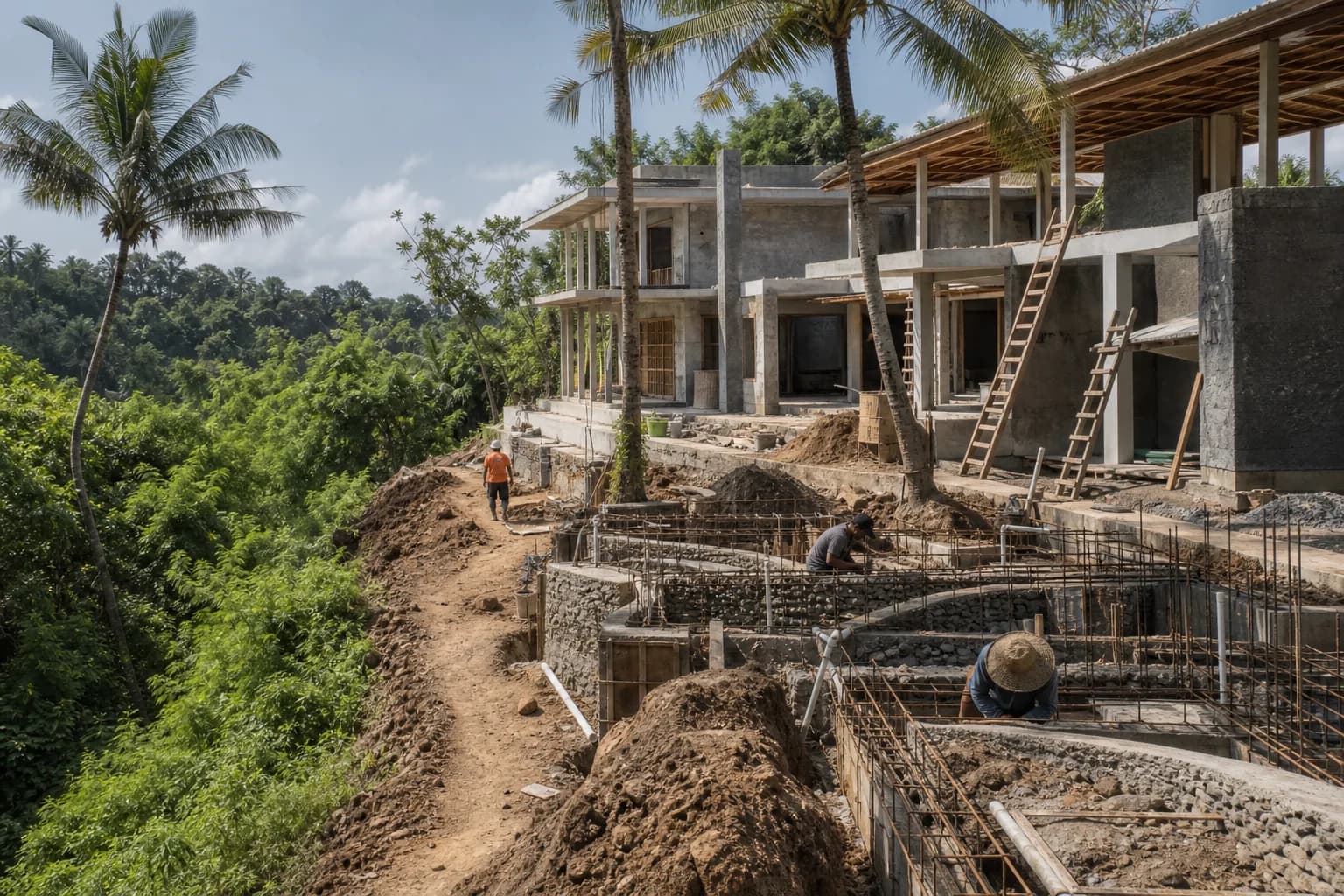
Denpasar Utility Connection Delays & Backup Generator Costs: Engineering Reality for Bali Construction Projects
When your villa construction reaches practical completion in Denpasar, the final barrier to occupancy often isn’t structural—it’s electrical. The May 2025 subsea cable failure that plunged Bali into darkness exposed a critical vulnerability in the Java-Bali power grid that continues to impact new construction timelines in 2026. For developers and villa owners, utility connection delays in Denpasar now routinely extend 4-8 weeks beyond PLN’s quoted timeframes, forcing difficult decisions about backup power infrastructure. The question isn’t whether to plan for grid instability—it’s how to engineer temporary and permanent power solutions that protect your construction investment without inflating operational costs by 30-40% annually.
Technical Infrastructure Reality: Denpasar’s Power Grid Constraints and Connection Bottlenecks
The Denpasar utility connection process operates within a stressed infrastructure system that experienced catastrophic failure in May 2025 when subsea cables linking Java’s power generation to Bali’s distribution network failed. While PLN (Perusahaan Listrik Negara) restored service using diesel backup generators, the incident revealed systemic capacity issues that directly impact new construction connection timelines.
Grid Capacity and Transformer Availability
Denpasar’s electrical distribution network relies on step-down transformers at the neighborhood level, with each transformer serving 15-25 properties depending on load capacity. New villa connections require available capacity on existing transformers or installation of new transformer infrastructure—a process PLN controls entirely. In high-density development areas like Sanur, Renon, and Kesiman, transformer capacity frequently reaches saturation, requiring PLN to install additional equipment before approving new connections.
The technical approval process involves load calculation verification where PLN engineers assess your villa’s designed electrical load (typically 5,500-11,000 VA for residential villas) against available transformer capacity. If capacity exists, connection proceeds through standard channels. If transformer upgrades are required, delays extend from PLN’s standard 14-21 day connection timeline to 45-90 days, depending on equipment procurement and installation scheduling.
Post-2025 Blackout Protocol Changes
Following the May 2025 grid failure, PLN implemented revised connection protocols prioritizing grid stability over connection speed. New requirements include mandatory load management systems for properties exceeding 6,600 VA, automatic transfer switch (ATS) documentation for properties with backup generators, and enhanced grounding specifications to protect against voltage fluctuations during grid instability events.
These protocol changes add 7-14 days to the technical approval phase as PLN engineers conduct more thorough load assessments and require additional documentation proving your electrical installation meets enhanced stability standards. For villa construction projects, this means electrical contractors must now provide detailed single-line diagrams, load distribution calculations, and ATS integration plans even for properties not initially planning backup power systems.
Backup Generator Engineering Requirements
Backup generator systems in Denpasar must comply with both PLN interconnection standards and local environmental regulations governing noise and emissions. Generator sizing requires careful load calculation—undersized units fail during peak demand, while oversized generators operate inefficiently and increase fuel consumption unnecessarily.
For typical 3-bedroom villas (200-300m²), backup power requirements range from 15 kVA for essential circuits only (lighting, refrigeration, security systems) to 35 kVA for whole-house backup including air conditioning. Generator placement must satisfy 5-meter minimum setback requirements from property boundaries, acoustic enclosure specifications limiting noise to 65 dB at boundary lines, and exhaust system designs preventing carbon monoxide accumulation in enclosed spaces.
Automatic transfer switch systems represent the critical interface between grid power and generator backup. ATS units must switch power sources within 10-15 seconds of detecting grid failure, prevent backfeeding into PLN’s distribution network (a safety and legal requirement), and manage load sequencing to prevent generator overload during startup. Quality ATS systems from manufacturers like Schneider Electric or ABB cost Rp 18-32 million installed, but inferior units create liability risks and potential PLN disconnection if backfeeding occurs.
Hidden Risks Buyers and Developers Consistently Overlook
The most expensive utility connection mistakes occur during the land acquisition and design phases—long before construction begins. Buyers purchasing land in Denpasar frequently fail to verify existing electrical infrastructure proximity and capacity, discovering only during the connection application process that their plot requires 200+ meters of new distribution line installation at costs of Rp 2.8-4.5 million per meter.
Infrastructure Distance and Cost Multiplication
PLN’s standard connection fee covers service drops up to 50 meters from existing distribution infrastructure. Beyond this distance, property owners bear full costs for distribution line extension, including poles, cabling, and transformer installation if required. In developing areas of Denpasar like Pemogan or Sidakarya, plots located 150-300 meters from existing infrastructure face connection costs of Rp 420-1,350 million—expenses that fundamentally alter project economics.
Competent land due diligence includes PLN infrastructure mapping, identifying the nearest distribution point, confirming available capacity, and obtaining preliminary connection cost estimates before purchase. This verification prevents the scenario where a seemingly affordable land parcel becomes financially unviable due to utility infrastructure gaps.
Generator Fuel Storage and Regulatory Compliance
Backup generators require fuel storage systems that comply with fire safety regulations and environmental protection standards. Diesel storage tanks exceeding 1,000 liters trigger additional permitting requirements from Denpasar’s environmental agency (Dinas Lingkungan Hidup), including secondary containment systems, spill prevention plans, and quarterly inspection protocols.
Many villa projects install undersized fuel storage (500-750 liters) to avoid regulatory complexity, then discover this capacity provides only 24-36 hours of continuous operation at 50% load—inadequate during extended grid outages. Proper fuel storage design for 5-7 day autonomy requires 2,000-3,000 liter capacity for 25 kVA generators, necessitating environmental permits, fire department approval, and professional installation with leak detection systems.
Maintenance Cost Underestimation
Generator systems require monthly exercise cycles, quarterly oil changes, annual comprehensive servicing, and parts replacement on 2-3 year intervals. Actual maintenance costs for properly maintained backup systems average Rp 4.2-6.8 million annually for 25 kVA units—expenses rarely included in initial project budgets. Deferred maintenance leads to generator failure during actual outages, defeating the entire purpose of backup power investment.
Step-by-Step Process: Engineering Utility Connections and Backup Power Systems
Phase 1: Pre-Construction Infrastructure Assessment (Weeks 1-2)
Before finalizing construction plans, conduct comprehensive utility infrastructure assessment. Engage PLN directly or through your construction partner to obtain formal infrastructure availability confirmation. This assessment identifies the nearest distribution point, confirms available capacity, establishes preliminary connection costs, and reveals any transformer upgrade requirements.
Simultaneously, evaluate backup power requirements based on your villa’s electrical design. Calculate total connected load, identify critical circuits requiring backup (security, refrigeration, communications), and determine whether whole-house backup justifies the additional investment. This analysis informs both generator sizing and fuel storage design.
Phase 2: Electrical Design Integration (Weeks 3-6)
Work with licensed electrical engineers to develop comprehensive electrical plans incorporating both grid connection and backup power systems. Plans must include single-line diagrams showing all distribution panels, load calculations for each circuit, ATS integration details, and generator interconnection specifications. These documents form the basis for both PLN connection applications and construction permitting.
Generator placement requires coordination with architectural plans, ensuring adequate setbacks, acoustic treatment, ventilation, and fuel storage access. Exhaust systems must route emissions away from occupied spaces and neighboring properties, while fuel lines require secondary containment and leak detection integration.
Phase 3: PLN Connection Application (Weeks 7-10)
Submit formal connection applications to PLN once construction reaches 60-70% completion—early enough to complete the process before practical completion, but late enough that PLN’s site inspection confirms actual construction progress. Required documentation includes electrical installation certificates from licensed contractors, load calculation verification, property ownership proof, and construction permit copies.
PLN’s review process involves document verification (5-7 days), site inspection scheduling (7-14 days), technical approval (7-10 days), and physical connection execution (7-14 days). Total timeline ranges from 26-45 days under normal circumstances, extending to 60-90 days if transformer upgrades are required.
Phase 4: Backup System Installation and Testing (Weeks 11-14)
Install generator systems, fuel storage, and ATS equipment during the final construction phase, allowing time for comprehensive testing before occupancy. Generator commissioning includes load bank testing to verify capacity under simulated full-load conditions, ATS switching cycle testing to confirm proper operation, and fuel system pressure testing to identify leaks before operation.
Coordinate final PLN connection with generator system completion, ensuring ATS programming prevents backfeeding and load management systems function correctly. This integration testing prevents the scenario where backup systems interfere with grid power or create safety hazards during switching operations.
Phase 5: Operational Protocol Development (Week 15+)
Establish maintenance schedules, fuel procurement contracts, and emergency operation procedures before occupancy. Document generator exercise protocols (typically monthly 30-minute runs under load), maintenance intervals, and emergency contact information for service providers. For rental villas, develop clear operational guidelines for property managers ensuring backup systems remain functional during owner absence.
Realistic Cost Ranges and Timeline Expectations for Denpasar Projects
Standard PLN connection costs for residential villas in Denpasar range from Rp 8.5-15 million for 5,500 VA service to Rp 18-28 million for 11,000 VA service, assuming infrastructure exists within 50 meters. These fees cover meter installation, service drop cabling, and administrative processing. Properties requiring distribution line extensions add Rp 2.8-4.5 million per meter beyond the standard 50-meter allowance.
Backup Generator System Costs
Complete backup power systems including generator, ATS, installation, and fuel storage break down as follows:
- 15 kVA generator system (essential circuits only): Rp 85-125 million including Perkins or Cummins generator, 500-liter fuel tank, ATS, acoustic enclosure, and professional installation
- 25 kVA generator system (partial house backup): Rp 145-195 million including generator, 1,000-liter fuel storage, ATS, exhaust system, and installation
- 35 kVA generator system (whole-house backup): Rp 215-285 million including generator, 1,500-liter fuel storage, ATS, acoustic treatment, and complete installation
These ranges reflect quality equipment from established manufacturers with proper installation by licensed contractors. Budget alternatives using Chinese-manufactured generators reduce initial costs by 30-40% but typically require replacement within 3-5 years versus 10-15 year lifespans for quality units.
Ongoing Operational Costs
Monthly utility expenses for completed villas in Denpasar average Rp 1.2-1.8 million for grid electricity depending on air conditioning usage and occupancy patterns. Backup generator operational costs add Rp 350,000-580,000 monthly including fuel for exercise cycles, routine maintenance, and parts replacement reserves. During extended outages requiring continuous generator operation, fuel costs reach Rp 180,000-250,000 per day for 25 kVA units operating at 50% load.
Frequently Asked Questions: Denpasar Utility Connections and Backup Power
How long do PLN connection delays typically last in Denpasar after the 2025 grid issues?
Current connection timelines in Denpasar range from 35-60 days for standard connections in areas with existing infrastructure capacity, extending to 75-120 days in areas requiring transformer upgrades or distribution line extensions. The May 2025 blackout prompted PLN to implement more rigorous technical reviews, adding 10-15 days to previous timelines. Projects in high-density areas like Sanur or Renon face longer delays due to transformer capacity constraints, while developing areas may require extensive infrastructure investment before connection approval. Working with experienced construction partners like Teville who maintain established PLN relationships can reduce uncertainty through early coordination and accurate timeline forecasting.
Is backup generator investment mandatory for new villa construction in Denpasar?
Backup generators are not legally mandatory for residential construction in Denpasar, but grid reliability concerns following the 2025 blacko
 3180 m²7 month(s)from 142.000 USD
Vasudeva
 4344 m²16 month(s)from 290.000 USD
Radha
 172 m²8 month(s)from 120.000 USD
Keshava
 3104 m²11 month(s)from 99.000 USD
TALA 100
 3127 m²9 month(s)from 177.000 USD
Mukunda
 3173 m²6 month(s)from 125.000 USD
TALA FOUR
 2144 m²11 month(s)from 104.000 USD
Narayana
 3124 m²6 month(s)from 123.000 USD
TALA 8

Want to calculate?
 1from 198.000 USD
Private: Haridas Villas
 164 m²7 month(s)from 79.000 USD
TALA TWO
164 m²7 month(s)from 79.000 USDPrivate: Haridas Villas, Tegallalang
Start With Real Numbers, Not Guesses
Before buying land or finalizing a design, check the realistic build cost range for your project in Bali.
Our team reviews your inputs and gives a grounded estimate.
Available lands
 7250 m²56 min$ 235714Bali, Tabanan
 889 m²15 min$ 145612Bali, Cepaka
 5000 m²8 min$ 424877Bali, Ungasan
 550 m²15 min$ 164594Bali, Mengwi
 325 m²15 min$ 44472Bali, Ungasan
 2000 m²5 min$ 738916Bali, Ungasan
 1720 m²2 min$ 241478Bali, Tabanan
 1375 m²10 min$ 447044Bali, Canggu
 2800 m²15 min$ 310345Bali, Tabanan
 3800 m²15 min$ 100616Bali, Pererenan
 3900 m²10 min$ 432266Bali, Tabanan
 3100 m²20 min$ 272968Bali, Tabanan
 700 m²15 min$ 162500Bali, Tabanan
 8313 m²15 min$ 716670Bali, Buduk
 2000 m²10 min$ 243842Bali, Mengwi
Essential Bali build & buy guides
- Bali villa construction cost per m² in 2026
- How much will your villa cost? Calculator
- Building a villa in Bali: the complete guide
- Buying land in Bali: step-by-step for foreigners
- Bali villa investment: yields, risks, returns
- Leasehold vs freehold: what foreigners can own
- Construction defect liability & 10-year warranty
- Bali building codes and construction standards
Related guides

Why a Cheap Bali Leasehold Is Cheap: Pricing Red Flags Every Buyer Should Decode
Suspiciously cheap Bali leaseholds are priced low for a reason: short remaining terms, forbidden zoning, missing road access, disputes or weak contracts. How to decode the discount before you pay for it.
8 min read
Fake Compliance and Licensing Agents in Bali: The 2026 Paperwork Scam and How to Verify Documents
Forged certificates, permit fixers and fake notaries: how Bali's paperwork scams work in 2026 and how to verify every property document at its government source.
7 min read
Buying a Bali Villa from Instagram: Phantom Listings, Render-Only Projects and How to Verify
Instagram is Bali's biggest property shop window and its least verified. How phantom listings, render-only projects and cloned developer accounts work — and the verification steps that expose them.
7 min read