Denpasar Hak Pakai Title Conversion Costs Timeline Bali
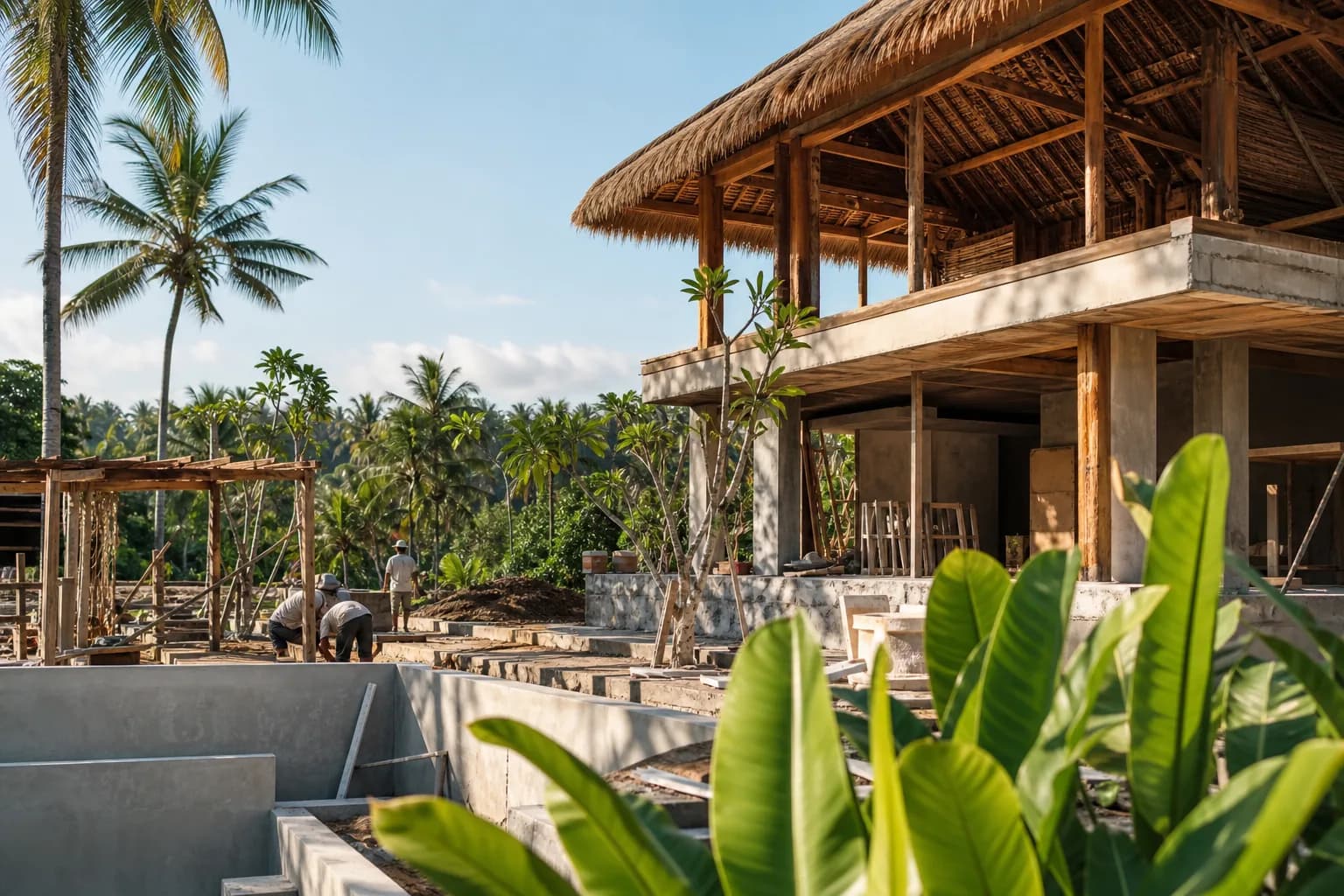
The Critical Title Conversion Question Most Denpasar Property Buyers Discover Too Late
When foreign buyers acquire land through a PT PMA structure in Denpasar, they often assume the Hak Pakai (Right to Use) title conversion is a simple administrative formality. The reality involves a complex legal process with variable costs, strict documentation requirements, and timeline dependencies that directly impact construction scheduling. Unlike other Bali regions where land administration may be more straightforward, Denpasar’s urban density, overlapping jurisdictional authorities, and higher transaction volumes create specific procedural bottlenecks. Understanding the precise conversion costs and realistic legal timelines isn’t just about budgeting—it’s about preventing construction delays, avoiding double-payment traps, and ensuring your building permits align with properly converted land titles before foundation work begins.
Technical Framework: Denpasar Hak Pakai Conversion Process Architecture
The conversion of land titles to Hak Pakai in Denpasar operates under Indonesia’s Basic Agrarian Law (UUPA) and subsequent regulations governing foreign-held entities. When a PT PMA purchases freehold land (Hak Milik) in Denpasar, the title must be converted to Hak Pakai before the company can legally hold it. This conversion involves the National Land Agency (BPN/ATR) Denpasar office, notary services, and multiple verification stages that differ significantly from residential leasehold arrangements.
The technical process begins with title verification at the Denpasar Land Office, where the existing certificate undergoes authenticity checks, boundary surveys, and encumbrance searches. Denpasar’s urban context means higher probability of overlapping claims, historical ownership disputes, or incomplete spatial planning compliance—issues that rural Bali parcels may not face. The land must be free from legal disputes (sengketa), properly registered in the land book (buku tanah), and compliant with Denpasar’s spatial planning regulations (RTRW) before conversion can proceed.
From an engineering perspective, this conversion timing directly impacts construction feasibility studies. At Teville, we’ve observed that initiating soil testing, topographic surveys, or preliminary engineering assessments before title conversion completion creates legal exposure. If conversion fails or reveals title defects, any construction preparation work becomes legally questionable. The proper sequence requires: (1) title conversion completion, (2) building permit application using the converted Hak Pakai certificate, (3) engineering assessments, (4) construction commencement. Reversing this order—common among buyers eager to start building—creates permit invalidation risks.
The Denpasar-specific complexity involves coordination between the Land Office, the Investment Coordinating Board (BKPM) for PT PMA validation, the local tax office for land transfer tax (BPHTB) calculation, and the notary who prepares the deed of conversion (Akta Konversi). Each entity operates on different processing schedules, and Denpasar’s higher transaction volume means longer queue times compared to Tabanan or Gianyar offices. The technical documentation required includes: original land certificate, PT PMA establishment deed, BKPM approval letter, tax clearance certificates (SPPT PBB), IMB readiness confirmation, and spatial planning compliance letters (KKPR).
A critical technical consideration often overlooked: the converted Hak Pakai title has a maximum 80-year term (renewable), but the initial grant period depends on the PT PMA’s investment value and business plan. Denpasar Land Office may grant 30, 50, or 80 years based on the company’s committed investment. This duration directly affects construction financing—banks typically require minimum 25-year remaining title terms for construction loans. If your conversion results in a 30-year Hak Pakai with 5 years already elapsed during company setup, you’re left with 25 years, creating financing complications for substantial villa construction projects.
The engineering intersection occurs during the IMB (building permit) application phase. Denpasar requires the building permit applicant’s name to exactly match the land title holder. If conversion is incomplete or the PT PMA name differs from the title certificate due to administrative errors, the IMB application will be rejected. We’ve documented cases where buyers proceeded with architectural designs and engineering plans, only to discover their title conversion had naming discrepancies that required 2-3 months to rectify—delaying construction starts and inflating holding costs.
Hidden Risks: What Denpasar Title Conversion Reveals About Construction Viability
The most dangerous assumption is treating title conversion as separate from construction planning. In Denpasar’s urban zones, the conversion process often reveals zoning restrictions that fundamentally alter building feasibility. A parcel may convert successfully to Hak Pakai, but the spatial planning compliance check might show it’s designated for commercial use with maximum 60% building coverage—incompatible with the villa design you’ve already commissioned. This discovery typically occurs 45-60 days into the conversion process, after significant design costs are sunk.
Another critical risk: the BPHTB (land transfer tax) calculation during conversion. Denpasar uses NJOP (tax object sale value) as the base, but the actual tax assessment can include penalties if the purchase price significantly exceeds NJOP, triggering tax authority investigations. Buyers often budget 5% BPHTB based on NJOP, but Denpasar tax offices increasingly apply market value assessments, pushing effective rates to 7-8% of actual transaction value. This gap—potentially IDR 50-100 million on a IDR 1.5 billion land purchase—creates budget shortfalls that delay conversion completion.
The timeline risk compounds during Denpasar’s peak transaction periods (July-August, December-January). Land Office processing queues extend from the standard 30-45 days to 60-90 days, but buyers rarely adjust construction schedules accordingly. If you’ve contracted builders based on a 45-day conversion assumption, the 90-day reality means either paying contractors to wait (expensive) or releasing them and re-contracting later (risking price increases and availability). At Teville’s construction process, we build conversion timeline buffers into project schedules specifically to prevent this cascade failure.
Step-by-Step Process: Denpasar Hak Pakai Conversion Execution
Phase 1: Pre-Conversion Verification (Week 1-2)
Engage a Denpasar-based notary (PPAT) experienced in PT PMA transactions to conduct preliminary title verification. The notary orders a land certificate check from BPN Denpasar, confirming the certificate is authentic, matches land book records, and shows no encumbrances. Simultaneously, request a spatial planning compliance letter (KKPR) from Denpasar’s Spatial Planning Office (Dinas Tata Ruang) to verify the land’s zoning designation. This reveals whether your intended villa construction aligns with permitted land use before you commit to conversion costs.
Obtain a tax clearance certificate showing all land taxes (PBB) are current. Denpasar Land Office will reject conversion applications if tax arrears exist. Also verify your PT PMA’s BKPM approval letter explicitly lists real estate/property development in the business activities—generic “construction services” may be insufficient for Hak Pakai conversion approval.
Phase 2: Conversion Application Submission (Week 3)
The notary prepares the Sale and Purchase Deed (AJB) and submits the conversion application package to BPN Denpasar. Required documents include: original land certificate, AJB, PT PMA establishment deed, BKPM approval, company tax ID (NPWP), director’s ID, spatial planning compliance letter, and PBB payment proof. The application includes a formal request to convert from Hak Milik to Hak Pakai with specified duration (request 80 years to maximize term).
Pay the application processing fee (approximately IDR 2-3 million) and BPHTB at the Denpasar tax office. The BPHTB calculation uses the higher of NJOP or transaction value. Ensure you receive official tax payment receipts—photocopies are insufficient for BPN processing.
Phase 3: BPN Processing and Field Verification (Week 4-8)
BPN Denpasar conducts internal verification, checking the land book, surveying boundaries, and confirming no conflicting claims exist. In Denpasar’s dense urban areas, boundary disputes are more common than rural zones. If neighbors contest boundaries, the process halts until resolution—potentially adding 30-60 days. This is why pre-conversion boundary surveys by licensed surveyors are critical risk mitigation.
During this phase, BPN may request additional documentation or clarifications. Response time is critical—delays in providing requested documents restart processing timelines. Maintain close communication with your notary who interfaces with BPN on your behalf.
Phase 4: Title Issuance and Registration (Week 9-10)
Upon approval, BPN issues the new Hak Pakai certificate in the PT PMA’s name. The notary collects the certificate, verifies all details (name spelling, parcel number, boundaries, duration), and registers it in the land book. Any errors must be corrected immediately—post-issuance corrections require separate applications with additional fees and 2-3 week processing times.
With the Hak Pakai certificate in hand, you can now legally apply for building permits (IMB) through Denpasar’s DPMPTSP office. The IMB application requires the Hak Pakai certificate as proof of land rights—applications submitted with pending conversions are automatically rejected.
Phase 5: Post-Conversion Construction Preparation (Week 11-12)
Commission engineering assessments: soil testing, topographic surveys, and structural feasibility studies. These should only commence after title conversion completion to ensure legal standing. Engage architects to finalize designs based on confirmed zoning parameters from the KKPR. Submit IMB application with converted title certificate, architectural drawings, and structural engineering calculations. Denpasar IMB processing typically requires 14-21 days for residential villas under 400m².
Realistic Cost Breakdown and Timeline Ranges for Denpasar Conversions
Legal and Administrative Costs:
- Notary fees (PPAT): IDR 15-25 million (includes AJB preparation, BPN liaison, document legalization)
- BPN processing fees: IDR 2-3 million (official government charges)
- BPHTB (land transfer tax): 5% of NJOP or transaction value (whichever is higher)—typically IDR 50-150 million for Denpasar land valued at IDR 1-3 billion
- Spatial planning compliance letter (KKPR): IDR 1-2 million
- Title verification and land book checks: IDR 500,000-1 million
- Boundary survey (if required): IDR 3-5 million
- Legal consultation and document preparation: IDR 10-15 million
Total estimated conversion costs: IDR 80-200 million, with BPHTB representing 60-75% of total costs. Land value directly determines the expense—higher-value Denpasar parcels in Sanur or Renon face proportionally higher BPHTB.
Timeline Ranges:
- Optimal scenario (no complications): 45-60 days from application to certificate issuance
- Standard scenario (minor clarifications needed): 60-75 days
- Complex scenario (boundary disputes, document issues): 90-120 days
- Peak period processing (July-August, December-January): Add 15-30 days to above ranges
For construction planning purposes, budget 90 days (3 months) as the realistic conversion timeline. This buffer accommodates typical Denpasar processing variations without derailing construction schedules. Buyers who assume 30-day conversions consistently face project delays and cost overruns when reality diverges from optimistic projections.
Frequently Asked Questions: Denpasar Hak Pakai Title Conversion Specifics
Can I start construction while title conversion is still processing in Denpasar?
No. Building permits (IMB) in Denpasar require the completed Hak Pakai certificate as mandatory documentation. Construction without valid IMB violates building regulations and risks demolition orders, fines up to IDR 100 million, and criminal liability for the builder and owner. Additionally, construction on land with pending title conversion creates legal ambiguity—if conversion fails due to discovered title defects, any construction becomes legally questionable. The proper sequence is: complete conversion, obtain IMB using the Hak Pakai certificate, then commence construction. At Teville’s villa projects, we never begin site work until both title conversion and IMB are finalized, protecting clients from regulatory and legal exposure.
Why does Denpasar title conversion take longer than other Bali regions?
Denpasar’s Land Office processes significantly higher transaction volumes than rural offices in Tabanan, Karangasem, or Bangli. Urban density means more complex boundary verifications, higher probability of overlapping claims, and more rigorous spatial planning compliance checks. Denpasar parcels often have longer ownership histories with multiple prior transactions, requiring more extensive land book verification. Additionally, Denpasar’s commercial importance means stricter scrutiny of PT PMA applications—authorities verify business legitimacy more thoroughly than in less-developed regions. These factors combine to extend processing from the theoretical 30-day minimum to practical 60-90 day realities.
What happens if my PT PMA’s BKPM approval expires during conversion processing?
BKPM approvals for PT PMA have validity periods, and if expiration occurs during title conversion, BPN Denpasar will suspend processing until renewal. This adds 30-45 days for BKPM renewal procedures. To prevent this, verify your BKPM approval has minimum 6 months validity remaining before initiating conversion. If expiration is imminent, renew BKPM approval first, then start conversion. This sequencing prevents mid-process suspensions that compound delays. Your notary should check BKPM validity during pre-conversion verification, but ultimate respons
 3104 m²11 month(s)from 99.000 USD
TALA 100
 3124 m²6 month(s)from 123.000 USD
TALA 8
 3173 m²6 month(s)from 125.000 USD
TALA FOUR

Want to calculate?
 164 m²7 month(s)from 79.000 USD
TALA TWO
164 m²7 month(s)from 79.000 USDPrivate: Haridas Villas, Tegallalang
 3180 m²7 month(s)from 142.000 USD
Vasudeva
 4344 m²16 month(s)from 290.000 USD
Radha
 172 m²8 month(s)from 120.000 USD
Keshava
 3127 m²9 month(s)from 177.000 USD
Mukunda
 2144 m²11 month(s)from 104.000 USD
Narayana
 1from 198.000 USD
Private: Haridas Villas
Start With Real Numbers, Not Guesses
Before buying land or finalizing a design, check the realistic build cost range for your project in Bali.
Our team reviews your inputs and gives a grounded estimate.
Available lands
 422 m²15 min$ 93547Bali, Kerobokan
 1300 m²10 min$ 312192Bali, Kutuh South Bali
 1350 m²5 min$ 283467Bali, Pecatu
 500 m²15 min$ 124692Bali, Kaba Kaba
 1720 m²2 min$ 241478Bali, Tabanan
 2800 m²2 min$ 713793Bali, Kedungu
 1000 m²5 min$ 350431Bali, Drupadi
 1000 m²10 min$ 384852Bali, Canggu
 300 m²55 min$ 32475Bali, Tegelalang
 889 m²15 min$ 145612Bali, Cepaka
 500 m²10 min$ 107143Bali, Tabanan
 2230 m²15 min$ 410573Bali, Padonan
 18900 m²2 min$ 6912931Bali, Pecatu
 260 m²5 min$ 51872Bali, Kedungu
 1230 m²15 min$ 132543Bali, Tegallalang
Essential Bali build & buy guides
- Bali villa construction cost per m² in 2026
- How much will your villa cost? Calculator
- Building a villa in Bali: the complete guide
- Buying land in Bali: step-by-step for foreigners
- Bali villa investment: yields, risks, returns
- Leasehold vs freehold: what foreigners can own
- Construction defect liability & 10-year warranty
- Bali building codes and construction standards
Related guides

Why a Cheap Bali Leasehold Is Cheap: Pricing Red Flags Every Buyer Should Decode
Suspiciously cheap Bali leaseholds are priced low for a reason: short remaining terms, forbidden zoning, missing road access, disputes or weak contracts. How to decode the discount before you pay for it.
8 min read
Fake Compliance and Licensing Agents in Bali: The 2026 Paperwork Scam and How to Verify Documents
Forged certificates, permit fixers and fake notaries: how Bali's paperwork scams work in 2026 and how to verify every property document at its government source.
7 min read
Buying a Bali Villa from Instagram: Phantom Listings, Render-Only Projects and How to Verify
Instagram is Bali's biggest property shop window and its least verified. How phantom listings, render-only projects and cloned developer accounts work — and the verification steps that expose them.
7 min read