Denpasar Building Permit Expiry: Penalties Renewal Costs Bali
{
“article”: “
The Hidden Cost of Permit Expiry: When Denpasar Building Approvals Lapse Mid-Construction
\n\n
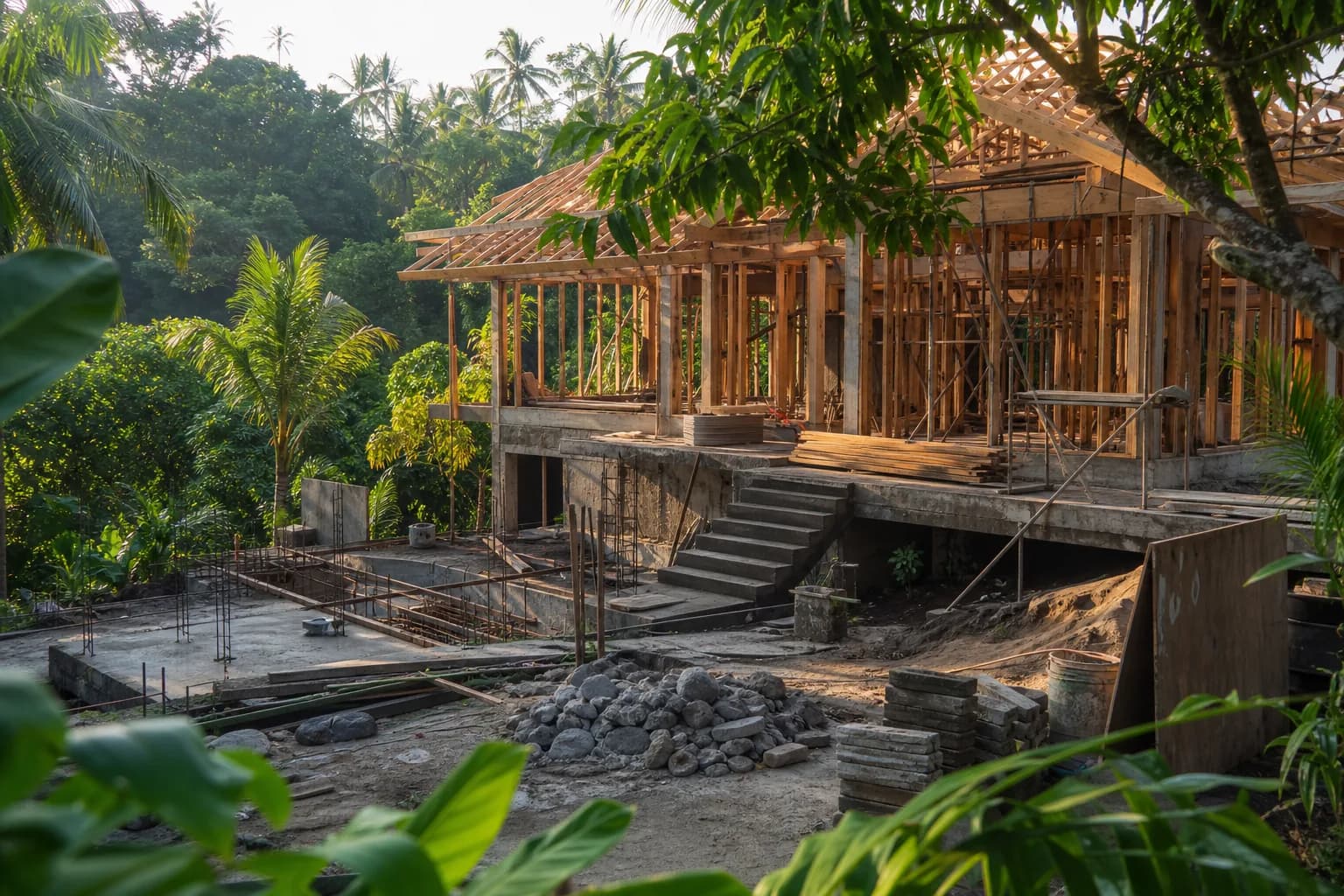
A partially completed villa foundation sits exposed to monsoon rains in Sanur, its building permit (PBG) expired six months ago. The owner, now facing IDR 45 million in renewal fees plus structural remediation costs, discovers that permit abandonment in Denpasar carries penalties far beyond simple administrative fines. This scenario repeats across Bali’s capital district as foreign buyers underestimate the strict enforcement timeline for construction permits and the cascading financial consequences of project delays. Understanding Denpasar’s specific permit expiry protocols, abandonment classification criteria, and renewal cost structures is critical for anyone managing villa construction in Bali’s most administratively rigorous jurisdiction.
\n\n
Technical Framework: How Denpasar Classifies Permit Expiry vs. Abandonment
\n\n
Denpasar’s building permit system operates under stricter enforcement protocols than neighboring regencies, with the Dinas Penanaman Modal dan Pelayanan Terpadu Satu Pintu (DPMPTSP) maintaining digital monitoring of construction progress against issued PBG timelines. A standard building permit in Denpasar grants 24 months for construction completion from issuance date, but the critical distinction lies in how authorities classify project status during this period.
\n\n
Permit expiry occurs when the 24-month validity period lapses with construction incomplete but demonstrable progress documented. This triggers renewal procedures with associated fees but avoids abandonment classification. Permit abandonment is declared when construction ceases for 180 consecutive days with no documented activity, regardless of remaining permit validity. Denpasar’s district offices conduct quarterly site inspections in high-density areas like Sanur, Renon, and Sesetan, photographically documenting construction status and comparing against permit timelines.
\n\n
The technical difference matters significantly: expired permits require administrative renewal with fees ranging from IDR 15-30 million depending on building complexity, while abandoned projects face penalty assessments of 2-5% of the original Nilai Perolehan Objek Pajak (NJOP) valuation, plus mandatory structural safety re-certification before work resumption. For a 400-square-meter villa on land valued at IDR 2 billion NJOP, abandonment penalties alone can reach IDR 40-100 million before addressing any renewal costs.
\n\n
Denpasar’s enforcement has intensified since 2024 following several structural failures in abandoned then hastily resumed projects. The district now requires that any construction halted beyond 90 days must file a formal suspension notice (Surat Pemberitahuan Penghentian Sementara) with documented reasons—medical emergencies, force majeure, or funding delays. Without this documentation, the 180-day abandonment clock begins immediately, and authorities have legal grounds to issue violation notices that complicate future permit renewals and property transfers.
\n\n
The engineering implications extend beyond administrative penalties. Exposed foundations and partially completed structures in Bali’s tropical climate deteriorate rapidly—reinforcement corrosion begins within 6-8 months of exposure, concrete surfaces develop biological growth that compromises bonding for subsequent pours, and waterproofing membranes degrade under UV exposure. Projects classified as abandoned require comprehensive structural assessments by certified engineers before resumption, adding IDR 25-40 million in inspection and remediation costs for typical villa projects. This technical reality makes permit abandonment exponentially more expensive than proactive renewal management.
\n\n
Hidden Risks: What Foreign Buyers Miss About Denpasar Permit Timelines
\n\n
The most dangerous assumption foreign buyers make is treating Denpasar building permits like renewable administrative documents similar to visas or vehicle registrations. Unlike permits in Western jurisdictions that can be extended with simple applications, Denpasar’s system treats permit expiry as evidence of project mismanagement requiring investigation into why construction failed to complete within the approved timeline.
\n\n
Buyers frequently miss that permit renewal is not automatic—it requires re-submission of updated construction drawings, current structural calculations, and proof of contractor licensing validity. If your original contractor’s IUJK (construction business license) has lapsed, or if the supervising engineer’s certification expired, renewal becomes impossible until these credentials are restored. This creates cascading delays where a simple permit renewal transforms into a multi-month credential restoration process costing an additional IDR 20-35 million.
\n\n
Another critical oversight involves zoning regulation changes during permit validity periods. Denpasar updates its Rencana Detail Tata Ruang (detailed spatial plans) every 3-5 years, and if your permit expires during a regulatory transition, renewal may require design modifications to comply with new setback requirements, building height restrictions, or green space ratios. Projects in areas like Sanur that underwent coastal zoning revisions in 2024-2025 have faced renewal denials requiring complete redesigns, effectively nullifying months of completed work.
\n\n
The financial risk compounds when buyers fail to understand that abandoned project penalties attach to the land title, not just the permit. If you purchase property with an abandoned construction permit in Denpasar’s records, you inherit the penalty liability even if you weren’t the original permit holder. Due diligence must include DPMPTSP records checks confirming no outstanding abandonment classifications—a step most real estate agents omit but that verified land acquisition processes systematically include to prevent inherited liabilities.
\n\n
Step-by-Step Process: Managing Permit Expiry and Avoiding Abandonment Classification
\n\n
Step 1: Establish Timeline Monitoring (Month 1 of Construction)
Immediately upon PBG issuance, create a digital calendar with alerts at 18 months (renewal preparation), 21 months (final push), and 23 months (emergency renewal). Assign a single point of contact—ideally your project manager or construction supervisor—to maintain a monthly photographic log of construction progress with dated images showing continuous work. Denpasar authorities accept timestamped photo documentation as evidence against abandonment claims if disputes arise.
\n\n
Step 2: File Suspension Notices for Planned Delays (Before 90-Day Threshold)
If construction must pause for legitimate reasons—monsoon-related material delays, owner medical issues, funding transfer complications—file a Surat Pemberitahuan Penghentian Sementara with Denpasar’s DPMPTSP before the 90-day continuous stoppage threshold. This administrative filing (cost: IDR 500,000-1,000,000 through a permit consultant) formally documents the delay reason and pauses the abandonment classification clock. Maximum suspension period is 12 months, after which you must either resume work or begin formal renewal procedures.
\n\n
Step 3: Initiate Renewal Process at 21-Month Mark (3 Months Before Expiry)
Begin permit renewal procedures three months before the 24-month expiry date to allow for processing delays and potential document requests. Required renewal documentation includes: updated construction progress photos, current contractor IUJK certificate, valid supervising engineer certification, proof of IMB (building use permit) application readiness, and updated structural calculations if design modifications occurred during construction. Engage a licensed permit consultant (biaya: IDR 8-12 million) to manage submission and follow-up with DPMPTSP officials.
\n\n
Step 4: Conduct Pre-Renewal Structural Assessment (If Construction Paused >6 Months)
If your project experienced extended delays with construction paused beyond six months, commission an independent structural assessment before renewal application. This proactive inspection (cost: IDR 15-25 million for villa projects) identifies concrete degradation, reinforcement corrosion, or waterproofing failures that could trigger rejection during official renewal inspections. Addressing issues before renewal submission prevents the more expensive scenario of renewal approval conditional on remediation work, which extends timelines and increases costs by 30-40%.
\n\n
Step 5: Prepare Abandonment Response Protocol (If 180-Day Threshold Approached)
If you receive an abandonment warning notice from Denpasar authorities, immediate response within 14 days is critical. Required actions include: formal written explanation of construction delays with supporting documentation, submission of revised construction timeline with specific completion milestones, proof of contractor re-engagement with signed construction resumption agreement, and payment of preliminary penalty assessment (typically 50% of total calculated penalty). Engage legal counsel experienced in Denpasar construction disputes—delay beyond the 14-day response window results in automatic penalty finalization and potential permit revocation requiring complete re-application.
\n\n
Realistic Cost Breakdown: Denpasar Permit Renewal and Abandonment Penalties
\n\n
Standard Permit Renewal (Construction Progressing, Pre-Expiry):
Administrative renewal fee: IDR 15-30 million (based on building size and complexity)
Permit consultant services: IDR 8-12 million
Updated drawing revisions: IDR 5-8 million
Total standard renewal: IDR 28-50 million
Processing timeline: 6-10 weeks
\n\n
Expired Permit Renewal (Post-24-Month Period, No Abandonment):
Base renewal fee: IDR 20-35 million
Late filing penalty: IDR 5-10 million (10-20% surcharge)
Mandatory structural inspection: IDR 15-25 million
Permit consultant with expedited processing: IDR 12-18 million
Total expired renewal: IDR 52-88 million
Processing timeline: 10-16 weeks
\n\n
Abandonment Classification Penalties (180+ Day Stoppage):
Abandonment penalty (2-5% of NJOP): IDR 40-100 million (for IDR 2B NJOP property)
Comprehensive structural re-certification: IDR 25-40 million
Remediation of weather-damaged construction: IDR 30-80 million (highly variable)
Permit renewal after penalty clearance: IDR 20-35 million
Legal consultation and dispute resolution: IDR 15-30 million
Total abandonment scenario: IDR 130-285 million
Resolution timeline: 5-9 months
\n\n
These figures reflect February 2026 costs in Denpasar specifically—neighboring regencies like Badung or Gianyar may have 15-25% lower fees but less stringent enforcement. The critical financial insight is that proactive renewal at the 21-month mark costs approximately IDR 28-50 million, while abandonment classification can exceed IDR 200 million when including structural remediation and legal costs. The cost differential of 400-600% makes timeline management the single most important financial risk mitigation strategy in Denpasar villa construction.
\n\n
Frequently Asked Questions: Denpasar Building Permit Expiry Specifics
\n\n
Q: Can I transfer an active building permit to a new owner if I sell the property mid-construction in Denpasar?
A: Denpasar permits are technically transferable but require formal novation procedures through DPMPTSP. The new owner must submit updated ownership documentation (AJB or land certificate), proof of financial capacity to complete construction, and confirmation that the original contractor will continue or formal contractor substitution documentation. Transfer processing costs IDR 10-18 million and takes 6-8 weeks. Critically, if the permit is within six months of expiry, authorities often require simultaneous renewal application, effectively doubling costs to IDR 38-68 million. Many buyers prefer to let the seller complete construction or negotiate purchase price reductions of 15-25% to account for permit transfer and renewal risks.
\n\n
Q: What happens if I discover my purchased land has an abandoned building permit from a previous owner in Denpasar records?
A: Abandoned permit penalties attach to the land parcel’s administrative record, not individual owners, making this a critical due diligence failure. You have two options: (1) Negotiate with the previous owner to clear the abandonment penalty before title transfer, or (2) Accept liability and budget IDR 50-120 million for penalty clearance, structural assessment of any existing construction, and potential demolition if structures are deemed unsafe. Denpasar’s land office (BPN) will flag these issues during title transfer if the abandonment occurred within the past five years. This scenario underscores why verified land acquisition processes include comprehensive DPMPTSP records checks as standard procedure—identifying these liabilities before purchase prevents inheriting six-figure penalty obligations.
\n\n
Q: How does Denpasar enforce the 180-day abandonment threshold—do they actually conduct site inspections?
A: Yes, Denpasar’s DPMPTSP conducts quarterly inspections in designated monitoring zones (primarily Sanur, Renon, Sesetan, and Pemogan) with photographic documentation compared against previous inspection records. High-value areas receive more frequent monitoring—monthly in some coastal Sanur locations. Inspectors look for specific indicators: equipment presence, material stockpiles, worker activity, construction progress against permit drawings, and site security maintenance. If two consecutive quarterly inspections show zero progress, authorities issue a preliminary abandonment warning requiring response within 30 days. The system is increasingly digitized with drone surveillance in some areas, making it nearly impossible to claim continuous work without physical evidence. Maintaining even minimal visible activity—security personnel, material deliveries, periodic equipment presence—can prevent abandonment classification during legitimate delay periods.
\n\n
Q: Can I apply for a permit extension before the 24-month period expires instead of going through full renewal?
A: Denpasar offers a one-time six-month extension option if applied for at least 60 days before the original 24-month expiry date. Extension requirements inclu
 164 m²7 month(s)from 79.000 USD
TALA TWO
 2144 m²11 month(s)from 104.000 USD
Narayana
164 m²7 month(s)from 79.000 USDPrivate: Haridas Villas, Tegallalang
 3173 m²6 month(s)from 125.000 USD
TALA FOUR

Want to calculate?
 172 m²8 month(s)from 120.000 USD
Keshava
 3104 m²11 month(s)from 99.000 USD
TALA 100
 3180 m²7 month(s)from 142.000 USD
Vasudeva
 1from 198.000 USD
Private: Haridas Villas
 4344 m²16 month(s)from 290.000 USD
Radha
 3127 m²9 month(s)from 177.000 USD
Mukunda
 3124 m²6 month(s)from 123.000 USD
TALA 8
Start With Real Numbers, Not Guesses
Before buying land or finalizing a design, check the realistic build cost range for your project in Bali.
Our team reviews your inputs and gives a grounded estimate.
Available lands
 3100 m²20 min$ 272968Bali, Tabanan
 800 m²8 min$ 113300Bali, Ungasan
 2230 m²15 min$ 410573Bali, Padonan
 2680 m²10 min$ 1732759Bali, Pererenan
 2800 m²2 min$ 713793Bali, Kedungu
 29000 m²6 min$ 3857143Bali, Tabanan
 1362 m²15 min$ 335468Bali, Tumbak
 700 m²15 min$ 90517Bali, Central Bali
 960 m²15 min$ 91034Bali, Mengwi
 2000 m²10 min$ 243842Bali, Mengwi
 500 m²15 min$ 124692Bali, Kaba Kaba
 325 m²15 min$ 44472Bali, Ungasan
 2000 m²15 min$ 523000Bali, Canggu
 3100 m²15 min$ 257697Bali, Tegallalang
 1700 m²10 min$ 632257Bali, Kuta
Essential Bali build & buy guides
- Bali villa construction cost per m² in 2026
- How much will your villa cost? Calculator
- Building a villa in Bali: the complete guide
- Buying land in Bali: step-by-step for foreigners
- Bali villa investment: yields, risks, returns
- Leasehold vs freehold: what foreigners can own
- Construction defect liability & 10-year warranty
- Bali building codes and construction standards
Related guides

Why a Cheap Bali Leasehold Is Cheap: Pricing Red Flags Every Buyer Should Decode
Suspiciously cheap Bali leaseholds are priced low for a reason: short remaining terms, forbidden zoning, missing road access, disputes or weak contracts. How to decode the discount before you pay for it.
8 min read
Fake Compliance and Licensing Agents in Bali: The 2026 Paperwork Scam and How to Verify Documents
Forged certificates, permit fixers and fake notaries: how Bali's paperwork scams work in 2026 and how to verify every property document at its government source.
7 min read
Buying a Bali Villa from Instagram: Phantom Listings, Render-Only Projects and How to Verify
Instagram is Bali's biggest property shop window and its least verified. How phantom listings, render-only projects and cloned developer accounts work — and the verification steps that expose them.
7 min read