Canggu Groundwater Testing for Property Purchase in Bali
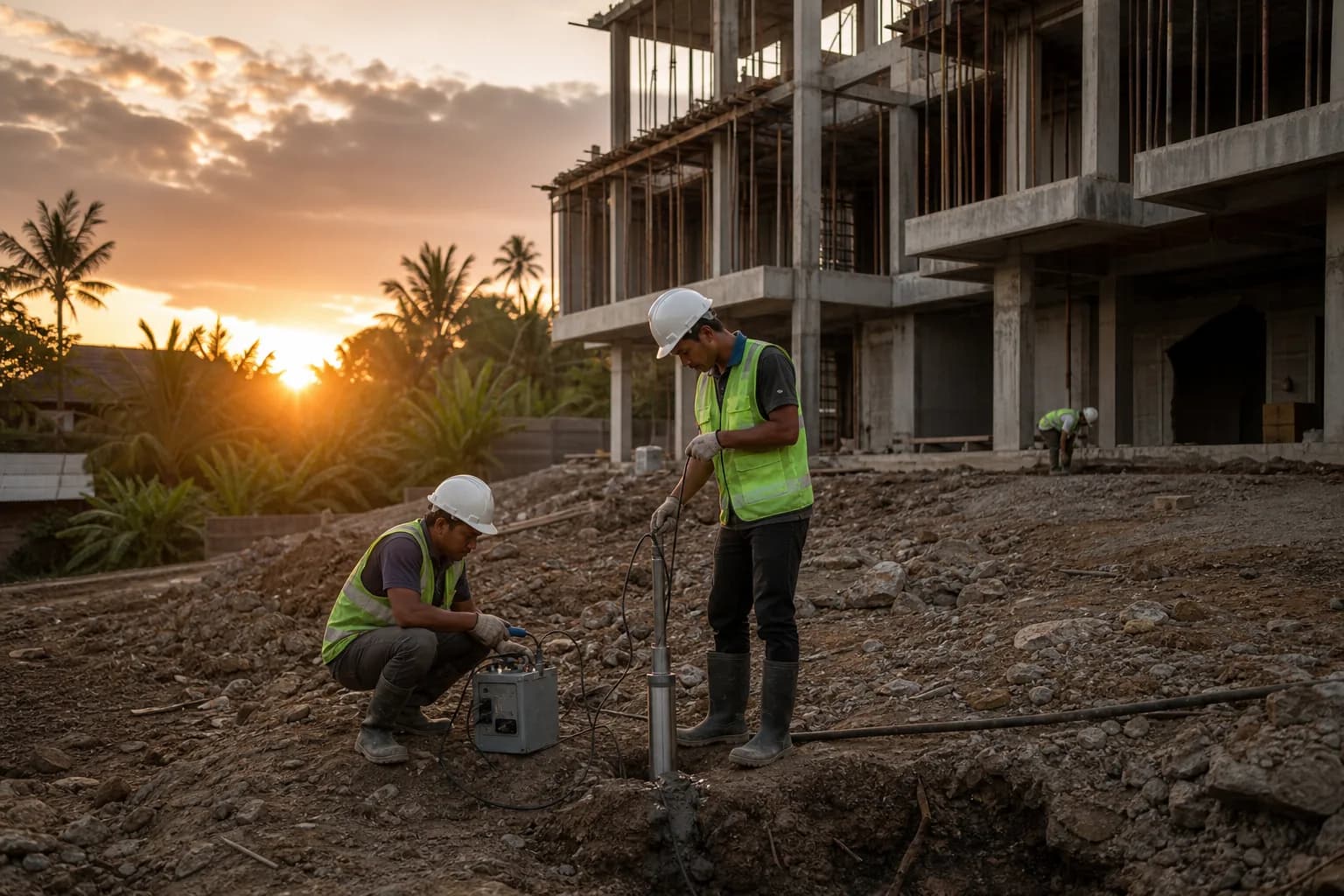
The Hidden Contamination Risk Beneath Canggu’s Development Boom
Canggu’s rapid transformation from rice paddies to high-density villa clusters has created an invisible crisis beneath the surface: groundwater contamination from inadequate septic systems, agricultural runoff, and saltwater intrusion. When purchasing land in Canggu, most buyers focus on location and zoning—yet fail to test the groundwater that will supply their villa’s daily needs. A contaminated aquifer doesn’t just threaten construction feasibility; it creates ongoing health risks, forces expensive water treatment infrastructure, and can render a property functionally unusable despite perfect legal documentation.
Engineering Reality: What Groundwater Testing Reveals About Canggu Subsurface Conditions
Groundwater contamination testing in Canggu requires understanding the region’s unique hydrogeological profile. The area sits on a shallow unconfined aquifer system, typically 3-8 meters below surface level, with highly permeable volcanic soil that rapidly transmits contaminants. Unlike deeper confined aquifers, Canggu’s groundwater responds immediately to surface pollution—septic leachate, fertilizer nitrogen, and bacterial contamination migrate horizontally within weeks.
Pre-purchase groundwater analysis must address three critical contamination vectors specific to Canggu’s development pattern. First, biological contamination from septic systems: the concentration of villas with individual septic tanks (often improperly constructed or undersized) creates plumes of fecal coliform bacteria, E. coli, and nitrate that extend 15-30 meters from each source. In densely built areas like Berawa and Batu Bolong, overlapping contamination zones create widespread aquifer pollution. Second, saltwater intrusion from over-extraction: excessive groundwater pumping for villa pools and irrigation has lowered the freshwater table, allowing seawater to migrate inland through the permeable substrate. Properties within 800 meters of the coastline show elevated chloride levels (>250 mg/L) that corrode plumbing systems and require reverse osmosis treatment. Third, agricultural chemical residue: parcels converted from rice cultivation retain pesticide compounds (organophosphates, carbamates) and heavy metals from fertilizers that persist in groundwater for years.
Comprehensive testing protocols must include both field measurements and laboratory analysis. Field testing establishes baseline conditions: pH (should be 6.5-8.5 for construction use), electrical conductivity (indicating total dissolved solids), and temperature. Laboratory analysis requires collecting samples from existing wells or test boreholes at the proposed construction depth (typically 6-10 meters for shallow wells, 15-25 meters for deep wells). The standard panel for Canggu properties should test for: total coliform and E. coli (biological contamination indicators), nitrate-nitrogen (septic system leachate marker), chloride (saltwater intrusion indicator), total dissolved solids, hardness (calcium/magnesium affecting plumbing), iron and manganese (staining and corrosion risks), and pH/alkalinity. For former agricultural land, add pesticide screening and heavy metal analysis (lead, arsenic, cadmium).
The timing of groundwater testing critically affects results. Dry season sampling (April-October) shows worst-case contamination concentrations as reduced rainfall minimizes dilution, while wet season testing (November-March) reveals aquifer recharge capacity and surface water infiltration patterns. Professional due diligence requires sampling in both seasons when purchase timelines allow, or at minimum during dry season to establish maximum contamination levels.
Interpretation requires comparing results against Indonesian drinking water standards (Permenkes 492/2010) and WHO guidelines, but construction planning demands stricter thresholds. Water with coliform counts below regulatory limits may still require treatment for villa use; chloride above 150 mg/L accelerates concrete reinforcement corrosion even if technically “safe” to drink. The engineering question isn’t just regulatory compliance—it’s whether groundwater quality supports construction methods and long-term building performance without expensive ongoing treatment.
Critical Oversights: What Buyers Miss in Groundwater Due Diligence
The most dangerous assumption is that clear, odorless water from a neighbor’s well indicates safe groundwater. Bacterial contamination, nitrates, and many chemical pollutants are invisible and tasteless at dangerous concentrations. Buyers routinely skip testing because existing villas “seem fine,” not realizing that contamination is spatially variable—a clean well 20 meters away provides zero information about conditions on your specific parcel.
Second, buyers test only the existing shallow well without investigating deeper aquifer zones. Canggu’s geology often shows contaminated water at 5-8 meters (where most existing wells draw) but cleaner water at 15-20 meters in semi-confined layers. Failing to test multiple depths means missing the opportunity to design well systems that access better quality water, or conversely, drilling expensive deep wells that encounter the same contamination at depth.
Third, single-point sampling creates false confidence. Groundwater quality varies across even small parcels due to localized contamination sources, soil heterogeneity, and flow patterns. A 500-square-meter lot may have acceptable water in one corner and severe contamination 15 meters away where the villa’s actual well will be located. Professional assessment requires multiple sampling points or at minimum, testing at the planned well location rather than convenience sampling from existing access points.
Fourth, buyers ignore the relationship between groundwater quality and construction methodology. Contaminated groundwater affects concrete mixing water quality (high chloride accelerates rebar corrosion), foundation dewatering requirements (contaminated water requires treatment before discharge), and long-term structural durability (aggressive groundwater attacks concrete and steel). Testing results must inform engineering specifications, not just water treatment decisions.
Professional Testing Protocol: Step-by-Step Pre-Purchase Process
Step one: Desktop hydrogeological assessment before site testing. Review available geological maps, identify the parcel’s position relative to coastline (saltwater intrusion risk), elevation above sea level, proximity to known contamination sources (existing septic systems, former agricultural operations, waste disposal sites), and local well depth patterns. This 2-3 hour analysis, typically conducted by environmental consultants or experienced construction engineers, determines testing scope and sampling strategy.
Step two: Site reconnaissance and sampling point selection. If existing wells are present, assess their construction quality, depth, and location relative to planned villa positioning. For vacant land, identify optimal test boring locations based on proposed building footprint, planned well location, and site topography. Professional practice requires testing at the actual planned well site, not just convenient existing access points. Document distances to potential contamination sources: septic systems on adjacent properties, drainage channels, livestock areas.
Step three: Sample collection following proper protocols. For existing wells, purge at least three well volumes before sampling to ensure representative aquifer water rather than stagnant well water. Use sterile containers for biological testing (provided by laboratories), and separate containers for chemical analysis. Record field parameters immediately: pH, temperature, electrical conductivity, dissolved oxygen. For properties without wells, drilling test boreholes (typically 10-15 cm diameter to planned well depth) allows direct aquifer sampling and provides geological profile information valuable for foundation design. Collect samples from multiple depths if drilling: shallow zone (5-8m), intermediate zone (10-15m), and deep zone (20-25m) if applicable.
Step four: Laboratory analysis with accredited facilities. Use Indonesian-accredited laboratories (KAN certification) or international standard labs operating in Bali. Standard turnaround is 5-7 working days for basic panels, 10-14 days for comprehensive analysis including pesticides and heavy metals. Request split samples if results will inform major purchase decisions—having duplicate samples allows verification testing if initial results show concerning contamination.
Step five: Engineering interpretation and construction impact assessment. Raw laboratory data requires professional interpretation in construction context. An environmental engineer or experienced construction consultant should evaluate: whether water quality supports concrete mixing without treatment, corrosion risk to building systems, required water treatment infrastructure and ongoing costs, feasibility of drilling deeper wells to access better quality zones, and regulatory compliance for discharge if dewatering is required during construction. This analysis directly informs construction cost estimates and design specifications.
Step six: Negotiate purchase terms based on findings. Contamination discoveries create legitimate grounds for price renegotiation or requiring sellers to address issues pre-closing. Severe contamination may justify purchase withdrawal if remediation costs exceed acceptable thresholds. Document all testing results and engineering assessments as part of purchase due diligence records—these become critical if disputes arise or if contamination worsens post-purchase from neighboring development.
Integration with Construction Planning
Groundwater testing results must flow directly into construction specifications. High chloride levels require using sulfate-resistant cement and increased concrete cover over reinforcement. Contaminated groundwater eliminates the option of using site water for concrete mixing, requiring trucked water and increasing costs. Aggressive groundwater conditions necessitate protective coatings on foundation elements and corrosion-resistant plumbing materials. At Teville’s engineering-driven construction process, groundwater analysis occurs during initial site assessment, with results incorporated into structural design and material specifications before cost estimation.
Testing Costs and Timeline Realities for Canggu Properties
Basic groundwater testing packages from accredited Bali laboratories range from IDR 2,500,000-4,500,000 ($160-290 USD) for standard potability panels covering biological indicators, major ions, and basic chemistry. Comprehensive pre-purchase analysis including pesticide screening, heavy metals, and multiple sampling points typically costs IDR 8,000,000-15,000,000 ($510-960 USD). For properties requiring test boring (no existing well), add drilling costs of IDR 3,500,000-6,000,000 ($225-385 USD) per borehole to 15-meter depth, including temporary casing and proper abandonment.
Timeline from sampling to actionable results: 7-10 working days for standard panels, 14-18 days for comprehensive analysis with pesticide and heavy metal screening. Add 3-5 days for engineering interpretation and construction impact assessment. Total due diligence timeline: 2-3 weeks from initial site visit to final recommendations, assuming no delays in laboratory processing or need for additional confirmatory testing.
For comparison, the cost of NOT testing can be severe: installing reverse osmosis systems for contaminated water costs IDR 45,000,000-85,000,000 ($2,900-5,450 USD) for villa-scale capacity, with ongoing maintenance of IDR 8,000,000-12,000,000 ($510-770 USD) annually. Drilling deeper wells when shallow water proves unusable adds IDR 35,000,000-65,000,000 ($2,250-4,170 USD). Remediation of concrete damage from aggressive groundwater can exceed IDR 150,000,000 ($9,600 USD) for foundation repairs. The testing investment represents 2-5% of potential remediation costs—a clear risk management value proposition.
Budget allocation for comprehensive pre-purchase groundwater assessment: testing and analysis (IDR 10,000,000), test boring if needed (IDR 5,000,000), professional engineering interpretation (IDR 4,000,000-6,000,000), total IDR 19,000,000-21,000,000 ($1,220-1,350 USD). This should be standard line item in land acquisition due diligence budgets for Canggu properties, alongside legal review and topographic survey costs.
Frequently Asked Questions: Canggu Groundwater Testing Specifics
How does Canggu’s groundwater contamination compare to other Bali villa areas like Seminyak or Uluwatu?
Canggu shows higher contamination rates than Uluwatu (which sits on elevated limestone with deeper, more protected aquifers) but similar patterns to Seminyak’s densely developed zones. The critical difference is development density and septic system concentration. Canggu’s rapid villa proliferation over the past 5-7 years created contamination faster than in gradually developed areas. Coastal Canggu (Berawa, Batu Bolong) faces more severe saltwater intrusion than inland areas (Padonan, Tumbak Bayuh). Properties more than 1 kilometer from coast and outside the densest villa clusters show significantly better groundwater quality, though testing remains essential as localized contamination sources create unpredictable patterns.
Can groundwater contamination be remediated, or does it make a property unsuitable for construction?
Contamination rarely makes construction impossible, but it significantly affects project costs and design requirements. Biological contamination (bacteria, nitrates from septic systems) can be addressed through drilling deeper wells below contaminated zones, installing comprehensive water treatment systems, or connecting to municipal water where available (limited in Canggu currently). Saltwater intrusion is more challenging—it requires either drilling to freshwater zones below the saltwater interface (often 30+ meters depth in coastal areas) or complete reliance on treated water. Chemical contamination from agricultural residues may require activated carbon filtration or reverse osmosis. The engineering question is whether treatment costs and ongoing maintenance fit within project economics. Severe contamination affecting multiple aquifer depths may justify walking away from a purchase, pa
 2144 m²11 month(s)from 104.000 USD
Narayana
 164 m²7 month(s)from 79.000 USD
Private: Haridas Villas, Tegallalang
 3127 m²9 month(s)from 177.000 USD
Mukunda
 3104 m²11 month(s)from 99.000 USD
TALA 100
 4344 m²16 month(s)from 290.000 USD
Radha
 3124 m²6 month(s)from 123.000 USD
TALA 8

Want to calculate?
 3173 m²6 month(s)from 125.000 USD
TALA FOUR
 1from 198.000 USD
Private: Haridas Villas
 3180 m²7 month(s)from 142.000 USD
Vasudeva
164 m²7 month(s)from 79.000 USDTALA TWO
 172 m²8 month(s)from 120.000 USD
Keshava
Start With Real Numbers, Not Guesses
Before buying land or finalizing a design, check the realistic build cost range for your project in Bali.
Our team reviews your inputs and gives a grounded estimate.
Available lands
 750 m²15 min$ 187038Bali, Kerobokan
 911 m²15 min$ 248217Bali, Pererenan
 680 m²15 min$ 110751Bali, Pererenan
 700 m²15 min$ 162500Bali, Tabanan
 2400 m²7 min$ 496552Bali, Canggu
 1000 m²10 min$ 384852Bali, Canggu
 2000 m²15 min$ 110837Bali, Karangasem
 400 m²15 min$ 67192Bali, Tabanan
 2000 m²15 min$ 261700Bali, Babakan
 325 m²15 min$ 44472Bali, Ungasan
 7900 m²25 min$ 413485Bali, Tabanan
 1000 m²10 min$ 184729Bali, Kutuh South Bali
 2200 m²15 min$ 508005Bali, Canggu
 1000 m²8 min$ 134544Bali, Bukit
 1000 m²10 min$ 303571Bali, Tabanan
Essential Bali build & buy guides
- Bali villa construction cost per m² in 2026
- How much will your villa cost? Calculator
- Building a villa in Bali: the complete guide
- Buying land in Bali: step-by-step for foreigners
- Bali villa investment: yields, risks, returns
- Leasehold vs freehold: what foreigners can own
- Construction defect liability & 10-year warranty
- Bali building codes and construction standards
Related guides

Why a Cheap Bali Leasehold Is Cheap: Pricing Red Flags Every Buyer Should Decode
Suspiciously cheap Bali leaseholds are priced low for a reason: short remaining terms, forbidden zoning, missing road access, disputes or weak contracts. How to decode the discount before you pay for it.
8 min read
Fake Compliance and Licensing Agents in Bali: The 2026 Paperwork Scam and How to Verify Documents
Forged certificates, permit fixers and fake notaries: how Bali's paperwork scams work in 2026 and how to verify every property document at its government source.
7 min read
Buying a Bali Villa from Instagram: Phantom Listings, Render-Only Projects and How to Verify
Instagram is Bali's biggest property shop window and its least verified. How phantom listings, render-only projects and cloned developer accounts work — and the verification steps that expose them.
7 min read