Canggu Groundwater Depth Basement Waterproofing Costs Bali
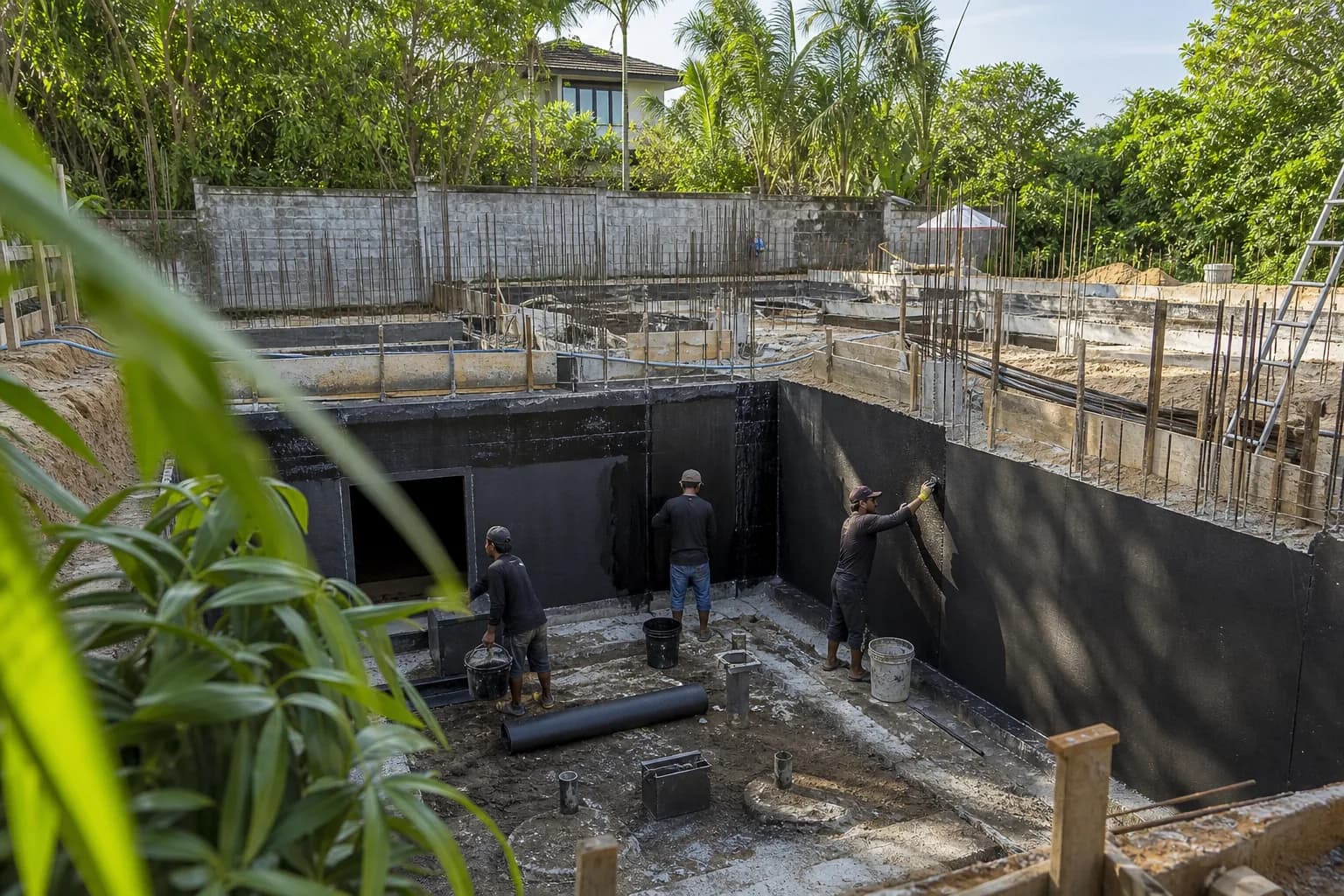
Why Canggu’s Groundwater Table Makes Basement Construction a High-Stakes Engineering Decision
Canggu’s proximity to the coastline and its position within Bali’s volcanic aquifer system creates a unique groundwater challenge that many villa developers discover too late. Unlike inland areas where water tables may sit 8-12 meters below surface, Canggu’s groundwater can rise to 1.5-3 meters depth during wet season, particularly in areas within 500 meters of the beach. This shallow water table transforms basement construction from a standard excavation project into a complex hydrostatic engineering challenge requiring specialized waterproofing systems, continuous dewatering during construction, and long-term drainage infrastructure that can add $45,000-$85,000 to your build budget before a single interior finish is installed.
The Hydrogeological Reality of Canggu’s Subsurface Conditions
Canggu sits on a coastal alluvial plain where Bali’s volcanic groundwater system meets tidal influence from the Indian Ocean. The area’s geology consists of layered volcanic deposits, sand, and clay formations that create a perched water table—meaning groundwater doesn’t sit at a uniform depth but varies dramatically based on your exact location, elevation, and distance from drainage channels.
Groundwater Depth Variations Across Canggu Micro-Zones
Engineering site assessments conducted across Canggu between 2023-2026 reveal significant depth variations. In Berawa’s beachfront zone (0-300m from coastline), test boreholes consistently encounter groundwater at 1.2-2.5 meters below natural grade during dry season (April-October), rising to 0.8-1.8 meters during wet season (November-March). Moving inland toward Padonan and Pererenan, the water table drops to 3-5 meters depth in elevated areas, but remains problematic for basement construction without proper engineering.
The critical factor most developers miss: Canggu’s water table isn’t static. Tidal influence extends up to 800 meters inland in low-lying areas, creating daily fluctuations of 15-30 centimeters. Seasonal monsoon recharge can raise the water table by 1-2 meters within weeks, and nearby construction dewatering operations can temporarily lower it, creating false confidence during site assessment.
Why Standard Waterproofing Fails in High Water Table Conditions
Conventional waterproofing membranes applied to basement exteriors are designed for damp-proofing—protecting against moisture migration, not resisting continuous hydrostatic pressure. When your basement floor sits below the water table, you’re essentially building a concrete box submerged in groundwater. The hydrostatic pressure at 2 meters depth exerts approximately 0.2 bar (2.9 PSI) of constant force against every square centimeter of your basement envelope.
This pressure will find every construction joint, penetration point, and micro-crack. Standard cementitious waterproofing or single-layer membrane systems will fail within 2-5 years under these conditions, leading to seepage, structural damage from water infiltration, and in extreme cases, basement flooding during seasonal water table peaks.
Engineering-Grade Waterproofing Systems for Below-Water-Table Construction
Successful basement construction in Canggu’s high water table conditions requires a multi-layer waterproofing approach combined with permanent drainage infrastructure. The system must include: a structural waterproof concrete mix (minimum W/C ratio 0.45 with crystalline admixtures), external tanking membrane (minimum 3mm HDPE or bentonite clay system), protection board, perimeter drainage system with sump pumps, and interior cavity drainage as backup.
The concrete itself becomes the primary waterproof barrier. This requires specialized mix design with water-reducing admixtures, proper curing protocols (minimum 14 days wet curing in tropical heat), and construction joint detailing with hydrophilic waterstops at every pour junction. The external membrane then provides redundancy, while the drainage system manages any water that penetrates the outer envelope before it can build pressure against the structure.
Dewatering Requirements During Construction Phase
Excavating below the water table requires continuous dewatering—pumping groundwater away from the construction zone throughout the build process. In Canggu, this typically means installing wellpoint systems or deep wells around the excavation perimeter, running pumps 24/7 for 4-8 months during basement construction. The pumping rate depends on soil permeability; Canggu’s sandy coastal soils can require pumping 50-150 cubic meters daily to maintain a dry excavation.
This creates two critical cost factors: energy consumption (diesel generators or grid power for continuous pumping) and environmental compliance. Bali’s groundwater regulations require discharge permits, and pumping operations must not cause subsidence in neighboring properties or saltwater intrusion into the aquifer—both of which have triggered construction stops and legal disputes in Canggu developments.
Hidden Risks That Turn Basement Projects Into Financial Disasters
The Site Assessment Gap
Most land purchases in Canggu proceed with minimal subsurface investigation. Buyers commission topographic surveys and soil bearing tests, but rarely conduct proper hydrogeological assessment with monitoring wells observed across multiple seasons. A single test boring during dry season will miss the wet season water table peak—the critical design parameter for waterproofing systems. This information gap leads to budget-crushing surprises when excavation begins and contractors encounter groundwater 2 meters higher than anticipated.
Permit Complications for Below-Grade Construction
Canggu falls under Badung Regency jurisdiction, where basement construction requires additional technical review beyond standard IMB (building permit) approval. Projects involving dewatering, excavation below water table, or construction within coastal setback zones trigger environmental impact assessment requirements. The review process adds 2-4 months to permit timelines and may result in design restrictions—including basement depth limits or mandatory groundwater monitoring systems—that weren’t factored into initial feasibility studies.
Long-Term Maintenance Obligations
A basement in Canggu isn’t a build-it-and-forget-it feature. The drainage system requires permanent maintenance: sump pumps need backup power systems, drainage pipes require annual inspection and cleaning, and waterproofing membranes need monitoring for degradation. Owners face ongoing costs of $1,200-$2,400 annually for system maintenance, plus the risk of pump failure during your absence leading to basement flooding. These operational realities rarely appear in initial project pro formas.
Step-by-Step Process for Basement Feasibility and Waterproofing Specification
Phase 1: Hydrogeological Site Investigation (4-8 Weeks)
Before committing to basement design, commission a proper subsurface investigation. This requires drilling minimum 2-3 monitoring wells to depths of 6-8 meters, installing slotted PVC casings, and recording water levels weekly across at least one full month, ideally spanning dry-to-wet season transition. The investigation should include permeability testing (slug tests or pump tests) to determine soil drainage characteristics and groundwater flow direction.
Engage a qualified hydrogeologist or geotechnical engineer licensed in Indonesia—not just a standard soil testing lab. The deliverable should be a written report specifying: seasonal water table range, soil permeability coefficients, recommended dewatering approach, and design groundwater level for waterproofing calculations. This report becomes the foundation for all subsequent engineering decisions and should be completed before finalizing architectural basement plans.
Phase 2: Waterproofing System Design (2-3 Weeks)
With hydrogeological data in hand, your structural engineer designs the waterproofing system. This isn’t a contractor’s decision—it requires engineering calculations for hydrostatic uplift forces, structural slab thickness to resist buoyancy, and waterproofing membrane specifications. The design must address: basement floor slab (typically 300-400mm thick with reinforcement designed for uplift), perimeter walls (minimum 250mm with waterproof concrete mix), construction joint details, penetration sealing for utilities, and drainage system capacity.
Request detailed specifications for: concrete mix design (including admixture types and dosages), membrane system (product specifications and installation method), drainage layer composition, sump pump capacity and redundancy, and quality control testing protocols. These specifications become contractual requirements—not suggestions—in your construction agreement.
Phase 3: Contractor Pre-Qualification (1-2 Weeks)
Basement waterproofing in high water table conditions requires specialized experience that most Bali villa contractors lack. During contractor selection, specifically verify: previous projects with below-water-table basements (request references you can visit), availability of dewatering equipment and experience operating it, relationships with waterproofing membrane suppliers and certified installers, and understanding of quality control requirements for waterproof concrete.
Request a detailed methodology statement describing their approach to: excavation sequencing, dewatering system design, concrete pouring sequence to minimize joints, membrane installation and testing, and contingency plans for unexpected groundwater conditions. Contractors who cannot provide this level of detail lack the capability for successful execution.
Phase 4: Construction Monitoring and Testing (4-8 Months)
Basement waterproofing quality depends entirely on construction execution. This requires independent third-party monitoring—not just contractor self-reporting. Critical inspection points include: dewatering system performance verification before excavation, excavation stability and groundwater control, concrete mix testing (slump, W/C ratio, compressive strength), construction joint preparation and waterstop installation, membrane installation and seam testing, and final flood testing before backfilling.
Budget for weekly site visits by your supervising engineer during basement construction phase, with mandatory hold points requiring engineer approval before proceeding. The cost of this monitoring ($3,000-$6,000 for basement phase) is insignificant compared to the cost of waterproofing failure discovered after completion.
Realistic Cost Breakdown for Canggu Basement Construction
Waterproofing System Costs
Engineering-grade waterproofing for a typical 60-square-meter basement in Canggu ranges from $18,000-$32,000 depending on system complexity. This includes: waterproof concrete mix with admixtures ($4,500-$7,000 premium over standard concrete), external tanking membrane system ($6,000-$11,000 for materials and certified installation), drainage layer and perimeter drains ($3,500-$6,000), sump pump system with backup ($2,000-$4,000), and protection board and backfill ($2,000-$4,000).
Dewatering and Excavation Premiums
Dewatering operations add $8,000-$18,000 to excavation costs for a standard basement, covering: wellpoint or deep well installation ($3,000-$6,000), pump rental and fuel for 4-6 months ($4,000-$9,000), discharge management and environmental compliance ($1,000-$3,000). These costs scale with basement size, water table depth, and soil permeability—sandy coastal soils require more intensive pumping than clay-rich inland areas.
Engineering and Monitoring
Professional services for basement projects include: hydrogeological investigation ($2,500-$4,500), waterproofing system design and specifications ($1,500-$3,000), construction phase monitoring and testing ($3,000-$6,000), and permit processing for dewatering and environmental compliance ($1,000-$2,000). Total professional services typically add $8,000-$15,500 to project costs.
Total Basement Premium
Compared to at-grade construction, adding a properly waterproofed basement in Canggu’s high water table conditions adds $34,000-$65,500 to your villa construction budget for a 60-square-meter basement—equivalent to $565-$1,090 per square meter premium. This is before any interior finishes, mechanical systems, or architectural features within the basement space itself.
Frequently Asked Questions: Canggu Basement Construction
Can I build a basement anywhere in Canggu, or are some areas impossible?
Basement construction is technically feasible throughout Canggu, but economic viability varies dramatically by location. Beachfront properties within 300 meters of the coastline face water tables as shallow as 1-2 meters and tidal influence, making waterproofing costs 40-60% higher than inland areas. Properties in low-lying areas near rice fields or drainage channels may encounter perched water tables that fluctuate unpredictably. The most favorable conditions exist in elevated areas of Padonan and northern Pererenan where natural grade sits 3-5 meters above sea level and water tables remain 4-6 meters deep. Before purchasing land with basement intentions, commission a hydrogeological assessment—the $3,000-$4,500 investigation cost is trivial compared to discovering unfavorable conditions after purchase.
What happens if waterproofing fails after construction is complete?
Waterproofing failure in a below-water-table basement is catastrophic and extremely expensive to remediate. Unlike above-grade water intrusion that can be patched, basement waterproofing failure requires excavating around the exterior to access and repair the membrane system—essentially demolishing landscaping, pools, and any structures built adjacent to the basement walls. Remediation costs typically range from $25,000-$55,000 depending on access constraints and extent of failure. Interior injection or coating systems marketed as “fixes” provide only temporary relief and don’t address hydrostatic pressure. This is why upfront investment in proper system design and construction quality control is non-negotiable—there are no affordable fixes for waterproofing failure in high water table conditions.
How do I verify my contractor has real experience with basement waterproofing?
Request specific project references for basements constructed below the water table—not just any basement project. Visit these reference projects personall
 2144 m²11 month(s)from 104.000 USD
Narayana
 3124 m²6 month(s)from 123.000 USD
TALA 8
 3173 m²6 month(s)from 125.000 USD
TALA FOUR
 4344 m²16 month(s)from 290.000 USD
Radha
 3104 m²11 month(s)from 99.000 USD
TALA 100
 1from 198.000 USD
Private: Haridas Villas
 3127 m²9 month(s)from 177.000 USD
Mukunda
 3180 m²7 month(s)from 142.000 USD
Vasudeva

Want to calculate?
 172 m²8 month(s)from 120.000 USD
Keshava
 164 m²7 month(s)from 79.000 USD
Private: Haridas Villas, Tegallalang
164 m²7 month(s)from 79.000 USDTALA TWO
Start With Real Numbers, Not Guesses
Before buying land or finalizing a design, check the realistic build cost range for your project in Bali.
Our team reviews your inputs and gives a grounded estimate.
Available lands
 1000 m²10 min$ 230911Bali, Kerobokan
 608 m²15 min$ 310377Bali, Seminyak
 610 m²10 min$ 165271Bali, Seminyak
 5028 m²10 min$ 361000Bali, Ubud
 13000 m²1 min$ 920567Bali, Pekutatan
 700 m²15 min$ 109052Bali, Buduk
 550 m²15 min$ 164594Bali, Mengwi
 10000 m²19 min$ 232759Bali, Buleleng
 1200 m²2 min$ 155172Bali, Klungkung
 600 m²10 min$ 206897Bali, Canggu
 1430 m²5 min$ 209862Bali, Klungkung
 1000 m²5 min$ 350431Bali, Drupadi
 550 m²5 min$ 217629Bali, Tabanan
 800 m²5 min$ 295567Bali, Seseh
 4270 m²10 min$ 394397Bali, Ubud
Essential Bali build & buy guides
- Bali villa construction cost per m² in 2026
- How much will your villa cost? Calculator
- Building a villa in Bali: the complete guide
- Buying land in Bali: step-by-step for foreigners
- Bali villa investment: yields, risks, returns
- Leasehold vs freehold: what foreigners can own
- Construction defect liability & 10-year warranty
- Bali building codes and construction standards
Related guides

Why a Cheap Bali Leasehold Is Cheap: Pricing Red Flags Every Buyer Should Decode
Suspiciously cheap Bali leaseholds are priced low for a reason: short remaining terms, forbidden zoning, missing road access, disputes or weak contracts. How to decode the discount before you pay for it.
8 min read
Fake Compliance and Licensing Agents in Bali: The 2026 Paperwork Scam and How to Verify Documents
Forged certificates, permit fixers and fake notaries: how Bali's paperwork scams work in 2026 and how to verify every property document at its government source.
7 min read
Buying a Bali Villa from Instagram: Phantom Listings, Render-Only Projects and How to Verify
Instagram is Bali's biggest property shop window and its least verified. How phantom listings, render-only projects and cloned developer accounts work — and the verification steps that expose them.
7 min read